The History of ColorCode: A Colour Barcode Developed by ColorZip |
1. Introduction to ColorCode |
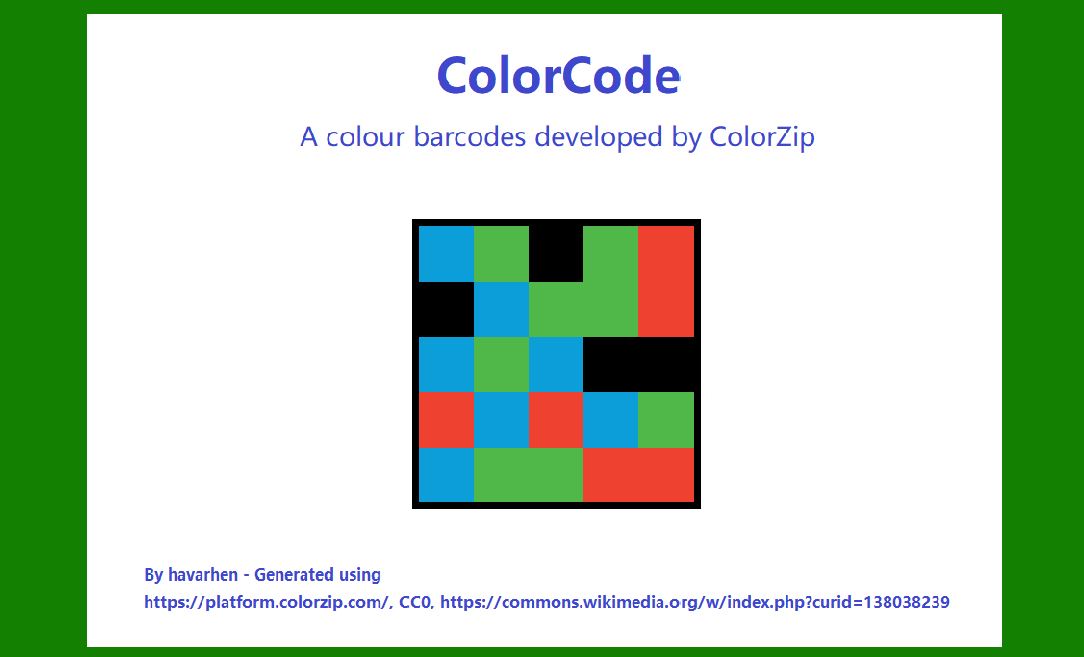
ColorCode, a type of color barcode, was developed by ColorZip Media, a company based in South Korea. ColorZip Media was established with a focus on creating innovative technology solutions that bridged the physical and digital worlds. ColorCode, their flagship product, was introduced as a next-generation barcode that utilized colors to store information, differentiating itself from traditional black-and-white barcodes. |
|
2. The Early Days (2000-2004) |
2.1. Concept and Inception |
The concept for ColorCode began to take shape in the early 2000s. The founders of ColorZip Media, recognizing the limitations of traditional barcodes and QR codes, envisioned a more advanced and visually appealing method of data encoding. The initial idea was to use multiple colors to increase the data density of barcodes and to make them more aesthetically pleasing. |
2.2. Formation of ColorZip Media |
In 2000, ColorZip Media was officially founded. The company assembled a team of engineers and researchers dedicated to developing the technology behind ColorCode. Early efforts were focused on researching color encoding algorithms, color stability under various lighting conditions, and the overall feasibility of using color as a data carrier. |
2.3. Prototype Development |
By 2002, ColorZip Media had developed the first prototypes of ColorCode. These early versions were simple, using basic color patterns to encode small amounts of data. The prototypes demonstrated the potential of color barcodes, attracting interest from investors and potential clients. |
2.4. Patenting the Technology |
Recognizing the novelty and potential of their invention, ColorZip Media applied for patents to protect their intellectual property. By 2004, several patents related to ColorCode technology were granted, covering various aspects of color encoding, decoding algorithms, and the use of color patterns for data storage. |

|
3. Advancements and Commercialization (2005-2010) |
3.1. Launch of ColorCode |
In 2005, ColorZip Media officially launched ColorCode. The product was marketed as a revolutionary advancement in barcode technology, capable of storing more information than traditional barcodes and QR codes due to its use of multiple colors. The launch included demonstrations of ColorCode's capabilities, showcasing its application in various industries such as advertising, retail, and logistics. |
3.2. Early Adopters and Pilot Projects |
Following the launch, several companies expressed interest in ColorCode. Early adopters included major retail brands and advertising agencies looking for innovative ways to engage customers. Pilot projects were initiated to test the effectiveness of ColorCode in real-world scenarios. One notable pilot project was with a major Korean retail chain, which used ColorCode in their in-store advertisements to provide customers with product information and promotional offers. |
3.3. Expansion into New Markets |
As the technology matured, ColorZip Media began expanding into new markets. By 2007, ColorCode was being used in Japan, China, and other parts of Asia. The company also started exploring opportunities in the United States and Europe, aiming to establish ColorCode as a global standard for color barcodes. |
3.4. Technological Improvements |
Between 2005 and 2010, significant advancements were made in the underlying technology of ColorCode. The color encoding algorithms were refined to improve data density and error correction capabilities. Additionally, ColorZip Media developed proprietary software for generating and reading ColorCodes, making it easier for businesses to adopt the technology. |
3.5. Partnerships and Collaborations |
To accelerate the adoption of ColorCode, ColorZip Media formed strategic partnerships with technology companies, mobile device manufacturers, and industry associations. These collaborations helped integrate ColorCode into various platforms and devices, expanding its reach and usability. |

|
4. Widespread Adoption and Integration (2011-2015) |
4.1. Growth in Popularity |
By 2011, ColorCode had gained significant traction in several industries. Its unique ability to encode more data than traditional barcodes made it particularly appealing for marketing and advertising campaigns. Companies began using ColorCodes on posters, billboards, and product packaging to deliver interactive content to consumers. |
4.2. Mobile Integration |
The rise of smartphones played a crucial role in the widespread adoption of ColorCode. ColorZip Media developed mobile applications that allowed users to scan ColorCodes using their smartphones, unlocking a wide range of digital content. This mobile integration was a game-changer, enabling consumers to easily interact with ColorCodes in their daily lives. |
4.3. High-Profile Campaigns |
Several high-profile marketing campaigns featured ColorCode prominently. For example, a leading beverage company used ColorCodes on their bottles, allowing customers to scan the codes to access exclusive videos and promotional offers. These campaigns demonstrated the potential of ColorCode to enhance consumer engagement and drive sales. |
4.4. Expansion into New Industries |
ColorCode's versatility led to its adoption in a variety of new industries. In the logistics sector, ColorCodes were used to track shipments and manage inventory. In healthcare, ColorCodes were employed on medical supplies and patient records to ensure accurate tracking and data management. The technology was also explored for use in secure identification and authentication applications. |
4.5. International Recognition |
ColorCode's success did not go unnoticed. The technology received several awards and accolades for its innovation and impact on the barcode industry. ColorZip Media was recognized as a leader in color barcode technology, and ColorCode was hailed as a significant advancement in data encoding. |

|
5. Challenges and Innovations (2016-2020) |
5.1. Technical Challenges |
Despite its success, ColorCode faced several technical challenges. Ensuring color accuracy and readability under different lighting conditions was a constant challenge. Additionally, the need for high-quality printing and consistent color reproduction presented hurdles for widespread adoption. |
5.2. Competition from Other Technologies |
The emergence of new technologies, such as augmented reality (AR) and near-field communication (NFC), posed competition for ColorCode. These technologies offered alternative methods for delivering interactive content and engaging consumers, challenging ColorZip Media to continually innovate and improve ColorCode. |
5.3. Continued Innovation |
In response to these challenges, ColorZip Media invested heavily in research and development. The company introduced new versions of ColorCode with enhanced features, such as improved error correction, higher data capacity, and faster decoding speeds. These innovations helped maintain ColorCode's competitiveness in the evolving technology landscape. |
5.4. Strategic Partnerships |
ColorZip Media continued to form strategic partnerships to enhance the capabilities and reach of ColorCode. Collaborations with mobile device manufacturers and software developers ensured that ColorCode remained compatible with the latest technologies and platforms. |
5.5. Educational Initiatives |
To promote the adoption of ColorCode, ColorZip Media launched several educational initiatives. These included workshops, webinars, and training programs aimed at educating businesses and developers about the benefits and applications of ColorCode. The company also provided resources and support to help partners integrate ColorCode into their systems. |

|
6. Recent Developments and Future Prospects (2021-Present) |
6.1. Adoption in the Post-Pandemic World |
The COVID-19 pandemic accelerated the adoption of contactless technologies, including ColorCode. As businesses sought ways to minimize physical contact, ColorCodes were used for digital menus, contactless payments, and virtual events. This surge in demand highlighted the flexibility and utility of ColorCode in various applications. |
6.2. Sustainability Initiatives |
In recent years, ColorZip Media has focused on sustainability. The company explored eco-friendly printing methods and materials for ColorCodes, aiming to reduce the environmental impact of barcode production. These efforts align with broader industry trends towards sustainability and responsible technology development. |
6.3. New Applications and Innovations |
ColorZip Media continues to innovate and explore new applications for ColorCode. Recent developments include integrating ColorCode with blockchain technology for secure data verification and exploring its use in smart packaging and IoT (Internet of Things) applications. These advancements position ColorCode for continued relevance in the rapidly evolving technology landscape. |
6.4. Global Expansion |
ColorZip Media remains committed to expanding the global reach of ColorCode. The company is actively pursuing opportunities in emerging markets and forming partnerships with international organizations. By leveraging its expertise and innovation, ColorZip Media aims to establish ColorCode as a global standard for color barcodes. |
6.5. Vision for the Future |
Looking ahead, ColorZip Media envisions a future where ColorCode is ubiquitous across various industries and applications. The company is focused on continuous improvement and innovation, ensuring that ColorCode remains at the forefront of barcode technology. With a commitment to excellence and a vision for the future, ColorZip Media is poised to drive the next wave of innovation in color barcodes. |

|
7. Key Milestones and Achievements |
7.1. Patents and Intellectual Property |
One of the early milestones for ColorZip Media was securing patents for ColorCode technology. These patents provided the foundation for the company's growth and innovation, protecting their unique approach to color barcode encoding. |
7.2. Industry Recognition |
Throughout its history, ColorCode has received numerous awards and recognition for its innovation. These accolades have validated the technology's impact and significance in the barcode industry. |
7.3. Strategic Partnerships |
Forming strategic partnerships has been crucial to the success of ColorCode. Collaborations with major technology companies and industry leaders have helped integrate ColorCode into various platforms and expand its reach. |
7.4. Global Adoption |
The global adoption of ColorCode across different industries and markets is a testament to its versatility and utility. From retail and advertising to logistics and healthcare, ColorCode has proven its value in enhancing data encoding and interaction. |
7.5. Continuous Innovation |
A commitment to continuous innovation has been a hallmark of ColorZip Media's approach. By constantly refining and improving ColorCode, the company has maintained its competitive edge and ensured the technology's relevance in an ever-changing landscape. |

|
8. Conclusion |
The history of ColorCode is a story of innovation, perseverance, and success. From its inception in the early 2000s to its current status as a leading color barcode technology, ColorCode has transformed the way data is encoded and interacted with. Through continuous innovation and strategic partnerships, ColorZip Media has established ColorCode as a versatile and powerful tool across various industries. As the technology continues to evolve, the future of ColorCode looks promising, with endless possibilities for new applications and advancements. |

|
 cs@easiersoft.com