1.Introduction and Development Background |
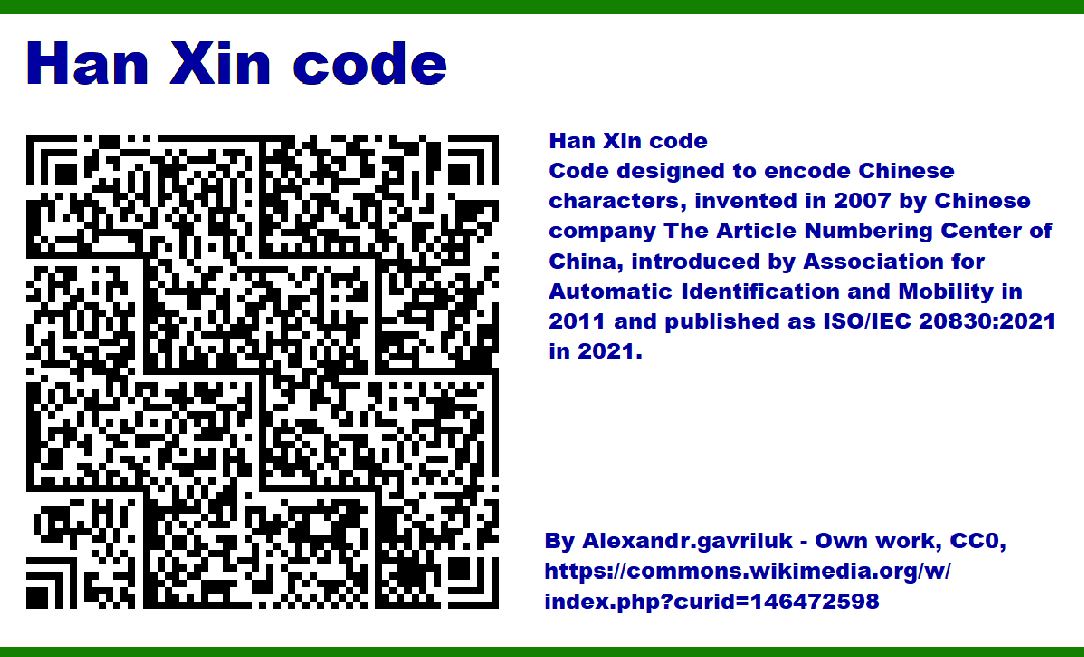
The Han Xin Code is a relatively new type of two-dimensional (2D) barcode designed to meet the growing needs of data encoding and rapid scanning in China. Its development was primarily driven by the necessity to create a barcode that could handle the unique requirements of Chinese characters efficiently. |
|
2.Early Conceptualization |
The early 2000s saw an increased need for a barcode system capable of encoding Chinese characters efficiently. Existing barcodes like QR Code and Data Matrix, although capable, were not optimized for the vast array of Chinese characters. This need led to the initial conceptualization of a new barcode type that could handle Chinese characters more effectively. |

|
3.Initiation of Development |
In 2007, the Chinese government, recognizing the need for a more suitable barcode system for its language, initiated the development of Han Xin Code. The objective was to create a barcode system that could encode a large volume of Chinese characters, numeric data, and other symbols more efficiently than existing systems. |
4.Collaboration and Research |
The development of Han Xin Code was a collaborative effort involving various research institutions, universities, and private companies. Key players included the Chinese Academy of Sciences, Tsinghua University, and several technology firms specializing in data encoding and barcode technology. |

|
5.Technical Specifications and Trials |
By 2009, the initial specifications of Han Xin Code were established. These specifications outlined the barcode's structure, encoding capacity, error correction mechanisms, and readability standards. Extensive trials were conducted to test the barcode's performance, particularly its ability to encode and decode Chinese characters accurately and quickly. |
6.Standardization and Publication |
In 2010, after rigorous testing and validation, the Han Xin Code was officially standardized. The Chinese National Standard GB/T 21049-2007 titled 'Information technology - Automatic identification and data capture techniques - Han Xin Code' was published. This standard provided detailed guidelines on the encoding, structure, and application of Han Xin Code. |

|
7.Initial Applications and Adoption |
Following its standardization, Han Xin Code began to be adopted in various industries in China. Early adopters included logistics companies, manufacturing sectors, and retail businesses. The barcode's ability to efficiently encode Chinese characters made it particularly useful in these fields. |
8.Government Endorsement and Promotion |
The Chinese government played a significant role in promoting Han Xin Code. Various government documents and directives encouraged its use across different sectors. This government endorsement significantly boosted the adoption rate of Han Xin Code in the following years. |

|
9.Integration with Mobile Technology |
With the rapid growth of smartphone usage in China, Han Xin Code found significant applications in mobile technology. It was integrated into mobile payment systems, ticketing, and authentication processes. The barcode's efficiency in encoding complex Chinese characters made it an ideal choice for these applications. |
10.Expansion to Public Services |
By 2012, Han Xin Code began to be utilized in public services such as healthcare, transportation, and social security. Hospitals started using it for patient records and medication tracking, while public transportation systems adopted it for ticketing and passenger information. |

|
11.Educational Sector Adoption |
The educational sector also saw the adoption of Han Xin Code. Schools and universities used it for student identification, library management, and examination processes. Its ability to encode large amounts of data efficiently was particularly beneficial in these settings. |
12.International Recognition and Comparisons |
Although primarily developed for use in China, Han Xin Code garnered international attention. Researchers and technology experts from other countries studied its structure and efficiency. Comparisons were made with other 2D barcodes like QR Code and Data Matrix, highlighting the unique advantages of Han Xin Code in encoding Chinese characters. |

|
13.Technological Enhancements |
Over the years, continuous improvements were made to the Han Xin Code. Enhancements in error correction capabilities, scanning speed, and data capacity were introduced. These technological advancements ensured that Han Xin Code remained relevant and efficient amidst evolving data encoding needs. |
14.Case Studies of Successful Implementations |
Numerous case studies documented the successful implementation of Han Xin Code across various industries. For instance, a major logistics company in China reported a significant improvement in package tracking and delivery accuracy after adopting Han Xin Code. Similarly, a large retail chain experienced faster and more accurate inventory management. |

|
15.Challenges and Solutions |
The journey of Han Xin Code was not without challenges. Issues such as initial resistance to change, integration with existing systems, and the need for specialized scanners were encountered. However, solutions were developed to address these challenges, including comprehensive training programs and the development of compatible scanning devices. |
16.Expansion to E-commerce |
The e-commerce boom in China further propelled the use of Han Xin Code. Major e-commerce platforms adopted it for product information, authentication, and transaction processes. Its ability to encode detailed product descriptions and specifications in Chinese made it a valuable tool for e-commerce. |

|
17.Regulatory Support and Mandates |
In 2015, new regulatory mandates were introduced that required certain industries to adopt Han Xin Code for specific applications. These mandates ensured that sectors such as pharmaceuticals, food safety, and product recalls leveraged the efficiency and accuracy of Han Xin Code for tracking and information dissemination. |
18.Technological Synergies |
Han Xin Code also found synergies with emerging technologies such as blockchain and IoT (Internet of Things). It was used in blockchain systems for secure data encoding and in IoT devices for seamless data transfer and tracking. These integrations showcased the versatility and adaptability of Han Xin Code in modern technological ecosystems. |

|
19.Research and Development Continuation |
Continuous research and development efforts were undertaken to further enhance Han Xin Code. Partnerships between academic institutions and industry players focused on exploring new applications, improving scanning algorithms, and increasing data capacity. This ongoing R&D ensured that Han Xin Code evolved in line with technological advancements. |
20.Global Influence and Potential |
While Han Xin Code remained predominantly used in China, its influence began to spread globally. Countries with significant Chinese-speaking populations showed interest in adopting it for local applications. Additionally, multinational companies with operations in China considered implementing Han Xin Code for their regional operations. |

|
21.Recent Developments |
In recent years, Han Xin Code has continued to see advancements and new applications. Developments in augmented reality (AR) and virtual reality (VR) technologies have explored the integration of Han Xin Code for interactive and immersive experiences. These new frontiers highlight the ongoing evolution and potential of Han Xin Code in the digital age. |
22.Conclusion |
The history of Han Xin Code is a testament to the innovative spirit and collaborative efforts of Chinese researchers, government bodies, and industry players. From its initial conceptualization to its widespread adoption and continuous evolution, Han Xin Code has proven to be a critical tool in modern data encoding, particularly for the Chinese language. Its journey reflects the dynamic nature of technology development and the importance of addressing specific linguistic and cultural needs through innovative solutions. |

|
 cs@easiersoft.com