History of IATA 2 of 5 Barcode |
1.Introduction and Early Development (1970s) |
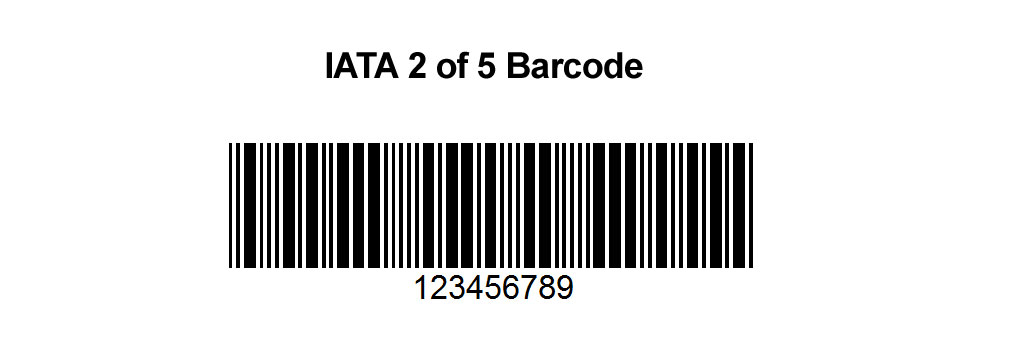
The IATA 2 of 5 barcode, also known as Interleaved 2 of 5 (I2/5), has its origins rooted in the 1970s. It was developed to meet the specific needs of the International Air Transport Association (IATA), an industry trade association for airlines. The primary purpose was to create a barcode that could efficiently handle the logistics of air cargo. The 2 of 5 barcode was chosen for its simplicity and robustness in encoding numerical data, which is essential for tracking and managing shipments in the aviation industry. |
|
2.Adoption by IATA (Late 1970s - Early 1980s) |
During the late 1970s and early 1980s, IATA officially adopted the Interleaved 2 of 5 barcode for air cargo labeling. This adoption was part of a broader effort to standardize air cargo processes and improve the efficiency and accuracy of tracking systems. The barcode was particularly suited for the aviation industry due to its compact and dense encoding capability, allowing it to fit more data into a smaller space compared to other barcode types available at the time. |

|
3.Enhancements and Standardization (1980s) |
Throughout the 1980s, the IATA 2 of 5 barcode underwent several enhancements to improve its reliability and functionality. One significant development was the introduction of checksum digits to detect and correct errors, which greatly enhanced the accuracy of data transmission. IATA worked closely with airlines and cargo handling companies to standardize the format and ensure widespread adoption across the industry. This period saw a significant increase in the use of barcodes for tracking air cargo, leading to improved efficiency and reduced errors in cargo handling. |

|
4.Integration with Airline Systems (Late 1980s - Early 1990s) |
By the late 1980s and early 1990s, the IATA 2 of 5 barcode had become an integral part of airline cargo tracking systems. Airlines integrated barcode scanning technology into their cargo management systems, allowing for real-time tracking and monitoring of shipments. This integration streamlined the logistics process, enabling faster and more accurate handling of cargo. The use of barcodes also facilitated better communication between different stakeholders in the air cargo supply chain, including shippers, freight forwarders, and customs authorities. |

|
5.Global Adoption and Impact (1990s) |
The 1990s marked a period of global adoption for the IATA 2 of 5 barcode. As more airlines and cargo handlers embraced barcode technology, the efficiency and accuracy of air cargo operations improved significantly. The barcode's ability to encode large amounts of numerical data in a compact form made it ideal for labeling various types of cargo, from small parcels to large freight containers. This widespread adoption led to a more standardized and streamlined air cargo industry, with reduced delays and errors in cargo handling. |

|
6.Technological Advancements and Transition (Late 1990s - Early 2000s) |
In the late 1990s and early 2000s, advancements in barcode technology and the emergence of new barcode types began to influence the use of the IATA 2 of 5 barcode. While the IATA 2 of 5 barcode remained a reliable and widely used format, the introduction of more sophisticated barcode systems, such as QR codes and Data Matrix codes, offered enhanced capabilities, including the ability to encode alphanumeric data and greater error correction. This period saw a gradual transition towards these newer barcode technologies in some areas of the air cargo industry. |

|
7.Continued Use and Legacy (2000s - Present) |
Despite the emergence of newer barcode technologies, the IATA 2 of 5 barcode has continued to be used in the air cargo industry due to its simplicity, reliability, and cost-effectiveness. Many airlines and cargo handlers still rely on the IATA 2 of 5 barcode for tracking and managing shipments, particularly for applications where numerical data encoding is sufficient. The barcode's legacy is evident in its long-standing use and the improvements it brought to the air cargo industry in terms of efficiency and accuracy. |

|
8.Case Study: Lufthansa Cargo (1990s - 2000s) |
Lufthansa Cargo, one of the world's leading air freight carriers, provides a notable example of the successful implementation of the IATA 2 of 5 barcode. In the 1990s, Lufthansa Cargo adopted the IATA 2 of 5 barcode as part of its cargo tracking system. The barcode was used to label and track shipments, enabling real-time monitoring and efficient handling of cargo. Over the years, Lufthansa Cargo integrated barcode scanning technology into its operations, leading to significant improvements in cargo handling efficiency and accuracy. The IATA 2 of 5 barcode played a crucial role in streamlining Lufthansa Cargo's logistics processes and enhancing customer satisfaction. |

|
9.Case Study: FedEx Express (1990s - Present) |
FedEx Express, a major global courier delivery services company, also adopted the IATA 2 of 5 barcode for tracking air cargo. In the 1990s, FedEx integrated the barcode into its tracking systems, allowing for precise monitoring and management of shipments. The use of the IATA 2 of 5 barcode contributed to FedEx's reputation for reliable and timely delivery services. Over the years, FedEx has continued to use the IATA 2 of 5 barcode alongside newer barcode technologies, demonstrating the barcode's enduring value in the air cargo industry. |

|
10.Impact on Air Cargo Industry Standards |
The adoption and widespread use of the IATA 2 of 5 barcode had a profound impact on air cargo industry standards. The barcode facilitated the development of standardized labeling and tracking systems, leading to greater consistency and interoperability among different stakeholders in the air cargo supply chain. The IATA 2 of 5 barcode set the stage for future advancements in barcode technology and contributed to the overall improvement of air cargo logistics. |

|
11.Future Prospects and Evolution |
Looking ahead, the IATA 2 of 5 barcode is likely to remain a relevant and valuable tool in the air cargo industry. While newer barcode technologies offer enhanced capabilities, the simplicity and reliability of the IATA 2 of 5 barcode ensure its continued use in certain applications. As the air cargo industry evolves, the IATA 2 of 5 barcode will continue to play a role in ensuring efficient and accurate cargo tracking and management. |

|
12.Conclusion |
The history of the IATA 2 of 5 barcode is a testament to its significance and impact on the air cargo industry. From its early development in the 1970s to its widespread adoption and integration into airline systems, the barcode has revolutionized the way air cargo is tracked and managed. Its legacy is evident in the improved efficiency, accuracy, and standardization of air cargo operations. As the industry continues to evolve, the IATA 2 of 5 barcode will remain a valuable tool in ensuring the smooth and efficient movement of cargo across the globe. |
 cs@easiersoft.com