Barcode Technology

Barcode History

Barcode Label Paper

Barcode Printer

Barcode Application

Inventory Management

AI Barcode QRCode

Barcode Scanner

Barcode Software

Barcode Software B

Barcode Software C

Barcode Software D

Barcode Software E

New Technology A

New Technology B

Robot Technology

Barcode Types

Barcode Types B

Barcode Types C

Barcode Types D

Barcode Types E

Barcode Types F

Electronic Technology

Psychology at Work

Barcode Technology and Barcode Software Related   <<< Back to Directory <<<

The history of EAN-128 barcode

The history of EAN-128 barcode

The Code 128 barcode has an interesting history. Let me share some details with you.

Code 128 is a high-density linear barcode symbology defined in ISO/IEC 15417:2007. It was developed by the Computer Identics Corporation in 1981. The main goal behind creating Code 128 was to have a flexible barcode that could encode a wide range of characters while still remaining compact.

Here are some key points about Code 128:

1. Character Set and Encoding:

Code 128 can encode all 128 characters of ASCII.

By using an extension symbol (FNC4), it can also encode the Latin-1 characters defined in ISO/IEC 8859-1.

It generally results in more compact barcodes compared to other methods like Code 39, especially when the texts contain mostly digits.

GS1-128 (formerly UCC/EAN-128):

GS1-128 is a subset of Code 128 and is used extensively worldwide in shipping and packaging industries.

It serves as a product identification code for the container and pallet levels in the supply chain.

GS1-128 encodes information such as GTIN (Global Trade Item Number), best-before dates, and batch numbers.

2. Barcode Structure:

A Code 128 barcode consists of seven sections:

Quiet zone

Start symbol

Encoded data

Check symbol (mandatory)

Stop symbol

Final bar (often considered part of the stop symbol)

The check symbol is calculated from a weighted sum (modulo 103) of all the symbols.

3. Code Sets:

Despite its name, Code 128 does not have 128 distinct symbols.

It shifts among three code sets: A, B, and C.

Code sets A and B cover all 128 ASCII characters, while code set C efficiently encodes digit strings.

4. Bidirectional Scanning:

The stop pattern in Code 128 permits bidirectional scanning.

When read left-to-right, the stop symbol is recognized.

When read right-to-left, the reverse stop symbol is recognized, indicating that the barcode should be read in reverse.

In summary, Code 128 is a versatile barcode system that balances character encoding flexibility with compactness, making it widely used in various industries.

Which industries use EAN-128 barcodes?

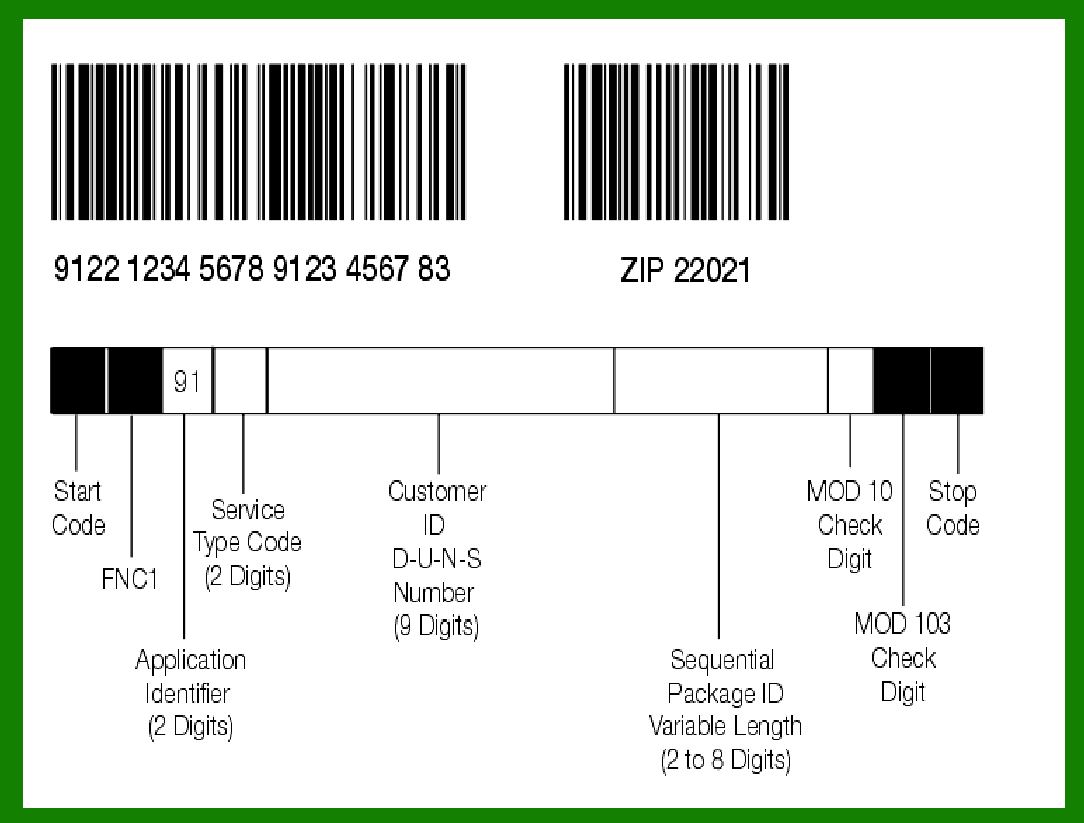
EAN-128 barcodes can be used to identify storage and transportation units or logistics unit information of goods, such as production date, batch number, measurement, etc.

Some common industry applications include shipping labels, portable databases, continuous data segments, logistics distribution labels, etc.

EAN-128 barcodes can also be used for products that contain a variety of data, such as weight, dimensions, opening date, destination, customer account number, etc.

What is the difference between EAN-128 barcode and Code-128?

The main difference between EAN-128 barcode and Code-128 barcode is the application scope and data format.

The Code-128 barcode can be used for automatic identification in any management system, while the EAN-128 barcode must be used in the EAN/UCC system to represent the information of the storage and transportation unit or logistics unit of the commodity.

EAN-128 barcodes must also carry application identifiers to represent different data types, such as production date, batch number, etc.

Code-128 barcode does not have this requirement and only requires a start mark, data area, check character and terminator.


EasierSoft Barcode Label Design & Bulk Printing Software

---- Use Excel Data to Batch Print Barcodes on Label Sheets or Roll Labels  

---- How to use this barcode software

Download:  Free Barcode Software + Barcode Label Designer

Download Free Barcode Software at Softonic

     Download at CNET

Once you obtain a GS1/UPC/EAN barcode, or other barcode type and QR code, you can use our free software to batch print barcode labels onto Roll label paper using a professional label printer, or to batch print barcodes onto Avery 5160 label sheets using a regular laser or inkjet printer. Our software has free and paid versions.

The free version fully meets your needs for batch printing GS1/UPC/EAN barcodes. The paid version can import data from Excel and databases to batch print barcode labels with different values.

How to Start

Input Data

Import Excel Data

Print Barcode

Barcode Format

Label Designer

All Screen Shot

Export Barcode Image

Save Template

Output Word Excel

How to Use & FAQ:

Save settings

Serial number generator

The supported barcode types

Load Excel data (pro)

Manually copy data from Excel files

Filter some data for printing

Edit imported barcode data

Input data (Pro)

Label Designer

Edit data in Label designer

Label Designer - Add new label

Label Designer - Printing

Set the barcode label format to be printed

Other Barcode Label Format Settings

Barcode types supported by this program

Barcode Label Font Settings

Configuring the Barcode Print Rotation

Text Alignment for Barcode Labels

Automatically Adjusting Barcode Width

Text Beneath the Barcode

Configuring Barcode Size

Auto Calculate the Barcode Size

Export Barcode images

Export Barcode Image Format

File Names for Exported Barcode

Resolution of Exported Barcode Images

Fixed Folder for Exporting Barcode

Default Barcode Image Export Format

Print bulk barcodes quickly

Print barcodes to Avery 5160 label

How to bulk Barcode Printing

Sample - Avery 5162 (2x7) Label Sheet

Example: Print barcodes to 5*3cm roll

Example: Print barcodes to 5161 label

Example: Print barcodes to 5162 label

Example: Print barcodes to 5163 label

Example: Print barcodes to 5164 label

Example: Print portrait orientation 5164

Example: Print barcodes to 5167 label

Example: Print barcodes to 5168 label

Example: Print portrait orientation 5168

Example: Print barcodes to 5169 label

Example: Print barcodes to 5660 label

Example: Print barcodes to 5661 label

Example: Print barcodes to 5662 label

Example: Print barcodes to 5663 label

Example: Print barcodes to 5664 label

Example: Print portrait orientation 5664

Example: Print barcodes to 5873 label

Example: Print barcodes to 5874 label

Highlights

Excel integration: Import data directly from Excel to generate and print barcodes in bulk.

Label designer: Create complex labels with multiple barcodes, text, logos, and shapes.

Batch printing: Print thousands of barcodes at once using standard inkjet/laser printers or professional barcode printers.


Flexible editions:

Standard Edition: Simple batch printing with Excel data.

Professional Edition: Adds command-line automation for workflow integration.

Label Designer Edition: Advanced design features for complex labels.


Why Choose Our Barcode Solutions?

Cost-effective: Free online generator and permanent free desktop version available.

Easy to use: No technical expertise required—just input data and print.

Versatile: Supports nearly all 1D and 2D barcode types, including QR codes.

Trusted: Recommended by CNET and widely downloaded by users worldwide.


Suitable Use Cases

Small businesses and startups needing quick barcode labels for products.

Retailers and online sellers managing inventory with batch barcode printing.

Manufacturers requiring sequential or custom barcode labels for packaging.

Educational and testing environments where barcodes are used for tracking.


CONTACT

cs@easiersoft.com

If you have any question, please feel free to email us.


https://free-barcode.com


<<< Back to Directory <<<     Barcode Generator     Barcode Freeware     Privacy Policy