Barcode Error Correction Algorithms |
Barcode error correction algorithms are crucial in enhancing the reliability and robustness of barcode scanning systems. They play a vital role in ensuring that even if a barcode is partially damaged or corrupted, the encoded information can still be accurately reconstructed. This detailed description will cover various aspects of barcode error correction algorithms, including the principles, types, techniques, and implementations. The content will be divided into major sections, each numbered for clarity. |
|
1. Introduction to Error Correction in Barcodes |
1.1. Importance of Error Correction |
Error correction in barcodes is essential for maintaining the accuracy and integrity of the data encoded within them. Barcodes are susceptible to physical damage, such as scratches, smudges, or distortions, which can cause partial or complete data loss. Error correction algorithms address these issues by using mathematical methods to recover or reconstruct missing or corrupted information from the remaining data. |
1.2. Basic Concept |
The core idea behind error correction is to include redundant information in the barcode that can be used to detect and correct errors. This redundancy allows the system to identify discrepancies between the expected and actual data and apply correction techniques to restore the original content. |

|
2. Fundamental Principles of Error Correction |
2.1. Redundancy |
Error correction relies on adding extra bits or symbols to the barcode data. This redundancy enables the decoding system to identify and correct errors by comparing the actual data with the expected data encoded in the barcode. The amount of redundancy needed depends on the level of error correction required. |
2.2. Error Detection and Correction |
Error detection involves identifying discrepancies or errors in the scanned data compared to the expected data. Error correction then involves applying algorithms to fix these errors. The effectiveness of error correction algorithms is measured by their ability to detect and correct errors within the barcode data. |
2.3. Mathematical Techniques |
Error correction algorithms use various mathematical techniques to achieve their goals. These techniques often involve finite fields, polynomial arithmetic, and matrix operations. The choice of technique depends on the specific error correction method used. |

|
3. Types of Error Correction Algorithms |
3.1. Parity Check Algorithms |
Parity checks are among the simplest error detection methods. They involve adding a parity bit to the data, which is used to check if the number of 1s in the data is even or odd. While effective for detecting single-bit errors, parity checks alone are insufficient for more complex error correction. |
3.2. Hamming Codes |
Hamming codes are a popular error correction method that can detect and correct single-bit errors and detect two-bit errors. They work by adding redundant bits to the data to create a code word. The position of the errors is identified through a syndrome, which is a binary vector calculated from the received data and the expected data. |
3.3. Reed-Solomon Codes |
Reed-Solomon codes are widely used in barcode applications due to their ability to correct multiple errors within a block of data. They are based on polynomial arithmetic over finite fields. Reed-Solomon codes are particularly effective in scenarios where burst errors are common, such as in damaged barcodes. |
3.4. BCH Codes |
BCH (Bose-Chaudhuri-Hocquenghem) codes are another class of error correction codes that can correct multiple errors. They are constructed using algebraic techniques and are particularly suitable for applications requiring high error correction capabilities. |
3.5. Convolutional Codes |
Convolutional codes use a sliding window approach to encode data. They are often used in combination with other error correction methods, such as Viterbi decoding, to achieve high error correction performance. Convolutional codes are less common in barcode systems but are used in some advanced applications. |
3.6. Turbo Codes |
Turbo codes are a class of error correction codes that combine multiple convolutional codes with iterative decoding techniques. They are designed to approach the Shannon limit of channel capacity and offer excellent error correction performance, although they are not widely used in traditional barcode applications. |

|
4. Error Correction in Common Barcode Standards |
4.1. 1D Barcodes |
1D barcodes, such as Code 39 and Code 128, typically use simple error detection techniques. Code 128, for example, includes a check character that helps detect errors in the encoded data. More advanced 1D barcodes, like Code 93, use additional redundancy for improved error correction. |
4.2. 2D Barcodes |
2D barcodes, including QR codes, Data Matrix codes, and PDF417, often employ more sophisticated error correction algorithms. For instance, QR codes use Reed-Solomon codes to correct errors in the encoded data, with varying levels of error correction depending on the version and error correction level selected. |
4.3. PDF417 |
PDF417 is a 2D barcode that uses a combination of Reed-Solomon error correction and error detection techniques. It is designed to handle relatively large amounts of data and can correct errors in both the horizontal and vertical dimensions of the barcode. |
4.4. Data Matrix |
Data Matrix codes also use Reed-Solomon codes for error correction. They are designed to be highly reliable and can correct errors caused by damage or distortion. Data Matrix codes are often used in industrial and logistical applications where data integrity is critical. |
4.5. Aztec Code |
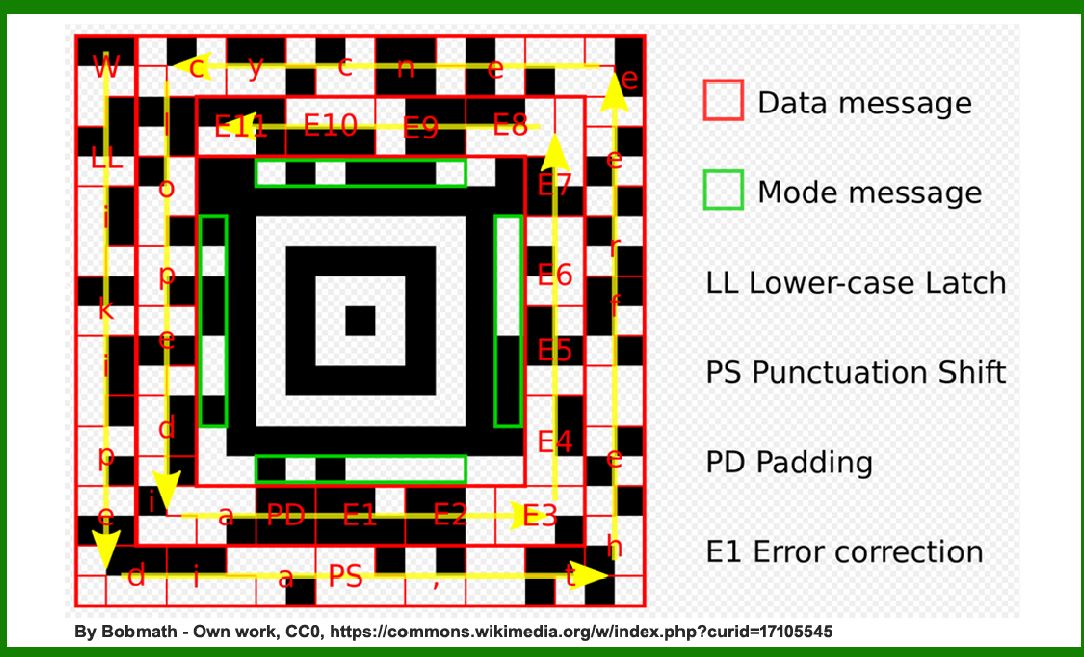
Aztec codes employ a combination of Reed-Solomon error correction and error detection techniques. They are designed to be compact and efficient, making them suitable for applications where space is limited, such as in mobile ticketing and electronic passports. |

|
5. Advanced Error Correction Techniques |
5.1. Error Correction in High-Density Barcodes |
High-density barcodes, such as those used in microelectronics or advanced packaging, require robust error correction algorithms to ensure data integrity. Techniques such as concatenated codes and hybrid error correction methods are often employed to achieve the necessary reliability. |
5.2. Adaptive Error Correction |
Adaptive error correction techniques adjust the level of error correction based on the quality of the scanned barcode. For instance, systems may use higher levels of redundancy for barcodes with more visible damage and lower levels for those with minimal errors. |
5.3. Error Correction in Multi-Modal Barcodes |
Multi-modal barcodes combine different types of data, such as alphanumeric characters and images. Error correction algorithms in these systems must handle the diverse nature of the encoded information, often using a combination of techniques to ensure reliable decoding. |
6. Implementation Considerations |
6.1. Performance and Efficiency |
Error correction algorithms must balance performance and efficiency. More complex algorithms provide higher error correction capabilities but may require more computational resources and time to process. Implementing efficient algorithms is crucial for real-time barcode scanning applications. |
6.2. Hardware vs. Software Implementation |
Error correction algorithms can be implemented in hardware or software. Hardware implementations offer faster processing and are suitable for high-speed scanning applications, while software implementations provide flexibility and are easier to update and modify. |
6.3. Integration with Scanning Systems |
Error correction algorithms must be seamlessly integrated into barcode scanning systems. This involves ensuring compatibility with existing hardware and software, as well as optimizing the algorithms for specific applications and environments. |
6.4. Testing and Validation |
Thorough testing and validation are essential to ensure the reliability and effectiveness of error correction algorithms. This includes testing the algorithms with various types of barcode damage and distortion to verify their performance under real-world conditions. |

|
7. Future Trends and Developments |
7.1. Machine Learning and AI |
Machine learning and artificial intelligence are emerging trends in error correction. These technologies can be used to develop adaptive and self-learning error correction systems that improve over time based on real-world data and scanning conditions. |
7.2. Enhanced Error Correction for Emerging Technologies |
As new barcode technologies and standards are developed, there will be a continued focus on enhancing error correction capabilities. This includes addressing the challenges posed by high-density barcodes, dynamic barcodes, and advanced scanning environments. |
7.3. Integration with IoT and Smart Devices |
The integration of error correction algorithms with Internet of Things (IoT) and smart devices will drive innovations in barcode scanning. Improved error correction will enhance the reliability of barcode-based data exchange in connected environments. |

|
8. Conclusion |
8.1. Summary of Key Points |
Barcode error correction algorithms are fundamental to ensuring data accuracy and reliability in barcode scanning systems. They use various mathematical techniques and methods to detect and correct errors, enhancing the robustness of barcodes in real-world applications. |
8.2. Importance of Ongoing Research |
Ongoing research and development in error correction algorithms are crucial for addressing the evolving challenges of barcode technology. Advances in error correction will continue to improve the performance and reliability of barcode systems across various industries. |
8.3. Future Outlook |
The future of barcode error correction will likely be shaped by technological advancements, including machine learning, AI, and integration with emerging technologies. These developments will drive innovation and enhance the effectiveness of error correction in barcode systems. |

|
 cs@easiersoft.com