1. Introduction to GS1 |
1.1 Origins of GS1: GS1 was originally founded in 1973 as the Uniform Code Council (UCC) in the U.S. The organization aimed to create a universal standard for product identification in the supply chain. It evolved from its roots as a simple barcode standard to becoming a global leader in supply chain standards and technology. |
1.2 Name Change and Global Expansion: In 2005, the organization rebranded to GS1 to reflect its global operations and broader scope, expanding beyond barcodes to encompass a wide range of standards that enable businesses to efficiently and accurately identify, capture, and share information about products and services worldwide. |
|
2. Mission and Vision |
2.1 Mission Statement: GS1's mission is to develop and maintain global standards that streamline business processes, ensure product traceability, and enhance the flow of information across industries. |
2.2 Vision Statement: GS1 envisions a world where data is universally shared and trusted, leading to enhanced efficiencies, reduced errors, and greater transparency in global supply chains. |
|
3. GS1 Standards |
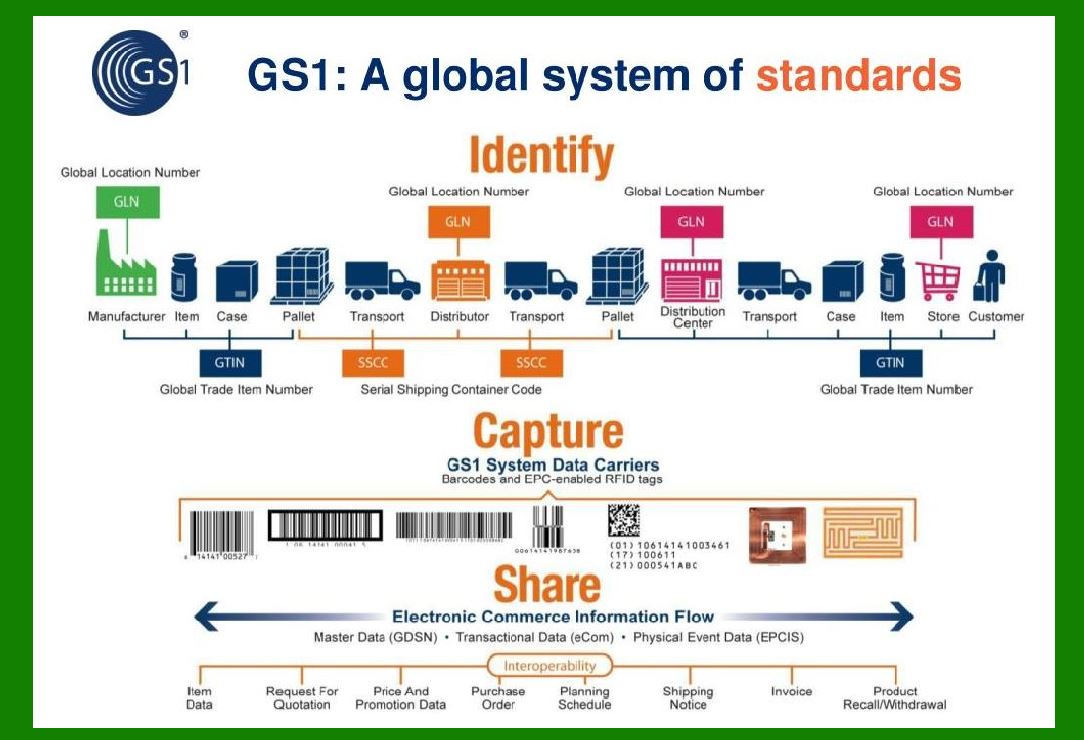
3.1 Types of Standards: GS1 is best known for its barcoding system, but it also offers a wide range of other standards, including those for radio-frequency identification (RFID), electronic data interchange (EDI), and data synchronization. |
3.2 Barcodes: One of the most recognized GS1 standards, the barcode provides an efficient way to encode and decode product data. This section will explore various types of GS1 barcodes like GS1-128, EAN-13, UPC, DataMatrix, QR codes, and more. |
3.3 Product Identification Standards: GS1 works with various product identifiers, such as the Global Trade Item Number (GTIN), Global Location Number (GLN), and Global Individual Asset Identifier (GIAI). These numbers are integral for tracking and managing inventory, shipments, and products in a digital supply chain. |
3.4 GS1 DataCarriers: This includes barcodes, RFID tags, and other methods of storing and transmitting data for easy and automated reading in supply chain environments. |
3.5 Electronic Data Interchange (EDI): GS1 plays a significant role in enabling businesses to exchange data electronically in a standardized format, reducing paperwork and increasing accuracy in transactions. |
|
4. Global Impact of GS1 |
4.1 Industries Served by GS1: The GS1 system is used across numerous industries, including retail, healthcare, food safety, pharmaceuticals, and logistics. The flexibility of the GS1 standards allows it to be customized and adopted by different sectors to enhance supply chain efficiency and consumer safety. |
4.2 Adoption Worldwide: GS1¡¯s standards are in use in over 150 countries, with more than 2 million companies and organizations utilizing GS1 systems. |
4.3 Case Studies: Several high-profile companies, such as Walmart, Coca-Cola, and Pfizer, have integrated GS1 standards into their operations. These companies use GS1 standards to streamline inventory management, enhance product traceability, and improve customer experience. |

|
5. GS1 Structure and Governance |
5.1 GS1 Global Office: The central office located in Brussels, Belgium, coordinates the overall direction of GS1 and the strategic development of its standards. |
5.2 GS1 Member Organizations: GS1 has a network of over 100 member organizations worldwide. These organizations work with local businesses to implement GS1 standards, educate the market, and provide support. |
5.3 Leadership and Board of Directors: GS1 operates under the guidance of a Board of Directors composed of senior leaders from both the private and public sectors. The governance model ensures that decisions regarding the development and implementation of standards are transparent and in line with the needs of the global business community. |
5.4 Collaborations and Partnerships: GS1 works in collaboration with global standardization bodies, regulatory agencies, and industry organizations, such as ISO, UN/CEFACT, and the World Health Organization (WHO), to align their standards with international regulations and emerging trends. |
|
6. Technological Innovations and Trends |
6.1 RFID and IoT: GS1 is heavily involved in the development and deployment of RFID technology, which has revolutionized supply chain management by allowing for automatic data capture of goods and assets. |
6.2 Blockchain and GS1: With the rise of blockchain technology, GS1 has started to explore the potential of combining its standards with blockchain to create secure, transparent, and tamper-proof systems for product tracking. |
6.3 Artificial Intelligence and Big Data: GS1 is researching ways to integrate its standards with artificial intelligence (AI) and big data analytics to enhance decision-making, forecast demand, and optimize supply chain operations. |

|
7. GS1 Certification and Accreditation |
7.1 Certification Process: Companies wishing to use GS1 standards must go through a certification process to ensure that their product information is accurately encoded and compliant with GS1¡¯s requirements. |
7.2 Benefits of Certification: Certification ensures that companies can effectively communicate with global trading partners, and it allows businesses to leverage GS1's standards for inventory management, product safety, and traceability. |
7.3 GS1 Member Services: GS1 offers a variety of services, such as barcoding support, training, consultancy, and software tools, to help businesses effectively implement their standards. |
|
8. GS1 in the Healthcare Sector |
8.1 Improving Patient Safety: One of GS1¡¯s primary goals in healthcare is to enhance patient safety by ensuring that drugs and medical devices are correctly identified and traceable. |
8.2 Adoption of GS1 in Hospitals: Many hospitals worldwide are now using GS1 standards to improve the management of medicines, equipment, and patient records, reducing errors and improving outcomes. |
8.3 Pharmaceutical Traceability: GS1 standards are being increasingly used in the pharmaceutical sector to meet regulatory requirements such as the U.S. Drug Supply Chain Security Act (DSCSA) and the European Falsified Medicines Directive (FMD). |

|
9. GS1 in Retail |
9.1 Efficiency in Retail Supply Chains: GS1 standards are widely used in retail to track and trace products from manufacturers to consumers, helping retailers manage stock levels, reduce waste, and improve the shopping experience. |
9.2 E-Commerce: With the rise of e-commerce, GS1 is helping businesses enhance their online presence and improve their digital interactions with consumers by providing accurate product information and seamless cross-border transactions. |
|
10. Future of GS1 |
10.1 Evolving with Industry Trends: As industries continue to digitize, GS1 is exploring ways to integrate its standards with emerging technologies such as augmented reality (AR), autonomous vehicles, and drones. |
10.2 Ongoing Collaboration with Standards Bodies: GS1¡¯s role in shaping future international standards continues to expand, particularly with the increasing importance of data privacy, consumer protection, and product traceability. |
10.3 GS1 Vision for the Next Decade: Looking ahead, GS1 plans to expand its portfolio of standards to address new challenges in the global supply chain, such as sustainability, climate change, and ethical sourcing. |

|
11. Conclusion |
11.1 GS1's Impact on the Global Economy: GS1¡¯s efforts have significantly impacted the global economy, improving efficiency in trade, manufacturing, and retail. Its standards enable businesses to reduce operational costs, improve product visibility, and enhance consumer safety. |
11.2 Call to Action for Businesses: As global supply chains continue to evolve, businesses of all sizes are encouraged to adopt GS1 standards to stay competitive, improve operational efficiency, and contribute to a transparent and sustainable global economy. |

|
Let¡¯s dive deeper into each section of the GS1 Global Organization¡¯s profile, expanding the details further. This exploration will offer a comprehensive understanding of GS1¡¯s structure, standards, global impact, and future trajectory. |
1. Introduction to GS1 |
1.1 Origins of GS1 |
The origins of GS1 can be traced back to the late 1960s and early 1970s when retailers and manufacturers in the United States were grappling with inefficiencies in inventory management and product identification. A collaborative effort led by grocery industry representatives resulted in the creation of the Universal Product Code (UPC), a simple barcode that could uniquely identify products. This initiative led to the formation of the Uniform Code Council (UCC) in 1973, whose primary purpose was to standardize the UPC system. Over the years, this system expanded, evolving into a global standard for business-to-business product identification. |
1.2 Name Change and Global Expansion |
As businesses around the world began to embrace the UPC, the need for a more global standard became evident. The organization rebranded as GS1 in 2005, reflecting its international presence and scope. The new name encompassed more than just barcodes¡ªit signified the expanded role of GS1 in managing product and location identification, electronic data exchange, and supply chain traceability across industries. |

|
2. Mission and Vision |
2.1 Mission Statement |
GS1¡¯s mission is to drive efficiency and transparency in global trade by developing and implementing universal standards for identification, data capture, and sharing. This includes enabling businesses to automate operations, reduce errors, and streamline supply chains with reliable, globally accepted data standards. GS1 strives to provide tools that enable greater visibility, track and trace capabilities, and regulatory compliance for companies across industries. |
2.2 Vision Statement |
The vision of GS1 is to create a world where data is trusted and shared seamlessly across borders. By enhancing information accuracy and data exchange, GS1 aims to improve productivity, reduce costs, and increase consumer safety. The organization¡¯s vision is aligned with evolving global needs, including transparency in the supply chain, sustainability, and the digital transformation of industries. |

|
3. GS1 Standards |
3.1 Types of Standards |
GS1 standards cover a broad array of data capture technologies and formats, including barcodes, RFID tags, QR codes, and more. These standards enable businesses to share vital product and logistics information in an automated and standardized way, thus increasing operational efficiency. |
Barcodes: The most widely known of GS1¡¯s standards. Different types of barcodes, including GS1-128, EAN-13, UPC, and DataMatrix, are tailored to different needs in industries such as retail, pharmaceuticals, and logistics. |
RFID: GS1 supports RFID as a means of automating inventory management and product tracking through the use of radio waves for data exchange between tags and readers. |
QR Codes: With the rise of smartphones, GS1 has integrated QR code technology into its standards, enabling both consumers and businesses to access detailed product information. |
3.2 Barcodes |
Barcodes are the cornerstone of GS1's offering. Different barcodes are used for different applications, each designed with specific use cases in mind: |
GS1-128: Used for logistics and supply chain management. It can carry additional data like batch numbers, expiration dates, and weights, making it ideal for inventory control and shipping. |
EAN-13 and UPC: These barcodes are used in retail, specifically for product identification. EAN-13 is primarily used in Europe, while UPC is used in North America. |
DataMatrix and QR Codes: These 2D barcodes are gaining traction in environments where space is limited, such as pharmaceuticals and electronics. DataMatrix is popular in the healthcare sector for its ability to store large amounts of information in a small, two-dimensional space. |
3.3 Product Identification Standards |
Product identification is at the core of GS1¡¯s system. GS1¡¯s most fundamental identifier is the Global Trade Item Number (GTIN), which can represent any product from a grocery item to a pharmaceutical product. GTINs are used in conjunction with other GS1 identifiers, such as: |
Global Location Number (GLN): Identifies physical locations, such as warehouses or stores, ensuring accurate tracking of goods. |
Global Individual Asset Identifier (GIAI): Used for identifying assets or non-tradable items, ensuring their traceability throughout the supply chain. |
3.4 GS1 DataCarriers |
GS1 DataCarriers are the physical or digital media that carry the encoded product data: |
Barcodes: Printed or displayed visually, they allow for quick and efficient product identification using scanners or mobile devices. |
RFID Tags: Often used in high-value goods or items that require real-time tracking, RFID provides more flexibility than traditional barcodes, with the ability to track items without needing a direct line of sight. |
QR Codes: These codes can be scanned by consumers with smartphones, offering an interactive experience by providing detailed product information, access to promotions, and additional services. |
3.5 Electronic Data Interchange (EDI) |
EDI allows businesses to exchange documents such as invoices, purchase orders, and shipping notices electronically, replacing manual paper-based systems. By standardizing these transactions, EDI reduces errors, speeds up processes, and minimizes delays. GS1's EDI standards provide the framework for global transactions, ensuring compatibility between businesses across different countries and industries. |

|
4. Global Impact of GS1 |
4.1 Industries Served by GS1 |
GS1 standards are adopted across various sectors, each benefiting from the enhanced efficiency, traceability, and safety that these standards provide: |
Retail: Barcodes and RFID improve product availability, stock control, and customer experience by ensuring quick and accurate identification at checkout. |
Healthcare: GS1¡¯s standards help track pharmaceuticals, medical devices, and hospital assets, improving patient safety and ensuring compliance with regulations such as the Drug Supply Chain Security Act (DSCSA). |
Food Safety: GS1 enables traceability in the food supply chain, helping organizations respond quickly to recalls and ensuring food safety compliance. |
Logistics and Transport: GS1 standards optimize supply chain management through accurate shipment tracking, barcode labeling for containers, and real-time data collection. |
4.2 Adoption Worldwide |
GS1 has established itself as a global leader in standardization, with member organizations in over 100 countries. The use of GS1 standards facilitates smoother international trade by ensuring that product data is consistent and universally understood across borders. |
4.3 Case Studies |
Leading companies such as Walmart, Nestl¨¦, and Pfizer utilize GS1 standards to enhance supply chain visibility, improve product traceability, and optimize inventory management. For instance, Walmart mandates that its suppliers use GS1 barcodes on products to improve stock tracking and reduce operational inefficiencies. |
|
5. GS1 Structure and Governance |
5.1 GS1 Global Office |
The GS1 Global Office is the headquarters of the organization, located in Brussels, Belgium. It oversees the development of global standards, coordinates member organizations, and manages initiatives aimed at the harmonization of trade practices across countries and industries. |
5.2 GS1 Member Organizations |
GS1 has over 100 member organizations worldwide, each responsible for implementing GS1 standards at the local level. These organizations offer education, support, and certification services, enabling companies to implement GS1 standards effectively in their specific markets. |
5.3 Leadership and Board of Directors |
The GS1 Board of Directors comprises executives from various sectors, ensuring that all decisions align with the needs of both the private and public sectors. This governance structure ensures broad industry representation and maintains the organization¡¯s neutrality and independence. |
5.4 Collaborations and Partnerships |
GS1 collaborates with international standardization bodies such as ISO (International Organization for Standardization), UN/CEFACT (United Nations Centre for Trade Facilitation and Electronic Business), and the WHO (World Health Organization). These partnerships ensure that GS1 standards are aligned with international regulations and support the global trade ecosystem. |

|
6. Technological Innovations and Trends |
6.1 RFID and IoT |
As the Internet of Things (IoT) continues to grow, GS1¡¯s standards are playing an increasingly important role in providing real-time data about products and assets. RFID technology, in particular, has allowed for better inventory management and logistics optimization by enabling automatic and contactless data capture. |
6.2 Blockchain and GS1 |
The integration of blockchain technology with GS1 standards has gained attention in sectors like food safety and pharmaceuticals. Blockchain¡¯s ability to offer secure, transparent, and immutable transaction records complements GS1¡¯s goal of product traceability, ensuring a trustworthy supply chain. |
6.3 Artificial Intelligence and Big Data |
GS1¡¯s standards are increasingly being used in conjunction with AI and big data analytics. These technologies allow for enhanced decision-making by predicting demand, identifying supply chain inefficiencies, and improving customer service. |
This provides a deeper understanding of each section within the GS1 organization. |
|
Detailed Overview of GS1 Barcodes |
GS1 barcodes are a cornerstone of the global supply chain, enabling the efficient and accurate identification of products and assets. These barcodes are critical for businesses across various industries, including retail, healthcare, logistics, and food safety. Below is an in-depth look at the different GS1 barcode types, their functionalities, applications, and benefits. |
1. Introduction to GS1 Barcodes |
GS1 barcodes are designed to provide a universal standard for product identification across different industries, businesses, and countries. Barcodes simplify the way information is shared and exchanged by ensuring that a product or asset can be uniquely identified and tracked at every stage of its lifecycle¡ªfrom production to consumption. |
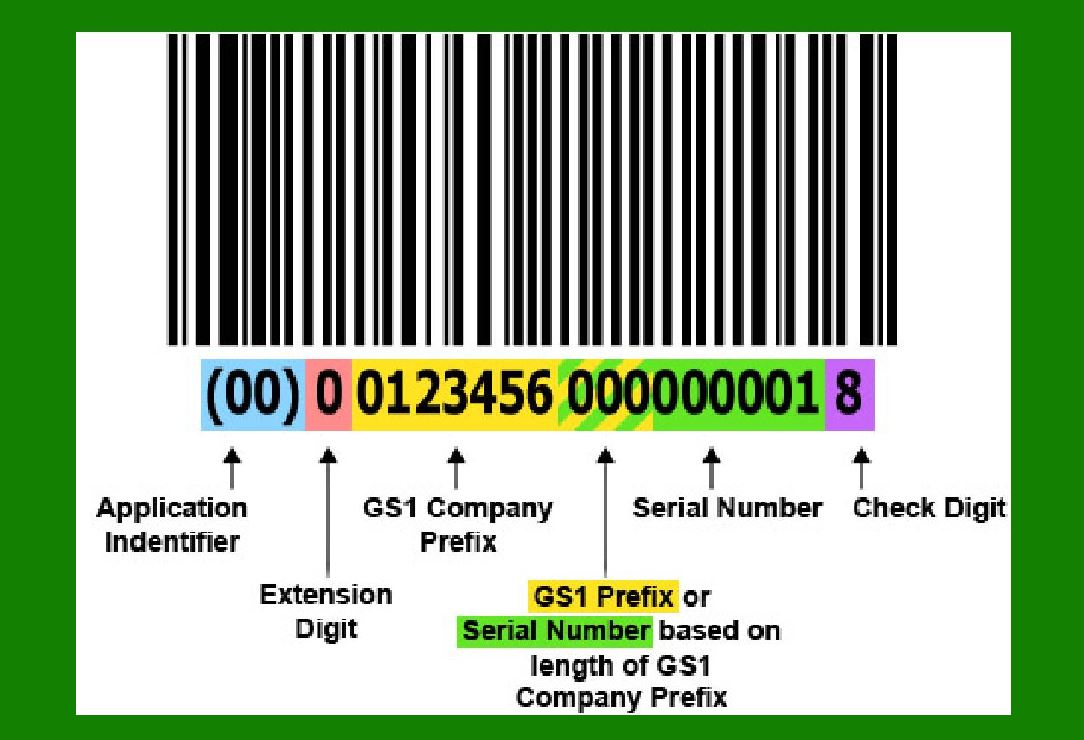
GS1 Barcode Structure: Every GS1 barcode encodes a unique identifier for a product, known as the Global Trade Item Number (GTIN), and includes additional data like batch numbers, expiration dates, and pricing information. The use of these identifiers ensures that information can be captured consistently and accurately. |
Purpose of GS1 Barcodes: The primary purpose of GS1 barcodes is to automate data capture processes, reduce errors, improve operational efficiency, and enhance product traceability. GS1 barcodes are widely used in industries like retail, logistics, pharmaceuticals, and healthcare. |

|
2. Types of GS1 Barcodes |
GS1 offers a variety of barcode formats, each designed to meet specific business needs. Below, we¡¯ll delve into the most commonly used GS1 barcode types: |
2.1 EAN-13 Barcode |
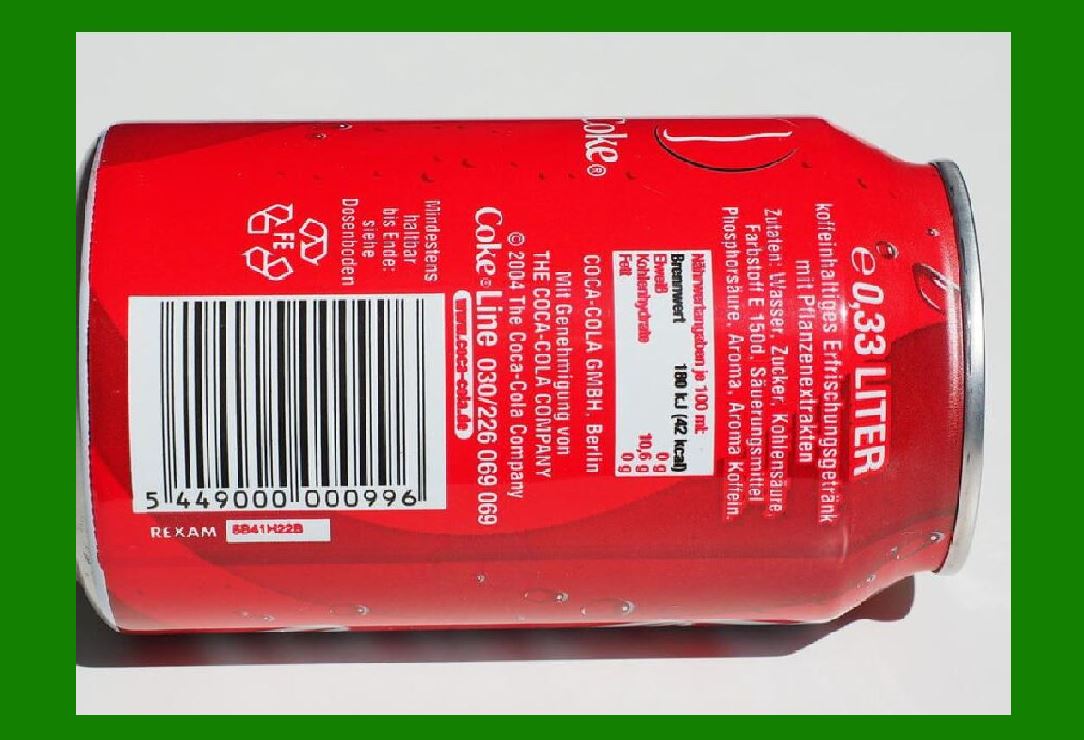
Description: The EAN-13 barcode (European Article Number) is a 13-digit numeric barcode primarily used for retail product identification. It is a variation of the UPC barcode used in North America, but it is widely accepted and used globally, especially in Europe. |
Structure: The EAN-13 barcode consists of: |
Prefix: A 3-digit country or company code. |
Manufacturer Code: A unique identifier for the manufacturer or company. |
Product Code: Identifies a specific product. |
Check Digit: A single digit at the end of the barcode that ensures the code¡¯s accuracy. |
Applications: EAN-13 barcodes are widely used for products sold in retail environments, such as groceries, clothing, electronics, and other consumer goods. This format allows businesses to streamline point-of-sale (POS) operations and improve inventory management. |
Benefits: Simplifies product identification, reduces human errors in data entry, and enables real-time tracking of product sales. |
2.2 UPC Barcode |
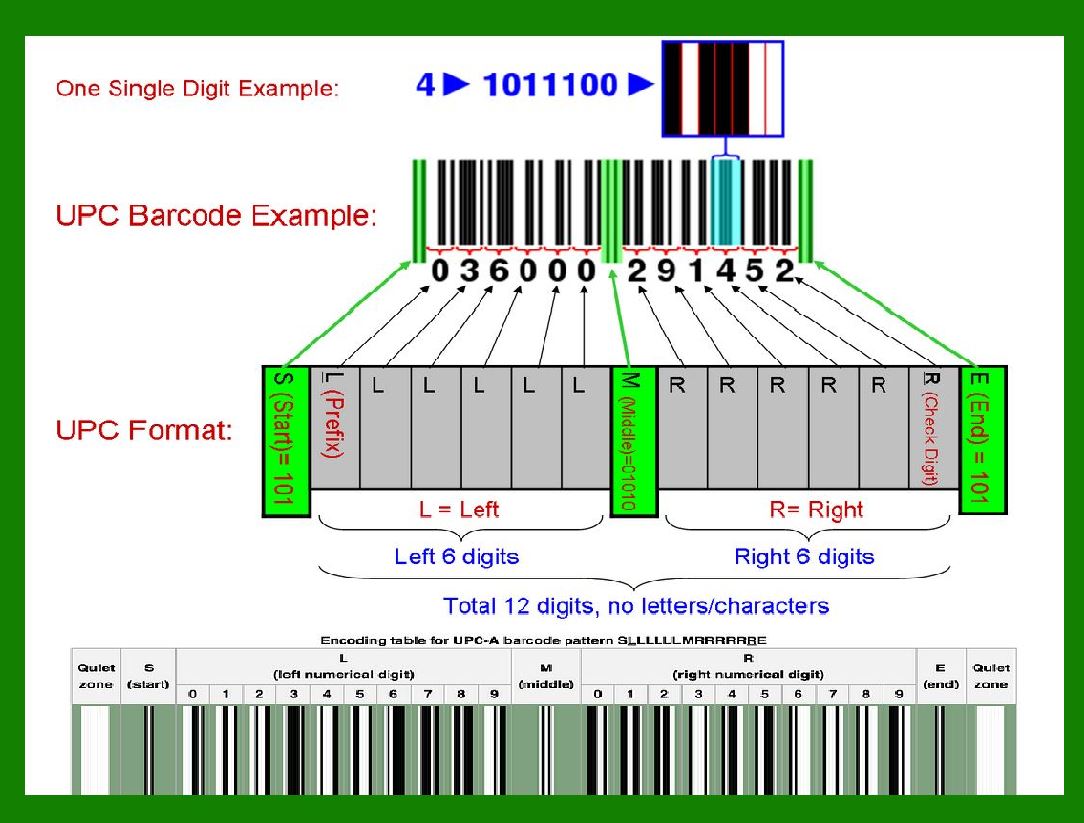
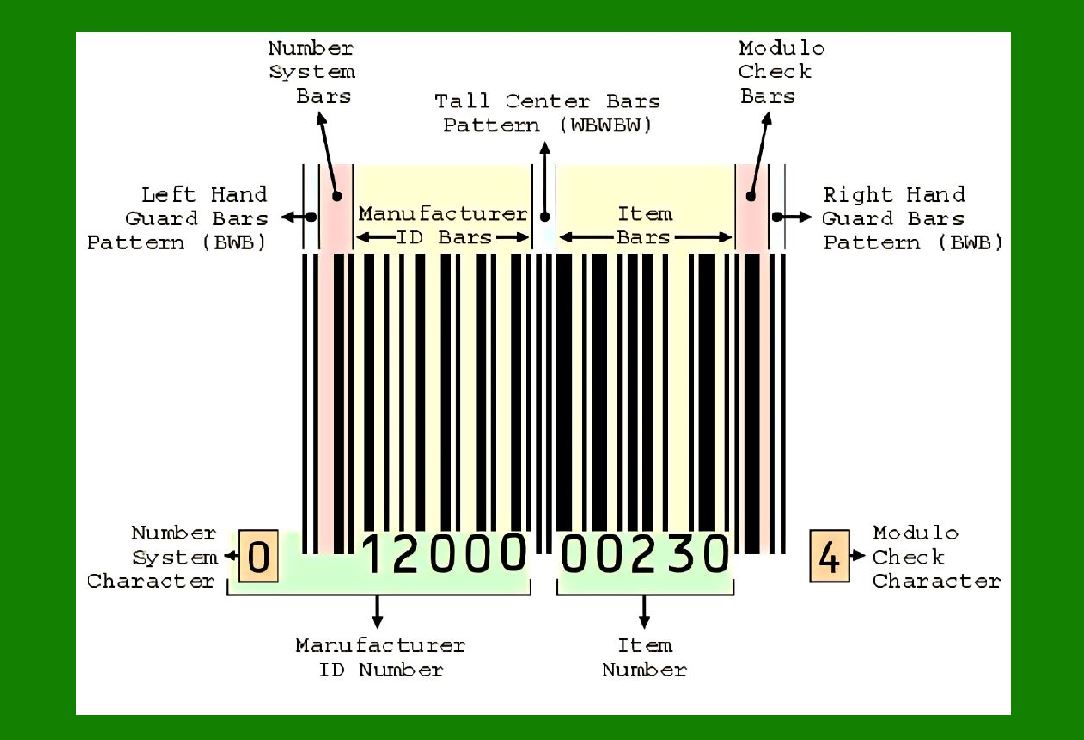
Description: The Universal Product Code (UPC) is one of the most common barcode types used in the United States and Canada. It is a 12-digit numeric code used to identify products in retail. |
Structure: The UPC barcode consists of: |
Manufacturer Code: The first 6 digits represent the manufacturer or company. |
Product Code: The next 5 digits represent the product. |
Check Digit: The final digit serves as a validation for the barcode¡¯s accuracy. |
Applications: UPC barcodes are primarily used in retail for product identification at the checkout point. They are also useful for inventory management, tracking product movements, and managing pricing information. |
Benefits: Provides fast and accurate product identification, streamlines inventory and logistics operations, and ensures consistent pricing information. |
2.3 GS1-128 Barcode |
Description: The GS1-128 barcode is a 1D linear barcode that can carry more data than standard UPC or EAN barcodes. It is an extended version of the Code 128 barcode that supports the GS1 Application Identifier (AI) format. |
Structure: The GS1-128 barcode includes: |
Prefix: A unique identifier for the data encoded in the barcode, known as the Application Identifier (AI). |
Variable Data: Depending on the Application Identifier, the GS1-128 barcode can encode information such as product numbers, expiration dates, batch numbers, and lot codes. |
Applications: GS1-128 is commonly used in logistics and supply chain management, as it allows businesses to track shipments, monitor product batches, and ensure accurate traceability of goods throughout the distribution network. |
Benefits: Ideal for managing complex product information in supply chains, enhancing data capture flexibility, and ensuring compliance with regulatory requirements like product traceability. |
2.4 DataMatrix Barcode |
Description: The DataMatrix is a 2D barcode that can store a large amount of data in a small space. It is typically used for product identification in industries where space is limited, such as pharmaceuticals and electronics. |
Structure: Unlike linear barcodes, DataMatrix is a square-shaped 2D barcode. It encodes data in both horizontal and vertical dimensions, allowing for more information to be stored in a compact format. |
Applications: DataMatrix is widely used in the pharmaceutical industry for drug labeling, medical device identification, and product traceability. It is also used in aerospace and automotive industries for tracking parts and components. |
Benefits: Its compact size makes it ideal for small items, and its high data capacity allows it to store detailed information such as serial numbers, batch codes, and expiration dates. It is also highly resilient to damage, making it suitable for environments where barcodes may be exposed to harsh conditions. |
2.5 QR Code |
Description: The Quick Response (QR) Code is a type of 2D barcode that can store a significant amount of data, including alphanumeric characters, URLs, and other data formats. |
Structure: QR Codes consist of black modules arranged in a square grid on a white background. They can store URLs, contact details, text, and more, offering businesses a way to engage customers through mobile devices. |
Applications: QR codes are widely used in marketing, packaging, and customer engagement, allowing businesses to provide product information, promotions, and coupons to customers. They are also used in healthcare for patient identification and in logistics for tracking packages. |
Benefits: QR codes provide a quick and efficient way for consumers to access information using smartphones. They can be used for a wide variety of applications and are easy to print on packaging, advertisements, and documents. |
2.6 EAN-8 Barcode |
Description: The EAN-8 barcode is a shorter version of the EAN-13 barcode, consisting of 8 digits. It is typically used for small retail products where a 13-digit barcode would be too large to print. |
Structure: The EAN-8 barcode consists of: |
Prefix: A 3-digit prefix identifying the country or company. |
Product Code: A 4-digit code that identifies the product. |
Check Digit: A single digit at the end of the barcode that validates the information. |
Applications: EAN-8 barcodes are used for smaller retail items like cosmetics, small food packaging, and convenience store items. |
Benefits: Offers a compact and space-efficient way of labeling small products while ensuring the same level of accuracy and efficiency as EAN-13 barcodes. |
2.7 ISBN Barcode |
Description: The International Standard Book Number (ISBN) barcode is used to uniquely identify books and other published media. It is based on the EAN-13 format. |
Structure: The ISBN barcode consists of: |
Prefix: Identifies the country or language of the publisher. |
Publisher Code: Identifies the publisher or author. |
Title Code: Represents the specific title or edition. |
Check Digit: A validation digit. |
Applications: ISBN barcodes are commonly used by booksellers, libraries, and publishers to track and sell books. |
Benefits: Simplifies inventory management for booksellers, reduces errors in ordering and tracking, and ensures accurate product identification for consumers. |

|
3. Benefits of GS1 Barcodes |
Operational Efficiency: GS1 barcodes streamline supply chain operations by enabling automatic data capture. This reduces manual data entry, minimizes errors, and enhances the speed of processing in industries ranging from retail to healthcare. |
Accuracy and Traceability: GS1 barcodes ensure that product data is consistently captured and shared across supply chains. This helps businesses track inventory, shipments, and products in real time, improving visibility and traceability. |
Compliance with Regulations: Many industries, especially healthcare and pharmaceuticals, require compliance with regulatory standards. GS1 barcodes help businesses meet these regulations by ensuring accurate labeling and tracking of products, such as drugs and medical devices. |
Global Standardization: GS1 barcodes are used worldwide, providing a consistent system for product identification that businesses can rely on for cross-border transactions and international trade. |

|
4. Future of GS1 Barcodes |
As technology continues to evolve, GS1 barcodes will remain a fundamental part of supply chain management. With advancements in RFID, blockchain, and AI, GS1 barcodes will continue to play an integral role in the automation and optimization of global trade. |
Integration with Emerging Technologies: GS1 barcodes, particularly 2D codes like DataMatrix and QR codes, are expected to be increasingly integrated with technologies such as blockchain for enhanced traceability and data security. |
GS1 barcodes are essential for businesses seeking to optimize their supply chain, improve product tracking, and comply with industry regulations. As the use of barcodes continues to expand, their role in global trade and consumer safety will remain indispensable. |

|
Several practical examples of how GS1 barcode technology is used across various industries to enhance efficiency, traceability, and overall operational effectiveness: |
1. Retail Industry |
Example: Walmart |
Challenge: Walmart, one of the largest retailers in the world, needs to efficiently manage inventory across thousands of stores worldwide, ensuring that products are available when customers need them and minimizing stockouts or overstocking. |
GS1 Barcode Solution: Walmart uses GS1 barcodes, specifically EAN-13 and UPC barcodes, on every product sold in its stores. These barcodes enable quick and accurate scanning at checkout, allowing for efficient point-of-sale (POS) transactions. |
Benefits: |
Inventory Management: By scanning barcodes at the point of sale and throughout the supply chain, Walmart can track product movement in real time, allowing it to replenish stock as needed and reduce waste from expired or overstocked items. |
Operational Efficiency: The use of barcodes speeds up the checkout process, reducing waiting times for customers and improving the overall shopping experience. |
Data Accuracy: Automated data entry ensures that product information is consistently accurate across all systems, reducing the likelihood of errors and discrepancies. |

|
2. Healthcare Industry |
Example: Pfizer (Pharmaceutical Company) |
Challenge: Ensuring the safety and authenticity of pharmaceutical products, particularly with the risk of counterfeit drugs entering the market. |
GS1 Barcode Solution: Pfizer utilizes GS1-128 barcodes on their pharmaceutical packaging. These barcodes include key information like the Global Trade Item Number (GTIN), batch numbers, expiration dates, and serial numbers for individual units. This ensures that each product can be tracked from production to the point of consumption. |
Benefits: |
Patient Safety: By using GS1 barcodes, Pfizer helps prevent the distribution of counterfeit drugs. The ability to track products at every stage of the supply chain ensures that only authentic, safe products reach patients. |
Regulatory Compliance: In many countries, including the U.S. and Europe, the use of GS1 barcodes is required for pharmaceutical traceability to comply with laws like the Drug Supply Chain Security Act (DSCSA) in the U.S. |
Efficient Recalls: In the event of a product recall, GS1 barcodes help Pfizer quickly trace affected products to specific batches, reducing the time needed to remove unsafe products from the market. |

|
3. Food Safety and Agriculture |
Example: Nestl¨¦ (Food Manufacturer) |
Challenge: With millions of products shipped globally, Nestl¨¦ faces the challenge of ensuring traceability throughout the food supply chain, from farm to table, especially when dealing with perishable goods like dairy, meat, and vegetables. |
GS1 Barcode Solution: Nestl¨¦ applies GS1 DataMatrix barcodes on food packaging to ensure traceability. The 2D barcode can store extensive information about the product, such as its origin (farm, country of origin), production date, and lot number. |
Benefits: |
Traceability and Transparency: GS1 barcodes allow consumers and businesses to trace food products back to their source, ensuring transparency in sourcing and providing reassurance regarding food safety. |
Efficient Supply Chain Management: Nestl¨¦ can use the barcodes to monitor stock levels, track shipments, and ensure products are delivered fresh. Additionally, the barcode enables quick scanning during shipping and at retail locations. |
Compliance with Food Safety Regulations: In some markets, regulatory bodies require food manufacturers to trace and manage food products via GS1 standards to ensure the safety of the supply chain. |

|
4. Logistics and Supply Chain Management |
Example: UPS (United Parcel Service) |
Challenge: UPS, a global logistics and parcel delivery service, handles millions of packages daily. Accurate, real-time tracking of packages across the entire delivery network is critical to maintain efficiency and customer satisfaction. |
GS1 Barcode Solution: UPS uses GS1-128 barcodes and QR codes to track packages through their network. Each parcel is tagged with a barcode that holds the Global Location Number (GLN), the tracking number, and other shipment details. |
Benefits: |
Efficient Tracking: The GS1 barcode system allows UPS to quickly and accurately track packages from the point of pickup to final delivery, ensuring customers receive timely updates about their shipments. |
Improved Customer Experience: Customers can scan QR codes on their packages to view real-time tracking information, giving them more control and visibility over their deliveries. |
Operational Efficiency: Automated scanning of barcodes at various points in the logistics process minimizes human errors, speeds up processing times, and enhances overall efficiency in handling large volumes of packages. |

|
5. Automotive Industry |
Example: General Motors (GM) |
Challenge: Managing complex inventories of parts and components across multiple manufacturing plants and warehouses worldwide. |
GS1 Barcode Solution: GM implements GS1 DataMatrix barcodes on automotive parts and components. These barcodes include essential data such as part numbers, manufacturing dates, and batch codes. |
Benefits: |
Parts Traceability: By using GS1 DataMatrix barcodes, GM can ensure that each part can be tracked throughout the production process. If a faulty part is identified, GM can trace it back to the specific batch and manufacturing line. |
Supply Chain Optimization: Automated barcode scanning streamlines inventory management and reduces manual stock counting, allowing for faster and more accurate part deliveries to assembly lines. |
Product Recall Management: In the case of a defect in a particular part, the barcode system allows GM to identify which vehicles contain the faulty parts and implement quick and effective recalls. |
|
6. Healthcare - Hospital Asset Management |
Example: Johns Hopkins Hospital |
Challenge: Tracking medical equipment and ensuring that inventory is properly managed in a large healthcare facility. |
GS1 Barcode Solution: Johns Hopkins uses GS1-128 barcodes and RFID technology to track medical devices and equipment. Each asset in the hospital, from wheelchairs to surgical instruments, is tagged with a GS1 barcode or an RFID tag containing its serial number, location, and maintenance information. |
Benefits: |
Asset Management: The use of GS1 barcodes enables the hospital to track medical equipment in real-time, reducing the risk of lost or misplaced items and improving equipment utilization. |
Compliance and Maintenance: GS1 barcodes help track the maintenance schedules for medical equipment, ensuring compliance with regulatory requirements and ensuring that equipment is always in working condition. |
Patient Safety: By tracking equipment with GS1 barcodes, hospitals can ensure that the right tools are available for each procedure, which enhances overall patient safety. |
|
7. Pharmaceutical Industry - Serialization and Anti-Counterfeiting |
Example: Novartis (Pharmaceutical Company) |
Challenge: Preventing the circulation of counterfeit drugs, especially in emerging markets, while also ensuring that pharmaceuticals are safe for consumption. |
GS1 Barcode Solution: Novartis applies GS1-128 and DataMatrix barcodes to pharmaceutical packaging. These barcodes contain serialized numbers for each individual product, along with the batch number, expiration date, and other critical data. |
Benefits: |
Anti-Counterfeiting: The use of serialized barcodes helps ensure that drugs are authentic by providing a unique identifier for each product. This prevents counterfeit drugs from entering the supply chain. |
Regulatory Compliance: GS1 barcodes are essential for compliance with laws such as the EU Falsified Medicines Directive (FMD) and the U.S. Drug Supply Chain Security Act (DSCSA), which mandate serialization and traceability of drugs. |
Streamlined Distribution: The serialized GS1 barcodes make it easier to track products through the distribution network, ensuring the right product reaches the right location and that any recall procedures can be executed swiftly. |
|
8. Consumer Goods - Product Information |
Example: Procter & Gamble (P&G) |
Challenge: Providing consumers with quick access to detailed product information while ensuring inventory management and store shelf optimization. |
GS1 Barcode Solution: P&G utilizes QR codes on product packaging to provide consumers with instant access to product details, including usage instructions, promotions, and environmental impact. |
Benefits: |
Enhanced Consumer Experience: Consumers can scan the QR code using their smartphones to learn more about the product, access additional services like promotions, or even connect to customer service. |
Inventory and Shelf Optimization: QR codes help P&G track products in-store more efficiently, ensuring that stock levels are optimized and reducing instances of out-of-stock products. |
Sustainability: Through the QR codes, P&G can also share sustainability information, allowing consumers to make informed choices about the environmental impact of their purchases. |
 cs@easiersoft.com