1. Introduction to the Concept of PDF417 |
1.1 The PDF417 barcode is one of the most important and widely adopted stacked linear barcodes in the world. It represents a bridge between simple 1D barcodes and fully two-dimensional matrix codes like Data Matrix and QR Code. Unlike purely linear barcodes, which encode information only horizontally, PDF417 organizes its information in multiple stacked rows, making it capable of carrying far more data within a compact rectangular area. |
1.2 The name PDF417 itself encapsulates two key ideas. 'PDF' stands for Portable Data File, emphasizing that it can function as a portable digital file printed on paper. The number '417' refers to its encoding structure: each pattern consists of 4 bars and 4 spaces (together making up 17 modules in width). Thus, PDF417 can be thought of as a 'portable printed file format,' capable of embedding hundreds or even thousands of characters of text, numbers, or binary data directly into a printed code. |
1.3 Originally developed by Symbol Technologies (now part of Zebra Technologies) in the late 1980s, PDF417 became a key component in large-scale identification systems, postal tracking, transportation logistics, and secure document encoding. It was later standardized under ISO/IEC 15438, which defines its symbology and encoding rules in international barcode standards. |
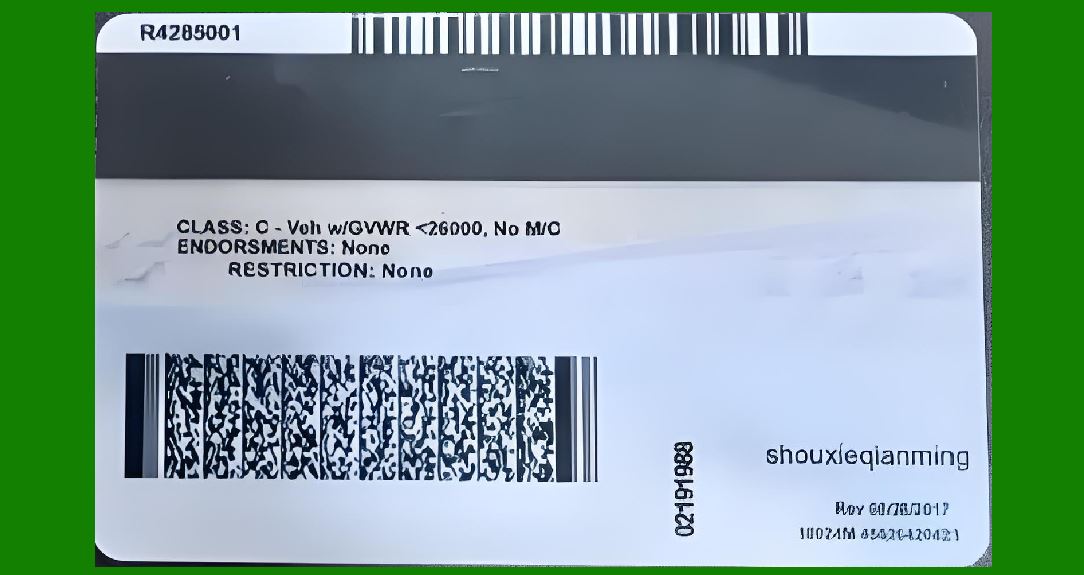
1.4 Over time, PDF417 has been used in many critical infrastructures such as U.S. driver 's licenses, airline boarding passes, postal forms, and customs documentation making it one of the cornerstones of the world 's data-carrying barcodes. To understand why it holds such importance, we must first explore how it is structured and what unique features make it distinct. |
|
2. The Structural Composition of PDF417 |
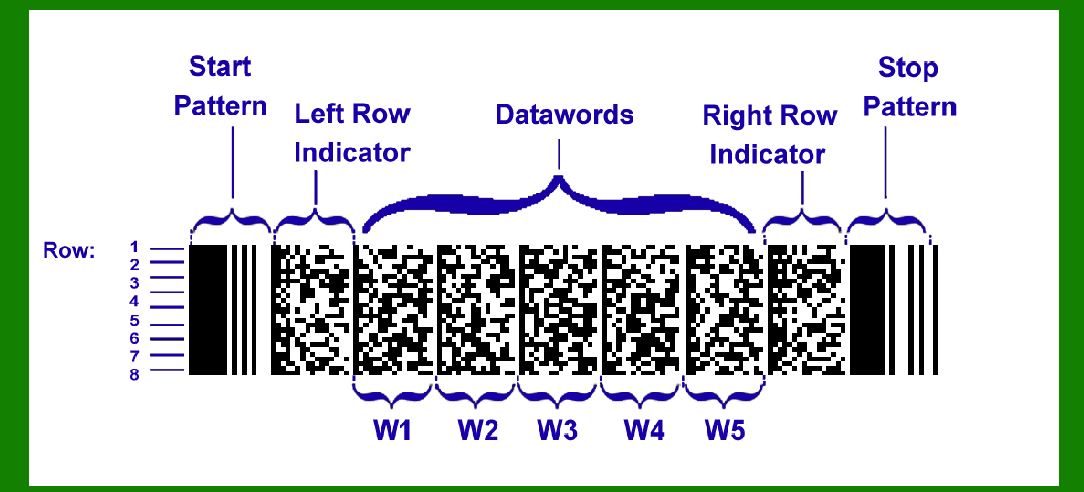
2.1 Unlike one-dimensional barcodes that consist of a single row of bars and spaces, PDF417 is designed as a stacked linear symbol meaning it 's built from multiple linear rows placed on top of each other. Each row can be scanned individually by a laser or camera, and collectively they reconstruct the encoded data. |
2.2 A single PDF417 barcode typically consists of 3 to 90 rows, each containing: |
A left row indicator (which helps the scanner recognize the row number and error correction level), |
A data region (the main encoded content area), and |
A right row indicator (which confirms row boundaries and format consistency). |
2.3 Each row contains codewords units of encoded information represented by unique patterns of bars and spaces. Every codeword is made up of 17 modules in width, subdivided into 4 bars and 4 spaces, hence the '417' in the name. |
2.4 The codewords themselves are numerical values ranging from 0 to 929, giving 930 possible codeword values. These are mapped through specific algorithms to represent text, numbers, or binary bytes, depending on the selected compaction mode (discussed later). |
2.5 The overall appearance of a PDF417 barcode is rectangular rather than square. Its width-to-height ratio can be adjusted by varying the number of rows or columns of codewords, allowing it to be customized to fit space requirements on printed documents or packaging labels. |
2.6 The structure of PDF417 is designed with redundancy and readability in mind. Each row is self-contained enough to allow partial decoding even if parts of the barcode are damaged or obscured a feature that makes it highly reliable in industrial and government use. |
|
3. The Meaning of 'Portable Data File' |
3.1 The designers of PDF417 envisioned it as a paper-based digital storage format, long before mobile QR codes and smartphones became mainstream. The term 'Portable Data File' was meant to signify that a sheet of paper could literally carry a small file of digital data, such as a record, certificate, or personal ID, that could be read by a scanner or computer. |
3.2 A single PDF417 symbol can encode over 1.1 kilobytes of data, depending on its configuration and error correction level. That may not sound like much today, but when PDF417 was invented in the early 1990s, this was a groundbreaking capacity for an optical code. |
3.3 With multiple PDF417 symbols chained together (a process called 'Macro PDF417'), much larger data sets can be stored, even megabytes of information distributed across multiple physical pages or labels. |
3.4 This concept storing structured, verifiable data on paper without electronic media became a crucial tool in secure document handling, allowing offline verification of identity, certificates, or shipment details without network connectivity. |
3.5 In essence, PDF417 made it possible for printed documents to carry their own machine-readable backup of digital information a revolutionary idea that continues to underpin ID cards, driver 's licenses, and boarding passes today. |
4. Key Design Principles Behind PDF417 |
4.1 The core design philosophy behind PDF417 can be summarized in four main objectives: |
High data capacity, far beyond what traditional barcodes could offer. |
Error correction, enabling reliable decoding even when symbols are partially damaged. |
Compactness and flexibility, allowing resizing to fit diverse printing and layout needs. |
Universal encoding, supporting text, numbers, and binary data in one symbol. |
4.2 To achieve these goals, PDF417 employs sophisticated algorithms for data compaction, error correction (Reed¨CSolomon coding), and symbol formatting. Together, they make it one of the most technically versatile linear barcodes ever designed. |
4.3 The stacked structure enables multiple 'lines' of codewords, much like lines in a text document. Each line contributes to the total data capacity and acts as an independent scanning opportunity, improving redundancy. |
4.4 The choice of the number of rows and columns gives designers flexibility to balance between: |
Symbol width (important for narrow labels), |
Symbol height (important for compact documents), |
Error correction level (important for data reliability). |
4.5 This adaptability has made PDF417 suitable for both large-format government documents and small industrial labels. |

|
5. Codewords and Encoding System |
5.1 The smallest information unit in a PDF417 symbol is the codeword. Each codeword is a pattern of bars and spaces 17 modules wide and 3 bars high. This fixed structure allows consistent printing and scanning across different printers and environments. |
5.2 Every codeword represents a numerical value between 0 and 929, inclusive. These numbers correspond to encoded values in one of several 'compaction modes' text, numeric, or binary depending on the type of data. |
5.3 Text Compaction Mode is optimized for alphanumeric data and uses clever switching between character sets (such as uppercase, lowercase, punctuation) to reduce codeword count. |
5.4 Numeric Compaction Mode allows up to 44 digits of numerical data to be represented by just 15 codewords, offering extremely efficient storage for long numbers such as ID codes or account numbers. |
5.5 Byte Compaction Mode supports 8-bit binary data, allowing arbitrary computer files or encrypted data segments to be encoded. |
5.6 PDF417 's encoding scheme can automatically switch between these modes within a single symbol to maximize efficiency similar to how modern compression algorithms choose different encodings for different data types. |
5.7 To mark transitions between modes or sections of data, special control codewords (such as latch or shift codes) are used. These enable the symbol to compactly encode complex data structures like forms or digital signatures. |

|
6. The Role of Start and Stop Patterns |
6.1 Each row of a PDF417 barcode begins with a start pattern and ends with a stop pattern. These patterns are unique and unambiguous, allowing scanners to recognize symbol boundaries even if the barcode is tilted, partially cut off, or printed on a curved surface. |
6.2 The start pattern encodes the beginning of the row and includes synchronization information to help the scanner align vertically across rows. |
6.3 The stop pattern contains an extra bar, ensuring the pattern cannot be mistaken for part of the data region. |
6.4 Between the start and stop patterns lie the left and right row indicators, which provide row-specific information like row number, error correction level, and cluster pattern (explained below). |
6.5 This design allows scanners to treat each row as a separate line of encoded text, similar to how an OCR reader scans lines of printed words. |

|
7. Cluster Patterns and the '417' Logic |
7.1 Each row of a PDF417 symbol belongs to one of three clusters, labeled 0, 3, and 6. These clusters define the specific pattern of bars and spaces for that row, preventing visual ambiguity between adjacent rows. |
7.2 The use of three clusters ensures that the same codeword will look visually different in each row, reducing the risk of decoding errors when scanning skewed or low-quality prints. |
7.3 The cluster assignment follows a repeating sequence: row 1 uses cluster 0, row 2 uses cluster 3, row 3 uses cluster 6, and then the pattern repeats. |
7.4 This system of alternating clusters is one of the unique features that gives PDF417 its visual 'wave-like' texture and contributes to its robustness. |

|
8. Error Correction and Reliability |
8.1 One of the most remarkable aspects of PDF417 is its built-in error correction capability. It uses Reed¨CSolomon error correction codes, which are also used in CDs, DVDs, and QR codes. |
8.2 The error correction system allows damaged or partially missing parts of the symbol to be reconstructed mathematically during decoding. |
8.3 There are 9 levels of error correction, from Level 0 (lowest redundancy) to Level 8 (maximum redundancy). At the highest level, nearly half the symbol can be damaged and still decoded successfully. |
8.4 Error correction codewords are interleaved throughout the symbol, meaning that damage in one area is distributed across multiple correction segments further enhancing resilience. |
8.5 This reliability makes PDF417 ideal for official documents, industrial logistics, and machine-readable travel documents, where physical wear, smudging, or partial printing is common. |

|
9. Symbol Dimensions and Customization |
9.1 PDF417 's physical dimensions can be adjusted according to the user 's needs. The number of columns can range from 1 to 30 codewords per row, and the number of rows can range from 3 to 90. |
9.2 For example, a 10¡Á20 symbol (10 columns by 20 rows) would contain 200 codewords roughly enough to encode hundreds of characters or a small data file. |
9.3 The symbol 's width and height can be further fine-tuned by adjusting the module width-to-height ratio (often called the 'aspect ratio'). This flexibility allows integration into documents of varying layouts, such as passports, shipping labels, or forms. |
9.4 The standard recommends a module width between 0.17 and 0.33 mm for most applications, balancing density and print clarity. |
9.5 This design flexibility gives PDF417 a practical advantage over rigid 2D codes in certain printing conditions for example, when high-resolution printing is unavailable or when the code must fit into a narrow horizontal space. |

|
10. Macro PDF417 Combining Multiple Symbols |
10.1 To overcome the size limit of a single PDF417 symbol, the standard includes a mechanism called Macro PDF417, which allows a large dataset to be split across multiple barcode symbols. |
10.2 Each symbol in a Macro PDF417 set contains metadata identifying the sequence number, total number of symbols, and file ID. When scanned together, the decoding software reassembles the complete dataset in the correct order. |
10.3 This feature has been particularly useful in applications such as government document archiving, technical manuals, or large-scale customs declarations, where entire digital records are embedded in printed forms. |
10.4 It effectively allows paper documents to serve as distributed physical media for digital data storage. |
10.5 In some postal and defense systems, Macro PDF417 was even used to encode complete digital forms for offline transmission and backup a remarkable demonstration of how barcodes can serve as physical 'data packets.' |

|
11. The Mathematical Foundation of PDF417 Error Correction |
11.1 Error correction in PDF417 is based on Reed¨CSolomon codes, a class of polynomial-based error-correcting codes used in digital communications and storage media. These codes operate on symbols from a finite field, allowing recovery of lost or corrupted data. |
11.2 Each PDF417 symbol includes a set of data codewords and error correction codewords. The ratio between them is determined by the chosen error correction level (0¨C8). |
11.3 For instance, Level 0 adds 2 error correction codewords, while Level 8 can add as many as 512 error correction codewords greatly increasing redundancy but also symbol size. |
11.4 The Reed¨CSolomon algorithm works by treating the codewords as coefficients of a polynomial. During decoding, if part of the symbol is missing or distorted, the algorithm uses the redundant coefficients to reconstruct the original polynomial and thus the original data. |
11.5 This system allows PDF417 to achieve extraordinary fault tolerance. Even if 30% to 50% of the barcode is damaged, it can often still be decoded accurately. |
11.6 The trade-off is size: higher error correction means more codewords and thus a larger symbol. Designers must balance between space and robustness according to the environment where the barcode will be used. |
11.7 For example, on shipping containers or luggage tags, where damage is likely, a higher correction level is desirable. For internal office forms or printed documents, a lower level suffices. |
11.8 The Reed¨CSolomon implementation in PDF417 was carefully optimized for printed barcodes not digital networks meaning it can tolerate real-world distortions such as smearing, low contrast, or misalignment during printing and scanning. |

|
12. Data Compaction and Encoding Efficiency |
12.1 One of the technical marvels of PDF417 is its ability to compact data efficiently. Each mode text, numeric, or byte is designed to minimize the number of codewords needed. |
12.2 Text Compaction Mode divides characters into three submodes: Alpha, Lowercase, and Mixed. Each submode can represent 30 or more characters. Switching between them allows optimal compression of mixed-content strings like 'IDA123bC.' |
12.3 Numeric Compaction Mode is extremely efficient for large numbers. Up to 44 digits can be encoded in 15 codewords by treating the number as a base-900 representation. This is especially useful for long serial numbers, national IDs, or financial codes. |
12.4 Byte Compaction Mode is used when arbitrary 8-bit data must be stored, such as encrypted data, small image fragments, or binary identifiers. It stores up to 6 bytes per 5 codewords on average. |
12.5 In practice, a single PDF417 symbol can hold around: |
1,800 text characters, |
2,700 numeric digits, or |
1,100 bytes of binary data. |
12.6 These capacities vary with error correction level and layout but illustrate the barcode 's extraordinary density for a printed format. |
12.7 This makes PDF417 one of the first true data-carrying barcodes, predating digital file attachments and cloud transmission in practical use. |

|
13. Decoding Process and Error Recovery |
13.1 When a scanner reads a PDF417 barcode, it captures an image or a laser sweep of the entire symbol. Specialized decoding software then analyzes the pattern row by row. |
13.2 The start and stop patterns are detected first, establishing symbol boundaries. Then the row indicators help identify the row 's cluster, error correction level, and row number. |
13.3 Each sequence of bars and spaces is converted back into its numerical codeword value, forming a stream of codewords. |
13.4 These codewords are then processed by the Reed¨CSolomon decoder, which uses the error correction polynomial to detect and correct any missing or incorrect values. |
13.5 Once all rows are reconstructed, the resulting sequence of codewords is translated into characters or bytes according to the original compaction mode. |
13.6 The final decoded output may represent text, binary data, or even structured information like XML or JSON (in modern implementations). |
13.7 Decoding software can also verify the symbol ID and sequence number in Macro PDF417 to assemble multiple segments automatically. |
13.8 The mathematical precision of this process is what allows PDF417 to be scanned even from low-quality photocopies, faxed images, or faded labels a significant advantage in archival and forensic use. |

|
14. Printing Technology and Tolerances |
14.1 PDF417 was designed with practical printing methods in mind. During its development in the late 1980s, dot-matrix and laser printers were common, so the barcode had to be readable under non-ideal conditions. |
14.2 The barcode uses wide modules and generous bar spacing to reduce the risk of print distortion. A module 's minimum width can be as low as 0.17 mm, but industrial standards often use 0.25¨C0.33 mm for clarity. |
14.3 The bars ' height is typically three times the module width, creating a good contrast ratio for scanning lasers or cameras. |
14.4 For color printing, the symbol should maintain a strong contrast typically black bars on a white or light background. However, dark blue, green, or brown can also be used if optical contrast is sufficient. |
14.5 PDF417 remains readable even when printed on thermal transfer, inkjet, or laser-engraved surfaces, making it suitable for documents, plastic cards, and metal nameplates alike. |
14.6 The standard also supports truncated PDF417, a variant where the right-hand indicator and stop pattern are removed to save space. Though smaller, it sacrifices some redundancy and is not recommended for critical applications. |
14.7 PDF417 's visual rectangularity also makes it ideal for documents where a square QR Code would not fit. It can be placed neatly along the bottom of a form or ID card without disrupting the layout. |

|
15. Scanning Equipment and Compatibility |
15.1 PDF417 can be read by both laser scanners and imaging scanners (cameras). However, its stacked nature makes it particularly suitable for imaging-based decoding. |
15.2 Early laser scanners developed by Symbol Technologies could sweep vertically across rows to capture the stacked code, reconstructing the data as a continuous stream. |
15.3 Modern camera-based readers use image recognition and pattern analysis to identify row boundaries and decode multiple rows simultaneously. |
15.4 Most commercial 2D scanners today including those that read QR Code and Data Matrix also support PDF417, making it universally interoperable. |
15.5 Mobile phone scanning has also improved dramatically; PDF417 can be read by modern smartphones using apps that support high-resolution imaging, though lighting and focus remain key factors. |
15.6 PDF417 's design ensures high readability even under distortion. Its tall structure helps maintain scan success if the symbol is skewed or partially covered, unlike QR Codes that depend heavily on position patterns. |
|
16. Comparison with Other 2D Codes |
16.1 To appreciate PDF417 's unique position, it helps to compare it with other well-known 2D codes. |
16.2 Unlike QR Code and Data Matrix, which are matrix-style codes (consisting of black and white squares), PDF417 is a stacked linear code essentially multiple rows of bar patterns. This makes it visually different and often more suitable for document-based layouts. |
16.3 While QR Code can encode similar data amounts, PDF417 offers superior control over physical dimensions and is more tolerant of uneven printing. |
16.4 Data Matrix excels at high-density marking on small items, such as microelectronics or surgical instruments. PDF417, however, is optimized for larger surfaces like labels, IDs, or transport documents. |
16.5 PDF417 also supports Macro encoding, allowing datasets larger than what QR or Data Matrix can store in a single symbol. |
16.6 For machine readability, PDF417 is somewhat more space-consuming but delivers stronger resilience in the presence of scratches or partial obscuration, especially when printed on paper that folds or creases. |
16.7 Therefore, industries that rely on form documents, licenses, shipping labels, and boarding passes often prefer PDF417, while consumer products and packaging lean toward QR and Data Matrix. |
|
17. Historical Background and Standardization |
17.1 The origins of PDF417 date to around 1987¨C1988, when engineers at Symbol Technologies sought a way to encode digital data onto paper in a compact, scannable form. |
17.2 The key inventor credited is Dr. Ynjiun P. Wang, whose patents laid the foundation for stacked linear symbologies. |
17.3 By the early 1990s, PDF417 had gained traction across multiple industries, especially government, postal, and logistics sectors that needed machine-readable, tamper-resistant documents. |
17.4 The symbology was standardized internationally in ISO/IEC 15438, titled 'Information technology Automatic identification and data capture techniques PDF417 bar code symbology specification.' |
17.5 This standardization ensured compatibility among scanners, printers, and software across different manufacturers and countries. |
17.6 Several derived formats, including MicroPDF417 and Compact PDF417, were later introduced for small-label and high-density applications. |
17.7 Over time, PDF417 became an official symbology in ISO/IEC 24728 (for postal use) and AIM standards, further integrating it into international commerce and documentation systems. |

|
18. Government and Regulatory Adoption |
18.1 Perhaps the greatest endorsement of PDF417 's reliability is its widespread use in government-issued documents. |
18.2 Many driver 's licenses in the United States and other countries incorporate PDF417 on the back. It stores key information such as name, address, date of birth, issuing state, and driver 's class codes. |
18.3 Because PDF417 can hold hundreds of characters and includes built-in error correction, it serves as a secure digital backup of the printed text. |
18.4 When scanned, authorities can instantly verify identity data, check against databases, or validate document authenticity. |
18.5 PDF417 's error correction makes it durable against scratches and wear from plastic ID cards that circulate for years. |
18.6 Similar uses extend to vehicle registrations, gun permits, voter cards, and medical licenses. |
18.7 In air travel, PDF417 is the standard barcode used on boarding passes under IATA Resolution 792. It encodes passenger information, flight number, seat assignment, and ticket details. |
18.8 The same format is used for baggage tags and cargo documentation, ensuring consistency throughout the aviation ecosystem. |
18.9 PDF417 has also been used in U.S. postal forms, customs declarations, border control documents, and national ID programs in various countries. |
18.10 Its ability to securely embed structured data in an offline medium made it invaluable before the era of constant internet connectivity and even today, it continues to function as an offline verification system. |

|
19. Security and Authentication Roles |
19.1 Beyond data storage, PDF417 supports secure encoding of digital signatures and encrypted data. |
19.2 For example, a government agency can digitally sign the encoded content of a PDF417 symbol, embedding the signature within the barcode. |
19.3 When scanned, the data can be verified cryptographically to confirm that the document has not been altered or counterfeited. |
19.4 This capability has been widely used for vehicle registration certificates, identity cards, and exam result slips. |
19.5 Because PDF417 can store both the plain data and its hash or digital signature within the same symbol, it acts as a self-contained verification system no database lookup required. |
19.6 This feature became particularly useful in developing regions or field operations where network access may be limited. |
19.7 In some systems, PDF417 also encodes expiration dates and issuing authority identifiers, ensuring integrity and traceability of credentials. |
19.8 The balance between open readability and optional cryptographic protection makes PDF417 both flexible and secure. |

|
20. PDF417 in the Postal and Logistics Industry |
20.1 One of the earliest and most influential adopters of PDF417 technology was the postal and logistics sector, where the ability to encode large amounts of structured data in a compact printed form revolutionized the handling of mail and packages. |
20.2 Traditional postal systems used linear barcodes such as Code 39 or Code 128, which could only represent relatively short tracking numbers. As e-commerce and global shipping expanded, carriers required barcodes that could encode full addresses, routing instructions, or digital customs data without needing separate database lookups. |
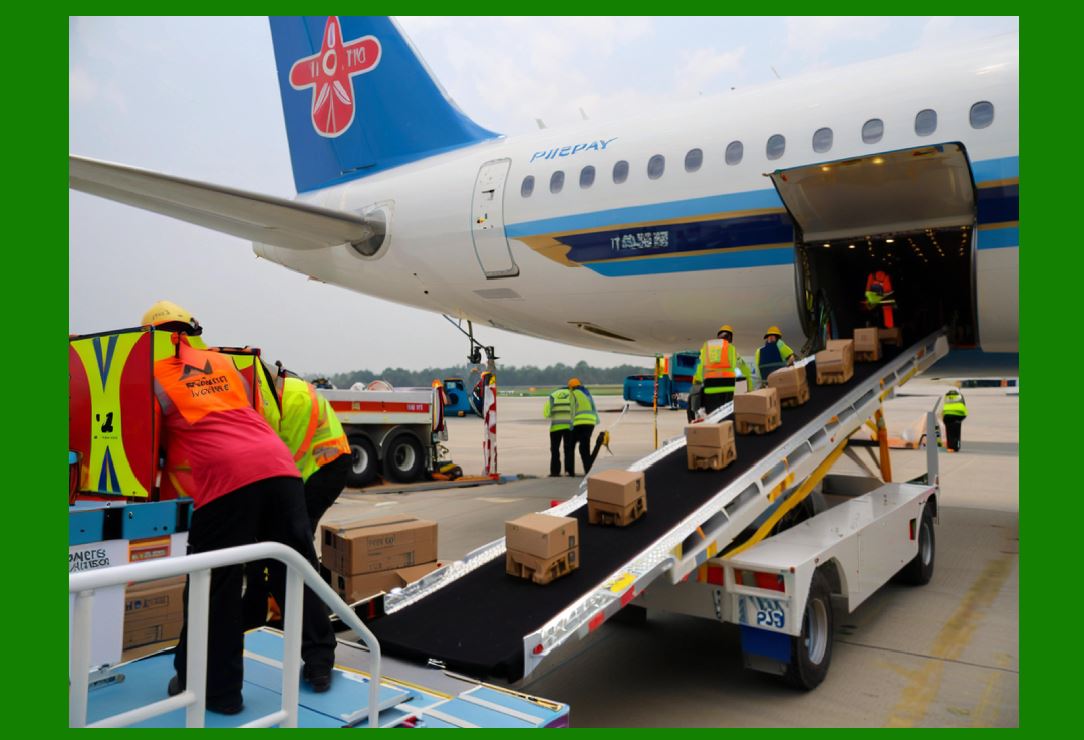
20.3 PDF417 met these needs perfectly. Its capacity for hundreds or thousands of characters meant entire shipment manifests could be embedded directly on a parcel or document, readable by scanning equipment anywhere in the world. |
20.4 In the United States, USPS and other carriers experimented with PDF417 to encode tracking identifiers and shipping information on customs forms. Because the barcode could survive partial damage, it was more reliable in handling centers where labels are often smudged or torn. |
20.5 Similarly, FedEx, UPS, and DHL integrated PDF417 into specific tracking and cargo documentation systems. It enabled automatic sorting and customs data validation without manual data entry. |
20.6 In some regions, especially in the 1990s and 2000s, PDF417 was used to encode not only the shipment number but also sender and recipient details, weight, insurance codes, and routing instructions a level of detail impossible with ordinary 1D codes. |
20.7 Logistics companies also used PDF417 to attach electronic data interchange (EDI) segments to paper documents, effectively turning a printed label into a digital message carrier. |
20.8 The error correction of PDF417 was critical for these applications. Parcels endure harsh environments: rain, dust, abrasion, and mechanical compression. The barcode 's ability to retain readability despite such wear directly translated into lower data loss and fewer misrouted packages. |
20.9 Even as QR and Data Matrix became popular in consumer goods, PDF417 remained dominant in industrial logistics, where forms and documents still required high-density, rectangular barcodes. |
20.10 The barcode 's role in logistics thus extends far beyond simple tracking: it enables automation, verification, and resilience all essential for global commerce. |

|
21. PDF417 in Air Travel and Transportation |
21.1 The aviation industry embraced PDF417 earlier than most sectors, adopting it as the standard barcode for boarding passes and baggage tags under IATA Resolution 792. |
21.2 When you print or receive an airline boarding pass, the rectangular barcode printed near the bottom is almost always a PDF417 symbol. |
21.3 This code encodes the passenger 's name, flight number, date, departure and destination airports, seat assignment, and ticket reference. It effectively serves as an offline backup of the digital record stored in the airline 's system. |
21.4 Before mobile boarding passes became common, PDF417 allowed airlines to offer paper-based self-check-in systems: passengers could print their own boarding passes at home, and scanners at airports could instantly validate them. |
21.5 Because the code includes error correction, even a wrinkled or partially folded boarding pass can still be scanned successfully, making it extremely practical for travel scenarios. |
21.6 The same principle applies to baggage tags, where PDF417 encodes flight routing data, passenger name record (PNR) references, and handling codes. |
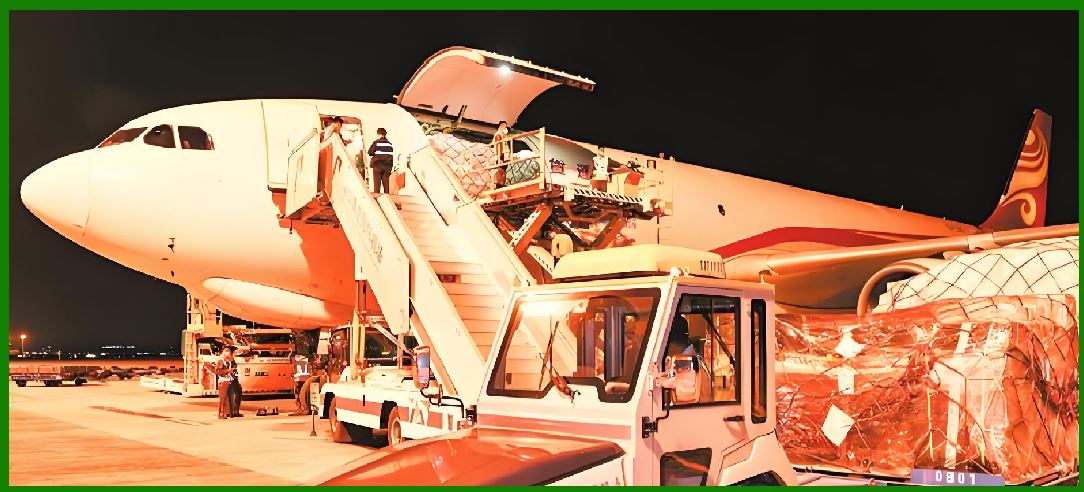
21.7 Airlines also use PDF417 for cargo waybills, enabling customs and tracking systems to process shipments automatically at hubs and transfer points. |
21.8 The barcode 's flexibility in shape means it can fit neatly on boarding passes and labels of various layouts without requiring square space an important ergonomic advantage over QR codes. |
21.9 Because of these proven strengths, PDF417 remains one of the few officially standardized barcodes in international aviation. Even modern digital boarding systems often maintain backward compatibility with PDF417 for printed backups. |
21.10 The use of PDF417 in transportation extends to rail freight, truck cargo manifests, and even shipping container documentation, showing its cross-modal relevance. |

|
22. Manufacturing and Industrial Uses |
22.1 In manufacturing environments, barcodes must endure dust, vibration, and temperature fluctuations while remaining readable on rough materials such as metal, plastic, or cardboard. PDF417 's strong error correction makes it ideal for these conditions. |
22.2 Factories often print PDF417 labels on work orders, batch sheets, or assembly line instructions, allowing each component or subassembly to carry digital documentation with it. |
22.3 The symbol can encode part numbers, quality control results, operator IDs, timestamps, and test data effectively embedding traceability information within each production batch. |
22.4 Because PDF417 can also represent binary data, some manufacturers embed calibration data files or machine configuration sets directly into the code, enabling rapid reprogramming of equipment. |
22.5 Automotive and aerospace industries, in particular, rely on PDF417 for compliance documentation. Each part may carry a label encoding its manufacturing origin, material specification, and inspection data. |
22.6 When scanned, this data is uploaded into enterprise resource planning (ERP) systems or quality assurance databases, ensuring full traceability from raw material to final product. |
22.7 Some factories also use Macro PDF417 to store large maintenance logs or firmware fragments that travel with equipment through the production process. |
22.8 The stacked structure makes PDF417 less sensitive to damage from oil smears or partial label abrasion compared with smaller matrix codes. |
22.9 PDF417 has thus proven valuable not only for data density but also for physical durability and operational continuity in demanding industrial settings. |
22.10 In short, it acts as a bridge between digital and physical production data, reinforcing Industry 4.0 principles of smart traceability. |

|
23. PDF417 in Retail and Inventory Management |
23.1 In retail and warehouse management, PDF417 offers capabilities far beyond ordinary UPC or EAN codes. |
23.2 Because it can encode product details, manufacturing dates, batch numbers, and regulatory data, it enables deep-level tracking of goods through distribution channels. |
23.3 Many wholesalers and warehouse systems use PDF417 to print pallet or case labels that summarize the contents of multiple items, eliminating the need for network access during scanning. |
23.4 When scanned at receiving docks, the barcode instantly updates the system with item counts, lot codes, and expiration data. |
23.5 Retailers that manage serialized goods such as electronics or luxury items often use PDF417 to embed serial numbers and anti-counterfeit verification strings on packaging. |
23.6 Because of its size flexibility, PDF417 can coexist with traditional UPC/EAN barcodes on the same label, serving as an extended information carrier for backend systems. |
23.7 In some large retail chains, PDF417 is printed on return receipts or warranty cards, encoding transaction data and item details that simplify service processing. |
23.8 The symbol 's resilience to printing imperfections also makes it suitable for on-demand thermal label printing, where printhead wear can cause minor irregularities. |
23.9 In warehouses, PDF417 is often used on shelving labels or picking documents, storing routing and bin location data for automated retrieval. |
23.10 As retail supply chains evolve toward greater automation and data transparency, PDF417 remains a robust tool for encoding structured logistics data. |

|
24. PDF417 in Healthcare Systems |
24.1 The healthcare industry values data accuracy, traceability, and security all strengths of PDF417. |
24.2 Hospitals use PDF417 to label patient wristbands, medication packages, and laboratory samples with detailed information far exceeding that of linear barcodes. |
24.3 A single PDF417 symbol can contain the patient 's ID, name, date of birth, allergy list, attending physician, and prescription details ensuring safe and efficient identification. |
24.4 In laboratory environments, PDF417 encodes test identifiers, sample collection times, and analysis instructions. Because of error correction, even smudged or condensed prints remain readable. |
24.5 Blood banks and tissue repositories use PDF417 for donor tracking, as it can store multiple data fields securely in a limited area. |
24.6 Hospitals also employ PDF417 on billing statements or insurance claim forms to store transaction metadata that can be automatically imported into systems. |
24.7 For medical device labeling, PDF417 is part of the FDA 's Unique Device Identification (UDI) system, where it can represent both the device identifier (DI) and production identifier (PI). |
24.8 This ensures that devices can be tracked through their entire lifecycle, from manufacture to patient use and post-market surveillance. |
24.9 The barcode 's ability to carry both plain text and encrypted data supports privacy requirements while maintaining machine readability. |
24.10 Thus, in healthcare, PDF417 promotes not only efficiency but also patient safety and regulatory compliance. |

|
25. PDF417 in Education and Certificates |
25.1 Educational institutions use PDF417 to secure diplomas, transcripts, and certificates against forgery. |
25.2 The barcode can store complete academic records including student names, course titles, grades, and issue dates directly on the document. |
25.3 When scanned, officials can verify authenticity by comparing embedded digital signatures or hashes with institutional records. |
25.4 This system has been adopted by universities and training organizations in multiple countries to simplify verification for employers and authorities. |
25.5 Some schools also use PDF417 for exam admission tickets, encoding candidate ID, seat number, and test center information. |
25.6 In online education, printed PDF417 certificates can bridge the gap between digital learning and physical credentialing, allowing verification even offline. |
25.7 The combination of high capacity and strong error correction makes PDF417 an ideal choice for long-term archival certificates that may fade or wrinkle over time. |
25.8 Unlike simple QR codes that usually contain only a verification link, PDF417 can carry the entire credential data itself, allowing authentication even without an internet connection. |
25.9 Educational institutions appreciate this offline resilience, especially in developing regions or for international verification scenarios. |
25.10 As a result, PDF417 has become a silent guardian of educational credibility worldwide. |

|
26. PDF417 in Government Administration and E-Government |
26.1 Governments rely on secure, verifiable, and interoperable data carriers for documents like IDs, permits, and certificates a perfect use case for PDF417. |
26.2 National ID programs in countries such as the United States, Canada, and the Philippines have used PDF417 for encoding citizen data, fingerprints, and digital signatures. |
26.3 Immigration agencies often print PDF417 on visa labels, encoding machine-readable information equivalent to the text on the document. |
26.4 Tax authorities use it for payment vouchers and receipt validation, where the symbol carries transaction data that can be verified instantly. |
26.5 In the Department of Motor Vehicles (DMV) systems across U.S. states, PDF417 is mandated by the American Association of Motor Vehicle Administrators (AAMVA) standard for driver 's licenses. |
26.6 The AAMVA specification defines how personal data, issue dates, restrictions, and endorsements are encoded, ensuring uniformity across all jurisdictions. |
26.7 Because of its error correction and high data density, PDF417 allows licenses to serve as self-contained data carriers even when offline or during network outages. |
26.8 Governments also use PDF417 for land registration certificates, birth certificates, and marriage licenses, embedding encrypted personal data directly on the document. |
26.9 During elections, some countries use PDF417-coded voter IDs or ballot forms to ensure secure and tamper-resistant identification. |
26.10 In short, PDF417 acts as the digital DNA of modern administrative documents compact, verifiable, and resistant to forgery. |

|
27. PDF417 in Banking and Finance |
27.1 Financial institutions rely on data accuracy, confidentiality, and traceability all of which align with PDF417 's strengths. |
27.2 Banks use PDF417 for encoding transaction data, account details, and cheque verification codes. |
27.3 On printed financial documents, PDF417 can store the full digital record of a transaction, ensuring easy reconciliation and auditability. |
27.4 In some countries, tax receipts and utility bills include PDF417 symbols that contain encrypted billing data. Customers can scan these for instant payment verification. |
27.5 PDF417 also appears in ATM service tickets, encoding transaction summaries or error codes for maintenance tracking. |
27.6 Because it can store binary data, it 's capable of carrying encrypted or signed information, ensuring privacy in financial communications. |
27.7 Banks have also used PDF417 to embed customer verification data on printed cards or forms, enabling quick re-verification during customer service processes. |
27.8 Insurance companies employ PDF417 for policy documents, ensuring that key policy terms are encoded directly into the printout for audit purposes. |
27.9 This capability supports long-term data preservation: even if the central database changes, the printed record retains the original verifiable data snapshot. |
27.10 Thus, in finance, PDF417 functions as a secure bridge between paper and digital accounting systems. |
 cs@easiersoft.com