QR Codes and Reed-Solomon Error Correction |
1.Introduction to QR Codes: QR (Quick Response) codes are two-dimensional barcodes that can store a variety of data types, including URLs, text, and other information. Developed by Denso Wave in 1994, QR codes have become ubiquitous due to their versatility and ease of use. One of the critical features that contribute to the robustness of QR codes is their error correction capability, which uses the Reed-Solomon error correction technique. This feature ensures that QR codes can be reliably scanned even if they are partially damaged or obscured. |
|
2.Overview of Reed-Solomon Error Correction: Reed-Solomon (RS) error correction is a powerful algorithm used to detect and correct errors in data transmission and storage. Named after its inventors, Irving S. Reed and Gustave Solomon, this technique is particularly well-suited for correcting burst errors, which are common in many real-world scenarios. RS codes are widely used in digital communications and data storage systems, including CDs, DVDs, and QR codes, to ensure data integrity and reliability. |
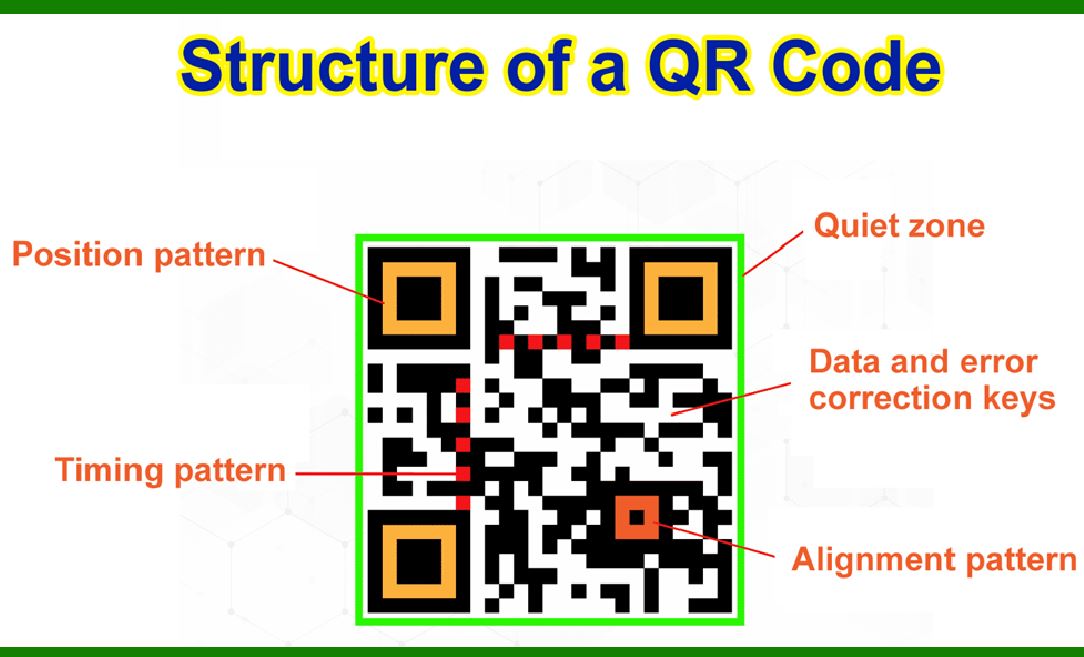
3.QR Code Structure and Data Encoding: A QR code consists of a matrix of black and white squares, where each square represents a bit of data. The data is encoded in such a way that it includes both the actual information and additional error correction codes generated using the RS algorithm. This structured approach allows for the detection and correction of errors that may occur during the scanning process. |

|
4.Error Correction Levels in QR Codes: QR codes offer four levels of error correction, denoted as L, M, Q, and H, which correspond to different amounts of error correction capability: |
Level L (Low): Can correct up to 7% of data errors. Level M (Medium): Can correct up to 15% of data errors. Level Q (Quartile): Can correct up to 25% of data errors. Level H (High): Can correct up to 30% of data errors. |
The choice of error correction level depends on the specific use case and the expected scanning conditions. Higher levels of error correction result in larger QR codes but offer greater reliability. |

|
5.Reed-Solomon Code Generation: The process of generating Reed-Solomon codes involves creating additional parity symbols based on the original data. These parity symbols are added to the data to form a codeword. The number of parity symbols determines the error correction capability. For example, a QR code with an H level of error correction (30%) will have more parity symbols than one with an L level (7%). |
6.Mathematical Basis of Reed-Solomon Codes: Reed-Solomon codes are based on finite field arithmetic, specifically Galois fields. A Galois field is a finite set of elements in which arithmetic operations (addition, subtraction, multiplication, and division) are defined. RS codes use a specific type of Galois field, denoted as GF(2^m), where 'm' is a positive integer. The encoding process involves polynomial arithmetic over this field, where the original data is represented as a polynomial, and parity symbols are generated as coefficients of another polynomial. |

|
7.Encoding Process: The encoding process of a QR code with RS error correction involves the following steps: |
Data Polynomial Formation: The original data is represented as a polynomial. Generator Polynomial: A generator polynomial is defined based on the desired error correction level. Polynomial Division: The data polynomial is divided by the generator polynomial, and the remainder from this division is the parity symbols. Codeword Formation: The original data and the parity symbols form the final codeword, which is then encoded into the QR code matrix. |

|
8.Decoding and Error Correction: When a QR code is scanned, the captured data may contain errors due to various factors such as dirt, damage, or distortion. The decoding process involves the following steps: |
Syndrome Calculation: Calculate syndromes from the received data to detect errors. Error Locator Polynomial: Use the syndromes to determine the error locator polynomial, which identifies the positions of errors. Error Magnitude Calculation: Calculate the magnitude of errors at the identified positions. Error Correction: Apply the calculated error magnitudes to the received data to correct the errors. |

|
9.Example of Error Correction in Action: Consider a QR code encoded with a high level of error correction (H), which can correct up to 30% of data errors. Suppose this QR code contains 1000 data bits. With H level correction, it can correct up to 300 bits of erroneous data. If the QR code is scanned and found to have 250 bits corrupted, the RS error correction process will detect and correct these errors, allowing the original data to be accurately retrieved. |
10.Advantages of Reed-Solomon Error Correction in QR Codes: The use of RS error correction in QR codes offers several advantages: |
Robustness: Ensures reliable data recovery even in challenging conditions. Flexibility: Multiple levels of error correction allow for adaptation to different use cases. Scalability: Can be applied to QR codes of varying sizes and data capacities. |

|
11.Real-World Applications: QR codes with RS error correction are used in various applications where data integrity is crucial. For instance: |
Product Packaging: Ensures that information such as product details and URLs can be reliably scanned even if the package is damaged. Event Tickets: Maintains the integrity of ticket information despite potential wear and tear. Payment Systems: Ensures accurate transaction processing even with partial obstructions on the QR code. |
12.Challenges and Limitations: While RS error correction significantly enhances the reliability of QR codes, it also introduces some challenges: |
Increased Code Size: Higher levels of error correction require more parity symbols, resulting in larger QR codes. Complexity: The encoding and decoding processes involve complex mathematical operations, requiring efficient algorithms and sufficient computational resources. |

|
13.Optimization Strategies: To balance the trade-offs between error correction capability and QR code size, several optimization strategies can be employed: |
Data Compression: Compressing the data before encoding can reduce the overall size of the QR code. Selective Error Correction Levels: Different parts of the QR code can use different levels of error correction based on their importance and likelihood of being damaged. Adaptive Scanning: Advanced scanning technologies can dynamically adjust the error correction process based on the condition of the QR code. |
14.Future Developments: As technology advances, there are ongoing efforts to improve QR code error correction and overall performance. Potential future developments include: |
Enhanced Algorithms: Developing more efficient algorithms for RS error correction to reduce computational complexity. Hybrid Techniques: Combining RS error correction with other error correction methods to further enhance reliability. Improved Materials: Using materials that are more resistant to damage for printing QR codes, reducing the likelihood of errors. |

|
15.Conclusion: QR codes with Reed-Solomon error correction represent a significant advancement in data encoding technology. By incorporating robust error correction capabilities, QR codes ensure that data can be reliably scanned and retrieved even under adverse conditions. This reliability makes QR codes suitable for a wide range of applications, from consumer products to secure transactions. As technology continues to evolve, further enhancements in error correction techniques and QR code design will likely emerge, continuing to expand the versatility and utility of QR codes in our daily lives. |

|
 cs@easiersoft.com