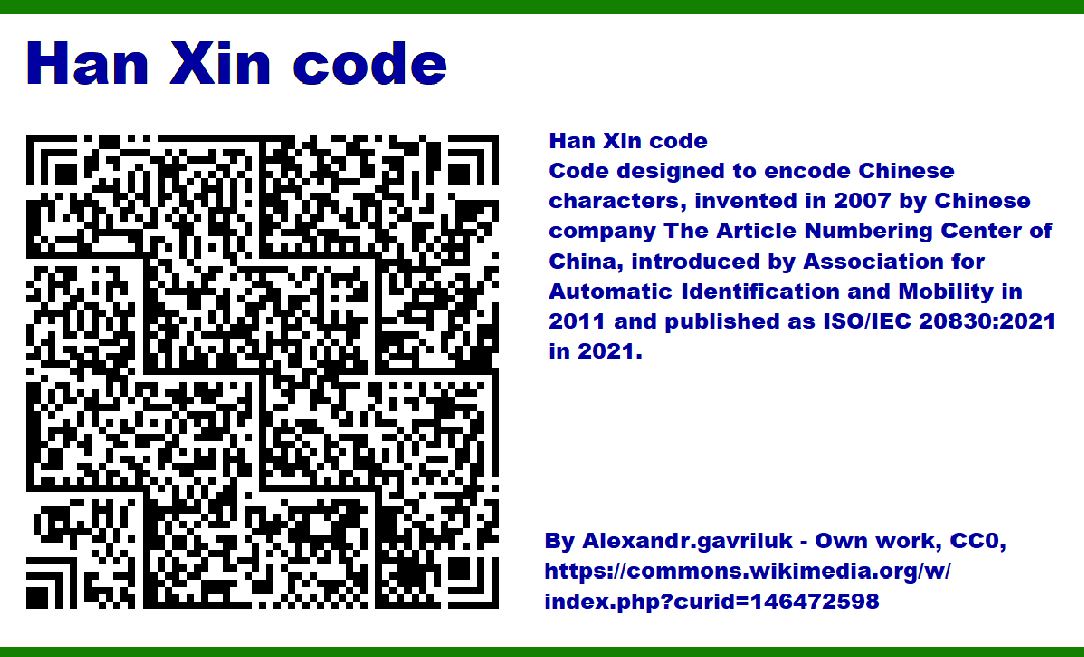
The Han Xin Code is a 2D barcode developed by Chinese company Han Xin Code Co., Ltd., introduced in 2011. This barcode format is designed to offer significant advantages over existing 2D barcode standards like QR codes and Data Matrix codes. Its unique characteristics make it suitable for various applications across industries ranging from consumer goods to logistics, healthcare, and beyond. |
|
Introduction to Han Xin Code |
Han Xin Code was developed as an open standard to address limitations observed in other 2D barcodes. It boasts several key features that enhance data capacity, error correction capabilities, and versatility in application. The code's development was influenced by the need for a barcode that could handle extensive data, withstand damage or distortion, and provide reliable scanning in diverse environments. |

|
Technical Specifications and Features |
Data Capacity and Structure |
Han Xin Code supports variable data capacity depending on the version used, ranging from a few hundred bytes to several kilobytes. This flexibility allows it to encode extensive information such as URLs, text, numeric data, and binary data. The code structure includes modules arranged in a grid pattern, with specific alignment patterns and timing patterns that aid in accurate decoding. |
Error Correction |
One of the standout features of Han Xin Code is its robust error correction capability. It utilizes Reed-Solomon error correction codes, which can restore data even when parts of the code are damaged or obscured. This makes it suitable for applications where reliability and data integrity are crucial, such as in supply chain management and archival systems. |
Scalability and Versioning |
Han Xin Code is designed with scalability in mind, offering multiple versions that vary in module size and data capacity. This allows users to choose the appropriate version based on their specific requirements for barcode size, scanning distance, and data storage needs. The standardization of different versions ensures compatibility across different scanning devices and software platforms. |

|
Applications of Han Xin Code |
Consumer Packaging and Retail |
In consumer goods and retail environments, Han Xin Code finds application in product packaging, inventory management, and marketing. Its ability to encode extensive product information, promotional content, and traceability data makes it valuable for enhancing supply chain transparency and consumer engagement. Retailers can utilize Han Xin Code to provide detailed product specifications, pricing information, and promotional offers directly accessible to consumers via smartphones or dedicated barcode scanners. |
Logistics and Transportation |
Logistics operations benefit from Han Xin Code's capacity to encode shipment details, tracking information, and logistical instructions. The barcode's error correction capabilities ensure accurate scanning even in challenging environments such as warehouses, transportation hubs, and during transit. Logistics companies leverage Han Xin Code to streamline inventory management, optimize route planning, and enhance shipment tracking accuracy from origin to destination. |
Healthcare and Pharmaceutical Industries |
In healthcare settings, Han Xin Code supports applications ranging from patient identification and medical record management to pharmaceutical product labeling and regulatory compliance. The barcode's ability to encode patient data securely and link to electronic health records aids in improving patient safety, medication management, and operational efficiency within healthcare facilities. Pharmaceutical companies utilize Han Xin Code for product serialization, anti-counterfeiting measures, and supply chain visibility to combat counterfeit drugs and ensure product authenticity. |
Document Management and Archival Systems |
Han Xin Code is employed in document management systems and archival environments where preserving and accessing large volumes of data is critical. Libraries, archives, and government agencies use the barcode for cataloging, indexing, and retrieving historical records, manuscripts, and other archival materials. Its high data capacity and error correction features facilitate accurate data retrieval and long-term preservation of cultural heritage and institutional knowledge. |
Automotive and Manufacturing |
Automotive manufacturers and suppliers integrate Han Xin Code into parts tracking, component labeling, and assembly processes to enhance traceability and quality control. The barcode's durability and reliability in industrial environments support lean manufacturing practices, just-in-time inventory management, and compliance with industry standards for product identification and warranty tracking. Han Xin Code ensures seamless integration with automated production systems and facilitates real-time data exchange across manufacturing operations. |

|
Comparison with Other 2D Barcode Standards |
QR Code |
Compared to QR codes, Han Xin Code offers higher data capacity and superior error correction capabilities, making it suitable for applications requiring extensive data encoding and reliable scanning performance. QR codes are widely recognized and supported globally, primarily used for consumer-facing applications such as mobile payments, advertising, and digital content distribution. |
Data Matrix Code |
Data Matrix codes excel in applications where space efficiency and high-speed scanning are paramount. They are commonly used in electronics manufacturing, healthcare, and inventory management due to their compact size and robust data encoding capabilities. Han Xin Code provides greater flexibility in data capacity and error correction, catering to applications demanding comprehensive data storage and retrieval capabilities. |

|
Implementation Challenges and Considerations |
Compatibility and Adoption |
The widespread adoption of Han Xin Code depends on its compatibility with existing barcode scanning equipment, software platforms, and industry-specific standards. Manufacturers and developers need to ensure seamless integration and interoperability across different devices and operating environments to facilitate widespread adoption and user acceptance. |
Security and Data Privacy |
As with any barcode technology, ensuring data security and protecting sensitive information encoded in Han Xin Code is paramount. Organizations must implement encryption protocols, access controls, and data management practices to safeguard against unauthorized access, data breaches, and malicious exploitation of encoded information. |

|
Future Trends and Innovations |
Integration with IoT and AI Technologies |
The convergence of Han Xin Code with Internet of Things (IoT) devices and artificial intelligence (AI) algorithms presents opportunities for real-time data analytics, predictive maintenance, and enhanced supply chain visibility. Smart packaging solutions equipped with Han Xin Code enable proactive inventory management, condition monitoring, and consumer engagement through personalized product experiences and automated replenishment services. |
Sustainability and Eco-Friendly Practices |
The development of eco-friendly barcode materials and printing technologies supports sustainable practices in consumer packaging, logistics, and manufacturing industries. Han Xin Code's compatibility with recycled materials and biodegradable substrates promotes environmental responsibility and aligns with corporate sustainability initiatives focused on reducing carbon footprint and minimizing waste generation. |

|
Conclusion |
Han Xin Code represents a significant advancement in 2D barcode technology, offering enhanced data capacity, robust error correction capabilities, and versatility across diverse applications. From consumer packaging and retail to logistics, healthcare, and manufacturing, the barcode standardizes data encoding, facilitates operational efficiency, and enhances user experiences through seamless integration with digital ecosystems. As industries continue to embrace digital transformation and demand for scalable, reliable data management solutions grows, Han Xin Code remains poised to play a pivotal role in shaping the future of barcode technology and its applications worldwide. |
This comprehensive overview highlights the technical specifications, applications, comparison with other 2D barcode standards, implementation challenges, future trends, and innovations associated with Han Xin Code, underscoring its ultimate importance in modern data encoding and management practices across industries. |
 cs@easiersoft.com