Barcode Technology

Barcode History

Barcode Label Paper

Barcode Printer

Barcode Application

Inventory Management

AI Barcode QRCode

Barcode Scanner

Barcode Software

Barcode Software B

Barcode Software C

Barcode Software D

Barcode Software E

New Technology A

New Technology B

Robot Technology

Barcode Types

Barcode Types B

Barcode Types C

Barcode Types D

Barcode Types E

Barcode Types F

Electronic Technology

Psychology at Work

Barcode Technology and Barcode Software Related   <<< Back to Directory <<<

Encoding of the High Capacity Color Barcode (HCCB)

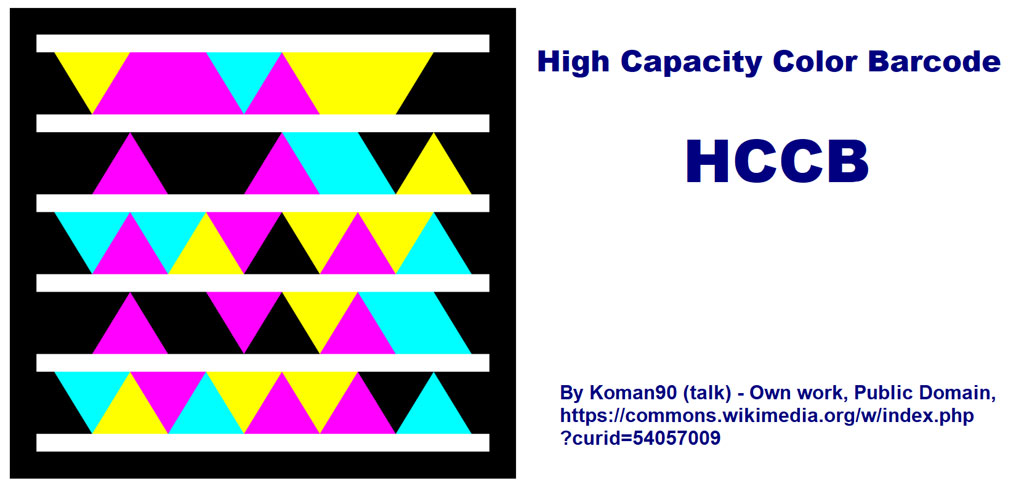
High Capacity Color Barcode (HCCB) is a 2D barcode technology developed by Microsoft. It is known for its ability to store large amounts of data in a compact form, using a unique encoding method that leverages colors and shapes to encode information. This detailed explanation will cover the encoding process of HCCB, including its structure, encoding principles, and examples.

Structure of HCCB

HCCB is structured as a grid of colored triangles arranged in a square or rectangular pattern. Each triangle can be one of four colors: black, white, green, or red. The arrangement and color of these triangles encode the data. The barcode is divided into regions that serve different purposes, such as data regions, timing patterns, and finder patterns.

Encoding Principles

1. Data Organization

HCCB encodes data in a hierarchical structure:

Cluster: The basic unit of HCCB encoding is a cluster, which consists of one or more adjacent triangles. A cluster can encode a single data value or part of a larger data sequence.

Byte Pair: Two adjacent clusters encode a byte pair, typically consisting of 8 bits (1 byte) of data.

Codeword: A codeword is a group of byte pairs that form a complete unit of data encoding. Codewords include error correction information to ensure data integrity.

2. Color and Shape Encoding

The encoding of data in HCCB relies on the color and shape of triangles:

Color Encoding: Each triangle can be black, white, green, or red. These colors correspond to specific bit values, enabling the representation of binary data.

Shape Encoding: Triangles within a cluster can have different orientations (pointing up, down, left, or right), which contributes to the encoding of additional information such as timing patterns and orientation markers.

3. Error Correction

HCCB uses error correction codes (ECC) to enhance reliability:

Reed-Solomon Error Correction: ECC is applied to codewords to detect and correct errors that may occur during scanning or data transmission. This ensures robustness against data corruption or partial damage to the barcode.

4. Quiet Zone and Alignment Patterns

Like other barcodes, HCCB includes quiet zones around its perimeter to ensure accurate scanning. Additionally, alignment patterns help scanners determine the barcode's orientation and size, aiding in decoding.

Encoding Example

Let's illustrate the encoding process with a simplified example:

Step 1: Data Conversion

Consider encoding the text 'HELLO123' into an HCCB barcode.

1.Convert to Binary: Convert each character to its binary representation:

'H' (ASCII 72) → 01001000

'E' (ASCII 69) → 01000101

'L' (ASCII 76) → 01001100

'O' (ASCII 79) → 01001111

'1' (ASCII 49) → 00110001

'2' (ASCII 50) → 00110010

'3' (ASCII 51) → 00110011

2.Group and Pad: Group binary bits into bytes (8 bits per byte) and pad as needed:

'H' → 01001000

'E' → 01000101

'L' → 01001100

'L' → 01001100

'O' → 01001111

'1' → 00110001

'2' → 00110010

'3' → 00110011

3.Encode into Clusters: Encode each byte pair into clusters of triangles based on color and shape:

Example encoding (simplified):

'H' (01001000) → Clusters of triangles with specific colors and shapes.

'E' (01000101) → More clusters based on color and orientation.

...

Step 2: Error Correction and Final Codewords

Apply Reed-Solomon error correction to ensure data integrity:

Codewords are generated from byte pairs, including ECC information.

Step 3: Visualization

The final barcode consists of a grid of colored triangles, with each triangle representing encoded data through its color and orientation. Scanners interpret this visual pattern back into the original data ('HELLO123' in this example).

Conclusion

High Capacity Color Barcode (HCCB) stands out for its use of colors and shapes to encode large amounts of data efficiently. Its encoding process involves organizing data into clusters, encoding with colors and shapes, applying error correction, and generating final codewords. This structured approach ensures that HCCB barcodes can store diverse types of information reliably, making them suitable for applications ranging from inventory management to digital ticketing and beyond.


EasierSoft Barcode Label Design & Bulk Printing Software

---- Use Excel Data to Batch Print Barcodes on Label Sheets or Roll Labels  

---- How to use this barcode software

Download:  Free Barcode Software + Barcode Label Designer

Download Free Barcode Software at Softonic

     Download at CNET

Once you obtain a GS1/UPC/EAN barcode, or other barcode type and QR code, you can use our free software to batch print barcode labels onto Roll label paper using a professional label printer, or to batch print barcodes onto Avery 5160 label sheets using a regular laser or inkjet printer. Our software has free and paid versions.

The free version fully meets your needs for batch printing GS1/UPC/EAN barcodes. The paid version can import data from Excel and databases to batch print barcode labels with different values.

How to Start

Input Data

Import Excel Data

Print Barcode

Barcode Format

Label Designer

All Screen Shot

Export Barcode Image

Save Template

Output Word Excel

How to Use & FAQ:

Configuring Barcode Size

Auto Calculate the Barcode Size

Export Barcode images

Export Barcode Image Format

File Names for Exported Barcode

Resolution of Exported Barcode Images

Fixed Folder for Exporting Barcode

Default Barcode Image Export Format

Print bulk barcodes quickly

Print barcodes to Avery 5160 label

How to bulk Barcode Printing

Sample - Avery 5162 (2x7) Label Sheet

Example: Print barcodes to 5*3cm roll

Example: Print barcodes to 5161 label

Example: Print barcodes to 5162 label

Example: Print barcodes to 5163 label

Example: Print barcodes to 5164 label

Example: Print portrait orientation 5164

Example: Print barcodes to 5167 label

Example: Print barcodes to 5168 label

Example: Print portrait orientation 5168

Example: Print barcodes to 5169 label

Example: Print barcodes to 5660 label

Example: Print barcodes to 5661 label

Example: Print barcodes to 5662 label

Example: Print barcodes to 5663 label

Example: Print barcodes to 5664 label

Example: Print portrait orientation 5664

Example: Print barcodes to 5873 label

Example: Print barcodes to 5874 label

Two ways to import Excel data

Import Excel Data - Pro Edition

Import Excel Data - Std Edition

Import Data from Excel - Detail

Load Data From Excel File

Data Editing Table

Copy Data From Excel

Four ways to input barcode data

Add ASCII Key E

Input Multiple Lines of Text for Barcodes

Generates Sequential Serial Numbers

Import or copy data from Excel sheets

Special sequence number generation

Std Details: Simple Input Form

Std Details: Multiple Line Text Input

Details: Sequence Barcode Generator

Examples: Sequence Barcode Generator

Import Data From Excel Spreadsheet

Barcode Data Correspondence Diagram

Data Editor

Highlights

Excel integration: Import data directly from Excel to generate and print barcodes in bulk.

Label designer: Create complex labels with multiple barcodes, text, logos, and shapes.

Batch printing: Print thousands of barcodes at once using standard inkjet/laser printers or professional barcode printers.


Flexible editions:

Standard Edition: Simple batch printing with Excel data.

Professional Edition: Adds command-line automation for workflow integration.

Label Designer Edition: Advanced design features for complex labels.


Why Choose Our Barcode Solutions?

Cost-effective: Free online generator and permanent free desktop version available.

Easy to use: No technical expertise required—just input data and print.

Versatile: Supports nearly all 1D and 2D barcode types, including QR codes.

Trusted: Recommended by CNET and widely downloaded by users worldwide.


Suitable Use Cases

Small businesses and startups needing quick barcode labels for products.

Retailers and online sellers managing inventory with batch barcode printing.

Manufacturers requiring sequential or custom barcode labels for packaging.

Educational and testing environments where barcodes are used for tracking.


CONTACT

cs@easiersoft.com

If you have any question, please feel free to email us.


https://free-barcode.com


<<< Back to Directory <<<     Barcode Generator     Barcode Freeware     Privacy Policy