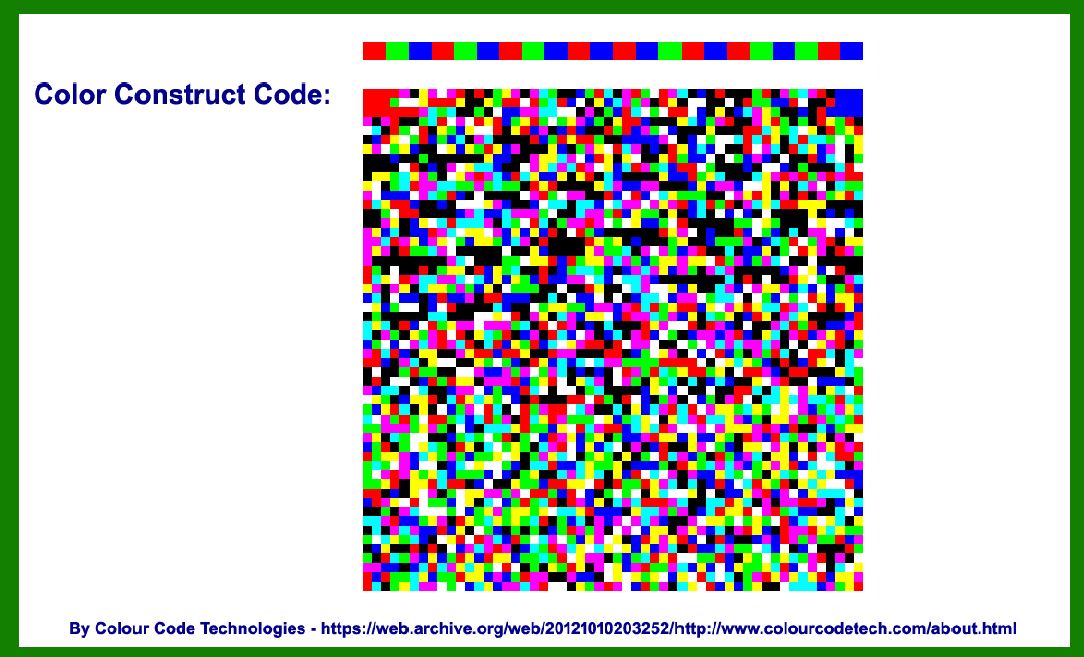
The Color Construct Code (CCC) developed by HP, also known as High Capacity Color Barcode (HCCB), is a unique barcode technology that utilizes color and geometric patterns to encode data. Unlike traditional 1D or 2D barcodes that primarily use black and white patterns, CCC/HCCB leverages a broader spectrum of colors and shapes to store information efficiently and securely. |
|
Encoding Mechanism of Color Construct Code (CCC) |
1.Color Palette and Encoding Logic: |
CCC uses a predefined color palette consisting of a set number of colors (typically 4 or 8) that are chosen for their distinctiveness and compatibility with printing technologies. Each color in the palette is assigned a specific binary value or combination of values, depending on the bit depth used for encoding. This assignment is crucial for the barcode reader to interpret the encoded data accurately. |
2.Geometric Pattern Design: |
CCC employs a grid-based design where data is encoded in cells or modules arranged in a grid format. Each cell can contain one or more color patches or geometric shapes that collectively encode a portion of the data. The geometric patterns (shapes such as squares, triangles, circles, etc.) within each cell are strategically placed to ensure reliable encoding and decoding. |
3.Error Correction and Data Redundancy: |
To enhance robustness against printing imperfections, environmental factors, and partial damage, CCC incorporates error correction techniques. These techniques typically involve adding redundant data elements or error correction codes (ECC) within the barcode. ECC ensures that even if parts of the barcode are obscured or damaged, the original data can still be reconstructed accurately during decoding. |

|
Example of Encoding Process |
Let's illustrate the encoding process with a hypothetical example: |
Example Data: |
Assume we want to encode the following alphanumeric string into a CCC/HCCB: ABC12345DEF |

|
Step-by-Step Encoding: |
1.Data Segmentation: |
Break down the alphanumeric string into manageable segments. In CCC, each segment may correspond to a specific part of the data structure (e.g., identifier, serial number, checksum). |
2.Color Assignment: |
Assign binary values to each character or segment of characters based on the predefined color palette. For example: A could be represented by Color 1 (binary: 00), B by Color 2 (binary: 01), C by Color 3 (binary: 10), 1 by Color 4 (binary: 11), and so on. |
3.Module Placement: |
Arrange modules or cells in a grid format. Each module contains a combination of colors and shapes representing encoded data. For instance, the segment ABC might be represented by a specific arrangement of colors and shapes in three adjacent modules within the barcode grid. |

|
4.Error Correction Coding: |
Introduce error correction codes (ECC) to improve data integrity. These codes are calculated based on the encoded data and inserted into designated modules within the barcode. The ECC allows the barcode reader to detect and correct errors up to a certain degree, ensuring reliable data retrieval even under adverse conditions. |
5.Final Barcode Generation: |
Combine all encoded segments, color assignments, geometric patterns, and error correction elements to generate the final CCC/HCCB barcode image. The resulting barcode is visually represented as a colorful patterned square or rectangle, suitable for printing on various media types including paper, labels, and packaging. |

|
Conclusion |
The Color Construct Code (CCC) or High Capacity Color Barcode (HCCB) developed by HP introduces a novel approach to barcode encoding using color and geometric patterns. By expanding beyond traditional monochromatic barcode technologies, CCC/HCCB offers enhanced data storage capacity, improved error correction capabilities, and robustness against environmental challenges. This encoding method not only supports high-density data storage but also ensures reliable data retrieval across diverse application scenarios, from consumer products to industrial logistics and beyond. |

|
 cs@easiersoft.com