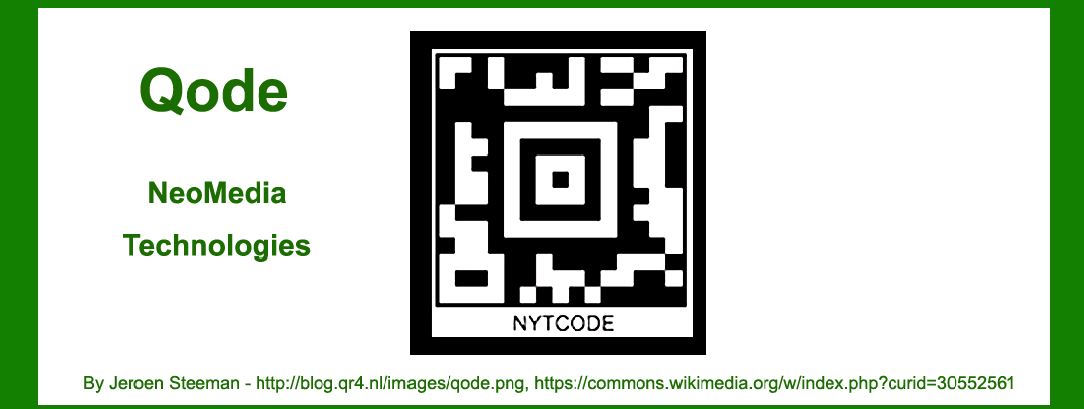
Encoding of the NeoMedia Qode involves a specific process that defines how information is represented within the barcode structure. NeoMedia Technologies developed Qode as a 2D barcode solution designed for various applications, including mobile marketing, advertising, and content delivery via camera phones. Understanding its encoding scheme involves exploring its format, data organization, and error correction mechanisms. |
|
Structure of NeoMedia Qode |
1.Basic Structure: NeoMedia Qode is a square matrix code, typically consisting of black and white modules arranged in a grid pattern. The code can vary in size, accommodating different amounts of data depending on the version and error correction level. |
2.Encoding Data: Qode encodes data in binary format, where each module (or dot) in the grid represents a binary value (0 for white, 1 for black). Data is organized into segments, including payload data, error correction codes, and possibly format information depending on the specific version. |
3.Error Correction: Qode incorporates error correction to enhance reliability. This is typically achieved using Reed-Solomon error correction codes, which allow the code to remain readable even if parts of it are damaged or obscured. Error correction ensures that the barcode can withstand certain levels of damage or distortion without losing the ability to be decoded accurately. |

|
Encoding Process |
1. Data Segmentation |
Qode organizes data into different segments, each serving a specific purpose: |
Payload Data: This segment contains the actual information intended to be conveyed by the barcode, such as a URL, text, or numeric data. Error Correction: Additional segments are allocated for error correction codes. These codes are generated based on the payload data and are appended to ensure data integrity. |
2. Binary Conversion |
Once segmented, the payload data undergoes binary conversion: |
Text and numeric characters are converted into their respective binary representations using predefined encoding tables. Binary data is then mapped onto the barcode grid, where each module's color (black or white) corresponds to a binary digit (1 or 0). |
3. Error Correction Encoding |
Error correction codes are computed based on the payload data: |
Reed-Solomon codes are generated using mathematical algorithms that produce redundant data bits. These bits are appended to the payload data, increasing the overall data size but improving the code's resilience to errors and damage. |
4. Formatting |
Qode includes formatting elements to ensure proper decoding: |
Start and stop patterns: These markers define the beginning and end of the barcode. Quiet zone: A clear space surrounding the barcode to prevent interference from nearby graphics or text. |

|
Example of NeoMedia Qode Encoding |
Let's consider encoding a simple URL 'https://example.com': |
1.Binary Conversion: Convert the characters of the URL into their binary representations using an encoding scheme compatible with Qode. For instance, 'h' might be represented as 01101000 in ASCII binary. |
2.Segmentation: Divide the binary data into segments suitable for encoding within the Qode structure. Segments include the payload data and space allocated for error correction. |
3.Error Correction Encoding: Generate Reed-Solomon error correction codes based on the payload data segments. These codes are calculated to ensure that the barcode remains readable even if up to a certain percentage of the code is damaged. |
4.Mapping onto Barcode Grid: Map the binary data onto the Qode grid, where each module (dot) represents a binary digit. The arrangement of black and white modules reflects the encoded data, including error correction information. |
5.Adding Formatting Elements: Include start and stop patterns to delineate the barcode boundaries. Ensure a quiet zone around the barcode to prevent misreads caused by adjacent graphics or text. |

|
Conclusion |
NeoMedia Qode's encoding process involves converting data into binary form, segmenting it for error correction, and mapping it onto a grid of black and white modules. This structured approach ensures data reliability and readability, making Qode suitable for applications requiring robust data encoding and decoding capabilities, especially in mobile marketing and content delivery contexts. |

|
 cs@easiersoft.com