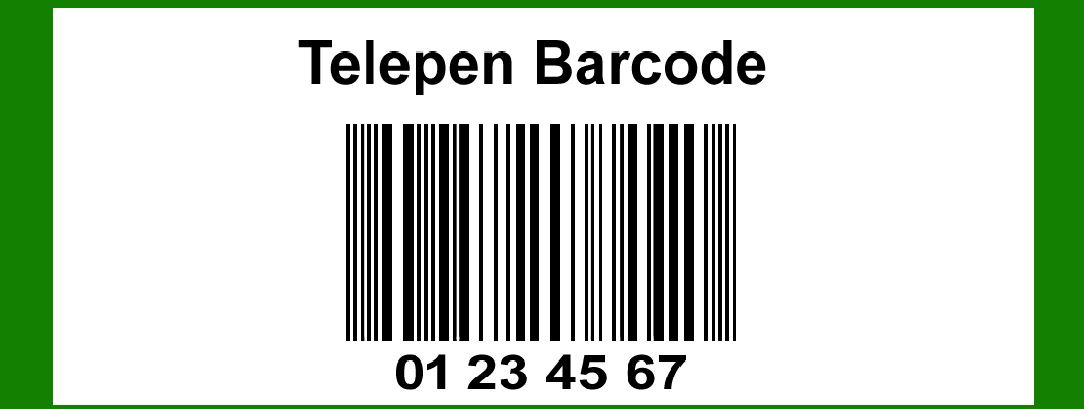
The Telepen barcode, primarily used in libraries and other applications where compact data encoding and high reliability are essential, has a distinct encoding structure. Here's a detailed description of how Telepen barcodes are encoded: |
|
Telepen Barcode Encoding Structure |
1. Character Set and Data Capacity |
Telepen barcodes utilize a unique character set optimized for encoding alphanumeric and numeric data. It supports: |
Alphanumeric characters: A-Z, 0-9, and special characters (e.g., space, punctuation). Numeric digits: 0-9. |
This character set allows Telepen barcodes to encode a wide range of data types efficiently. |

|
2. Barcode Structure |
The Telepen barcode is designed to be compact yet robust. It consists of the following components: |
Start Character: Marks the beginning of the barcode. It signals the scanner to start reading data. Data Characters: Encode the actual data using the Telepen encoding scheme. Check Character: Provides error detection to ensure data integrity. Stop Character: Marks the end of the barcode. It signals the scanner that the data transmission is complete. |

|
3. Encoding Method |
Telepen barcodes employ a unique encoding method that efficiently packs data while maintaining readability and error resilience: |
Variable-Length Encoding: Telepen barcodes can vary in length depending on the amount of data to encode. This flexibility is crucial for applications requiring different data capacities. Character Mapping: Each alphanumeric and numeric character is mapped to a corresponding set of bars and spaces. This mapping ensures that each character is encoded consistently and can be decoded accurately by a barcode scanner. |

|
4. Example of Encoding Process |
Let's encode the phrase 'TELEPEN123' using Telepen barcode encoding: |
Character Conversion: Each character is converted into its Telepen barcode equivalent based on the established mapping rules. |
T: Encoded as a specific sequence of bars and spaces. E: Another sequence different from T. L: Encoded similarly to T but distinguishable. E: Similar to the previous E. P: Encoded uniquely. E: As before. N: Encoded differently. 1: Numeric characters are encoded with a different set of rules. 2: Similar to 1 but with variations. 3: Another numeric character with its own encoding sequence. |
Concatenation: These encoded sequences are concatenated together to form a continuous barcode pattern. Start and Stop Characters: The barcode begins with a specific start character and ends with a stop character, ensuring clear demarcation for barcode scanners. Check Character Calculation: A check character is computed based on the encoded data to detect and correct errors during scanning. |

|
5. Error Correction and Detection |
Check Character: Typically computed using a modulo algorithm or a similar checksum method, the check character helps verify the integrity of the decoded data. If errors are detected, the barcode scanner can request a re-read or alert the user to take corrective action. |

|
6. Usage Examples |
Library Systems: Telepen barcodes are widely used in libraries for cataloging books and other media. Each item's unique identifier (e.g., ISBN or library-specific code) is encoded into a Telepen barcode for efficient tracking and management. Inventory Management: In retail and manufacturing, Telepen barcodes are utilized to encode product information, such as serial numbers, batch numbers, and manufacturing dates. This enables accurate inventory tracking and supply chain management. |

|
7. Advantages of Telepen Barcodes |
Compact Size: Telepen barcodes can encode significant amounts of data in a relatively small space, making them suitable for items with limited surface area. Error Resilience: The use of check characters enhances reliability by detecting and correcting scanning errors. Versatility: Telepen barcodes support both alphanumeric and numeric data, offering flexibility for various application needs. |

|
Conclusion |
The encoding of Telepen barcodes involves converting alphanumeric and numeric data into a structured sequence of bars and spaces. Each character has a unique encoding pattern, and error detection mechanisms ensure data integrity. This encoding method supports efficient data storage and retrieval across a wide range of applications, making Telepen barcodes a preferred choice in libraries, inventory management, and other sectors requiring robust data encoding and scanning capabilities. |
 cs@easiersoft.com