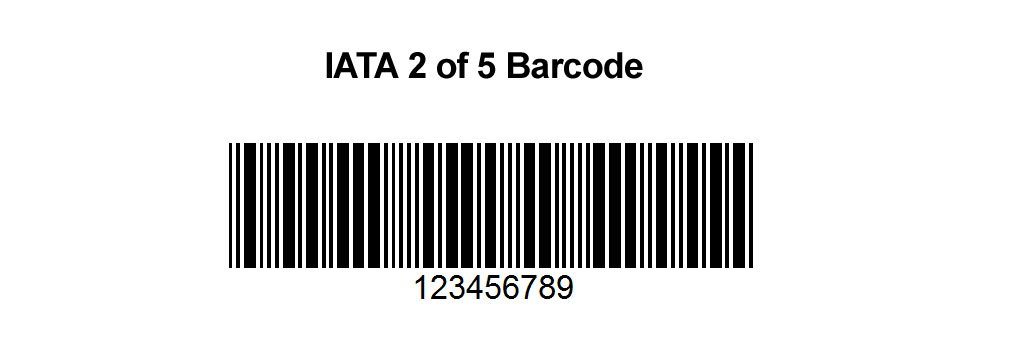
The IATA 2 of 5 barcode, also known as International Air Transport Association 2 of 5 barcode, is a specific variant of the Industrial 2 of 5 barcode format tailored for use in the air transport industry. This barcode system is designed to efficiently encode and decode data related to air cargo and other logistical applications. To delve into its technology in detail, we'll explore its structure, encoding process, applications, advantages, and considerations. |
|
Structure and Encoding |
Barcode Format |
The IATA 2 of 5 barcode is a continuous, self-checking barcode format that consists of bars and spaces representing numeric data. Unlike other barcode types that may vary in length, the IATA 2 of 5 barcode has a fixed length of 17 digits. These 17 digits include 16 valuable package identification digits and a 17th check digit for error detection. |
Character Set |
The barcode encodes numeric data using a set of two widths of bars and spaces. It typically uses five elements (two wide bars and three narrow spaces), hence the name '2 of 5,' indicating that each character is composed of a pattern of these elements. |
Encoding Methodology |
Each digit in the barcode is represented by a specific pattern of bars and spaces. The encoding process involves translating each digit of the data into its corresponding barcode pattern. The patterns are designed to be easily readable and interpretable by barcode scanning devices commonly used in logistics and air transport operations. |

|
Applications |
Logistics and Air Transport |
The primary application of the IATA 2 of 5 barcode is in the air transport and logistics sectors. It is used extensively for tracking and managing packages, cargo, and other items within the air transport network. Airlines, freight forwarders, and logistics companies rely on this barcode format to ensure efficient handling and tracking of shipments across the globe. |
Package Identification |
Each barcode encodes essential package identification information, such as shipment numbers, destination codes, sender information, and other logistical data critical for accurate and timely delivery. This information is vital for tracking shipments throughout their journey from origin to destination. |
Error Detection |
The inclusion of a check digit in the barcode format enhances its reliability by enabling error detection. The check digit is calculated based on a specific algorithm applied to the preceding 16 digits. This allows scanning devices to verify the integrity of the data read from the barcode and detect any discrepancies that may arise during scanning or transmission. |

|
Advantages |
Compactness and Efficiency |
The IATA 2 of 5 barcode format is known for its compact size and efficient use of space. It can encode a significant amount of numeric data within a relatively small area, making it suitable for use on various packaging materials, documents, and labels associated with air cargo and logistics. |
Readability |
The barcode's straightforward structure consisting of bars and spaces ensures high readability with minimal errors. Barcode scanning devices equipped with appropriate technology can quickly and accurately decode the encoded data, facilitating rapid data entry and processing in logistics operations. |
Industry Standard |
As a standardized barcode format endorsed by the International Air Transport Association (IATA), the IATA 2 of 5 barcode enjoys widespread acceptance and implementation across the air transport industry. Its use as a standardized solution enhances interoperability and compatibility among different stakeholders involved in air cargo handling and logistics. |

|
Considerations |
Limited Data Capacity |
One limitation of the IATA 2 of 5 barcode is its restricted capacity to encode only numeric data. This limitation restricts its applicability primarily to applications where numeric identification and tracking data suffice, such as in logistics and air transport. For applications requiring alphanumeric or extended data encoding, alternative barcode formats may be more suitable. |
Barcode Quality |
The quality of printed IATA 2 of 5 barcodes is crucial for ensuring accurate scanning and data capture. Factors such as print resolution, contrast between bars and spaces, and adherence to barcode printing standards influence the barcode's readability and performance. Proper barcode printing practices and quality assurance measures are essential to minimize scanning errors and ensure reliable data capture. |
Technology Evolution |
With advancements in barcode technology and logistics management systems, newer barcode formats and technologies have emerged offering enhanced capabilities, such as higher data capacity, support for alphanumeric characters, and improved readability. Organizations involved in logistics and air transport may consider evaluating newer barcode solutions that better align with evolving operational needs and technological advancements. |
|
Conclusion |
The IATA 2 of 5 barcode represents a specialized barcode format tailored for the unique requirements of the air transport and logistics sectors. Its fixed-length structure, numeric data encoding capability, and robust error detection mechanism make it well-suited for efficiently tracking and managing shipments within the air transport network. As a standardized solution endorsed by the International Air Transport Association, the IATA 2 of 5 barcode continues to play a pivotal role in facilitating secure, accurate, and efficient handling of air cargo and logistics operations worldwide. |
|
 cs@easiersoft.com