Barcode Technology

Barcode History

Barcode Label Paper

Barcode Printer

Barcode Application

Inventory Management

AI Barcode QRCode

Barcode Scanner

Barcode Software

Barcode Software B

Barcode Software C

Barcode Software D

Barcode Software E

New Technology A

New Technology B

Robot Technology

Barcode Types

Barcode Types B

Barcode Types C

Barcode Types D

Barcode Types E

Barcode Types F

Electronic Technology

Psychology at Work

Barcode Technology and Barcode Software Related   <<< Back to Directory <<<

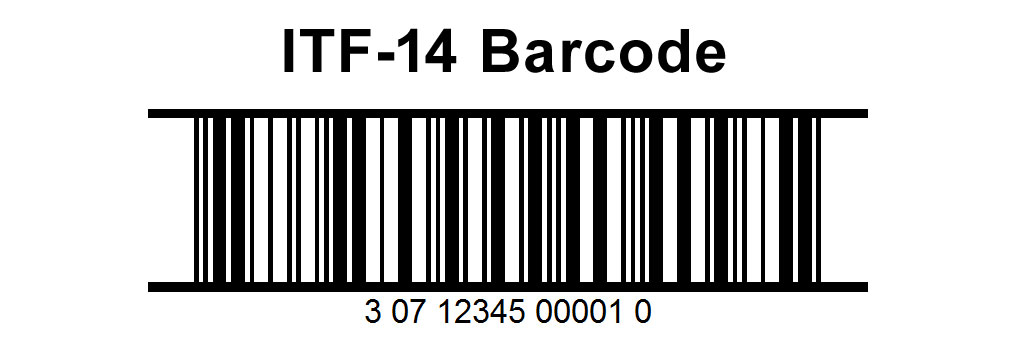
ITF-14 barcode

The ITF-14 barcode, also known as the Interleaved Two of Five (ITF) barcode, is a linear barcode widely used for labeling and tracking products in supply chain management.

It is an extension of the standard Interleaved 2 of 5 barcode, designed specifically for carton and pallet labeling in distribution and logistics applications. This comprehensive description will cover its technology, structure, encoding process, applications, advantages, limitations, and comparisons with other barcode types.

Overview of ITF-14 Barcode

Technology and Structure

The ITF-14 barcode belongs to the family of linear barcodes, which represent data in a series of parallel lines and spaces of varying widths. It uses the Interleaved 2 of 5 encoding scheme, where pairs of digits are represented by bars and spaces. Each pair encodes one digit, with each digit encoded by five bars and spaces (two bars and three spaces or vice versa).

Encoding Method: ITF-14 encodes numeric data only, typically a 13-digit Global Trade Item Number (GTIN-13) plus a check digit. The check digit ensures data accuracy by verifying the integrity of the barcode data.

Structure:

Start and stop characters frame the barcode to indicate the beginning and end of the data.

Quiet zones are clear spaces on either side of the barcode to prevent misreads caused by adjacent text or graphics.

The data itself consists of bars and spaces encoding the numeric digits of the GTIN-13.

Encoding Process

The encoding process for ITF-14 involves several key steps:

1.Data Preparation: Obtain the 13-digit GTIN-13, which uniquely identifies a trade item. Calculate and append the check digit to complete the 14-digit data sequence.

2.Start and Stop Characters: Add the start and stop characters to define the boundaries of the barcode.

3.Bar and Space Generation: Encode each digit pair using bars and spaces according to the Interleaved 2 of 5 encoding rules. Each digit pair is represented by a unique pattern of bars and spaces.

4.Quiet Zones: Ensure that clear margins are maintained on either side of the barcode to prevent interference from adjacent text or graphics.

5.Verification: Validate the encoded barcode to ensure compliance with ITF-14 specifications and readability by scanning devices.

Applications

ITF-14 barcodes are predominantly used for:

Carton Labeling: They are applied to shipping cartons to identify and track bulk shipments within supply chains.

Pallet Labeling: Used on pallets to facilitate efficient warehouse management and inventory tracking.

Retail and Distribution: Enables retailers and distributors to manage inventory, automate stock replenishment, and track shipments throughout the distribution process.

Advantages

High Density: ITF-14 barcodes can encode a significant amount of data in a compact space, making them suitable for packaging applications where space is limited.

Readability: They are easily readable by scanners, ensuring fast and accurate data capture in logistics and retail environments.

Compatibility: Widely accepted across global supply chains and retail markets, ensuring interoperability between different systems and organizations.

Limitations

Numeric Data Only: ITF-14 barcodes can only encode numeric digits, limiting their use compared to 2D barcodes that can encode alphanumeric and binary data.

Space Requirement: Requires adequate space for printing due to its linear format and quiet zone requirements.

Comparison with Other Barcode Types

Code 128: Offers higher data density and can encode alphanumeric characters, making it more versatile for variable data types.

GS1-128: Extends the Code 128 symbology to include additional information such as batch numbers, expiry dates, and serial numbers within a single barcode.

QR Code: A 2D barcode that can store significantly more data and can encode not only numeric and alphanumeric characters but also binary data such as images and URLs.

Conclusion

The ITF-14 barcode is a crucial tool in supply chain management, providing reliable identification and tracking capabilities for bulk shipments and pallets. Its simplicity, high data density, and widespread acceptance make it indispensable in industries requiring efficient logistics and inventory management. While it primarily handles numeric data and requires adequate space for printing, its role in ensuring accurate product identification and traceability underscores its importance in modern commerce.

By leveraging the Interleaved 2 of 5 encoding scheme and adhering to global standards, ITF-14 barcodes continue to play a vital role in enhancing operational efficiency and supply chain visibility across various sectors worldwide.


EasierSoft Barcode Label Design & Bulk Printing Software

---- Use Excel Data to Batch Print Barcodes on Label Sheets or Roll Labels  

---- How to use this barcode software

Download:  Free Barcode Software + Barcode Label Designer

Download Free Barcode Software at Softonic

     Download at CNET

Once you obtain a GS1/UPC/EAN barcode, or other barcode type and QR code, you can use our free software to batch print barcode labels onto Roll label paper using a professional label printer, or to batch print barcodes onto Avery 5160 label sheets using a regular laser or inkjet printer. Our software has free and paid versions.

The free version fully meets your needs for batch printing GS1/UPC/EAN barcodes. The paid version can import data from Excel and databases to batch print barcode labels with different values.

How to Start

Input Data

Import Excel Data

Print Barcode

Barcode Format

Label Designer

All Screen Shot

Export Barcode Image

Save Template

Output Word Excel

How to Use & FAQ:

Print bulk barcodes quickly

Print barcodes to Avery 5160 label

How to bulk Barcode Printing

Sample - Avery 5162 (2x7) Label Sheet

Example: Print barcodes to 5*3cm roll

Example: Print barcodes to 5161 label

Example: Print barcodes to 5162 label

Example: Print barcodes to 5163 label

Example: Print barcodes to 5164 label

Example: Print portrait orientation 5164

Example: Print barcodes to 5167 label

Example: Print barcodes to 5168 label

Example: Print portrait orientation 5168

Example: Print barcodes to 5169 label

Example: Print barcodes to 5660 label

Example: Print barcodes to 5661 label

Example: Print barcodes to 5662 label

Example: Print barcodes to 5663 label

Example: Print barcodes to 5664 label

Example: Print portrait orientation 5664

Example: Print barcodes to 5873 label

Example: Print barcodes to 5874 label

Two ways to import Excel data

Import Excel Data - Pro Edition

Import Excel Data - Std Edition

Import Data from Excel - Detail

Load Data From Excel File

Data Editing Table

Copy Data From Excel

Four ways to input barcode data

Add ASCII Key E

Input Multiple Lines of Text for Barcodes

Generates Sequential Serial Numbers

Import or copy data from Excel sheets

Special sequence number generation

Std Details: Simple Input Form

Std Details: Multiple Line Text Input

Details: Sequence Barcode Generator

Examples: Sequence Barcode Generator

Import Data From Excel Spreadsheet

Barcode Data Correspondence Diagram

Data Editor

Editing a Single Row Data in Form

Batch Editing Multiple Rows of Data

Batch Data Editing - Example 2

Design & print complex barcode labels

Configuring Text Elements on Label

Configuring Barcode Elements on Label

Configuring Image Elements on Label

Setting Line Elements on Label

Highlights

Excel integration: Import data directly from Excel to generate and print barcodes in bulk.

Label designer: Create complex labels with multiple barcodes, text, logos, and shapes.

Batch printing: Print thousands of barcodes at once using standard inkjet/laser printers or professional barcode printers.


Flexible editions:

Standard Edition: Simple batch printing with Excel data.

Professional Edition: Adds command-line automation for workflow integration.

Label Designer Edition: Advanced design features for complex labels.


Why Choose Our Barcode Solutions?

Cost-effective: Free online generator and permanent free desktop version available.

Easy to use: No technical expertise required—just input data and print.

Versatile: Supports nearly all 1D and 2D barcode types, including QR codes.

Trusted: Recommended by CNET and widely downloaded by users worldwide.


Suitable Use Cases

Small businesses and startups needing quick barcode labels for products.

Retailers and online sellers managing inventory with batch barcode printing.

Manufacturers requiring sequential or custom barcode labels for packaging.

Educational and testing environments where barcodes are used for tracking.


CONTACT

cs@easiersoft.com

If you have any question, please feel free to email us.


https://free-barcode.com


<<< Back to Directory <<<     Barcode Generator     Barcode Freeware     Privacy Policy