Barcode Technology

Barcode History

Barcode Label Paper

Barcode Printer

Barcode Application

Inventory Management

AI Barcode QRCode

Barcode Scanner

Barcode Software

Barcode Software B

Barcode Software C

Barcode Software D

Barcode Software E

New Technology A

New Technology B

Robot Technology

Barcode Types

Barcode Types B

Barcode Types C

Barcode Types D

Barcode Types E

Barcode Types F

Electronic Technology

Psychology at Work

Barcode Technology and Barcode Software Related   <<< Back to Directory <<<

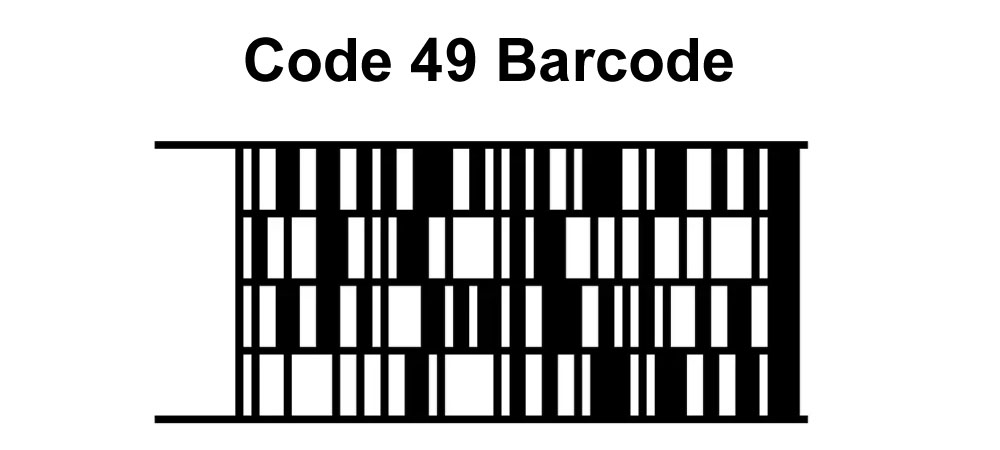
Encoding of the Code 49 barcode

Encoding of the Code 49 barcode involves a sophisticated method of data representation designed to efficiently encode alphanumeric and numeric data. This barcode type, developed by Intermec in 1987, was intended to provide a high-density, high-capacity solution suitable for industrial applications. It utilizes a two-dimensional stacked format, which means it can store significantly more data in a smaller space compared to traditional linear barcodes. In this detailed exploration, we'll delve into the specifics of how Code 49 encodes data, examining its structure, character sets, encoding process, and practical examples.

Structure of Code 49 Barcode

Code 49 is structured in a stacked format, where multiple rows of data are stacked on top of each other to form the complete barcode. It consists of:

1.Start Code: A special pattern that indicates the beginning of the barcode.

2.Rows: Each row contains a segment of encoded data.

3.Check Characters: Used for error detection and correction.

4.Stop Code: Indicates the end of the barcode.

Character Set and Data Encoding

Code 49 supports multiple character sets, allowing it to encode both alphanumeric and numeric data. The character sets typically include:

Alphanumeric: Letters (A-Z, both uppercase and lowercase) and digits (0-9).

Numeric: Digits (0-9) only.

Encoding Process

The encoding process for Code 49 involves several key steps:

1.Data Input: Convert the data (alphanumeric or numeric) that needs to be encoded into a string format.

2.Data Compression: Code 49 uses a compression algorithm to optimize the amount of data that can be stored in a barcode. This involves converting groups of characters into a more compact representation.

3.Error Correction: Code 49 incorporates error detection and correction mechanisms. It uses check characters to ensure data integrity, allowing the barcode to withstand minor damage or printing imperfections.

4.Binary Conversion: Convert the compressed data into a binary format that can be represented as black and white bars in the barcode.

5.Row Stacking: Arrange the binary data into multiple rows, stacking them vertically to form the complete barcode.

6.Quiet Zones: Add quiet zones (blank spaces) around the barcode to ensure accurate scanning and decoding.

Example of Encoding

Let's walk through an example of encoding the text 'CODE49' into a Code 49 barcode:

1.Data Input: 'CODE49'

2.Data Compression: Depending on the compression algorithm used by the specific implementation of Code 49, the data might be optimized to reduce redundancy and increase encoding efficiency.

3.Error Correction: Calculate and append error correction check characters to ensure robustness against errors during scanning.

4.Binary Conversion: Convert the processed data into a binary format. For instance, 'CODE49' might be represented as a series of binary digits.

5.Row Stacking: Organize the binary data into multiple rows. Each row contains a segment of the binary data, stacked vertically to form the complete barcode.

6.Quiet Zones: Add quiet zones around the barcode to prevent interference and ensure accurate scanning.

Advantages of Code 49 Encoding

High Density: Code 49 can store large amounts of data in a relatively small space, making it suitable for applications where space is limited but data capacity is crucial.

Error Correction: Incorporates error detection and correction mechanisms, enhancing reliability in data transmission.

Versatility: Supports both alphanumeric and numeric data, accommodating a wide range of applications.

Applications of Code 49 Barcode

Code 49 finds application in various industries, including:

Logistics and Inventory Management: Tracking and managing inventory efficiently.

Healthcare: Patient identification and medical record management.

Manufacturing: Product labeling and traceability.

Document Management: Efficient document tracking and archiving.

Conclusion

In conclusion, Code 49 is a versatile and efficient two-dimensional barcode that excels in encoding alphanumeric and numeric data. Its structured, stacked format allows for high data capacity in a compact space, supported by robust error detection and correction mechanisms. Understanding its encoding process provides insights into its application across diverse industries, where efficient data management and traceability are essential.

This detailed exploration of Code 49 encoding highlights its capabilities and practical implementation, showcasing its relevance in modern barcode technology.


EasierSoft Barcode Label Design & Bulk Printing Software

---- Use Excel Data to Batch Print Barcodes on Label Sheets or Roll Labels  

---- How to use this barcode software

Download:  Free Barcode Software + Barcode Label Designer

Download Free Barcode Software at Softonic

     Download at CNET

Once you obtain a GS1/UPC/EAN barcode, or other barcode type and QR code, you can use our free software to batch print barcode labels onto Roll label paper using a professional label printer, or to batch print barcodes onto Avery 5160 label sheets using a regular laser or inkjet printer. Our software has free and paid versions.

The free version fully meets your needs for batch printing GS1/UPC/EAN barcodes. The paid version can import data from Excel and databases to batch print barcode labels with different values.

How to Start

Input Data

Import Excel Data

Print Barcode

Barcode Format

Label Designer

All Screen Shot

Export Barcode Image

Save Template

Output Word Excel

How to Use & FAQ:

Export barcodes to Excel

Export barcodes to Word

Add ascii key to barcode

Auto calculate barcode size (Std)

Make barcode by command line

Export barcode image files

Barcode text font setting

Generate ISBN barcode

Predefined label templates

Printing setup

Save settings

Serial number generator

The supported barcode types

Load Excel data (pro)

Manually copy data from Excel files

Filter some data for printing

Edit imported barcode data

Input data (Pro)

Label Designer

Edit data in Label designer

Label Designer - Add new label

Label Designer - Printing

Set the barcode label format to be printed

Other Barcode Label Format Settings

Barcode types supported by this program

Barcode Label Font Settings

Configuring the Barcode Print Rotation

Text Alignment for Barcode Labels

Automatically Adjusting Barcode Width

Text Beneath the Barcode

Configuring Barcode Size

Auto Calculate the Barcode Size

Export Barcode images

Export Barcode Image Format

File Names for Exported Barcode

Resolution of Exported Barcode Images

Fixed Folder for Exporting Barcode

Default Barcode Image Export Format

Print bulk barcodes quickly

Print barcodes to Avery 5160 label

How to bulk Barcode Printing

Sample - Avery 5162 (2x7) Label Sheet

Example: Print barcodes to 5*3cm roll

Example: Print barcodes to 5161 label

Example: Print barcodes to 5162 label

Example: Print barcodes to 5163 label

Example: Print barcodes to 5164 label

Example: Print portrait orientation 5164

Example: Print barcodes to 5167 label

Example: Print barcodes to 5168 label

Highlights

Excel integration: Import data directly from Excel to generate and print barcodes in bulk.

Label designer: Create complex labels with multiple barcodes, text, logos, and shapes.

Batch printing: Print thousands of barcodes at once using standard inkjet/laser printers or professional barcode printers.


Flexible editions:

Standard Edition: Simple batch printing with Excel data.

Professional Edition: Adds command-line automation for workflow integration.

Label Designer Edition: Advanced design features for complex labels.


Why Choose Our Barcode Solutions?

Cost-effective: Free online generator and permanent free desktop version available.

Easy to use: No technical expertise required—just input data and print.

Versatile: Supports nearly all 1D and 2D barcode types, including QR codes.

Trusted: Recommended by CNET and widely downloaded by users worldwide.


Suitable Use Cases

Small businesses and startups needing quick barcode labels for products.

Retailers and online sellers managing inventory with batch barcode printing.

Manufacturers requiring sequential or custom barcode labels for packaging.

Educational and testing environments where barcodes are used for tracking.


CONTACT

cs@easiersoft.com

If you have any question, please feel free to email us.


https://free-barcode.com


<<< Back to Directory <<<     Barcode Generator     Barcode Freeware     Privacy Policy