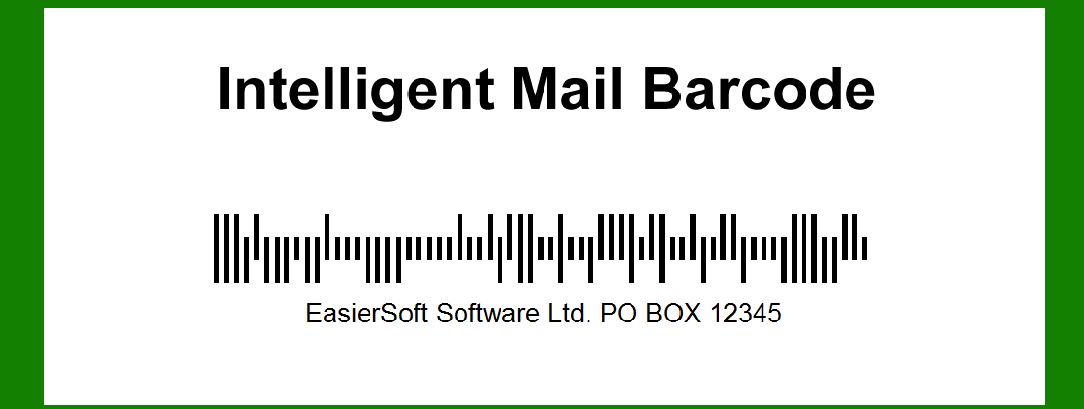
Encoding of the Intelligent Mail barcode (IMb) involves a structured approach to representing information in a format that is both machine-readable and efficient for postal sorting and tracking purposes. Developed by the United States Postal Service (USPS), the Intelligent Mail barcode combines multiple data elements into a single barcode, allowing for enhanced tracking, delivery point validation, and other postal services functionalities. Here, we will delve into the encoding process of the Intelligent Mail barcode, detailing its structure, components, and encoding rules. |
|
Structure of Intelligent Mail Barcode |
The Intelligent Mail barcode consists of four main components: |
1.Barcode Identifier (BI): Identifies the presort or automation level of the mailpiece. 2.Service Type Identifier (STID): Defines the class of mail and any additional services requested. 3.Mailer Identifier (MID): Identifies the mail owner or sender. 4.Serial Number (SN): Unique sequence number assigned by the mailer. |
These components are encoded using a combination of bars and spaces of varying widths, which are read by barcode scanners to interpret the encoded data. |

|
Encoding Rules |
1. Barcode Identifier (BI) |
The Barcode Identifier (BI) specifies the presort or automation level of the mailpiece. It consists of a 2-digit numeric code. Here are some examples: |
00: Non-automation rate category. 03: Basic automation rate category. 04: High density and saturation mail rate category. |
2. Service Type Identifier (STID) |
The Service Type Identifier (STID) indicates the class of mail and any additional services requested. It consists of a 3-digit numeric code. Examples include: |
001: First-Class Mail with a tracking barcode. 201: Standard Mail with a tracking barcode. 700: Periodicals with a tracking barcode. |
3. Mailer Identifier (MID) |
The Mailer Identifier (MID) uniquely identifies the mail owner or sender. It consists of a 6- or 9-digit numeric code assigned by the USPS to registered mailers. |
Example MID: 123456 (6-digit), 012345678 (9-digit) |
4. Serial Number (SN) |
The Serial Number (SN) is a unique sequence number assigned by the mailer. It can range from 1 to 8 digits depending on the mail volume and the mailer's system requirements. |
Example SN: 00012345 |

|
Encoding Examples |
Let's encode an example Intelligent Mail barcode step-by-step using the information provided: |
Example Information: |
Barcode Identifier (BI): 03 Service Type Identifier (STID): 201 Mailer Identifier (MID): 123456789 Serial Number (SN): 00012345 |

|
Step-by-Step Encoding Process: |
1.Start Sentinel: The barcode begins with a unique start pattern that scanners recognize to start decoding. It consists of two bars and two spaces. Example: 101 |
2.Barcode Identifier (BI): Encode the BI using bars and spaces. Each digit is represented by a combination of bars and spaces: 03 would be encoded as: 0110001 (for '0') and 1000110 (for '3') Encoded BI: 0110001 1000110 |
3.Service Type Identifier (STID): Encode the STID similarly to the BI, using bars and spaces: 201 would be encoded as: 1001110 (for '2'), 0100111 (for '0'), and 0111001 (for '1') Encoded STID: 1001110 0100111 0111001 |
4.Mailer Identifier (MID): Encode the MID using bars and spaces. For each digit in the MID, a unique combination of bars and spaces is used: 123456789 would be encoded based on the specific USPS encoding rules. Encoded MID: (Encoded representation based on USPS standards) |
5.Serial Number (SN): Encode the SN using bars and spaces. Similar to the MID, each digit in the SN has a specific encoding pattern. 00012345 would be encoded based on USPS standards. Encoded SN: (Encoded representation based on USPS standards) |
6.End Sentinel: The barcode ends with a unique end pattern that scanners recognize to stop decoding. It also consists of two bars and two spaces. Example: 1101 |

|
Conclusion |
The Intelligent Mail barcode encoding process is precise and follows USPS guidelines to ensure accurate scanning and tracking of mailpieces throughout the postal system. Each component-Barcode Identifier, Service Type Identifier, Mailer Identifier, and Serial Number-is encoded using specific patterns of bars and spaces. This structured approach facilitates efficient sorting, delivery, and tracking of mail, enhancing the overall efficiency of postal operations. |

|
 cs@easiersoft.com