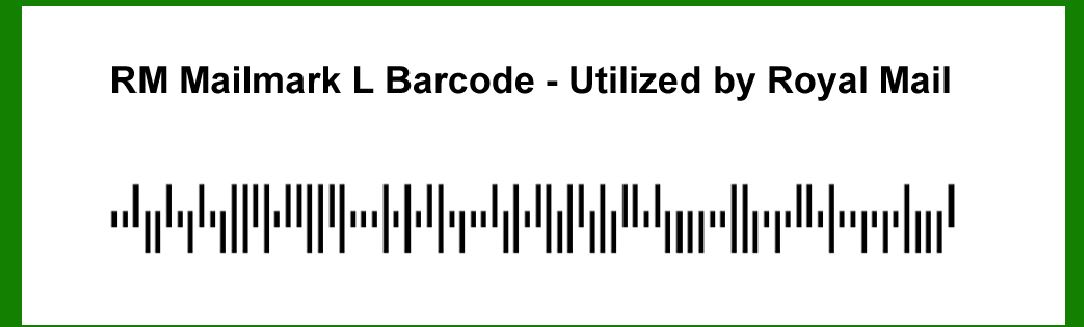
To encode the RM Mailmark L barcode, we need to delve into its structure, encoding rules, and how data is represented within it. The RM Mailmark L barcode is used by Royal Mail in the UK for efficient tracking and management of mail items. Here's a detailed description of its encoding process: |
|
Structure of RM Mailmark L Barcode |
The RM Mailmark L barcode belongs to the Mailmark family of barcodes used by Royal Mail. It is designed to encode essential information about a mail item in a compact form suitable for automated sorting and tracking. |
Components of RM Mailmark L Barcode |
1.Barcode Format: The RM Mailmark L barcode is a type of 2D barcode, specifically designed for use on large letters and parcels. |
2.Data Elements: It encodes various data elements that are crucial for mail processing and tracking. These elements typically include: Destination postcode Delivery point identifier Mail class Return address information Unique identifier for the mail item |
3.Error Correction: Like most 2D barcodes, RM Mailmark L includes error correction mechanisms to ensure data integrity even if the barcode is partially damaged or obscured. |

|
Encoding Details |
1. Data Encoding |
The encoding process involves converting the relevant information into a format that the barcode can represent. Here's a breakdown of how different types of data are encoded: |
Numeric Data: Numerical data such as postcodes, identifiers, and counts are straightforwardly encoded in binary or decimal formats depending on the specifics of the barcode standard used by RM Mailmark L. Alphanumeric Data: This includes text data such as addresses and names. Each character is typically represented by a binary sequence according to an agreed-upon character set, often using ASCII or UTF-8 encoding for broader character support. Special Characters: Some data elements might require encoding of special characters or symbols. These are mapped to specific binary sequences within the barcode's encoding table. |
2. Binary Representation |
RM Mailmark L, being a 2D barcode, encodes data in a matrix of black and white modules (dots or squares). Each module represents a bit of data, with the entire barcode consisting of a grid of these modules. |
Module Size: The size of each module (dot or square) is standardized to ensure readability across different scanning devices and distances. Quiet Zone: A clear area surrounding the barcode, known as the quiet zone, ensures that no other marks or printing interfere with the barcode's scanning and decoding. |
3. Error Correction Encoding |
To enhance reliability, RM Mailmark L employs error correction techniques such as Reed-Solomon codes. These codes add redundant information to the barcode, allowing the barcode scanner to reconstruct the original data even if parts of the barcode are damaged or missing. |
Error Correction Levels: Different error correction levels may be used depending on the application and the required robustness against errors. |

|
Example of RM Mailmark L Encoding |
Let's consider an example where a mail item needs to be encoded with RM Mailmark L: |
1.Data Elements: Destination postcode: EC1A1BB Delivery point identifier: 12345 Mail class: First Class Return address: John Doe, 123 Main St, London, UK Unique identifier: 987654321 |
2.Encoding Process: Convert each data element into its binary representation according to the RM Mailmark L encoding rules. Apply error correction coding to ensure robustness against errors and damage. |
3.Generate Barcode: Arrange the binary data into the matrix of black and white modules. Add quiet zones around the barcode to ensure proper scanning. |
4.Final Barcode: The completed RM Mailmark L barcode will visually appear as a grid of black and white squares or dots, representing the encoded data. |

|
Conclusion |
The encoding of RM Mailmark L barcode involves converting essential mail item data into a binary format that can be efficiently scanned and decoded by automated systems. It utilizes error correction techniques to ensure data integrity and reliability during the mail processing and delivery process. This structured approach to encoding ensures that Royal Mail can effectively track and manage large volumes of mail items with minimal errors and maximum efficiency. |

|
 cs@easiersoft.com