Barcode Technology

Barcode History

Barcode Label Paper

Barcode Printer

Barcode Application

Inventory Management

AI Barcode QRCode

Barcode Scanner

Barcode Software

Barcode Software B

Barcode Software C

Barcode Software D

Barcode Software E

New Technology A

New Technology B

Robot Technology

Barcode Types

Barcode Types B

Barcode Types C

Barcode Types D

Barcode Types E

Barcode Types F

Electronic Technology

Psychology at Work

Barcode Technology and Barcode Software Related   <<< Back to Directory <<<

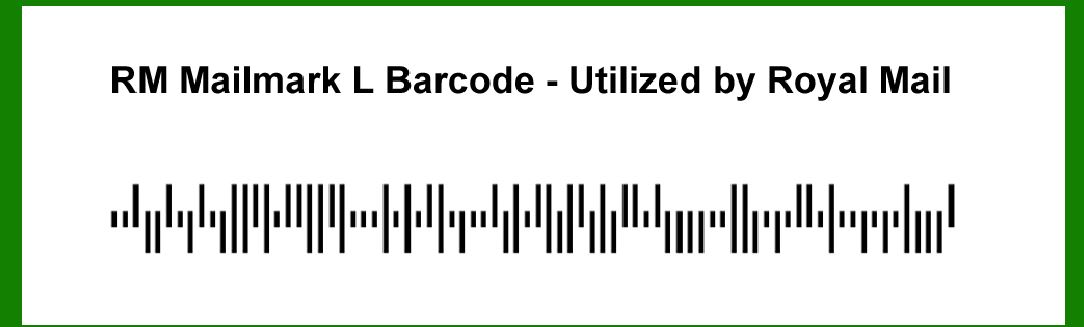
Structures of RM Mailmark L barcode

The RM Mailmark L barcode, also known as the Royal Mail Mailmark Large Letter barcode, is a specific type of barcode used by Royal Mail in the United Kingdom for the efficient tracking and processing of large letters and parcels. This barcode is part of the Mailmark service, which provides enhanced visibility and tracking capabilities compared to traditional barcodes.

Components of RM Mailmark L Barcode

The RM Mailmark L barcode consists of several key components, each serving a specific role in encoding and conveying information about the item it is attached to:

1.Barcode Format: The RM Mailmark L barcode adheres to the specifications set by Royal Mail, ensuring compatibility with their sorting and tracking systems.

2.Data Payload: The barcode contains essential data elements that encode information such as sender details, recipient details, postal service level, and tracking identifiers. This information is crucial for accurate sorting and delivery of the mail item.

3.Checksum: To ensure data integrity and accuracy during scanning and processing, the RM Mailmark L barcode includes a checksum. This checksum helps detect errors or discrepancies in the barcode data, reducing the likelihood of misrouted or lost items.

4.Human-Readable Information: Alongside the barcode itself, human-readable information is typically printed. This includes details such as the barcode identifier, postal service details, and sometimes additional information for manual handling or verification purposes.

Structures of RM Mailmark L Barcode

The structure of the RM Mailmark L barcode is designed to optimize scanning efficiency and data readability, both by automated sorting equipment and by human operators when necessary. Here's a detailed breakdown of its structure:

1.Barcode Layout: The RM Mailmark L barcode is typically a two-dimensional (2D) barcode, meaning it encodes data in both horizontal and vertical dimensions. This allows it to store more information than traditional linear barcodes.

2.Quiet Zone: Like all barcodes, the RM Mailmark L barcode includes a quiet zone around its edges. This zone is free of any printing or markings and serves to ensure that the barcode scanner can properly distinguish the barcode from its surroundings. The quiet zone is an essential component for reliable scanning.

3.Data Regions: Within the barcode, specific areas are designated for encoding different types of data. These regions may include sections for sender information (such as postal code and address), recipient details (address and delivery preferences), tracking numbers, and service level indicators. Each section is organized to allow for efficient retrieval and decoding of information during scanning.

4.Encoding Method: The RM Mailmark L barcode typically uses encoding methods optimized for the data it needs to convey. This might include various encoding schemes to represent alphanumeric characters, numeric data, and special characters within a compact format suitable for barcode scanning.

5.Error Correction: To enhance reliability, the RM Mailmark L barcode may incorporate error correction techniques. These techniques allow the barcode to withstand minor damage or distortion, ensuring that critical data remains accessible even under less-than-ideal scanning conditions.

6.Scanning and Interpretation: Barcode scanners used by Royal Mail and other postal operators are designed to interpret the RM Mailmark L barcode accurately. They decode the encoded information, verify the checksum for data integrity, and route the item accordingly based on the information retrieved.

Example of RM Mailmark L Barcode Structure

Here is a simplified example illustrating how the components and structure of an RM Mailmark L barcode might appear:

Barcode Format: 2D Matrix Code

Data Payload: Encodes sender details (name, postal code), recipient details (name, address), service level (priority, standard), tracking ID

Checksum: Ensures data integrity

Human-Readable Information: Printed below or alongside the barcode for manual verification

[Quiet Zone]

[Barcode Data Regions]

[Checksum]

[Human-Readable Information]

In this example, the barcode data regions would contain the encoded sender and recipient information, service level details, and a tracking identifier. The checksum helps ensure that the encoded data is accurate and complete. Human-readable information provides a visual reference for the encoded data, aiding in manual verification if needed.

Conclusion

The RM Mailmark L barcode is a critical tool in modern postal operations, enabling efficient tracking, sorting, and delivery of large letters and parcels within the Royal Mail network. Its structured design and encoding methods ensure reliable data capture and processing, contributing to improved service reliability and customer satisfaction. Understanding its components and structure is essential for stakeholders involved in postal logistics and barcode technology.


EasierSoft Barcode Label Design & Bulk Printing Software

---- Use Excel Data to Batch Print Barcodes on Label Sheets or Roll Labels  

---- How to use this barcode software

Download:  Free Barcode Software + Barcode Label Designer

Download Free Barcode Software at Softonic

     Download at CNET

Once you obtain a GS1/UPC/EAN barcode, or other barcode type and QR code, you can use our free software to batch print barcode labels onto Roll label paper using a professional label printer, or to batch print barcodes onto Avery 5160 label sheets using a regular laser or inkjet printer. Our software has free and paid versions.

The free version fully meets your needs for batch printing GS1/UPC/EAN barcodes. The paid version can import data from Excel and databases to batch print barcode labels with different values.

How to Start

Input Data

Import Excel Data

Print Barcode

Barcode Format

Label Designer

All Screen Shot

Export Barcode Image

Save Template

Output Word Excel

How to Use & FAQ:

Print barcodes to Avery 5160 label

How to bulk Barcode Printing

Sample - Avery 5162 (2x7) Label Sheet

Example: Print barcodes to 5*3cm roll

Example: Print barcodes to 5161 label

Example: Print barcodes to 5162 label

Example: Print barcodes to 5163 label

Example: Print barcodes to 5164 label

Example: Print portrait orientation 5164

Example: Print barcodes to 5167 label

Example: Print barcodes to 5168 label

Example: Print portrait orientation 5168

Example: Print barcodes to 5169 label

Example: Print barcodes to 5660 label

Example: Print barcodes to 5661 label

Example: Print barcodes to 5662 label

Example: Print barcodes to 5663 label

Example: Print barcodes to 5664 label

Example: Print portrait orientation 5664

Example: Print barcodes to 5873 label

Example: Print barcodes to 5874 label

Two ways to import Excel data

Import Excel Data - Pro Edition

Import Excel Data - Std Edition

Import Data from Excel - Detail

Load Data From Excel File

Data Editing Table

Copy Data From Excel

Four ways to input barcode data

Add ASCII Key E

Input Multiple Lines of Text for Barcodes

Generates Sequential Serial Numbers

Import or copy data from Excel sheets

Special sequence number generation

Std Details: Simple Input Form

Std Details: Multiple Line Text Input

Details: Sequence Barcode Generator

Examples: Sequence Barcode Generator

Import Data From Excel Spreadsheet

Barcode Data Correspondence Diagram

Data Editor

Editing a Single Row Data in Form

Batch Editing Multiple Rows of Data

Batch Data Editing - Example 2

Design & print complex barcode labels

Configuring Text Elements on Label

Configuring Barcode Elements on Label

Configuring Image Elements on Label

Setting Line Elements on Label

Designing Labels for 5164 Sheet

Highlights

Excel integration: Import data directly from Excel to generate and print barcodes in bulk.

Label designer: Create complex labels with multiple barcodes, text, logos, and shapes.

Batch printing: Print thousands of barcodes at once using standard inkjet/laser printers or professional barcode printers.


Flexible editions:

Standard Edition: Simple batch printing with Excel data.

Professional Edition: Adds command-line automation for workflow integration.

Label Designer Edition: Advanced design features for complex labels.


Why Choose Our Barcode Solutions?

Cost-effective: Free online generator and permanent free desktop version available.

Easy to use: No technical expertise required—just input data and print.

Versatile: Supports nearly all 1D and 2D barcode types, including QR codes.

Trusted: Recommended by CNET and widely downloaded by users worldwide.


Suitable Use Cases

Small businesses and startups needing quick barcode labels for products.

Retailers and online sellers managing inventory with batch barcode printing.

Manufacturers requiring sequential or custom barcode labels for packaging.

Educational and testing environments where barcodes are used for tracking.


CONTACT

cs@easiersoft.com

If you have any question, please feel free to email us.


https://free-barcode.com


<<< Back to Directory <<<     Barcode Generator     Barcode Freeware     Privacy Policy