Code 128 Barcodes: A Technical Deep Dive and Industry-Wide Integration with ERP Systems |
Chapter 45: Oracle WMS Cloud - Wave Execution |
Brief Summary: This chapter explores the technical intricacies of Code 128 barcodes and their critical role in modern warehouse operations, specifically focusing on wave execution within Oracle Warehouse Management Cloud. When a wave is released, pickers scan Code 128 location tags, triggering near-instantaneous updates to inventory on-hand and the generation of outbound load IDs within Oracle systems. Through a series of real-world U.S. application examples, we will examine how this technology streamlines complex fulfillment processes, reduces errors, and provides the real-time data visibility essential for supply chain efficiency. The integration of Code 128 barcodes with ERP systems like Oracle WMS Cloud represents a fundamental shift from manual, error-prone data entry to automated, precise, and auditable digital workflows. |

|
1. Introduction: The Digital Backbone of the Modern Warehouse |
In the high-stakes environment of modern logistics, speed and accuracy are not merely goals; they are prerequisites for survival. A single misplaced item or a delayed shipment can cascade into significant financial losses, damaged customer relationships, and a tarnished brand reputation. This is where the seemingly humble barcode becomes a hero. While they are often invisible to the consumer, barcodes form the digital backbone of the supply chain, enabling the automation and precision that modern commerce demands. |
Among the various barcode symbologies, Code 128 stands out as a robust, high-density symbology capable of encoding a large amount of data in a relatively small space . Its versatility and widespread adoption make it a cornerstone technology for warehouse management systems (WMS) and enterprise resource planning (ERP) platforms. This chapter delves into the technical underpinnings of Code 128 and its seamless integration with Oracle WMS Cloud, using the pivotal process of 'wave execution' as our primary lens. |
In a typical warehouse, 'wave picking' is a method where orders are grouped and released in waves, or batches, to maximize efficiency . When a wave is released in Oracle WMS Cloud, pickers are directed to specific locations, where they scan Code 128 barcodes to confirm their actions. This simple act of scanning triggers a complex cascade of digital events, updating inventory, generating shipping documents, and ensuring that the entire supply chain ecosystem remains synchronized. This chapter will illuminate how this process unfolds in real-time, underscoring the profound impact of Code 128 technology on operational efficiency. |

|
2. Understanding Code 128: More Than Just Black and White Stripes |
Before diving into the specifics of wave execution, it is essential to understand the technical capabilities that make Code 128 the symbology of choice for many logistics applications. |
2.1. The Technical Superiority of Code 128 |
Code 128 is a high-density linear barcode symbology. Its primary advantage lies in its ability to encode all 128 characters of the ASCII character set (including uppercase and lowercase letters, numbers, and special characters). This makes it far more versatile than older symbologies like Code 39, which is limited to uppercase letters and numbers. Furthermore, Code 128 is self-checking, which means it includes internal algorithms to detect and prevent scanning errors. |
The symbology achieves its high density by employing three different start codes (A, B, and C) that allow it to switch between different character sets within a single barcode. For example, Code 128C can encode numeric data with double density, making it exceptionally efficient for applications that require long strings of numbers, such as serial container codes (SSCC). This flexibility and efficiency are why Code 128 is a preferred standard for the GS1-128 standard, which is widely used in supply chain applications to encode information like GTINs (Global Trade Item Numbers), lot numbers, and expiry dates . |
2.2. Code 128 in the Warehouse Environment |
Within a warehouse environment, Code 128 is used to label virtually every physical entity. It is the common language that bridges the physical world of goods with the digital world of the ERP system. |
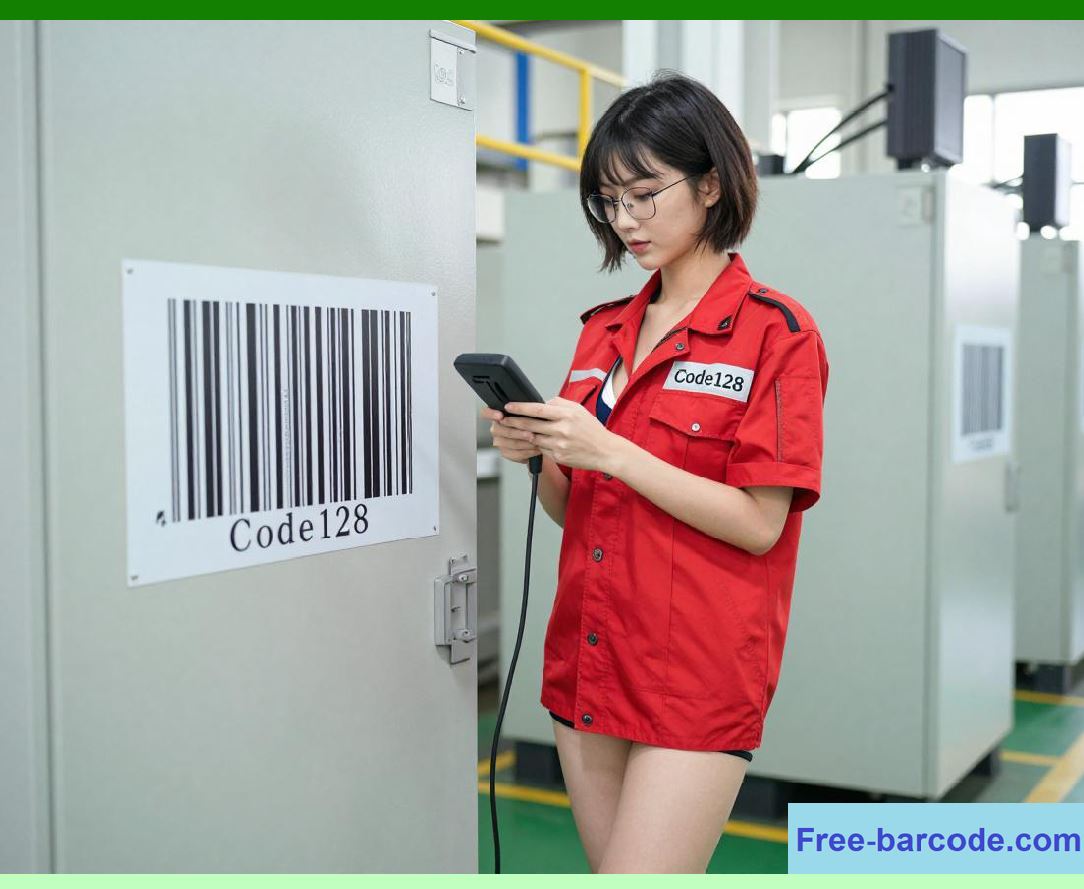
Location Tags: Every bin, rack, aisle, and zone in a modern warehouse is typically assigned a unique identifier, which is encoded into a Code 128 barcode . These are printed on durable labels and affixed to the physical location. As the Oracle documentation notes, when setting up barcodes in their label designer, features like 'Dynamic Repeating' allow for the efficient generation of thousands of unique location labels . |
Product Labels: Items received from suppliers or manufactured internally are tagged with Code 128 labels that encode the product's SKU, lot number, batch, expiry date, and serial number. The ability to encode so much varied data is why Code 128 is often used in conjunction with Application Identifiers (AIs) as per the GS1-128 standard . |
Shipping and Handling Unit Labels: As orders are picked and packed, Code 128 is used to generate labels for cartons, pallets, and other shipping containers. The most prominent of these is the SSCC (Serial Shipping Container Code), a unique 18-digit number used to track entire shipping units throughout the supply chain . |
The process of generating these labels is often streamlined through software tools. Solutions like Cleverence Label allow warehouse managers to import location lists from a CSV or Excel file and bulk-print Code 128 labels for every bin, ensuring a consistent and scan-ready naming hierarchy throughout the facility . |
|
3. Oracle WMS Cloud: The System of Record |
Oracle WMS Cloud is a comprehensive, cloud-based supply chain execution system that provides end-to-end visibility and control over warehouse operations . It is designed to manage complex, high-volume fulfillment operations, supporting everything from inbound receiving to outbound shipping. The system is characterized by its deep functionality, which includes directed putaway, task interleaving, cycle counting, and, of course, sophisticated wave management. |
The integration of Oracle WMS Cloud with barcode scanning is fundamental. Oracle supports barcode scanning for all core inventory transactions, including receiving, putaway, picking, cycle counting, and material transfers . The mobile-enabled workflows allow workers using handheld scanners or voice-directed systems to interact with the WMS in real-time, eliminating paper-based processes and significantly reducing manual data entry errors . |
Oracle's platform is designed with flexibility in mind. The Document and Label Designer Guide, for example, details how administrators can configure complex barcode labels for documents and physical tags. It highlights the system's ability to handle dynamic data and even auto-scale Code 128 barcodes, ensuring they always fit within the defined space on a label, regardless of the amount of data encoded . This kind of advanced functionality is crucial for maintaining a reliable and efficient warehouse operation. |

|
4. The Crucial Link: Integrating Code 128 with ERP Systems |
The true power of Code 128 barcodes is realized when they are tightly integrated with the ERP system. The scanner is not just a data entry tool; it is a direct input device that triggers transactions, updates databases, and initiates business processes. |
4.1. Data Mapping and Transaction Flow |
The integration between a barcode scanner and an ERP system like Oracle WMS Cloud involves several critical layers. When a scanner reads a Code 128 barcode, it captures a string of data. A middleware layer or the scanner's software itself must parse this data and map it to specific fields in the ERP system . |
For instance, a barcode on a product might encode multiple pieces of data using AIs. The middleware must identify the GTIN (AI 01), the lot number (AI 10), and the expiry date (AI 17), and map them to the correct fields in the Oracle WMS database . This ensures that the transaction recorded in the ERP is accurate and complete. A common transaction is the 'Goods Receipt,' where scanning an inbound SSCC or a product barcode posts the inventory receipt automatically . |
4.2. Real-World Application: SEW-EURODRIVE's DriveTag |
A compelling example of this deep integration is the DriveTag service from SEW-EURODRIVE, an industrial manufacturer. Launched in the U.S. in late 2025, DriveTag is a custom barcode labeling service designed to streamline product identification and material flow . |
The genius of DriveTag lies in its customizability and direct ERP integration. Customers can define exactly what data is encoded in the Code 128 (or DataMatrix, Code 39, etc.) label, including their own material number, purchase order number, project number, and the SEW serial number. This means that when a customer receives a SEW-EURODRIVE product, a single scan instantly feeds all relevant data into their own ERP or inventory management platform . |
This eliminates manual data entry, reduces receiving errors, and provides real-time transparency. For a U.S. automotive manufacturer, this could mean a critical motor drive arrives, is scanned at the receiving dock, and is immediately logged in the ERP system as available for a specific project or work order, all within seconds. This level of integration, powered by Code 128, is a prime example of how physical inventory can be seamlessly connected with digital intelligence . |

|
5. Chapter Focus: Wave Execution in Oracle WMS Cloud |
With the foundational technologies in place, we can now focus on the core subject of this chapter: wave execution. |
5.1. What is a 'Wave' |
In warehouse management, a 'wave' is a method of grouping and releasing orders for picking . Instead of picking orders one at a time as they come in, a warehouse manager will use Oracle WMS Cloud to define a wave template that selects a group of orders based on specific criteria. These criteria can be customer-specific, shipping carrier, order type (e.g., express vs. standard), or product characteristics (e.g., heavy items vs. small items). |
The wave release is a scheduled event that 'releases' these grouped orders, generating pick tasks for the warehouse workers . This approach allows for greater efficiency, as pickers can be directed to pick multiple orders simultaneously, which is especially beneficial for batch picking or zone picking strategies . |
5.2. The 'Sub-Second' Transaction |
The phrase 'when a wave is released, pickers scan Code 128 location tags; Oracle updates inventory on-hand and generates outbound load IDs in sub-seconds' captures the speed and precision of this process. Let's break down what happens in that sub-second moment. |
1. The Wave is Released: A warehouse manager or an automated schedule triggers the wave release in Oracle WMS Cloud. The system immediately allocates inventory to the orders in the wave, creating pick tasks and reserving the stock. |
2. The Picker's Action: A picker, using a mobile handheld computer, scans the Code 128 barcode on a location tag (e.g., Aisle B, Rack 3, Bin 7) to confirm they are at the correct spot . |
3. Instant Data Capture: The scanner sends the location code to Oracle WMS Cloud. |
4. Oracle Transaction: Oracle instantly verifies that the location is correct for the pick task. It then updates the system's inventory-on-hand record. The items are 'removed' from the inventory balance in that specific location. |
5. Outbound Load ID Generation: As the inventory is confirmed, Oracle immediately updates the outbound shipment record. It generates a unique identifier for the load---the Outbound Load ID. This ID is used to track the shipment through packing, shipping, and transit. |
6. System-Wide Synchronization: All of this occurs in less than a second, and the updated data is instantly available across the entire Oracle Fusion Cloud Supply Chain & Manufacturing (SCM) suite. This provides real-time visibility to everyone from warehouse managers to the finance department . |
This process, repeated tens of thousands of times a day in a large distribution center, is the engine of modern order fulfillment. |
5.3. Wave Configuration and Barcode Generation |
The wave execution process begins long before the actual picking. It starts with configuring the wave template in Oracle WMS Cloud. The system must be set up to create the necessary tasks and to integrate with the label printing system. |
As mentioned, Oracle's own Document and Label Designer allows for the creation of intricate labels, including those for dynamic data . Once a wave is released, the system will often trigger the printing of shipping labels and packing slips, many of which will include Code 128 barcodes for the SSCC or order number. The 'Dynamic Repeating Barcodes' feature in Oracle allows for efficient printing of these barcodes for every line item or carton in the wave, ensuring that the physical cartons are linked to their digital records . |

|
6. U.S. Real-World Application Examples |
To further illustrate the critical importance of Code 128 and wave execution, let's examine several real-world application examples across various U.S. industries. |
6.1. Example 1: The 3PL (Third-Party Logistics) Provider |
A large 3PL provider operates a multi-tenant warehouse in the U.S. for several retail clients. They use Oracle WMS Cloud to manage the complex inventory of all these clients. In their facility, they have thousands of pallet locations, bin locations, and aisles, each labeled with a unique Code 128 barcode for easy identification . |
When a client like a major shoe retailer sends in a bulk shipment, it is received and putaway using directed putaway. The system directs the forklift driver to a specific aisle via a warehouse aisle sign printed with a Code 128 barcode. The driver scans the aisle barcode to confirm they are in the right area before scanning the rack location . When orders come in for the shoe retailer, the system groups them into a wave based on the client's shipping deadlines. Pickers then use their scanners to scan location barcodes, confirming they are picking the correct SKU from the correct bin, maintaining a near-perfect inventory record. This level of organization and automation is critical for a 3PL to service multiple clients with diverse inventory needs from a single facility. |
6.2. Example 2: The Manufacturing OEM (Original Equipment Manufacturer) |
Consider an American manufacturer of industrial automation systems, like SEW-EURODRIVE, which supplies critical components to other businesses. They leverage Code 128 as part of their manufacturing and logistics process, using services like DriveTag to embed customer-specific information directly on their products . |
When a large order for a complex component is processed, the system creates a wave in the ERP. The wave directs workers to pick various sub-components from different storage areas. Each sub-component is scanned, and its Code 128 barcode ensures the correct part is used in the assembly. Once assembled, the final product is labeled with a customized Code 128 barcode containing the customer's purchase order number, a serial number, and the product's final specification. This information is critical. When the product arrives at the customer's facility, the receiving dock worker can scan the Code 128 barcode and instantly route the equipment to the correct production line or project in their own ERP system, as the data is pre-configured to match their internal workflows. This integration streamlines the entire supply chain and is a direct application of the technology described in the DriveTag case study . |

|
6.3. Example 3: The High-Volume E-commerce Retailer |
An e-commerce retailer in the U.S. operates a massive fulfillment center where speed is the only currency. They utilize wave execution in Oracle WMS Cloud to batch orders by shipping carrier to optimize processing times. Their facility uses a mix of dynamic picking strategies. |
During a peak sales event, their system may release a wave specifically for ground shipping orders. The wave is configured to use a 'batch picking' strategy where pickers are given a list of items for up to 20 orders at once . The picker starts by scanning a Code 128 barcode on a tote to 'create' the tote in the system. They then follow a voice-directed or screen-directed path through the warehouse. At each location, they scan the Code 128 bin location barcode to confirm they are in the right spot , and then they scan the product's barcode to confirm the right item. The scanner updates the system in real-time. Once all items are picked, the picker takes the tote to a packing station. |
At the packing station, workers scan a Code 128 barcode on the tote or the first item to recall the order. The system then instructs them on the correct box size and automatically prints shipping labels containing another Code 128 barcode---the Outbound Load ID or tracking number. This entire process is a testament to the speed and precision enabled by Code 128 technology in a high-pressure environment. |
6.4. Example 4: The Cold Storage Facility |
Cold storage warehouses present unique challenges, including harsh environmental conditions and the need for workers to wear bulky clothing. In a U.S. cold storage facility, Code 128 labels are crucial for identifying products and their specific, often temperature-sensitive, storage locations. |
Warehouse aisle signs and location tags are printed in large formats with Code 128 barcodes that are readable from a forklift up to 30 feet away, allowing operators to navigate and pick correctly without exiting the cab . The labels are printed on durable, weather-resistant materials that can withstand freezing temperatures and high humidity. Wave execution in Oracle WMS Cloud might prioritize 'fast-moving' items in a wave scheduled for the morning to ensure that the most frequently requested products are picked when workers are at their peak, minimizing time spent in the extreme cold. The use of long-range Code 128 scanners, as enabled by these large-format labels, is essential for maintaining safety and efficiency in these challenging environments . |

|
6.5. Example 5: Healthcare and Medical Supply Distribution |
In the healthcare sector, traceability is not just an operational requirement; it is a regulatory and ethical necessity. A medical supply distributor in the U.S. uses Code 128 barcodes to track everything from surgical instruments to pharmaceuticals. |
Oracle's cloud inventory management solutions support barcode scanning for receiving, putaway, and picking in healthcare, and even integrate with RFID for advanced replenishment . Each unit, batch, and lot is assigned a unique identifier encoded in a Code 128 barcode. This allows for complete, cradle-to-grave traceability. During wave execution, pickers are directed to specific lots of a product, often scanning the barcode on the case and the shelf location to ensure the oldest inventory (First-Expired, First-Out) is picked first. The ability to instantly generate a detailed Advanced Shipping Notice (ASN) with all this lot and expiry data is critical for healthcare customers who must verify shipments against strict regulatory standards . In this context, the sub-second update of inventory and load IDs in Oracle WMS Cloud is not just about efficiency---it's about patient safety and compliance. |

|
7. Conclusion: The Future of Automated Logistics |
The journey from a physical product in a warehouse to a completed shipment is a complex dance of data, humans, and machines. At the heart of this dance in the modern era is the humble yet powerful Code 128 barcode, integrated with sophisticated systems like Oracle WMS Cloud. |
The chapter's core case study---wave execution---perfectly encapsulates this synergy. The process begins with a wave release, a digitally orchestrated grouping of orders aimed at maximizing efficiency . It relies on a physical infrastructure of Code 128 location tags, from massive aisle signs down to individual bin labels, all ensuring that the system and the human worker are in perfect alignment . When a picker scans these tags, the Oracle system updates inventory balances and generates outbound load IDs in a fraction of a second, a process that Oracle's design guides support through efficient label generation and dynamic data handling . |
The U.S. examples provided---from 3PLs and manufacturers to e-commerce giants, cold storage, and healthcare distributors---demonstrate that this is not a niche technology but a ubiquitous requirement. Companies like SEW-EURODRIVE are innovating with services like DriveTag, embedding customer-specific data directly into Code 128 labels to create a truly seamless integration from supplier to recipient, ensuring that their U.S. customers can automate identification, improve visibility, and take control of their logistics with speed and precision . The ability to map this data from a barcode directly into an ERP system is a prime example of how digital transformation is occurring on the warehouse floor . |

|
In conclusion, the world of logistics is moving faster than ever. The integration of Code 128 barcodes with Oracle WMS Cloud for wave execution represents a proven and critical solution for managing this complexity. It provides the speed to meet customer demands, the accuracy to prevent costly errors, the traceability for regulatory compliance, and the real-time visibility needed to make intelligent business decisions. As technology continues to advance, these systems will only become more integrated and intelligent, but the foundational role of the Code 128 barcode as the bridge between the physical and digital worlds is certain to endure, driving efficiency in the supply chains that power the American economy. |
 cs@easiersoft.com