Chapter 18: Typical Data Density Figure |
Summary Snapshot |
At a moderate X-dimension---the narrow bar width---of 0.25 millimeters, Code 39 encodes roughly 2 to 3 characters per centimeter. This places its data density at about half that of Code 128, a more modern symbology. This single figure, 2-3 characters per centimeter, is not merely a technical specification; it is a defining characteristic that has profoundly shaped where Code 39 thrives and where it has been superseded. |
The moderate density of Code 39 stems directly from its design. Every character in the standard Code 39 set is composed of nine elements: five bars and four spaces. Crucially, exactly three of these nine elements are wide, while the remaining six are narrow . This 'three of nine' pattern is the reason for the symbology's name. This fixed structure, while robust and self-checking, is inherently space-inefficient when compared to symbologies like Code 128, which use varying element widths to pack more information into a smaller area . |
This chapter will explore the practical implications of this density. We will move beyond the simple 2-3 characters per centimeter figure to examine how this technical characteristic influences the real-world application of Code 39 across a diverse range of industries. We will see how its moderate density is both a limitation and a strength, shaping its role in defense, automotive, healthcare, and other sectors where reliability and simplicity often take precedence over raw information density. |
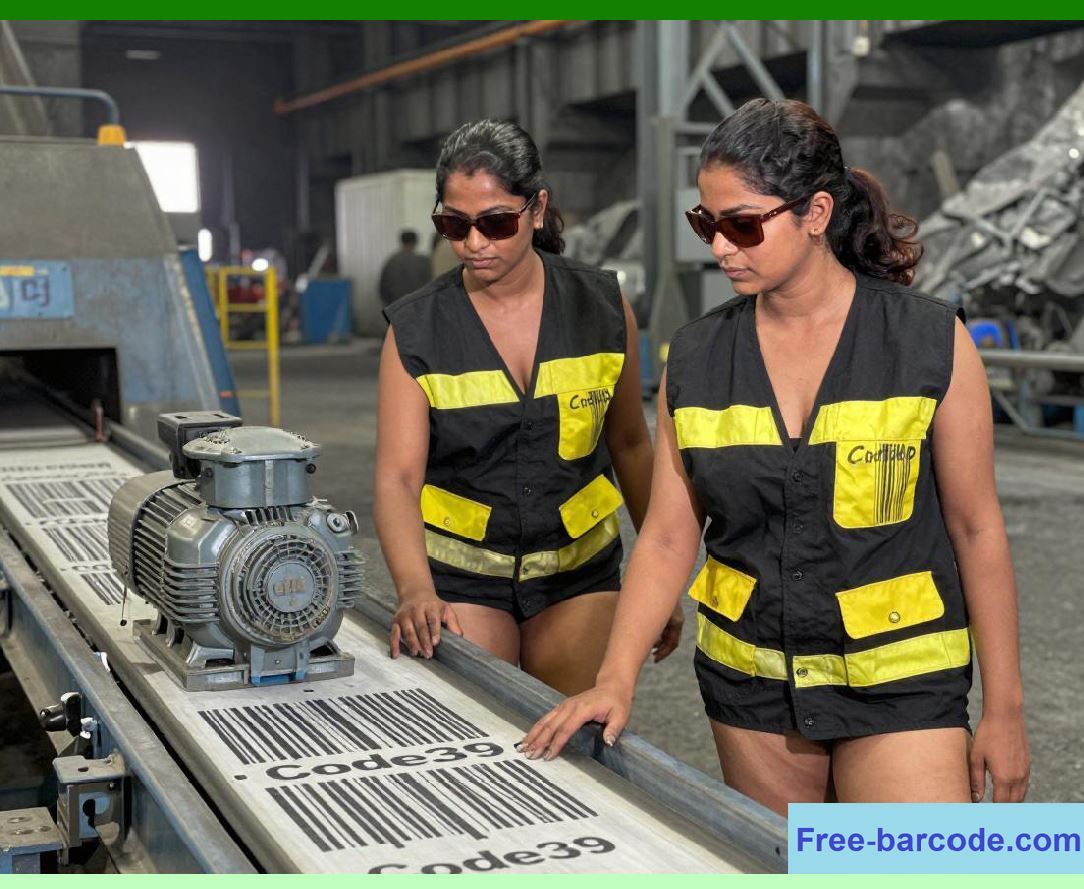
|
18.1 The Code 39 Density Paradigm |
To understand the 'Typical Data Density Figure,' we must first understand the symbology's architecture. Code 39 is a discrete, variable-length barcode. 'Discrete' means that each character is independently encoded and separated by an intercharacter gap, typically a narrow space. This makes it simple to decode, as the scanner can identify each character individually without needing complex pattern recognition for the entire symbol . |
The name 'Code 39' itself tells us a great deal about its density. Each character is represented by a total of nine elements (bars and spaces). Of these nine, exactly three are wide, and six are narrow. This 3-of-9 pattern provides a high level of redundancy, making the code self-checking. If a single bar or space is misread, the resulting pattern will likely not have the required three wide elements out of nine, thus the scanner can reject the erroneous character . This self-checking feature is a significant advantage for reliability, a point we will revisit throughout this chapter. However, this fixed pattern is inherently not space-efficient. It requires a substantial amount of physical area to represent a given amount of data. |
Consider the given baseline: a moderate X-dimension of 0.25 millimeters. X-dimension refers to the width of the narrowest bar or space in the barcode. It is the fundamental building block of the symbol. At this scale, Code 39 achieves a density of roughly 2 to 3 characters per centimeter. This figure is a direct consequence of the 3-of-9 encoding rule. Each character, with its nine elements plus the intercharacter gap, physically occupies a length that, at this X-dimension, translates to about 3-5 millimeters per character. This gives a practical limit of around 2 to 3 characters per centimeter. |
To put this in perspective, Code 128, a symbology with a more efficient encoding algorithm that uses four different element widths, can often achieve nearly double the density of Code 39 for the same X-dimension . This means that the same data encoded in Code 39 will produce a barcode that is roughly twice as long as one encoded in Code 128. This seemingly simple fact---that Code 39's barcodes are large---has a cascading effect on its applications and its endurance in the market. |

|
18.2 The Symbology's Enduring Strengths |
Why would a symbology with such moderate density and high space consumption remain in use for over half a centuryThe answer lies in the strengths that accompany its simple design. Its moderate density is a trade-off that yields significant benefits in specific contexts. |
18.2.1 Simplicity and Robustness |
The most profound advantage of Code 39 is its simplicity. Because it is discrete and self-checking, it is exceptionally robust. A label that is slightly damaged, smudged, or poorly printed on a rough surface is more likely to be correctly read if it is a Code 39 symbol than a more complex, high-density barcode. The self-checking mechanism provides an inherent layer of error detection without the need for a mandatory check digit (though one is often added for extra security) . |
This reliability is paramount in industrial settings where barcode labels are subjected to harsh conditions. A barcode on an automotive part that is exposed to grease, oil, and abrasion needs to be dependable. A barcode on a medical device that undergoes sterilization must remain scannable. The moderate density of Code 39, while creating a larger label, allows for a 'forgiving' design where the wide elements are sufficiently distinct from the narrow ones, making it more resilient to variations in print quality and environmental wear. |
18.2.2 Ease of Integration |
Another key factor in Code 39's persistence is its ease of integration. The symbology does not require a mandatory check digit to be generated or validated by software . This means that in many early applications, Code 39 could be treated almost like a specialized font. Users could simply type their data and print it using a Code 39 barcode font, without needing complex barcode generation libraries. This simplicity was instrumental in its early adoption and continues to make it a convenient choice for legacy systems and simpler applications where low cost and ease of use are more valuable than maximizing data density . |

|
18.3 Industry Applications: Where Density Meets Reality |
The interplay between Code 39's moderate density and its strengths creates a clear pattern of industry adoption. It is the workhorse for applications where the labels can be large enough to accommodate the relatively long barcodes and where the environment demands exceptional durability and reliability. We will now examine how this plays out in a variety of sectors. |
18.3.1 The US Department of Defense and LOGMARS |
Perhaps the most historically significant endorsement of Code 39 is its adoption by the US Department of Defense for the LOGMARS (Logistics Applications of Automated Marking and Reading Symbols) program. MIL-STD-1189 designated Code 39 as the standard symbology for marking unit packs, outer containers, and selected documents . This was a monumental decision that cemented Code 39's place in the supply chain of the world's largest logistics operation. |
Why Code 39 for the militaryThe decision was not about density, but about reliability and universality. Military logistics involves moving enormous quantities of supplies across the globe, often through harsh and unforgiving environments. Labels needed to survive extremes of temperature, humidity, and physical abuse. The self-checking, robust nature of Code 39 ensured that these labels could be reliably read from a distance using ruggedized scanners. The lower data density was less of a concern because the items being labeled, such as ammunition crates, vehicle parts, and supply pallets, typically had large surface areas that could easily accommodate the longer barcodes. |
The LOGMARS standard created a massive installed base of Code 39 infrastructure, including printers, scanners, and software. This legacy has persisted for decades, creating a 'stickiness' that is difficult to overcome. Even though Code 128 is now recommended by many standards bodies for logistics, the sheer volume of existing systems and labels that use Code 39 ensures its continued presence in the defense industrial base . |

|
18.3.2 The Automotive Industry: Tracking the Supply Chain |
Following the military's lead, the automotive industry also adopted Code 39 as a key standard. Organizations like the Automotive Industry Action Group (AIAG) have specified Code 39 for various labeling applications . In this sector, the barcode density figure directly impacts the size and placement of labels on a vast array of components. |
Consider the journey of a single part, like a starter motor, from a Tier 1 supplier to an assembly plant. This part requires a label that encodes a part number, supplier code, date of manufacture, and maybe a serial number. This data string might be 20-30 characters long. Using Code 39 at an X-dimension of 0.25mm, this label would need to be about 70-100mm long, which is perfectly manageable for a part the size of a starter motor. The label is durable, the symbology is robust, and it integrates seamlessly with the supplier's existing barcode systems. |
The moderate density, while using more space, also makes the label easier to read from a variety of angles in a busy manufacturing environment. Workers using handheld scanners on a production line benefit from a symbology that is forgiving of less-than-perfect scan angles and lighting conditions. For these reasons, Code 39 is often called the 'alpha-numeric barcode' of the automotive industry, a workhorse that reliably tracks parts from raw material to the final assembly line . |

|
18.3.3 Healthcare and Medical Devices: The HIBC Standard |
The healthcare industry presents a fascinating study in the density-versus-reliability trade-off. The Health Industry Bar Code (HIBC) standard was developed to provide a standardized approach to labeling medical devices, pharmaceuticals, and health-related products. While the HIBC standard supports multiple symbologies, Code 39 has been a significant component, especially for device labeling . |
In healthcare, the cost of a scanning error can be catastrophic. A misread label on a surgical instrument or a pharmaceutical package could have life-or-death consequences. Therefore, the self-checking, ultra-reliable nature of Code 39 makes it a highly appealing choice. The labels on medical devices, such as a surgical drill or a package of sutures, can be engineered to accommodate the longer symbols. The packaging or device itself often has a large enough 'real estate' for the label, so the relatively low density is not a significant constraint. |
Furthermore, the healthcare environment is demanding. Labels are exposed to sterilization processes, chemicals, and physical handling. The robust nature of Code 39, which stems from its simple 3-of-9 pattern, ensures that these labels remain scannable even after repeated autoclaving or exposure to disinfectants. While newer standards like GS1 are pushing for the use of more compact symbologies like Data Matrix and GS1-128 for certain applications, Code 39 remains deeply entrenched in healthcare, especially for non-retail, internal tracking of medical assets and instruments where its reliability is paramount . |

|
18.3.4 Government and Defense Beyond LOGMARS |
The influence of LOGMARS extended beyond the military proper. Various government agencies and defense contractors adopted Code 39 as their internal standard. The American National Standards Institute (ANSI) also described Code 39 in its early specifications for barcode symbols on transport packages and unit loads . This broad government adoption created a dense ecosystem of Code 39 usage that spans federal, state, and local government agencies, as well as their suppliers. |
This government affinity for Code 39 is primarily a legacy of the reliability standards set by LOGMARS. When a government agency needs to track assets, from office furniture to IT equipment to sensitive military hardware, they often default to a system that is time-tested and proven to work. Code 39's simplicity also aligns with the procurement and operational needs of public sector organizations, where low cost and ease of implementation are often critical constraints. The barcode density, while not ideal for extremely small labels, is perfectly adequate for tracking the large assets that governments are typically responsible for, such as vehicles, buildings, and major equipment . |

|
18.3.5 Manufacturing and Industrial Tracking |
Beyond the military and automotive sectors, Code 39 is widely used in general manufacturing for work-in-progress tracking, inventory control, and asset management. A manufacturer of furniture, electronics, or telecommunications equipment will often use Code 39 labels to track sub-assemblies as they move through the production floor . |
On a factory floor, the barcode labels are often printed on-demand using thermal transfer printers and applied to pallets, bins, or individual items. The moderate density of Code 39, combined with its ease of generation and integration, makes it a practical choice. The labels can be printed at a size that is readable by workers on the shop floor, and the symbology is robust enough to withstand the dusty, oily environment of a factory. |
For example, an aluminum extrusion plant might use Code 39 to label long, heavy bars of aluminum. The label can be large and placed on the end of the bar, and the barcode can be read from a distance with a fixed-position scanner as the bar moves through the production process. Similarly, electronics manufacturers who need to track small circuit boards might face challenges. The tiny boards might not have enough space for a Code 39 label with a long data string, which is where a higher-density symbology like Code 128 or Data Matrix becomes more appropriate. Thus, the density figure directly dictates what can be labeled. Code 39 is the choice for the larger items and assemblies in a manufacturing environment, not the smallest components . |

|
18.3.6 Postal and Shipping Services |
Postal services have historically been a major user of Code 39. Many countries' postal systems adopted Code 39 for tracking packages and mail pieces . The Universal Postal Union (UPU), however, has recommended the use of Code 128 for all cases, signaling a shift towards higher-density symbologies in the postal sector . |
The reason for this shift is density. Postal services need to encode increasingly long tracking numbers, service codes, and routing information on small labels that must fit on letters, flats, and small parcels. The low density of Code 39 becomes a critical limitation in this context. A Code 39 label on a large package might be fine, but the same code on a standard letter would be too large and unsightly. Code 128, with its near-double density, allows for much smaller labels, which is essential for automated sorting of small mail pieces where every square millimeter counts. |
Despite the UPU's recommendation, you will still find Code 39 in use in some postal and courier applications. It persists in some internal sorting operations, in specialized applications where the reliability of the self-checking Code 39 is valued, or simply because it is a legacy system that is expensive to replace. However, the density disadvantage is most acutely felt in this sector, showing the clear boundary of Code 39's applicability . |

|
18.4 Technical Characteristics Influencing Application |
Let us dissect how the specific technical traits of Code 39, particularly its density, influence its suitability for the industries we have explored. |
18.4.1 X-Dimension and Print Quality |
The X-dimension, the width of the narrowest bar, is the primary variable controlling overall barcode size. At an X-dimension of 0.25mm (approximately 10 mils), the density is about 2-3 characters per centimeter. At smaller X-dimensions, like 0.125mm (5 mils), the density increases, but the barcode becomes much more difficult to print accurately and requires a high-resolution scanner to read. |
In applications like automotive and defense, labels are often printed with a robust X-dimension of 0.25mm or larger. This not only ensures good readability but also allows the label to be printed using a variety of printing technologies, including dot-matrix and thermal transfer printers. The moderate X-dimension and the resulting moderate density are thus a feature, not a bug, for these applications. It prioritizes scanability and robust print quality over maximizing data in a small area . |
The decode distance is also a function of the X-dimension. A 20-mil Code 39 barcode (0.5mm X-dimension) can be read from over 40 centimeters (16 inches) away by some scanners, while a 5-mil Code 39 (0.125mm X-dimension) has a much shorter range . This characteristic makes the larger, lower-density Code 39 labels ideal for warehouse scanning, where employees need to read labels on pallets from a distance. The figure of 2-3 characters per centimeter at 0.25mm is a sweet spot that balances print quality, readability, and range for many industrial scanning tasks. |

|
18.4.2 The Self-Checking Advantage |
The self-checking nature of Code 39 is a direct result of its 3-of-9 pattern. This is arguably its most significant advantage. The scanner can independently verify each character, ensuring that any error in reading a single character does not propagate through the entire barcode. This reliability is what makes Code 39 suitable for mission-critical applications in healthcare, automotive, and defense . |
In the healthcare industry, a self-checking barcode provides an extra layer of safety. If a barcode on a patient's wristband is slightly damaged, the scanner is more likely to either read it correctly or reject it outright, rather than producing an incorrect, invalid character that could lead to a medical error. This principle also applies to military logistics, where a misread could send critical supplies to the wrong location. The self-checking feature is thus a crucial characteristic that overrides the density disadvantage in many high-stakes environments. |

|
18.4.3 The Absence of a Mandatory Check Digit |
The fact that Code 39 does not require a check digit simplifies its implementation. In many early and legacy systems, barcodes were generated simply by printing the raw data in the Code 39 font. This ease of implementation was a huge driver of its adoption. While a Modulo 43 check digit is often added, especially in standards like HIBC and LOGMARS, the non-mandatory nature of it allowed for a very low barrier to entry . |
This simplicity, while a major advantage, also means that without a check digit, Code 39 has no inherent error correction. It only has error detection. This means it can detect errors but not correct them. For many applications, detection is sufficient; if the barcode fails, the operator can simply re-scan it. In high-volume automated sorting, however, where barcodes are scanned at high speed and a failure might send an item to the wrong destination, a check digit becomes more critical. This is another reason why more advanced symbologies with mandatory check digits, like Code 128, are favored in postal sorting and high-volume logistics. |

|
18.5 The Density Comparison: Code 39 and Code 128 |
It is impossible to fully appreciate the role of Code 39's density without comparing it directly to its most common competitor, Code 128. The comparison starkly illustrates the trade-offs that are made when choosing a symbology. |
| Feature | Code 39 | Code 128 | |
| Character Density | Moderate (2-3 chars/cm at 0.25mm) | High (approx. twice the density of Code 39) | |
| Encoding | 43 characters (A-Z, 0-9, 7 special chars) | Full ASCII 128 character set natively | |
| Check Digit | Not mandatory (self-checking) | Mandatory and more robust | |
| Best Use Case | Simpler asset labeling, older systems, industrial & defense where reliability is key | High-volume logistics, compact labels, retail, and new applications | |

|
The density advantage of Code 128 is profound. It can encode the same data in about half the linear space of Code 39. This makes Code 128 the obvious choice for applications where label space is extremely limited, such as on small electronic components, pharmaceutical vials, or retail price tags. For example, if you need to encode a 20-character string on a small label, Code 128 can do it with a label that is about half the length of a Code 39 label. |
However, the density of Code 128 comes at the cost of complexity. Code 128 is a continuous symbology, meaning there are no intercharacter gaps, and it uses four different element widths. This makes it more demanding to print and decode. It also requires a mandatory check digit, which adds a layer of complexity to the software needed to generate it. |
This brings us full circle. Code 39 remains relevant precisely because of its simplicity, even at half the density. In many industrial and government applications, the extra space required for a Code 39 label is not a constraint. The robustness, ease of integration, and self-checking nature of Code 39 outweigh the density advantage of Code 128. It is a classic engineering trade-off: choosing the simpler, more robust, but less space-efficient solution. |

|
18.6 The Future of Code 39 in a High-Density World |
The march of technology is towards higher density and smaller labels. As the Internet of Things (IoT) and advanced manufacturing techniques like micro-assembly drive the need to label ever-smaller objects, the limitations of Code 39's density become more apparent. Two-dimensional (2D) barcodes like Data Matrix and QR Code can encode vast amounts of information in a tiny area, far surpassing both Code 39 and Code 128 . |
Given these trends, it is reasonable to ask: Is Code 39 a fading technologyThe answer is nuanced. While its use in new, cutting-edge applications is declining, its installed base is enormous. The vast number of existing systems, procedures, and physical labels that rely on Code 39 ensures its continued existence for the foreseeable future. It is the 'legacy workhorse' of the barcode world. Replacing these systems is often prohibitively expensive and unnecessary. |
In the defense and aerospace sectors, where systems are designed to last for decades and change management is rigorous and slow, Code 39 will remain a standard for many years. In automotive, the AIAG standards continue to support Code 39, and there is a large, entrenched infrastructure of suppliers and OEMs who rely on it. In healthcare, many internal asset tracking systems are built around Code 39, and the symbology's reliability is well-understood and trusted. |
Where we see Code 39 being phased out is in areas where new technology is being deployed from the ground up. Any new logistics system for retail or e-commerce, for example, will overwhelmingly choose Code 128 or a 2D symbology due to the need for compact labels and high data capacity. The Universal Postal Union's recommendation to use Code 128 is a clear signal of this industry-wide shift . |
The density of Code 39, then, serves as a clear boundary condition. If your application requires a small label, you simply cannot use Code 39. But if you have the space, the reliability and simplicity of Code 39 make it a compelling choice. It occupies a specific niche in the barcode ecosystem---a niche defined by its moderate density and characterized by reliability, robustness, and longevity. |

|
18.7 Summary and Reflections |
In this chapter, we began with a single, concrete data point: at an X-dimension of 0.25 mm, Code 39 encodes roughly 2 to 3 characters per centimeter. This figure is about half the density of Code 128. From this seemingly dry technical specification, we have built a comprehensive understanding of where and why Code 39 is used across a diverse range of industries. |
We explored how the technical architecture of Code 39---its 3-of-9 encoding pattern, its discrete character structure, and its self-checking nature---directly results in this moderate density. This density is not a flaw but a trade-off. It gives up space efficiency in exchange for an exceptionally robust and simple symbology that is easy to print, easy to integrate, and forgiving of harsh conditions. |
In the US Department of Defense's LOGMARS program, the moderate density was a non-issue because labels were applied to large items like ammunition crates and vehicle parts. The priority was reliability, and Code 39 delivered. The automotive industry adopted Code 39 for similar reasons, using it to track parts through a supply chain where durability and scanability are paramount. The healthcare industry, guided by the HIBC standard, values the self-checking property of Code 39 for patient safety and medical device tracking. Across government, manufacturing, and even postal applications, Code 39 has proven to be a trusted workhorse. |
The limitations of its moderate density become clear when we consider smaller items, like electronic components, or high-volume automated sorting, like postal mail. In these contexts, Code 39's space consumption is a liability. This is where higher-density symbologies like Code 128 and 2D barcodes are better choices. Code 39 excels in a specific, well-defined set of scenarios where reliability, simplicity, and durability are valued over compactness. |

|
Ultimately, the chapter demonstrates that the 'Typical Data Density Figure' of Code 39 is more than a number. It is a window into the history, strengths, and limitations of a symbology that has been a cornerstone of automatic identification for over half a century. While new technologies will continue to emerge, Code 39's moderate density and its associated benefits ensure that it will remain a functional and relevant part of the industrial landscape for decades to come. It is a testament to the engineering principle that sometimes, the simplest solution that works is the one that endures. |
 cs@easiersoft.com