DataMatrix Decoded: A Technical Deep-Dive |
Executive Summary |
Reading a DataMatrix code is a sophisticated blend of optical engineering and computational intelligence. While consumer smartphone cameras can sometimes decode these codes, industrial and commercial applications rely on specialized reading technologies designed for speed, accuracy, and challenging conditions. The core hardware includes CMOS image sensors for cost-effective imaging, CCD cameras for superior image quality in demanding environments, and laser-based raster scanners for specific high-speed applications . But hardware is only part of the story: advanced algorithms enable these readers to decode DataMatrix codes from curved surfaces like pharmaceutical vials, from highly reflective metal parts in aerospace manufacturing, and even from codes that are partially damaged or obscured . |
In the United States, these reading technologies enable mission-critical applications across every major industry. The U.S. Postal Service relies on high-speed tunnel scanners to read DataMatrix codes on millions of packages daily, with redundant codes providing extra chances for successful reading on distorted or creased shipping labels . Semiconductor manufacturers use specialized wafer readers with infrared illumination to read DataMatrix codes on silicon wafers through surface coatings and reflections . Aerospace component makers depend on handheld readers with advanced decoding algorithms that can read codes marked on curved metal parts with poor contrast . This article explores the technical foundations of DataMatrix reading technologies and presents dozens of real-world American applications that depend on reliable decoding. |

|
Part One: Core Reading Technologies |
Chapter 1: CMOS Image Sensors |
CMOS (Complementary Metal-Oxide-Semiconductor) sensors are the most common imaging technology in modern DataMatrix readers. These sensors convert light into electrical signals using an array of photodiodes, with each pixel capturing the intensity of light reflected from the DataMatrix code. CMOS sensors are cost-effective, consume less power, and can be manufactured with high resolution, making them ideal for industrial fixed-mount readers and handheld scanners . The NLS-N1-ER from Newland, for example, uses a 640 by 480 pixel CMOS sensor to decode DataMatrix codes with module sizes as small as 6.67 mils . CMOS sensors are excellent for most applications, but they can face challenges in low-light conditions or when reading extremely small codes. |
Chapter 2: CCD Cameras |
CCD (Charge-Coupled Device) cameras offer superior image quality compared to CMOS sensors, particularly in low-light conditions and when capturing high-contrast images. CCD sensors are often used in specialized applications where image quality is critical, such as semiconductor wafer reading and high-precision inspection. The Cognex In-Sight 1740 series, for instance, uses a CCD sensor with 1024 by 768 pixel resolution and specialized red or infrared illumination to read DataMatrix codes on silicon wafers . While more expensive than CMOS, CCD cameras are preferred for applications requiring the highest possible image clarity and accuracy. |
Chapter 3: Laser-Based Raster Scanners |
Laser-based raster scanners use a moving laser beam to scan the DataMatrix code line by line, similar to how a laser printer creates an image. These scanners capture the reflected light intensity to build a grayscale image of the code. Laser scanners are particularly effective for reading codes on reflective surfaces where camera-based systems might struggle with glare. However, they are slower than image-based systems and are less commonly used in modern applications. Most industrial readers today use image-based technology because it is faster, more versatile, and can capture multiple codes simultaneously . |

|
Chapter 4: The Role of Illumination |
Proper illumination is essential for reliable DataMatrix reading. Different surfaces and materials reflect light differently, and readers must adapt to these variations. Polarized lighting filters out reflections from shiny metal and plastic surfaces, making the code's contrast clearly visible . Diffuse lighting spreads light evenly across the surface, avoiding the bright center and dark edges that can occur on curved surfaces . Red and blue light sources are used to enhance contrast against specific backgrounds; for example, red light is effective for reading codes on blue or green backgrounds . |
Chapter 5: Infrared Illumination |
Infrared (IR) illumination is a specialized technique for reading DataMatrix codes on materials that reflect visible light poorly or where surface coatings obscure the code. IR light penetrates certain coatings and reveals the underlying code pattern. The Cognex In-Sight 1742, for example, uses IR illumination at 880 nanometers wavelength to read DataMatrix codes on silicon wafers with specific surface coatings that would be difficult to image with visible light . This technology is critical in semiconductor manufacturing, where wafer surfaces can be highly reflective or coated. |
Chapter 6: Dedicated DataMatrix Readers |
Dedicated DataMatrix readers are purpose-built devices that combine imaging hardware with specialized decoding algorithms. Unlike general-purpose barcode scanners, these readers are optimized for the specific challenges of DataMatrix reading: small module sizes, low contrast, curved surfaces, and damage. The HawkEye series from RVSI, for example, offers unique features such as audiovisual alignment, auto-learn capability, and intelligent imaging that simplify integration and provide robust reading of challenging codes . Dedicated readers often include verification capabilities to monitor mark quality in real time . |

|
Chapter 7: Smart Cameras |
Smart cameras are self-contained imaging systems that integrate image sensor, processor, lighting, and communication interfaces in a compact package. They are used in industrial automation where a fixed reader is mounted over a production line. The HawkEye 1500 line of DataMatrix readers, for example, delivers leading performance in a compact smart camera package, with built-in decoding algorithms that handle challenging codes directly marked on various parts . Smart cameras are widely used in automotive, electronics, and packaging industries for automated quality control and traceability. |
Chapter 8: Handheld Readers |
Handheld DataMatrix readers are portable devices used in warehouses, maintenance shops, and field operations. The Cognex DataMan 8500, used by a leading aerospace component manufacturer, features variable-focus liquid lens technology that makes it easy to read both very small 2D codes and longer barcodes without manual lens adjustment . Its advanced 1DMax and 2DMax code reading algorithms offer the industry's most advanced technology for reading codes regardless of size, quality, printing method, or surface . These handheld readers are essential for applications where mobility is required. |
Chapter 9: Fixed-Mount Readers |
Fixed-mount readers are permanently installed on production lines, conveyor belts, and sorting equipment. They are triggered by sensors when a package or part passes through the reading zone. These readers capture images at high speed and decode DataMatrix codes in milliseconds. The USPS uses fixed-mount tunnel scanners to read Intelligent Mail Matrix Barcodes on packages as they move along conveyor belts . Industrial fixed readers often support industrial Ethernet protocols for integration with PLCs and manufacturing execution systems. |

|
Part Two: Advanced Decoding Algorithms |
Chapter 10: Finding the L-Shape |
The first step in decoding a DataMatrix code is locating the L-shaped finder pattern. The decoder searches for the distinctive solid border that defines the code's orientation and size. This process can be challenging when the code is on a reflective surface, in poor lighting, or partially obscured. The Cognex 2DMax algorithm, for example, uses advanced image processing to locate codes regardless of the surface they are marked on . The algorithm can handle codes that are distorted, poorly printed, or marked on reflective metal surfaces. |
Chapter 11: Determining Cell Size |
Once the L-shape is located, the decoder must determine the size of each module. The alternating Clock Track on the opposite sides of the code provides the information needed. The decoder measures the number of transitions along the Clock Track and calculates the average module size. This measurement must be precise because even a small error can cause the decoder to sample the wrong positions and extract incorrect data. For curved surfaces, the module size may vary across the code, requiring advanced correction algorithms. |
Chapter 12: Perspective and Distortion Correction |
When a DataMatrix code is viewed from an angle or is on a curved surface, the image appears distorted. The decoder uses the geometry of the L-shaped finder pattern and the Clock Track to correct for this distortion. The correction process mathematically transforms the distorted image back into a regular grid. For cylindrical surfaces, additional algorithms are needed to compensate for the curvature. A Chinese patent describes a method for correcting non-uniform illumination on cylindrical metal surfaces using polynomial interpolation, enabling decoding of DataMatrix codes that would otherwise be unreadable due to reflections . |

|
Chapter 13: Handling Low Contrast |
Low contrast is one of the most common challenges in DataMatrix reading, particularly for direct part marking on metal surfaces. The contrast between the marked and unmarked areas may be subtle, and the decoder must distinguish the modules from the background. Advanced algorithms use adaptive thresholding and local contrast enhancement to extract the code pattern. The NLS-N1-ER from Newland, for example, can decode DataMatrix codes with a symbol contrast as low as 20 percent . |
Chapter 14: Reading Curved Surfaces |
Curved surfaces present a unique challenge for DataMatrix decoding. The code appears distorted when viewed from a camera, and reflections can obscure parts of the code. For cylindrical surfaces, the curvature causes the modules to appear different sizes across the code. Specialized algorithms correct for this curvature by modeling the surface geometry and remapping the image onto a flat plane. This is essential for reading DataMatrix codes on pharmaceutical vials, syringes, and cylindrical metal parts. |
Chapter 15: Reading Reflective Surfaces |
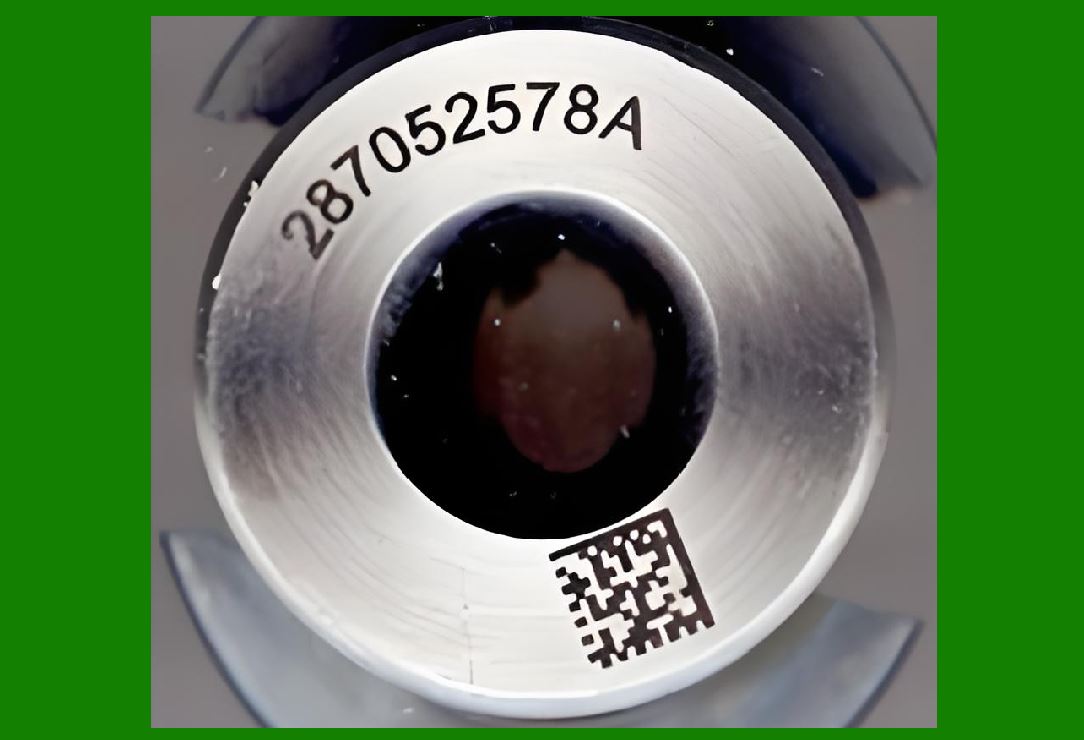
Reflective surfaces such as polished metal, glass, and silicon wafers can cause glare that obscures the DataMatrix code. The decoder must compensate for this glare, often using polarized lighting or multiple images taken from different angles. In semiconductor wafer reading, the Cognex In-Sight 1740 series uses red or infrared illumination matched to the wafer's surface coating to minimize reflections and enhance contrast . The choice of illumination wavelength (633 nm red, 622 nm red, or 880 nm infrared) depends on the wafer material and coating . |
|
Chapter 16: Handling Damaged Codes |
DataMatrix codes can be damaged by scratches, dirt, wear, or partial obscuration. The Reed-Solomon error correction built into the code is the primary defense against this damage. However, the decoder must first extract the codewords from the damaged image. Advanced algorithms use interpolation and error detection to identify the codewords that are missing or corrupted. The decoder can then apply Reed-Solomon correction to recover the original data. Even if up to 30 percent of the code is damaged, the decoder can still read it successfully. |
Chapter 17: Reading Dot-Shaped DataMatrix Codes |
Dot-shaped DataMatrix codes are a specialized type where the modules are isolated dots rather than solid squares. This pattern is used in some direct part marking applications where solid squares would be difficult to read. Reading dot-shaped codes requires special preprocessing: the decoder must connect the dots using morphological operations such as corrosion or expansion before applying the standard decoding algorithm . This process converts the dot pattern into a solid-grid pattern that the standard decoder can read. This approach is particularly useful for codes engraved on metal materials with strong background interference such as dirt, pits, and noise points . |
Chapter 18: Decoding Polyethylene-Foiled Codes |
In logistics and shipping, DataMatrix codes are often covered by polyethylene foiling that causes reflections and reduces contrast. A real-time multiple 2D barcode reader system, presented at the IEEE conference in 2010, uses a custom optical hardware setup integrated with machine vision algorithms to address reflection and illumination challenges. The system achieves a recognition accuracy of approximately 98 percent on codes covered by polyethylene foiling in moving images . This capability is essential for automated sorting in logistics applications. |

|
Chapter 19: Machine Vision Integration |
DataMatrix reading is often integrated into broader machine vision systems for quality control and inspection. The reader captures an image of the code and also analyzes it for print quality, verifying that the code meets industry standards. RVSI's HawkEye readers, for example, include optional built-in verification using unique direct part mark verification technology that enables users to monitor mark quality on a real-time basis . This integration ensures that only codes meeting quality standards proceed through the supply chain. |
Chapter 20: The USPS Intelligent Mail Matrix Barcode |
The United States Postal Service has developed the Intelligent Mail Matrix Barcode (IMmb), a GS1 DataMatrix barcode used for routing and tracking packages . The IMmb is designed to overcome the challenge of reading codes on irregularly shaped packages, softpacks, and polybags that can become distorted or creased during automated parcel processing . The smaller barcode footprint allows two IMmb barcodes to be added to standard shipping labels, providing redundancy and giving sorters two additional chances to read the barcode . This approach increases the volume and quality of scan data collected on processing equipment, reducing mail rework and improving package visibility . |

|
Part Three: American Applications by Reading Technology |
Chapter 21: USPS Package Routing (High-Speed Tunnel Scanners) |
The United States Postal Service processes billions of packages each year through high-speed sorting facilities. Fixed-mount tunnel scanners with CMOS and CCD cameras read Intelligent Mail Matrix Barcodes as packages move along conveyor belts at high speed . The scanners must handle packages that are distorted, creased, or covered in polyethylene foiling. The redundancy provided by two IMmb barcodes on each label improves the chances of successful reading, ensuring packages are routed correctly and tracking data is captured throughout the journey . |
Chapter 22: Pharmaceutical Packaging (High-Speed Inspection) |
American pharmaceutical manufacturers use fixed-mount DataMatrix readers on packaging lines to verify that serialized codes are correctly printed and readable. The readers capture images of each package as it moves through the line, decoding the GS1 DataMatrix code and verifying it against the production database. The Drug Supply Chain Security Act requires that every package be serialized, and the readers ensure that each code is scannable before the package leaves the factory. High-speed reading is essential for maintaining production throughput. |
Chapter 23: Hospital Pharmacy (Handheld Scanners) |
American hospitals use handheld DataMatrix scanners in the pharmacy to verify medications before dispensing. Pharmacists scan the GS1 DataMatrix code on each package to confirm the National Drug Code, lot number, and expiration date. The handheld scanners must be easy to use and reliable, as they are used in a fast-paced environment. The scanners use CMOS imaging with advanced decoding algorithms to read codes even if the label is slightly damaged or curved. |

|
Chapter 24: Clinical Laboratories (Automated Analyzers) |
Clinical laboratories across the United States use automated analyzers with integrated DataMatrix readers to process patient samples. The analyzers read DataMatrix codes on specimen containers to identify each sample, linking it to the patient's electronic health record. The readers must handle codes on curved tube surfaces, often with small module sizes. The reading technology must be fast and accurate to maintain the high throughput of modern clinical laboratories. |
Chapter 25: Semiconductor Wafer Reading (CCD with IR Illumination) |
In semiconductor manufacturing, DataMatrix codes are laser-etched onto silicon wafers. The Cognex In-Sight 1740 series of wafer readers uses CCD sensors with specialized red or infrared illumination to read these codes . The 1741 model uses red LED illumination at 622 nm, while the 1742 model uses IR LED illumination at 880 nm, chosen based on the wafer's surface material and coating . The readers decode DataMatrix codes conforming to the SEMI T7 standard, as well as wafer OCR, BC412, IBM412, and QR codes . They are used in both front-end and back-end semiconductor processes for wafer identification and traceability . |
Chapter 26: Aerospace Component Tracking (Handheld Readers) |
A leading manufacturer of components for the aerospace industry uses Cognex DataMan handheld readers to scan DataMatrix codes marked on parts and on order sheets . The readers are used to verify that orders have been correctly processed and to create a traceable path for each part throughout the supply chain . The powerful code-reading algorithms ensure reliable performance even on the most difficult 2D DataMatrix codes marked on virtually any surface . The variable-focus liquid lens technology makes it easy to read both very small 2D codes and longer barcodes with no manual adjustment to the lens . |

|
Chapter 27: Aerospace Part Manufacturing (Fixed-Mount Readers) |
In aerospace manufacturing, fixed-mount readers are used on production lines to read DataMatrix codes on turbine blades, engine housings, and airframe structures. The readers must handle codes that are laser-etched on curved metal surfaces with low contrast. Advanced algorithms correct for perspective distortion and surface curvature, ensuring accurate decoding. The readers are integrated with manufacturing execution systems to track each part through production and assembly. |
Chapter 28: Automotive Manufacturing (Smart Cameras) |
American automotive manufacturers use smart cameras to read DataMatrix codes on engine blocks, transmissions, and electronic control units. RVSI's HawkEye smart camera readers, for example, are specified by automotive manufacturers for reading performance, ease of use, and uptime . The readers are mounted on assembly lines, capturing and decoding codes as components move past. The built-in auto-learn capability simplifies integration, allowing plug-and-play setup without an external PC or monitor . |
Chapter 29: Automotive Supply Chain (Handheld Readers) |
In the automotive supply chain, handheld DataMatrix readers are used to verify parts and track shipments. Suppliers use the readers to confirm that components are correctly labeled with DataMatrix codes before shipping. The readers must handle codes on various surfaces, including cast metal, plastic, and labels. The rugged design of industrial handheld readers ensures they survive the harsh conditions of automotive manufacturing environments. |

|
Chapter 30: Electronics Manufacturing (Fixed-Mount Readers) |
American electronics manufacturers use fixed-mount DataMatrix readers on printed circuit board assembly lines. The codes on PCBs are often very small, with module sizes as small as a few mils. The readers must have high resolution and precise focus to capture the code clearly. The reading speed must match the production line speed to avoid bottlenecks. RVSI's HawkEye readers, for example, are used for tracking and tracing printed circuit boards to which DataMatrix marks have been inscribed . |
Chapter 31: Semiconductor Packaging (Dedicated Readers) |
In semiconductor packaging, DataMatrix codes are marked on IC packages and lead frames. Dedicated readers with high-resolution imaging and specialized algorithms are used to decode these tiny codes. The readers must handle codes on reflective metal surfaces, often with low contrast between the mark and the background. The reading process is integrated with the packaging equipment to ensure each package is correctly identified before final testing. |
Chapter 32: USPS Mail Processing (Fixed Scanners) |
The USPS uses fixed scanners with CCD sensors to read DataMatrix codes on envelopes and flats in mail processing facilities. The scanners must handle codes on a wide variety of surfaces, including paper, plastic, and polywrap. The reading process is integrated with the sorting equipment to ensure mail is routed correctly. The high-speed scanners must be reliable, with minimal 'no-reads,' to maintain processing efficiency. |

|
Chapter 33: Parcel Carrier Sorting (Tunnel Scanners) |
FedEx, UPS, and other private carriers use tunnel scanners with CMOS and CCD cameras to read DataMatrix codes on shipping labels. The scanners capture images of codes from multiple angles as packages pass through the tunnel. The advanced algorithms can decode codes that are rotated, tilted, or partially obscured by other labels. The tunnel scanners handle thousands of packages per hour, making speed and reliability essential. |
Chapter 34: Warehouse Inventory (Handheld and Fixed-Mount) |
American warehouses use both handheld and fixed-mount DataMatrix readers for inventory management. Handheld readers are used for cycle counting and put-away operations, while fixed-mount readers are mounted on conveyor belts for automated scanning. The readers must handle codes on a variety of surfaces, including cardboard boxes, plastic totes, and metal rack beams. The reading technology must be reliable in dusty and dimly lit warehouse environments. |
Chapter 35: Food Processing (Inspection Systems) |
American food processors use fixed-mount DataMatrix readers as part of inspection systems to verify that codes are correctly printed on packaging. The readers capture images of each package as it moves through the line, decoding the DataMatrix code and verifying it against the production database. The readers must handle codes on flexible packaging that may stretch or wrinkle. The food processing environment requires readers that are washdown-compatible and resistant to moisture. |

|
Chapter 36: Medical Device Manufacturing (Vision Systems) |
American medical device manufacturers use machine vision systems with integrated DataMatrix readers for quality control. The readers verify that UDI codes are correctly marked on devices, packaging, and labels. The vision systems capture images and analyze the code for print quality, ensuring it meets FDA requirements. The integrated verification capability is essential for regulatory compliance. |
Chapter 37: Defense Logistics (Handheld Rugged Readers) |
The U.S. Department of Defense uses rugged handheld DataMatrix readers in logistics operations. The readers must survive harsh field conditions, including dust, moisture, and temperature extremes. Military personnel use the readers to scan Item Unique Identification codes on equipment, tracking assets through the supply chain. The readers must be reliable, with long battery life and fast decoding. |
Chapter 38: EV Battery Manufacturing (Fixed-Mount Readers) |
American electric vehicle battery manufacturers use fixed-mount DataMatrix readers on battery assembly lines. The readers decode codes on cylindrical and pouch cells, tracking each cell through the manufacturing process. The codes are often marked on curved, reflective metal surfaces, requiring advanced algorithms to handle reflection and curvature. The readers must operate at high speed to keep up with production. |

|
Chapter 39: Solar Panel Manufacturing (Handheld and Fixed-Mount) |
American solar panel manufacturers use DataMatrix readers for panel identification and warranty tracking. Handheld readers are used in the field for installation and maintenance, while fixed-mount readers are used on production lines. The readers must handle codes on aluminum frames and junction boxes, often in outdoor conditions with bright sunlight. The reading technology must be robust to handle varying lighting conditions. |
Chapter 40: Construction Steel Fabrication (Handheld Rugged Readers) |
American steel fabricators use rugged handheld DataMatrix readers to scan codes on structural steel beams. The codes are dot-peened on steel surfaces, often with low contrast. The readers must handle the challenging surface conditions, including rust, dirt, and welding spatter. Structural engineers use the readers to verify yield strength and mill certification data on construction sites. |
Chapter 41: Chemical and Biomedical Instruments (Fixed-Mount Readers) |
American manufacturers of chemical and biomedical analysis instruments use DataMatrix readers on assembly lines and in quality control. The readers decode codes on consumables, reagents, and instrument parts. The codes are often marked on small surfaces, such as vials and tubes, requiring high-resolution imaging. The readers must be reliable, as a decoding error could affect test results. |

|
Chapter 42: Jewelry Inventory (Specialized Readers) |
American jewelry retailers use specialized DataMatrix readers for inventory management. The codes are engraved on the inside of rings, watch clasps, and other items. The readers must handle extremely small codes on curved surfaces, often with low contrast. The reading technology must be precise, as the codes are used for authentication and anti-counterfeiting. |
Chapter 43: Apparel Distribution (Automated Scanners) |
American apparel distributors use automated DataMatrix readers on conveyor belts to scan codes on garment tags and care labels. The readers handle codes on fabric that may be folded or wrinkled. The automated scanning enables efficient sorting and inventory management, supporting the high volume of e-commerce fulfillment. |
Chapter 44: Retail Point-of-Sale (Consumer Smartphones) |
The retail industry's Sunrise 2027 initiative aims to enable scanning of 2D barcodes at point-of-sale using consumer smartphones. The smartphone camera captures an image of the DataMatrix code, and the GS1 Digital Link-enabled app decodes it. This requires robust decoding algorithms that can handle the varying quality of smartphone cameras and lighting conditions. The GS1 US guidelines provide practical advice for implementing 2D barcodes for both supply chain and consumer engagement . |

|
Chapter 45: Hospital Patient Identification (Handheld Scanners) |
American hospitals use handheld DataMatrix readers to scan codes on patient wristbands. The codes encode the patient's medical record number and other identifiers. The readers are used at various points in the patient's hospital stay, including admission, medication administration, and discharge. The readers must be easy to use and reliable, as a decoding error could affect patient safety. |
Chapter 46: Surgical Instrument Sterilization (Fixed-Mount Readers) |
American hospitals use DataMatrix readers in sterile processing departments to track surgical instruments. The readers decode codes on instruments as they pass through sterilization cycles. The codes are often marked on metal surfaces that have been repeatedly sterilized, with accumulated wear. The readers must handle the low-contrast and damaged codes, ensuring that every instrument is tracked correctly. |
Chapter 47: Food Safety Recall (Field Readers) |
American food safety investigators use handheld DataMatrix readers in the field during foodborne illness outbreaks. The readers decode codes on food packaging to trace contaminated products back to their source. The readers must handle codes on packaging that may be wet, cold, or damaged. The reading technology must be portable and reliable, as rapid traceability is essential for public health. |

|
Chapter 48: 3D Printed Part Inspection (Vision Systems) |
American manufacturers of 3D printed parts use machine vision systems with DataMatrix readers for quality control. The codes are embedded directly into the part surface during printing. The vision systems capture images and decode the codes, verifying that they are correctly formed. The reading technology must handle the textured surface of 3D printed parts. |
Chapter 49: Museum and Archive Inventory (Handheld Scanners) |
American museums and archives use handheld DataMatrix readers for inventory management. The codes are printed on labels attached to artifacts, storage boxes, and archival folders. The readers must be gentle, as they are used around fragile items. The reading technology must be reliable, as the codes are used for curatorial and research purposes. |
Chapter 50: The Future of DataMatrix Reading |
As technology advances, DataMatrix reading will become faster, more reliable, and more accessible. AI-enhanced decoding algorithms will enable reading of even severely damaged codes. Mobile devices will become more capable scanners, with specialized apps and hardware add-ons for industrial applications. The integration of DataMatrix reading with augmented reality will enable new applications, such as heads-up display for maintenance and inspection. The reading technologies that make DataMatrix work will continue to evolve, ensuring that American industry can meet the growing demands for traceability and accountability. |

|
Detailed Summary |
DataMatrix reading is a sophisticated combination of optical hardware and advanced algorithms. The core hardware includes CMOS image sensors for cost-effective imaging, CCD cameras for superior image quality in demanding environments, and laser-based raster scanners for specific applications . Specialized illumination techniques, including polarized lighting for reflective surfaces, diffuse lighting for curved surfaces, and infrared illumination for penetrating coatings, are essential for reading codes in challenging conditions . |
The decoding algorithms are equally advanced. They locate the L-shaped finder pattern, determine module size, correct for perspective and curvature distortion, and handle low contrast, damage, and reflection . Advanced techniques include reading dot-shaped DataMatrix codes by connecting isolated dots with morphological operations, decoding codes covered by polyethylene foiling, and handling codes on cylindrical metal surfaces with non-uniform illumination . The Reed-Solomon error correction built into the code recovers data even when up to 30 percent of the code is damaged. |
In the United States, these reading technologies enable critical applications across every major industry. The USPS uses high-speed tunnel scanners to read Intelligent Mail Matrix Barcodes on packages, with redundant codes providing extra chances for successful reading . Semiconductor manufacturers use dedicated wafer readers with infrared illumination to read DataMatrix codes on silicon wafers . Aerospace manufacturers use handheld readers with advanced algorithms to read codes on curved metal parts . Pharmaceutical manufacturers use high-speed inspection systems to verify serialized codes. Hospitals use handheld scanners for medication verification and patient identification. |

|
The GS1 US guidelines for 2D barcode adoption in healthcare, apparel, and general merchandise support the transition to DataMatrix reading across the American economy . The retail industry's Sunrise 2027 initiative will enable scanning of 2D barcodes at point-of-sale using consumer smartphones. As AI-enhanced decoding and mobile scanning capabilities advance, DataMatrix reading will become faster, more reliable, and more accessible, supporting the growing demands for traceability and accountability in American industry . |
 cs@easiersoft.com