DataMatrix Decoded: A Technical Deep-Dive |
Executive Summary |
Print Contrast Signal (PCS) measures the contrast between the dark and light modules of a barcode, and the ISO/IEC 16022 standard sets a minimum PCS of 0.4 for DataMatrix symbols. This requirement ensures that the code can be reliably distinguished from its background by standard imaging equipment. However, a remarkable feature of DataMatrix is its ability to be read at much lower contrast ratios than traditional linear barcodes . This tolerance for low contrast is one of the key reasons DataMatrix has become the standard for Direct Part Marking (DPM) on challenging surfaces such as etched metal, glass, silicon, and reflective materials. |
In the United States, this low-contrast tolerance enables critical applications across multiple industries. In electronics manufacturing, DataMatrix codes etched onto glass substrates for smartphone screens must be read with high reliability; the contrast between the etched code and the glass is extremely subtle . In automotive assembly, DataMatrix codes are permanently laser-etched or dot-peened onto engine blocks, transmission housings, and other components---the contrast between the code and the metal surface is often minimal, yet these codes must be read reliably to ensure that only genuine, correctly matched components are installed . The aerospace industry relies on DataMatrix for tracking turbine blades and airframe components that are marked on curved, reflective metal surfaces . Medical device manufacturers use laser etching to mark surgical instruments and implants, requiring decoding from low-contrast marks that must survive sterilization cycles . This article explores the technical aspects of contrast and reflectance in DataMatrix reading and presents dozens of real-world American applications that depend on the symbology's ability to perform under challenging conditions. |

|
Part One: Understanding Print Contrast Signal |
Chapter 1: What is Print Contrast Signal |
Print Contrast Signal is a measurement of the difference in reflectance between the dark and light elements of a barcode. In simple terms, it measures how clearly the scanner can distinguish the black or dark modules from the white or light background. The standard measurement uses a gray scale where pure white reflects 100% of light and pure black reflects 0%. The PCS value is calculated as the difference between the reflectance of the light background and the dark elements. |
Chapter 2: The Minimum PCS Requirement for DataMatrix |
The ISO/IEC 16022 standard specifies a minimum Print Contrast Signal of 0.4 for DataMatrix symbols. This means that the light background must reflect at least 40% more light than the dark modules. For printed labels with black ink on white paper, achieving a PCS of 0.4 is easy because the contrast is naturally high. However, for direct part marking on metal surfaces, achieving this contrast is challenging because the mark and the background are often made of the same material, and the difference is created only through micro-relief, changes in reflectivity, or slight color variations . |
Chapter 3: Why DataMatrix Can Read Low-Contrast Codes |
Despite the minimum PCS requirement in the standard, modern DataMatrix readers can decode symbols with significantly lower contrast. Unlike linear barcodes that require sharp, distinct bars, DataMatrix's two-dimensional structure and Reed-Solomon error correction provide tolerance for reading codes on challenging surfaces . The 2D structure provides redundancy, and the error correction can recover data even if some modules are not clearly distinguishable due to low contrast, damage, or obscuration. DataMatrix has been recognized for its ability to be read at lower contrast ratios than most barcode symbologies . |

|
Chapter 4: Low-Contrast Scenarios in Direct Part Marking |
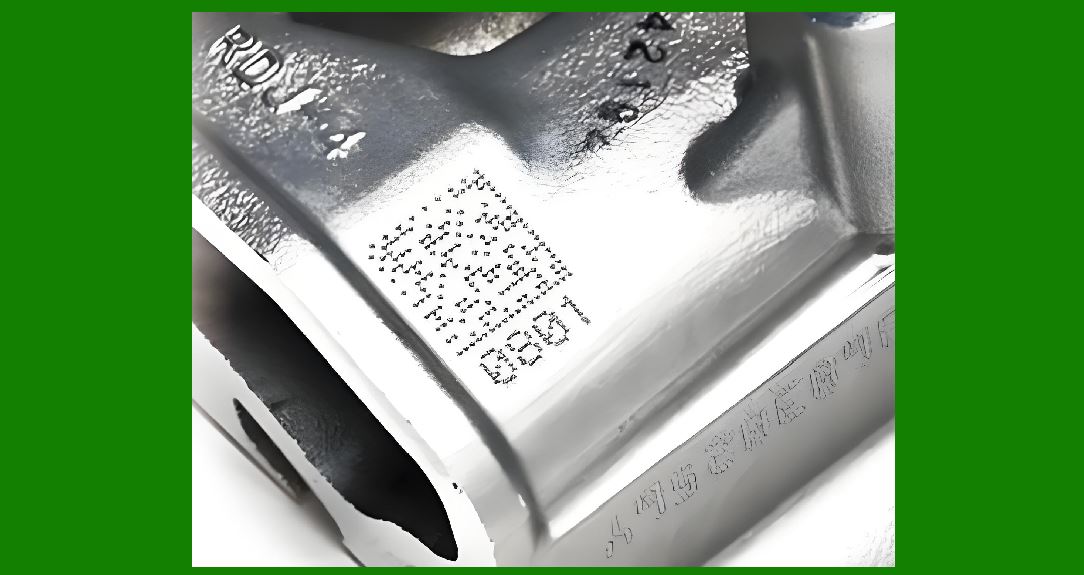
Low contrast is the defining challenge of Direct Part Marking. When a DataMatrix code is laser-etched or dot-peened onto a metal surface, the mark may be only slightly darker or lighter than the surrounding material . The contrast may also vary depending on the viewing angle, lighting conditions, and surface finish. On curved surfaces, reflections and shadows can further reduce the apparent contrast. In applications where components have textured or uneven surfaces, the background may contain granules, stripes, or other irregularities that interfere with code reading . |
Chapter 5: The Role of Lighting in Overcoming Low Contrast |
Proper illumination is often the key to reading low-contrast DataMatrix codes. The choice of lighting technique can dramatically affect the apparent contrast between the code and the background. Dark-field illumination, for example, uses light directed at a low angle to make laser-etched codes appear much darker than the surrounding reflective surface . Bright-field illumination is better for codes on flat surfaces with machining flaws. Advanced barcode readers integrate multicolored LED lights that can be configured for different lighting patterns, optimizing contrast for each specific surface and marking method . |
Chapter 6: Dark-Field Illumination for Reflective Surfaces |
Dark-field illumination is particularly effective for reading codes on flat, highly reflective metal surfaces . In this technique, blue or red LEDs are positioned to direct light at a shallow angle onto the surface. The light reflects off the smooth, unmarked areas, while the roughened or etched areas scatter the light and appear dark. This creates a high-contrast image where the code stands out clearly against the reflective background . The ABR 7000 barcode reader from Banner Engineering is an example of a device that uses this technique to reliably decode low-contrast DataMatrix codes on automotive components . |

|
Chapter 7: Diffuse Lighting for Curved Surfaces |
For curved parts, diffuse lighting is often preferred. A diffusely reflecting dome is illuminated from below, producing non-directional light that falls evenly on the part and does not cast defined shadows . This is commonly used for reading codes on cylindrical or complex-shaped parts where directional lighting would cause glare or shadows that obscure the code. The AIM specification includes diffuse dome lighting as an option for DataMatrix verification . |
Chapter 8: Polarized Lighting and Glare Reduction |
Reflections, or specular reflections, from metal and glass surfaces can saturate the imager and degrade reading performance . Polarized lighting filters out these reflections, allowing the code's contrast to be clearly visible. This is particularly useful for reading codes on polished metal or glass substrates. The Cognex DataMan readers, for example, use high dynamic range technology to increase image contrast and readability even on challenging surfaces like etched glass . |
Chapter 9: The Role of Imaging Algorithms |
Beyond lighting, advanced imaging algorithms are essential for decoding low-contrast DataMatrix codes. These algorithms perform adaptive thresholding, contrast enhancement, and noise reduction to extract the code pattern from a poor-quality image . The Cognex 2DMax algorithm with PowerGrid technology, for example, reliably reads DataMatrix codes even if they are damaged, occluded, or missing vital elements . Dynamsoft's proprietary algorithms are optimized for the specific challenges of DPM codes, including the lack of uniformity in dot depth and shape . |

|
Chapter 10: Print Quality Verification and Grading |
To ensure DataMatrix codes are reliably decodable, print quality verification systems grade the symbol's contrast, modulation, and other parameters. The Association for Automatic Identification and Mobility (AIM) maintains specifications for DataMatrix verification that include requirements for lighting environments . Verification is essential for regulated applications, such as pharmaceutical serialization and medical device marking, where codes that fail quality standards cannot be used in the supply chain. |
|
Part Two: American Applications on Challenging Surfaces |
Chapter 11: Glass Substrate Marking in Electronics Manufacturing |
In the production of smartphone and electronic device screens, manufacturers receive large sheets of coated glass with discrete etched 2D codes from the OEM. Each sheet is cut into appropriate sizes, and each part must be traceable back to the original sheet for quality traceability throughout the production process . The small DPM barcode on the glass is difficult for traditional barcode readers to see and read due to the lack of contrast on the glass substrate surface . If the barcode is not read and there are quality issues with displays, manufacturers cannot trace those issues back to the original substrate. Cognex DataMan fixed-mount barcode readers are used for this application because their high dynamic range technology increases image contrast and readability, and the 2DMax algorithm combined with PowerGrid technology reliably reads DataMatrix codes even on low-contrast glass surfaces . |
Chapter 12: Semiconductor Wafer Identification |
In semiconductor manufacturing, DataMatrix codes are laser-etched onto silicon wafers. The codes are often extremely small and the contrast between the etched mark and the silicon surface is very low. The Cognex In-Sight 1740 series of wafer readers uses specialized illumination---red or infrared---chosen based on the wafer's surface material and coating, to read these codes . The 1742 model uses IR illumination at 880 nanometers, which can penetrate certain surface coatings and reveal the underlying code pattern. These readers are used in both front-end and back-end semiconductor processes for wafer identification and traceability, conforming to the SEMI T7 standard. |
Chapter 13: Automotive Component Traceability |
In the American automotive industry, DataMatrix and other 2D codes are permanently etched into the surface of each critical component to ensure that parts can be traced throughout their entire life cycle . The codes are small, complex, and dense with information specific to the component. Contrast levels between the codes and the material they are etched into are low, and scratches, surface imperfections, and reflectivity can make the codes difficult to read . To ensure that each component is genuine original and matches the build order, the code must be verified prior to being installed in a vehicle . The ABR 7000 barcode reader, deployed along the assembly line, uses dark-field illumination with blue LEDs to create enhanced contrast between the code and the component surface, capturing a detailed image for verification . |
|
Chapter 14: Engine Block and Transmission Marking |
Engine blocks, transmission housings, and other cast metal parts in the automotive industry are marked with DataMatrix codes using dot-peen or laser etching. These components must withstand high temperatures, vibration, and exposure to oil and other fluids. The DataMatrix codes must be readable throughout the vehicle's lifetime, supporting warranty tracking and recall management. Dot-peen marking creates deep indentations that survive the harsh engine environment, but the contrast is often low, requiring specialized illumination and imaging algorithms. |
Chapter 15: Aerospace Component Lifecycle Tracking |
In the aerospace industry, every element installed on an aircraft, from the smallest screw to complex systems such as engines, must be traceable throughout its entire operational life cycle, which can span decades . DataMatrix codes are laser-etched onto turbine blades, engine housings, and airframe structures. The marks are often on curved, highly reflective metal surfaces, with low contrast between the mark and the material. Advanced imaging algorithms are required to correct for perspective distortion, handle reflections, and extract the code pattern despite the low contrast and challenging surface geometry. |
Chapter 16: Turbine Blade Marking |
Turbine blades in jet engines are among the most critical components in aerospace manufacturing. They are subject to extreme temperatures, vibration, and continuous stress. DataMatrix codes are laser-etched onto the blade root or surface, encoding part numbers, serial numbers, material certifications, and maintenance histories. The marks must survive the high-temperature environment of the engine. Nickel-based superalloys such as Inconel 718 require sophisticated laser marking approaches to achieve stable contrasts, using MOPA lasers with precise pulse control. The low contrast on these components demands readers with high-resolution imagers and advanced decoding algorithms. |

|
Chapter 17: Medical Implant Identification |
American medical implant manufacturers use laser etching to mark DataMatrix codes on hip stems, pacemaker cases, and dental screws. The codes encode the Unique Device Identifier (UDI), serial number, and manufacturing history. The marks must survive the implant's lifetime inside the body and be readable by surgical teams during implantation procedures. The titanium or stainless steel surface is often highly reflective, and the contrast is low, requiring specialized lighting and imaging systems. The FDA's Unique Device Identification regulations require that UDI codes be readable and verifiable, driving the adoption of advanced DataMatrix reading technology . |
Chapter 18: Surgical Instrument Traceability |
American hospitals and surgical instrument manufacturers use DataMatrix codes on scalpels, clamps, retractors, and other reusable surgical tools. The codes encode instrument identifiers, manufacturing dates, and sterilization histories. The marks must survive repeated autoclave sterilization cycles without degrading . Laser marking provides the durability required for instruments that are sterilized hundreds of times. The low contrast after multiple sterilization cycles requires robust decoding algorithms that can extract the code pattern despite accumulated wear and surface changes. |
Chapter 19: Printed Circuit Board Marking |
American electronics manufacturers use DataMatrix codes on printed circuit boards to encode board specifications, revision numbers, and manufacturing parameters. The codes are often very small, with module sizes as small as 0.075 millimeters. Fiber lasers create high-contrast marks on the board surface without damaging sensitive components. However, the contrast may be low if the board surface is dark or textured. High-resolution imagers with advanced lighting are required to capture the code clearly. The codes enable traceability through the electronics manufacturing process, linking each board to test results and supply chain data. |

|
Chapter 20: Electronic Component Identification |
DataMatrix codes are marked on connectors, switches, and other electronic components. The marks are often extremely small, using high-resolution laser systems. The codes encode component identifiers, manufacturing dates, and test results. The low contrast on some plastic or ceramic surfaces requires specialized illumination. The durability of laser marks is essential for components that will be soldered, cleaned, and handled during assembly. |
Chapter 21: Defense Equipment Item Unique Identification |
The U.S. Department of Defense requires DataMatrix codes on military equipment under MIL-STD-130 for Item Unique Identification. Both laser etching and dot-peen marking are used, depending on the equipment and material. The marks must survive harsh battlefield conditions, including sand, moisture, and temperature extremes. The low contrast on some equipment surfaces requires robust decoding. The marks must achieve specified quality grades, verified through inspection systems. The codes enable equipment tracking from acquisition through disposal. |
Chapter 22: Pharmaceutical Packaging and Serialization |
While pharmaceutical DataMatrix codes are typically printed on high-contrast labels, there are challenging applications. Codes printed directly onto aluminum blister foils or onto small vials with curved surfaces can present contrast and reflection issues. High-speed inkjet printing must produce codes with sufficient contrast for reliable decoding throughout the supply chain. The Drug Supply Chain Security Act requires serialization, and the codes must be readable at pharmacies and hospitals. Specialized inks and printing systems are used to ensure consistent contrast. |

|
Chapter 23: Laboratory Sample Tracking |
Clinical laboratories across the United States use DataMatrix codes on specimen containers, slides, and test tubes. The codes are often printed or laser-etched on small surfaces, with limited contrast. The codes encode patient identifiers, sample numbers, and test requisition data. The marks must be readable through automated analyzers that process hundreds of samples per hour. The curvature of the tube and the small module size present challenges that require high-resolution imaging and distortion correction. |
Chapter 24: Solar Panel Frame Marking |
American solar panel manufacturers use DataMatrix codes on panel frames and junction boxes. The codes are often laser-etched on aluminum surfaces, with low contrast. The marks must survive decades of outdoor exposure to sunlight, rain, and temperature extremes. Field service personnel use handheld scanners to read the codes during installation and maintenance. The marks must be readable despite accumulated dirt, oxidation, and weathering. |
Chapter 25: EV Battery Cell Traceability |
American electric vehicle battery manufacturers use DataMatrix codes on cylindrical and pouch battery cells. The codes encode cell identifiers, capacity readings, and manufacturing dates. The marks are often laser-etched on metal surfaces, with low contrast due to the reflective surface. The codes must be readable throughout the battery assembly process and after the battery is installed in the vehicle. The curvature of the cell and reflections present significant challenges for readers. |

|
Chapter 26: Construction Structural Steel Verification |
American steel fabricators apply DataMatrix codes to structural steel beams using dot-peen markers. The codes encode yield strength and mill certification data. Structural engineers scan the codes on-site to verify materials. The marks are on steel surfaces that may be dirty, rusty, or covered in welding spatter. The contrast is low, and the surface conditions can obscure the code. Rugged handheld readers with advanced decoding algorithms are required for reliable field reading. |
Chapter 27: Direct Part Marking on Plastic Components |
DataMatrix codes are marked on plastic components in the automotive, electronics, and consumer goods industries. The marks may be applied by laser etching or molding. The contrast is often low, especially on dark plastics. The surface may be textured or curved, presenting additional challenges. Reading these codes requires specialized illumination and decoding algorithms that can handle the low contrast and challenging surface conditions. |
Chapter 28: Industrial Tool and Equipment Tracking |
American manufacturers of industrial tools and equipment use DataMatrix codes for asset tracking. The codes are applied to tools, engine components, and motor parts. The marks must survive harsh industrial environments, including exposure to oil, dirt, vibration, and physical impacts. The contrast may be reduced by accumulated grime or surface wear. Rugged handheld readers are used by maintenance personnel to scan the codes and access maintenance histories and calibration records. |

|
Chapter 29: Jewelry and Luxury Goods Identification |
American jewelry retailers engrave DataMatrix codes on rings, watch clasps, and other luxury items. The codes are extremely small and often have low contrast against the metal surface. The marks must be readable for inventory management, authentication, and anti-counterfeiting. Specialized readers with high magnification are used to capture the tiny codes. The low contrast on highly polished gold, silver, or platinum surfaces requires careful illumination. |
Chapter 30: Medical Device Packaging |
American medical device manufacturers use DataMatrix codes on packaging for larger devices such as imaging equipment and surgical robots. The codes are often printed on labels that may be reflective or have low contrast. The FDA's Unique Device Identification regulations require that codes be readable and verifiable. Labeling must meet quality standards for contrast and print quality. Verification systems ensure that the codes meet the required standards before packaging is released. |
Chapter 31: 3D Printed Part Identification |
American manufacturers of 3D printed parts embed DataMatrix codes directly into the CAD model. After printing, the code is integral to the part. The marks are often on textured surfaces with low contrast. The decoders must handle the challenges of reading codes on printed surfaces that may have layer lines or other surface irregularities. Laser marking after printing provides additional contrast but may still be low on certain materials. |

|
Chapter 32: Advanced Illumination Techniques |
The reading of low-contrast DPM codes often requires advanced illumination techniques beyond standard lighting. The AIM specification defines multiple lighting environments for DataMatrix verification, including diffuse dome lighting (90-degree incident light, angle specifier D) for curved parts, directional lighting from orthogonal planes (angle specifier 30Q, 30T, 30S), and other configurations . These lighting options are designed to optimize contrast for different surface types and marking methods. |
Chapter 33: The Role of High-Resolution Imagers |
Low-contrast DataMatrix codes often have small module sizes, requiring high-resolution imagers to capture enough detail for reliable decoding. The ABR 7000 barcode reader, for example, features a 1.3 MP or 2 MP imager that reliably captures fine details on small, complex, and challenging barcodes . High resolution allows the decoder to distinguish individual modules even when the contrast is low or the surface is textured. This is essential for applications with tiny codes on semiconductor dies, PCBs, or small components. |
Chapter 34: Adaptive Thresholding and Image Processing |
To decode low-contrast DataMatrix codes, imaging software applies adaptive thresholding to determine the boundary between dark and light modules . Because the contrast may vary across the code, a single threshold is not sufficient. Adaptive thresholding adjusts the threshold based on local image characteristics, allowing the decoder to handle variations in lighting and surface reflectivity. Additional image processing steps, such as noise reduction and contrast enhancement, are used to improve the image quality before decoding. |

|
Chapter 35: The Importance of Code Verification |
Across all applications, DataMatrix code verification ensures that printed or marked codes meet quality standards. Verification systems analyze the code's contrast, modulation, and other parameters to assign a grade. For direct part marking, ISO/IEC 29158 defines seven quality parameters. Codes that fail verification must be corrected before they can be used in regulated supply chains. Verification is essential for compliance with DSCSA, FDA UDI, DoD MIL-STD-130, and industry standards . |
Chapter 36: Aiming Challenges for Handheld Readers |
Handheld imaging readers for DPM codes face unique challenges. DPM codes are often difficult for a human operator to even find on workpieces, which often have complicated surfaces . The codes are also relatively small, often less than 2 mm by 2 mm . Traditional aiming pattern frames are correspondingly small, making targeting difficult. Patent US20090218403 describes an arrangement that emits an aiming light pattern with an outer bright region and an inner dark region, allowing the operator to manually position the bright region to surround the code while the code is visible in the dark region . |

|
Detailed Summary |
Print Contrast Signal (PCS) is a critical parameter for DataMatrix readability, measuring the contrast between the dark and light modules of the code. While the ISO/IEC 16022 standard sets a minimum PCS of 0.4, modern DataMatrix readers can decode symbols with significantly lower contrast, thanks to the symbology's two-dimensional structure and powerful Reed-Solomon error correction . This low-contrast tolerance is a defining feature of DataMatrix, making it the preferred choice for Direct Part Marking (DPM) on challenging surfaces such as etched metal, glass, silicon, and highly reflective materials . |
Direct Part Marking presents unique challenges for barcode reading. Codes are etched, dot-peened, or laser-marked directly onto the surface of a part, often resulting in very low contrast between the code and the background . The surface may be reflective, curved, uneven, or textured, further complicating reading . Scratches, wear, and environmental exposure can reduce contrast over time . Advanced techniques are required to reliably read these codes, including specialized illumination (dark-field, diffuse, polarized), high-resolution imagers, and sophisticated decoding algorithms that perform adaptive thresholding and contrast enhancement . |
In the United States, low-contrast DataMatrix reading enables critical applications across multiple industries. In electronics manufacturing, DataMatrix codes etched onto glass substrates for smartphone screens are read using high dynamic range technology and 2DMax algorithms . In automotive assembly, laser-etched DataMatrix codes on engine blocks and transmission housings are decoded using dark-field illumination and high-resolution imagers, ensuring that only genuine components are installed . The aerospace industry uses DataMatrix codes on turbine blades and airframe components, with marks on curved, reflective metal surfaces that require specialized lighting and distortion correction . Medical device manufacturers laser-etch DataMatrix codes on surgical instruments and implants, which must remain readable through repeated sterilization cycles and low-contrast surfaces . |

|
The defense industry relies on DataMatrix codes under MIL-STD-130 for Item Unique Identification, with marks on military equipment exposed to harsh conditions. Semiconductor manufacturers use infrared illumination to read DataMatrix codes on silicon wafers. Solar panel, EV battery, and construction industries all depend on the technology for traceability and compliance. The low-contrast tolerance of DataMatrix is not merely a technical curiosity but a fundamental capability that enables the modern supply chain. From the factory floor to the hospital operating room, from the assembly line to the battlefield, DataMatrix codes on challenging surfaces silently ensure traceability, quality, and safety. |
 cs@easiersoft.com