DataMatrix Decoded: A Technical Deep-Dive |
Executive Summary |
In modern automotive manufacturing, the ability to trace every component from its raw material to its final assembly is not just a quality benchmark---it is a fundamental requirement for safety, compliance, and operational efficiency. The automotive industry has embraced DataMatrix direct part marking (DPM) as its standard for permanent, machine-readable identification on critical components . These codes, typically laser-etched or dot-peened directly onto engine blocks, transmission housings, brake discs, and chassis parts, serve as each part's 'digital birth certificate,' encoding information such as part numbers, serial numbers, production dates, and batch codes in a compact format . |
The real power of DataMatrix in automotive assembly lies in its integration with automated production systems. Robotic cameras and fixed-mount barcode readers positioned along assembly lines scan these codes at every critical stage, enabling just-in-sequence production where the right part arrives at the right station at the right time . When a transmission housing or engine block is scanned, the system instantly verifies it is the correct component for the vehicle being built, records its installation, and updates the digital thread that follows the part throughout its lifecycle. This automated traceability is essential for managing the complexity of modern vehicles, which can contain over 200,000 individual parts . |
This article explores the technical foundations of DataMatrix marking in automotive manufacturing, the standards and technologies that make it work, and real-world case studies from American and global automotive facilities that demonstrate its transformative impact on quality, efficiency, and recall management. |
|
Part One: The Technical Foundations of DataMatrix in Automotive Manufacturing |
Chapter 1: The Complexity of Modern Vehicle Assembly |
A modern vehicle is an engineering marvel of staggering complexity. A typical automobile transmission consists of around 300,000 parts, while an engine comprises approximately 200,000 components including pistons, cylinder heads, engine blocks, camshafts, and crankshafts . Managing this complexity requires a traceability system that can track each individual component from production through assembly and into the service lifecycle. DataMatrix codes provide the foundation for this system, offering a compact, durable, and machine-readable identifier that can be applied directly to the component surface. |
Chapter 2: Why Direct Part Marking Replaces Labels |
Traditional identification methods like adhesive labels or ink stamps are insufficient for automotive components. Engine blocks and transmission housings are exposed to extreme temperatures, oil, vibration, and mechanical handling during assembly . Labels can peel, ink can fade, and stamps can wear away. Direct part marking with DataMatrix codes creates a permanent, tamper-evident identification that survives the harsh environment of the engine compartment and the vehicle's entire operational life . Laser-etched marks on engine components retain legibility after hundreds of thousands of miles of operation, including exposure to extreme temperatures, vibration, and chemical cleaning . |
Chapter 3: The DataMatrix Symbology in Automotive Production |
The automotive industry has standardized on DataMatrix ECC 200 for direct part marking. This variant uses Reed-Solomon error correction, allowing the code to be decoded even if up to 30% of the symbol is damaged . This robustness is essential for components that may be scratched, contaminated with oil, or partially obscured during handling and assembly. The code can store up to 2,335 alphanumeric characters in a compact space, typically between 5 by 5 millimeters and 14 by 14 millimeters, encoding essential data such as lot numbers, production dates, supplier codes, unique part identifiers, and references to critical process parameters . |

|
Chapter 4: Marking Technologies in Automotive Manufacturing |
Several marking technologies are used to apply DataMatrix codes to automotive components, each suited to different materials and production environments. |
Chapter 5: Fiber Laser Etching |
Fiber lasers with a wavelength of 1064 nanometers are the most popular solution for marking metal automotive components . They produce high-contrast, permanent marks on aluminum, steel, stainless steel, and cast iron by melting or ablating the material surface. The process is fast---galvo systems can mark at speeds up to 10,000 millimeters per second---making them suitable for high-volume production lines . Laser marking is the standard for inline marking of serial numbers, barcodes, and DataMatrix codes on production metals because cycle times are critical and mark contrast is excellent . |
Chapter 6: Laser Marking of Aluminum Extrusions |
Aluminum extruders supplying the automotive industry face new challenges as programs demand that parts be marked as soon as they are off the press. Laser marking provides reliable inline traceability without limiting throughput, allowing compliance with automotive standards such as IATF 16949 and ISO 9001 . Laserax, a provider of laser marking solutions, has partnered with extrusion equipment manufacturer Granco Clark to integrate laser etching directly on extrusion lines. Their LXQ fiber lasers, bearing an IP67 protection rating for harsh environments, can mark moving extrusions at speeds up to 230 feet per minute (70 meters per minute) . The laser markers adapt to varying profile geometries with dynamic autofocus and a marking range of 150 millimeters. |
Chapter 7: Dot Peen Marking |
Dot peen marking uses a pneumatic or electromagnetic pin to create a series of tiny indentations on the part's surface. It is a cost-effective, robust solution for creating deep, durable marks that can survive post-treatments like shot peening and coating. Dot peen is particularly suitable for marking engine blocks and transmission housings where the depth of the indentations (up to 100 micrometers) ensures that the mark can only be destroyed by significant material removal, offering maximum protection against tampering . |

|
Chapter 8: Marking Quality and Verification |
It is not enough to simply mark a component; the mark must be readable and verified. Verification systems, typically using smart cameras with specialized illumination, analyze the code's contrast, modulation, and other parameters to assign a grade. For automotive applications, Tier-1 suppliers typically require a minimum grade of 'B' or better under ISO/IEC 15415 criteria, verified on 100% of parts produced . Inline vision systems capture high-resolution images of freshly etched DataMatrix codes, analyzing local contrast, module size, and geometric accuracy to ensure the code meets industry standards . |

|
Part Two: Regulatory and Quality Standards |
Chapter 9: IATF 16949 and ISO 9001 |
The automotive industry operates under strict quality management standards. IATF 16949, the global standard for automotive quality management, requires traceability systems that allow parts to be tracked throughout the manufacturing process and supply chain. Laser marking and DataMatrix codes provide the technological foundation for meeting these requirements . |
Chapter 10: AIM-DPM Verification Standards |
The Association for Automatic Identification and Mobility (AIM) has established direct part marking verification standards that are widely adopted in automotive manufacturing. Smart camera systems can verify DataMatrix codes in compliance with AIM-DPM standards, checking parameters such as symbol contrast, modulation, and geometric accuracy . These verification capabilities are critical for maintaining traceability throughout the manufacturing process . |
Chapter 11: Component-Level Traceability Requirements |
The automotive industry's traceability requirements extend beyond simple part identification. Each component's DataMatrix code must encode sufficient information to link the physical part to its manufacturing data: supplier certifications, material test reports, inspection results, and assembly records. This 'digital thread' enables complete lifecycle traceability, supporting recall management, warranty resolution, and liability protection . |

|
Part Three: American and Global Applications in Action |
Chapter 12: BMW Spartanburg - Pioneering DataMatrix in U.S. Body-in-White Production |
At BMW's manufacturing facility in Spartanburg, South Carolina, a pioneering DataMatrix traceability system has been in operation since the mid-2000s. The plant, which employs approximately 4,700 workers producing the BMW X5 and Z4 series for the world market, faced a critical challenge: the original handwritten labeling of body-in-white components was unreliable . After assembly, the handwritten descriptions were often no longer readable or smeared from parts handling. |
To optimize traceability of all car body components, BMW implemented a system using dot-peened or laser-etched DataMatrix codes on each component, along with a part number in plain text. For automatic detection of the codes and numbers, 26 code reading systems from Siemens (SIMATIC VS 130-2) were installed throughout the body-in-white construction area . Each component is assigned a consecutive 8-digit number from the higher-level control system, applied as a DataMatrix code with 20 by 20 dots. |
The smart camera systems, with an IP65 protection rating, operate reliably under the challenging conditions of body-in-white construction---consistently subject to welding dust and spatter---without special cleaning requirements . The system provides necessary assurance that the correct parts are being installed in each vehicle, enabling precise traceability of motor and rear compartments as different materials are combined based on ordered vehicle type . This American facility demonstrates how DataMatrix technology supports high-volume, mixed-model production with uncompromising quality standards. |

|
Chapter 13: Bosch Diesel Systems - 99% Read Rates and Wireless Efficiency |
Bosch Diesel s.r.o., a manufacturer of automotive components for the Diesel Systems division, implemented Cognex ID readers and vision systems to control production quality and track pump bodies and other products through twelve production sections . The demanding operations required 100% inspection accuracy, often with permitted deviations of only a few micrometers. |
The system was designed to eliminate production errors on pump bodies and, when an error is detected, identify its source. DataMan ID readers control the legibility of imprinted 6-millimeter DataMatrix codes. The success rate of error detection (readings) increased from the original 85% before implementation to a current rate of 99 to 100% . This dramatic improvement means that defective products are reliably prevented from reaching the next station, and the source of errors can be traced. |
A particularly innovative feature is the use of approximately 75 wireless readers out of about 80 total. Workers can use the readers two or three meters from their normal position, eliminating the time-consuming and potentially hazardous handling of wired readers in a production environment with slippery floors . The readers require minimal maintenance---workers only need to wipe the camera lens cover two or three times per shift. |
The system enables a complete tracked course of pump bodies through production from all key operations. Different properties are recorded using the DataMatrix code: operation time, worker name, machine, spindle, code quality, and body status. One of the most striking effects is the ability to perform backward searches using recorded images from production operations, enabling rapid root cause analysis when quality issues arise . Bosch Jihlava plans to purchase additional vision systems based on the demonstrated success. |

|
Chapter 14: KIA Motors - Overcoming Challenges on 6-Speed Transmission Lines |
KIA Motors, while based in Korea, represents a benchmark case study for the global automotive industry's adoption of DataMatrix. The company's traceability program reads 2D DataMatrix codes on engine and transmission components to verify correct part matching and save manufacturing information such as production date and model number for full traceability . |
When KIA shifted to a 6-speed transmission production line, the company faced significant challenges. The conventional transmission line produced approximately 1,800 units daily but only delivered 96-97% read rates. The engine line, producing 1,300-1,400 engines daily, had read rates under 97%. An increase in read rate of just 2-3% would deliver substantial benefits: increased production yield, reduced manufacturing costs, and improved work efficiency . |
The challenges were significant. Parts for the 6-speed gearbox were very small, and KIA had downsized the marking area from 10 by 10 millimeters to 5 by 5 millimeters, impacting marking quality. Additionally, components were assembled with anti-rust oil spray, and the DataMatrix codes were stained or damaged by dirt or scratches despite washing . The previous barcode reader frequently caused production machine stops due to read failures and was manually operated, making it hard to maintain production cycle times. |
KIA Motors deployed Cognex barcode readers, achieving 99% read rates on the 6-speed transmission production line . The 2DMax+ code reading algorithm was unaffected by the oil, dirt, scratches, and reduced marking size. Even when critical parts of the code were missing---such as finder or timing patterns---the software could locate and read underexposed and overexposed codes without multiple read attempts . KIA installed the In-Sight 5110 fixed-mount readers at each assembly point and the compact In-Sight Micro 1110 for tight spaces, with DataMan 8500 handheld readers as a backup system . |

|
Chapter 15: Continental AG - Smart Camera Integration for Label Verification |
Continental AG's Czech Republic division, a Tier 1 automotive supplier producing electronic assemblies, implemented a smart camera solution to meet a new customer requirement from a global automobile manufacturer: verify the position and print quality of every label on its subassemblies . The previous system used a pneumatic label applicator and a stationary linear scanner to read serial number data. |
The new requirements included reading both linear and DataMatrix codes, ensuring label presence, verifying proper label position and orientation, and ensuring print accuracy . Continental replaced its existing laser scanner with a miniaturized smart camera from Microscan (Vision MINI), chosen for its small size (26 by 46 by 54 millimeters), light weight (57 grams), and RS-232 serial connection . The communication was set up to emulate the former scanner, allowing smooth migration without reprogramming the existing application in the PLC. |
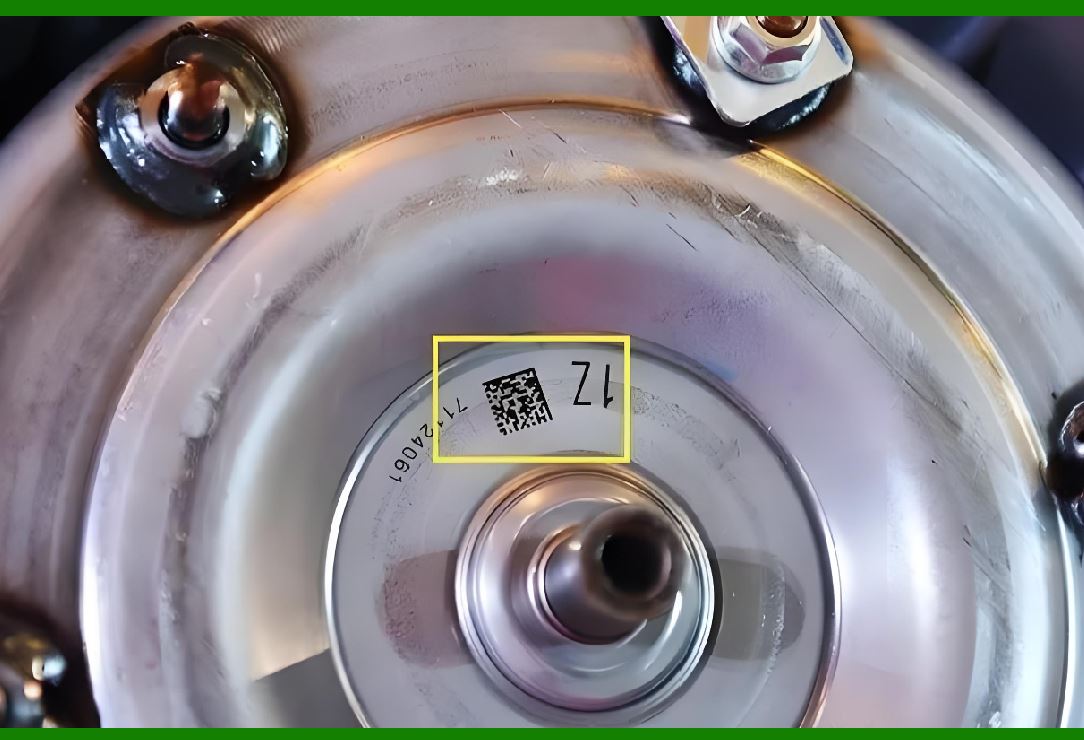
The smart camera simultaneously reads the DataMatrix code and locates the label on the part, verifying its presence, orientation, and placement. A pattern match tool checks print accuracy. This consolidation of functions in a single device demonstrates how smart cameras meet the convergence of machine vision and auto ID technologies in automotive manufacturing. |
|
Chapter 16: Integri Robotics Case Study - 99.9% Accuracy in Part Traceability |
A major automotive component manufacturer faced increasing demands for complete part traceability from OEM customers while struggling with error-prone manual documentation processes. The existing system could not meet new regulatory requirements for 100% part history verification . Challenges included multiple production lines with diverse part types, limited space for additional equipment, legacy MES systems requiring integration, and strict cycle time constraints. |
Integri Robotics implemented a vision-based direct part marking verification system integrated at critical production stages. The system combines high-resolution cameras with specialized lighting to reliably read 2D DataMatrix codes laser-etched directly onto metal components. The solution required custom mounting to accommodate space constraints, with carefully engineered lighting to handle reflective metal surfaces. |
Results were measured across six months of production, with read rates exceeding 99.9% across all part variants. The system successfully linked complete manufacturing data---process parameters, inspection results, and material certifications---to each individual component. Documentation errors were reduced by 85%, eliminating costly quality holds and customer complaints. Return on investment was achieved in 9 months, significantly faster than the projected 18-month payback period, primarily from unanticipated savings in warranty costs and the elimination of customer chargebacks . When a potential quality issue was identified months after production, the system enabled rapid isolation of exactly which vehicles contained potentially affected parts, limiting the field investigation to precisely 2,183 vehicles. |

|
Chapter 17: Brake Disc Marking for Safety and Compliance |
Brake discs represent a safety-critical component where traceability is not just best practice but mandatory. European Directive 2007/46/EC and UNECE Regulation R90 govern brake system type approval, requiring documented traceability of each brake disc . Manufacturers must be able to prove, in the event of recalls or safety investigations, the origin and production route of each individual component placed on the market. |
Fiber laser technology, with wavelengths around 1064 nanometers, enables stable optical contrasts on cast iron and metal alloys, engraving readable DataMatrix codes throughout the component's operational life. The DataMatrix code, standardized to ISO/IEC 16022, allows up to 2,335 alphanumeric characters to be stored in a small space---typically 5 by 5 millimeters to 14 by 14 millimeters on brake discs. This information density allows incorporation of lot numbers, production dates, supplier codes, unique part identifiers, and references to critical process parameters . |
Laser marking parameters on brake discs require careful calibration to avoid microstructural alterations that could trigger cracks or brittle zones. Typical materials---gray pearlitic cast iron GG15, spheroidal cast iron GGG40, or special alloys---have different thermal responses to laser energy. The goal is to achieve a marking depth between 20 and 50 micrometers, sufficient to ensure permanence without affecting the functional thickness of the disc. Thermal fatigue tests show that properly executed markings do not reduce mechanical strength when the marked area is positioned away from areas of maximum mechanical stress . |
Integration with automatic conveyors enables marking of moving components, reducing cycle times compared to stop-and-mark stations. On lines with target throughputs of 60-120 discs per hour, encoder-follower systems can increase overall plant efficiency (OEE) by 15-20% . Integrated post-marking machine vision systems grade each DataMatrix code according to ISO/IEC 15415, with Tier-1 suppliers typically requiring a minimum grade of B or better on 100% of parts produced. |
|
Chapter 18: Granco Clark - Laser Marking on Extrusion Lines |
Aluminum extruders supplying the automotive industry face the challenge of marking extrusions directly on the press rather than after finishing. Granco Clark, a provider of extrusion handling equipment, has partnered with Laserax to integrate laser etching systems that meet OEM requirements for traceability. The LXQ fiber lasers, with an IP67 protection rating, can be positioned anywhere on the extrusion line, even face up below the extrusion . The laser's 3D head with dynamic autofocus achieves a long marking range of 150 millimeters, adjusting to varying profile geometries without complex mechanical setups. The marking window of 300 by 300 millimeters allows marking multiple profiles at once, while the system's speed matches extrusion rates up to 230 feet per minute . Laser marking eliminates the consumables and maintenance costs associated with inkjet printing, lowering operating costs. |
Chapter 19: Inline Label Inspection in Robotic Cells |
Automotive manufacturers require accurate label inspection to ensure compliance, traceability, and safety. Labels containing DataMatrix codes must be verified for quality and accuracy, even in challenging environments like robot cells . A smart camera inspection system with high-intensity spot illumination enables inspection of labels from over 3 feet away, ensuring strong, even lighting for accurate inspections. The camera system verifies DataMatrix codes in compliance with AIM-DPM standards and performs 100% Optical Character Verification (OCV) on printed symbols and text, ensuring every label meets specifications for legibility and accuracy . |
Chapter 20: The Future of DataMatrix in Automotive Manufacturing |
As automotive manufacturing continues to evolve, DataMatrix traceability will become even more critical. Electric vehicle battery cells, electronic control modules, and advanced driver assistance system components all require permanent, machine-readable identification. Laser marking systems are being integrated with vision systems and AI-based quality control to automatically verify DataMatrix quality in real time . The convergence of DataMatrix technology with Industry 4.0 and the Internet of Things will enable unprecedented visibility into the production process, turning traceability data from a compliance requirement into a strategic asset for continuous improvement . |

|
Detailed Summary |
DataMatrix direct part marking has become the foundational technology for traceability in automotive assembly. By permanently etching or dot-peening these compact two-dimensional codes onto critical components---engine blocks, transmission housings, chassis parts, and brake discs---manufacturers create an immutable link between each physical part and its digital history. This 'digital birth certificate' accompanies the component through its entire lifecycle, from raw material to assembly to service and, if necessary, recall. |
The technical implementation relies on a combination of marking technologies, with fiber lasers being the dominant choice for high-speed production lines. Laser markers, operating at speeds up to 10,000 millimeters per second, produce high-contrast, permanent marks on aluminum, steel, and cast iron components. Dot peen marking provides a cost-effective alternative for deep, durable marks on hard metals. Verification systems, using smart cameras with specialized illumination, ensure every code meets the required quality grade---typically 'B' or better under ISO/IEC 15415---before the component proceeds to the next production stage. |
The real-world impact of this technology is demonstrated by case studies across global automotive manufacturing. BMW's Spartanburg, South Carolina plant implemented DataMatrix traceability for body-in-white components, eliminating the unreliability of handwritten labeling and enabling precise tracking of components through mixed-model production. Bosch Diesel Systems achieved 99-100% read rates on 6-millimeter DataMatrix codes, with approximately 75 wireless readers providing flexibility and safety on the production floor. KIA Motors, despite challenges of reduced marking size, oil contamination, and small parts, achieved 99% read rates on 6-speed transmission lines. |
The benefits extend beyond compliance. Automated traceability systems have demonstrated 99.9% read rates across all part variants, reduced documentation errors by 85%, and enabled rapid isolation of affected vehicles in potential quality issues---limiting field investigations to precisely identified VINs. Return on investment has been achieved in as little as 9 months through unanticipated savings in warranty costs and elimination of customer chargebacks. |

|
The automotive industry's adoption of DataMatrix direct part marking represents a convergence of quality management, automation, and information technology. It is not merely about meeting regulatory requirements---it is about transforming manufacturing data into a strategic asset that drives continuous improvement, builds customer confidence, and ensures that every vehicle on the road is built from components that are genuine, traceable, and safe. As vehicles become more complex and the demand for transparency grows, DataMatrix traceability will remain an indispensable foundation of modern automotive manufacturing. |
 cs@easiersoft.com