DataMatrix Decoded: A Technical Deep-Dive |
Executive Summary |
In the world of modern electronics, traceability is no longer a luxury---it is a necessity. A single smartphone contains dozens of circuit boards, each populated with hundreds of tiny components, and any one of them could be the source of a defect that leads to a costly recall. DataMatrix codes have become the standard for component identification in electronics manufacturing because they can store substantial information in a minimal amount of space . These tiny two-dimensional codes---often no larger than 1 to 2 millimeters square---contain serial numbers, batch information, and manufacturing data essential for traceability in complex global supply chains . |
The application of DataMatrix in electronics manufacturing presents unique technical challenges. Components are increasingly miniaturized, with codes measuring just millimeters across. Surface treatments, soldering processes, and handling can damage codes, while reflective component surfaces create glare that obscures code patterns . Yet, the reliability of these tiny marks is so critical that manufacturers demand 100% read rates to maintain production efficiency and protect against costly recalls. |
This article explores how DataMatrix codes are applied to printed circuit boards (PCBs) and electronic components, the technologies that make this possible, the challenges faced in the production environment, and the real-world applications that demonstrate the technology's transformative impact on quality and traceability. |

|
Part One: The Technical Foundation of PCB Marking |
Chapter 1: Why DataMatrix for PCBs |
Printed circuit boards are the nervous system of every electronic device. From smartphones and laptops to medical devices and automotive control units, PCBs must be identified, tracked, and traced throughout their lifecycle. Traditional methods like paper labels are insufficient---they can crimp, tear, and fall off during the harsh manufacturing process. A circuit board with its paper label missing is often considered scrap . |
DataMatrix codes solve this problem by providing a permanent, machine-readable mark that can be applied directly to the board surface. Laser etching or high-quality inkjet printing creates indelible marks that cannot be accidentally removed . This is particularly valuable in the electronics industry, where the ability to track an individual board from raw material to finished product is essential for quality management, warranty tracking, and recall protection. |
The compact size of DataMatrix is crucial for modern electronics. As electronic devices continue to shrink, PCBs have inevitably downsized, leaving less 'real estate' for identification marks . A DataMatrix code can encode sufficient information to uniquely identify every circuit board manufactured, yet fit into an extremely small space---as little as 1 by 1 millimeter . |

|
Chapter 2: The Data Matrix Code for Electronics |
The DataMatrix code is a two-dimensional matrix barcode that can store large amounts of data in a limited space . In electronics manufacturing, the code is typically ECC 200 compliant, using Reed-Solomon error correction. This means even if 30% of the mark is obliterated, the full set of data encoded in the mark remains readable . |
DataMatrix codes on PCBs typically store information such as part numbers, serial numbers, revision codes, lot codes, vendor IDs, production dates, and other manufacturing-related data . The increasing demand for product traceability requires more manufacturing-related information to be labelled onto every PCB, and DataMatrix codes provide the capacity to encode all this data in a compact format . |
Chapter 3: Marking Technologies for PCBs |
Two primary marking technologies are used for applying DataMatrix codes to PCBs: laser marking and inkjet printing. |

|
Chapter 4: Laser Marking |
Laser marking is the preferred method for creating permanent DataMatrix codes on PCBs. Fiber lasers create permanent 2D codes on metal PCBs, while CO2 lasers work well for non-metallic surfaces . Laser marking is particularly valuable for applications requiring durability, such as automotive PCBs where the marking must survive the board's entire lifetime . |
Laser marking offers several advantages: it is permanent, tamper-proof, and can create very small codes with high resolution. Modern inline PCB marking machines can mark DataMatrix codes as small as 2 by 2 millimeters on PCBs with positioning accuracy of (+-)0.01 millimeters . The process is fast and can be integrated directly into the production line, with the ability to mark workpieces of a wide range of sizes . |
Chapter 5: Inkjet Printing |
Continuous Inkjet (CIJ) printing is a high-speed, non-contact method for printing alphanumeric text and 2D codes on PCBs . While not as permanent as laser marking, inkjet printing is suitable for applications where the mark does not need to survive extreme conditions. However, the durability of inkjet marks depends on the characteristics of the ink used; typically, a white pad is screened on, then the mark is ink-jetted onto the pad . |
Chapter 6: Miniature Identifier Chips |
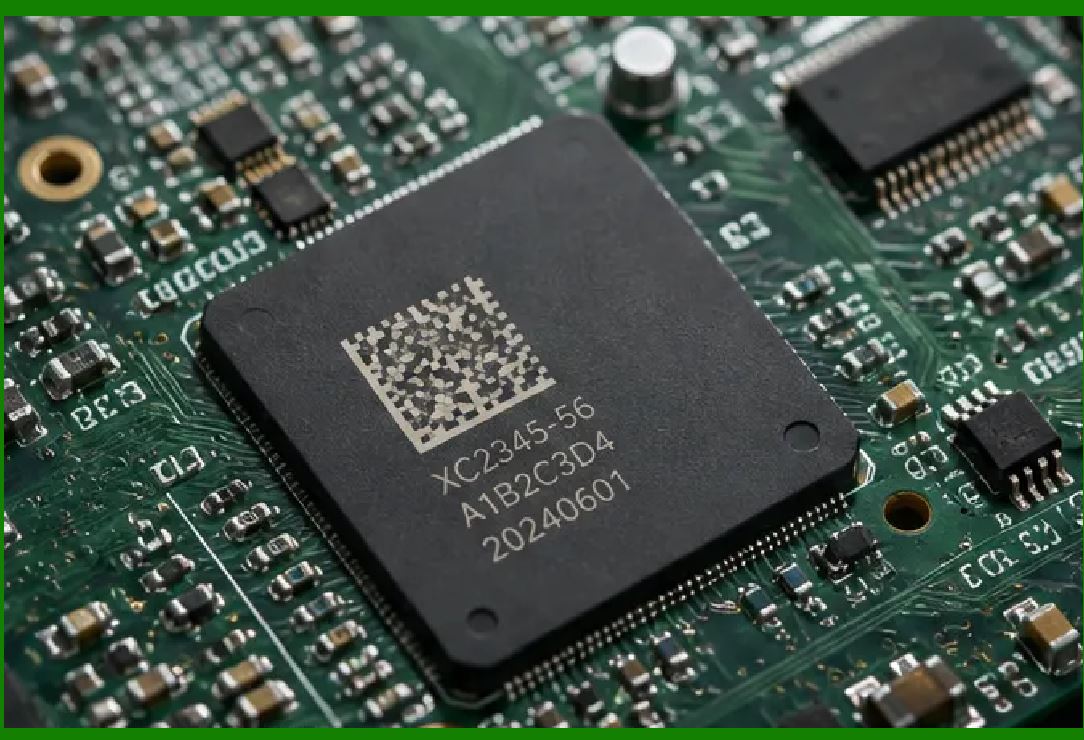
An emerging approach for PCB identification is the use of miniature identifier chips that are placed onto the board like any other component. These chips, typically measuring about 1.2 millimeters square, contain a high-density DataMatrix code that provides unique product traceability . The pad is loaded into a standard SMT chip shooter and then picked-and-placed alongside other components during the PCB manufacturing process. Each board thereby gains a unique identification that provides traceability data not only for the PCB itself, but also for all other components contained on the populated PCB . |

|
Chapter 7: The 2x2 Millimeter Code |
The minimum size for a DataMatrix code on a PCB is typically 2 by 2 millimeters, though codes as small as 1 by 1 millimeter are achievable with laser marking and specialized equipment . These tiny codes require high-quality printing with no smudges, diffusion, or errors, as any imperfection can place the dots in the wrong location and render the code unreadable . Dedicated PCB marking systems now offer the ability to mark 2 by 2 millimeter DataMatrix codes as a standard feature . |
Chapter 8: The Importance of Code Verification |
After marking, the DataMatrix code must be verified to ensure it meets quality standards. Verification involves taking an image of the mark as soon as it has been printed or etched on the circuit board and grading it for readability based on industry standards . This verification step is critical in electronics manufacturing because a non-readable code can lead to production stoppages and lost traceability. |
Chapter 9: Reading Challenges in Electronics Manufacturing |
Electronics manufacturers face unique challenges with DataMatrix reading. Components are small, with codes measuring just millimeters across. Surface treatments, soldering processes, and handling can damage codes, while reflective component surfaces create glare that obscures code patterns . Advanced vision systems address these challenges through specialized algorithms designed for damaged or partially obscured codes. These systems can reconstruct DataMatrix patterns even when portions are missing due to scratches, manufacturing defects, or surface contamination . |

|
Chapter 10: The Need for 100% Read Rates |
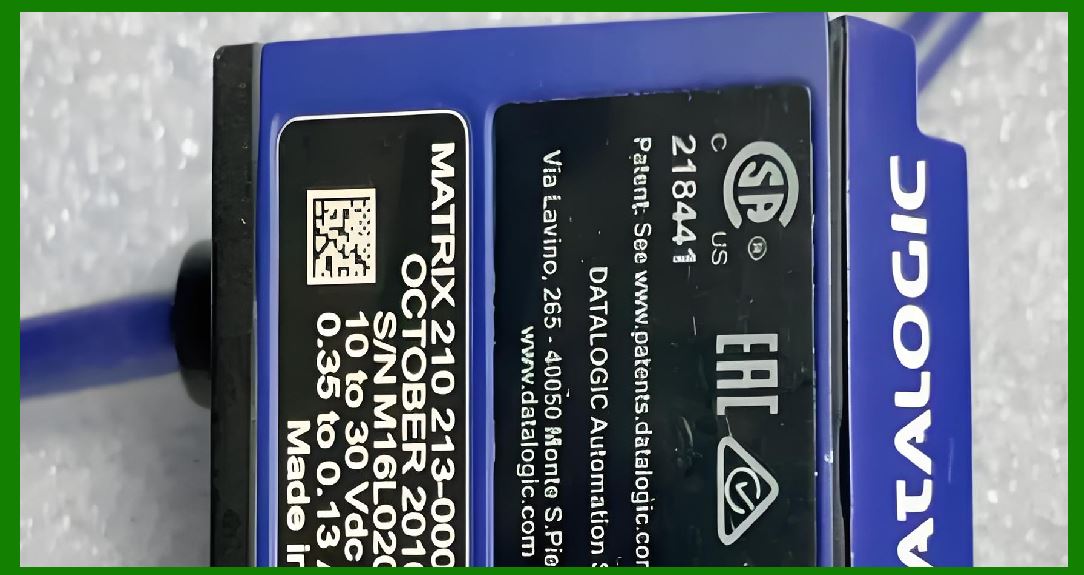
In electronics manufacturing, production lines operate at high speed with minimal tolerance for interruptions. A single non-read can cause the production line to stop, requiring manual intervention. This is why manufacturers demand 100% read rates for DataMatrix codes. When a leading electronics manufacturer improved their read rate from 95% to 100%, they achieved a production boost of approximately 10% . The success rate of error detection increased from under 85% to a current rate of 99-100% in some implementations . |
|
Part Two: Standards and Traceability Requirements |
Chapter 11: Regulatory and Industry Standards |
As electronics manufacturing evolves with smaller components and diverse product variations, traceability has become essential, especially in critical industries like aerospace, healthcare, defense, and power generation . Regulatory and industry standards require precise codes and compliance logos to support safety, environmental responsibility, and traceability . Standards such as UL, ISO, and MIL-STD Digital Product Passport (DPP) increasingly mandate traceability systems that DataMatrix codes help satisfy. |
Chapter 12: The Automotive Industry Standard |
Virtually all automotive companies are using the DataMatrix symbology in one form or another . The automotive industry, which has some of the strictest traceability requirements, has been a major driver of DataMatrix adoption on PCBs. Automotive PCBs must be traced from manufacturing through the entire vehicle lifecycle, enabling recall management and warranty tracking. |
|
Chapter 13: Aerospace and Defense Requirements |
In the aerospace and defense industries, traceability is not just a best practice but a regulatory requirement. PCBs used in aircraft and military equipment must be identifiable throughout their operational life. The permanent nature of laser-etched DataMatrix marks makes them ideal for these applications, where paper labels would not survive the harsh environment. |
Chapter 14: Medical Device Traceability |
PCBs in medical devices must be traceable to comply with FDA Unique Device Identification (UDI) requirements. DataMatrix codes provide the permanent, machine-readable identification that these regulations require, enabling tracking of medical devices from manufacturing through patient use. |
Chapter 15: Counterfeit Prevention |
Counterfeiting is a growing threat in the electronics industry, jeopardizing product reliability, regulatory compliance, and brand trust . Advanced marking technologies help combat counterfeiting by providing unique product identifiers that make replication more difficult . Both serialized and batch-specific codes, enabled by DataMatrix marking, are nearly impossible for counterfeiters to replicate effectively. |

|
Part Three: American and Global Applications in Action |
Chapter 16: Sony Malaysia - Achieving 100% Read Rates |
One of the most compelling case studies in DataMatrix PCB marking comes from Sony's manufacturing facility in Penang, Malaysia. Sony was producing PCBs for a new MPx player targeting the demanding consumer market, and required a reliable solution for reading DataMatrix codes on each board . |
The challenge was significant. Each PCB moving along the conveyor belt on nine production lines was marked with a DataMatrix code containing 10 characters of product information, measuring just 1 millimeter by 1 millimeter . The factory produced 40,000 units daily, so any reading failure would disrupt production and cause costly delays. |
Sony's existing reading solution was clearly inadequate, with an average weekly rejection rate of 10,000 units . This was costing the company money and delaying product time-to-market. |
Sony tested multiple readers on the market. The only solution that could meet their expectations was Cognex's In-Sight vision system with ID Tools . The system demonstrated superior performance in several areas: exceptional decoding speed and stability, new perspective distortion support enabling reliable reading even at an angle, and the ability to store jobs in the reader to attempt multiple reads at different exposures . |
The results were dramatic. The In-Sight ID readers were installed on all nine production lines. Reading time improved from more than 10 seconds to just 2 seconds per read. The success rate improved from 95% to 100% . With 100% success, production lines no longer needed to stop because of code reading failures, eliminating the need to stop lines for product repositioning or focus adjustment . |
The financial impact was substantial: Sony calculated weekly savings of approximately $5,000 USD based on a 5% failure rate within 200,000 units weekly . The company expected a return on investment within 10 months. TK Tan, Senior Engineer at Sony Penang, stated: 'We improved our reading speed and increased the success rate to 100%, saving us valuable time and improving production efficiency - we hope to implement these visual solutions at other facilities to solve other OCR applications' . |

|
Chapter 17: Beyonics Singapore - 10% Production Boost |
Beyonics Technology, an electronics manufacturing services provider, faced two challenges: smaller PCBs meant less space for barcode labels, and increasing demand for product traceability required more information to be encoded onto each PCB . Information like lot code, vendor ID, product number, serial number all needed to be encoded onto a smaller label. |
Beyonics and its customers resolved these issues by migrating to DataMatrix codes . The real challenge was implementation: within the plant, Beyonics had many in-circuit and functional testers with different reader configurations. Their existing readers were in poor condition and could not read 2D codes . Many systems required custom cabling to handle various triggering inputs, and some were configured to communicate with different protocols. |
Through on-site troubleshooting, Cognex's sales and engineering team performed a direct replacement of Beyonics' fixed-mount readers without altering any existing software programming or hardware wiring configurations . Beyonics' process engineers spent little time on this migration, allowing them to focus on keeping production lines running. |
The results: prior to installing DataMan readers, Beyonics was experiencing unacceptable read rates. Operators often had to reload PCBs when a no-read situation occurred, causing SMT machines to stop until manual intervention . After installing DataMan fixed-mount readers, they achieved about a 10% increase in production throughput . |
The solution was so successful that Beyonics also replaced their existing handheld ID readers with the DataMan handheld series. The handheld readers used the same Setup Tool software as the fixed-mount units, making deployment easier without additional training . |

|
Chapter 18: ATC Automation - Miniature Identifier Chips |
One of ATC Automation's customers, a leading supplier of electrical and fiber optic interconnects, switches, and application tooling, manufactures miniature identifier chips that provide unique product traceability of work-in-progress PCBs in medium to high-volume electronics assembly processes . |
During the end customers' PCB manufacturing process, the pad is loaded into a standard SMT chip shooter and then picked-and-placed alongside other components before the PCB is solder reflowed. Each PCB thereby gains a unique identification that provides traceability data not only for the PCB, but also for all other components contained on the populated PCB . |
It is paramount that the high-density miniature DataMatrix code is present and readable on each individual pad . The manufacturer used Microscan's products to ensure code readability during the manufacturing process. This application demonstrates how DataMatrix technology can be integrated directly into the PCB assembly process, providing traceability without requiring additional steps. |

|
Chapter 19: RVSI's Early Adoption (2000) - Global Mobile Phone Manufacturers |
RVSI (Robotic Vision Systems Inc.), the inventor of DataMatrix, received orders from three of the world's largest mobile phone manufacturers for equipment to verify and read DataMatrix codes on circuit boards . These orders aggregated over $1 million and were received by RVSI Acuity CiMatrix. |
The three manufacturers committed to global use of DataMatrix for tracking and tracing circuit boards through the manufacturing process, and then through the lifecycle of the product once in the customer's hands . One European manufacturer had already installed 500 'read points'---stations where codes are read during manufacturing---and planned to deploy 1000 read points by the end of that year . |
RVSI sold two types of equipment: the DMx Verifier+ for verifying that marks had been made properly, grading the mark for readability based on industry standards; and the much more prevalent DMx AutoID+, used for reading marks as boards made their way through the manufacturing process . These fixed-mount units combined cameras, lighting, hardware, and software in an installation-ready package. |
The mobile phone manufacturers recognized that DataMatrix would likely supplant paper labels for tracking circuit boards. As RVSI's CEO noted: 'For any small electronics device, 'real estate' on a circuit board is a precious commodity. A DataMatrix can encode sufficient information to individually identify every circuit board manufactured, yet put this information into an extremely small space on that board; as little as one millimeter square' . |

|
Chapter 20: Inner Layer Traceability in PCB Production |
In the complex process of PCB manufacturing, traceability must be maintained from the earliest stages. One approach involves laser-marking a DataMatrix code at the entrance of the inner layer line. The direct imaging machine exposes the code, allowing traceability to be built into the process from the start . |
Since codes are typically placed on the technological frame, it is important to ensure they remain undamaged during handling---or to include a backup code as a precaution . After lamination, copper covers the top and bottom surfaces, making it impossible for standard scanners to read through the copper. However, it is still possible to use an X-ray source to read a DataMatrix code on an inner layer . |
If unique serialization is required, the most stable method is to drill the DataMatrix code during the X-ray stage. However, this affects throughput, as code drilling slows the X-ray process and can create a production bottleneck . An alternative is using job-level traceability, where a laser marker at the X-ray stage creates a job code without slowing processing, and the code is read at station 1 of the drilling machine to load the job . |

|
Chapter 21: Automotive PCB Traceability |
Automotive PCBs must survive harsh environments including extreme temperatures, vibration, and chemical exposure. Laser-marked DataMatrix codes have been tested to ensure they last the life of the board . According to engineers at the Symbology Research Center in Huntsville, Alabama, who work in conjunction with NASA to develop marking methods, the durability of the mark on PCBs depends upon the method employed. Laser marking should last the life of the board, while inkjet is dependent upon the characteristics of the ink used . |
Virtually all automotive companies are using the DataMatrix symbology in one form or another . Some companies are even using a removable ink placed on the board to carry its warranty and repair history, which is 'erased' and then updated by service depots on warranty claims . |
Chapter 22: 2D Codes as Digital Passports |
Technologies like 2D codes serve as digital passports for electronic products, enabling lifecycle tracking and facilitating recycling efforts . A DataMatrix code on a PCB provides a unique identifier that links the physical board to its digital history---information about where components came from, who assembled them, when, and under what conditions. |

|
Detailed Summary |
DataMatrix codes have become an indispensable tool in electronics manufacturing, particularly for printed circuit board identification and traceability. The ability to encode a substantial amount of information in a minimal space---as little as 1 by 1 millimeter---makes DataMatrix the ideal solution for modern electronics, where board space is at a premium and traceability requirements are increasingly stringent. |
The technology has proven its value through real-world applications across the global electronics industry. Sony achieved 100% read rates on 1-millimeter DataMatrix codes, eliminating costly production stoppages and generating weekly savings of approximately $5,000 . Beyonics Technology improved read rates from unacceptable levels to achieve a 10% production boost by migrating to DataMatrix and reliable reading solutions . Major mobile phone manufacturers committed to global DataMatrix implementation in the early 2000s, recognizing its superiority over paper labels for circuit board identification . |
The technical foundations of DataMatrix PCB marking are robust. Laser marking provides permanent, tamper-proof identification that can survive the board's entire lifetime. Inkjet printing offers high-speed, non-contact marking for applications where permanent marking is not required. Verification systems ensure every code meets quality standards before the board proceeds. Advanced reading solutions handle the challenges of small codes, reflective surfaces, and damaged marks. |
DataMatrix traceability in electronics manufacturing is not merely about marking each PCB---it is about creating a digital thread that follows the board from raw material through assembly, testing, and into the final product. This digital thread enables quality management, rapid recall response, counterfeit prevention, and lifecycle tracking. As electronic devices continue to shrink and supply chains become more complex, DataMatrix codes will remain an essential component of traceability systems, ensuring that every board can be identified, tracked, and traced throughout its lifecycle. |
 cs@easiersoft.com