DataMatrix Decoded: A Technical Deep-Dive |
Executive Summary |
In the fresh produce industry, a single contaminated batch can lead to widespread illness, massive recalls, and irreversible damage to brand trust. The challenge has always been speed: how quickly can you trace a contaminated product back to its source and remove it from the supply chainDataMatrix codes have emerged as a powerful solution to this challenge by encoding critical traceability data directly on individual fruit labels or punnets. |
Unlike traditional linear barcodes that only identify the product type, DataMatrix codes can store a wealth of information including farm origin, harvest date, grower ID, batch information, net weight, and use-by dates in a compact format . This enables rapid, targeted recalls based on specific batches rather than pulling entire product lines from shelves . The technology is part of a broader industry shift toward 2D barcodes in food packaging, driven by initiatives like GS1's Sunrise 2027 and regulatory frameworks such as the FDA's Food Safety Modernization Act (FSMA) Rule 204 . |
This article explores how DataMatrix codes are being applied to fresh produce, the technical implementation, and real-world examples that demonstrate their transformative impact on food safety, waste reduction, and supply chain visibility. |

|
Part One: The Technical Foundation of Produce Traceability |
Chapter 1: Why Fresh Produce Needs Better Traceability |
Fresh produce presents unique traceability challenges compared to packaged goods. Individual fruits and vegetables are often sold loose or in punnets, with limited space for labeling. Traditional 1D barcodes on price-look-up (PLU) stickers only identify the product type, not the specific batch or origin. When a contamination event occurs, investigators may know the product type but cannot quickly identify which farm, field, or harvest batch was affected. |
The Food Safety Modernization Act (FSMA) Rule 204, enforced by the FDA, addresses this gap by requiring enhanced traceability for certain foods . The rule mandates that supply chain partners maintain and share traceability information, with GS1 Standards providing the framework for implementation . DataMatrix codes are a key technology for meeting these requirements, as they can encode the Global Trade Item Number (GTIN), batch/lot number, and other critical data elements in a scannable format . |
|
Chapter 2: What is a GS1 DataMatrix Code |
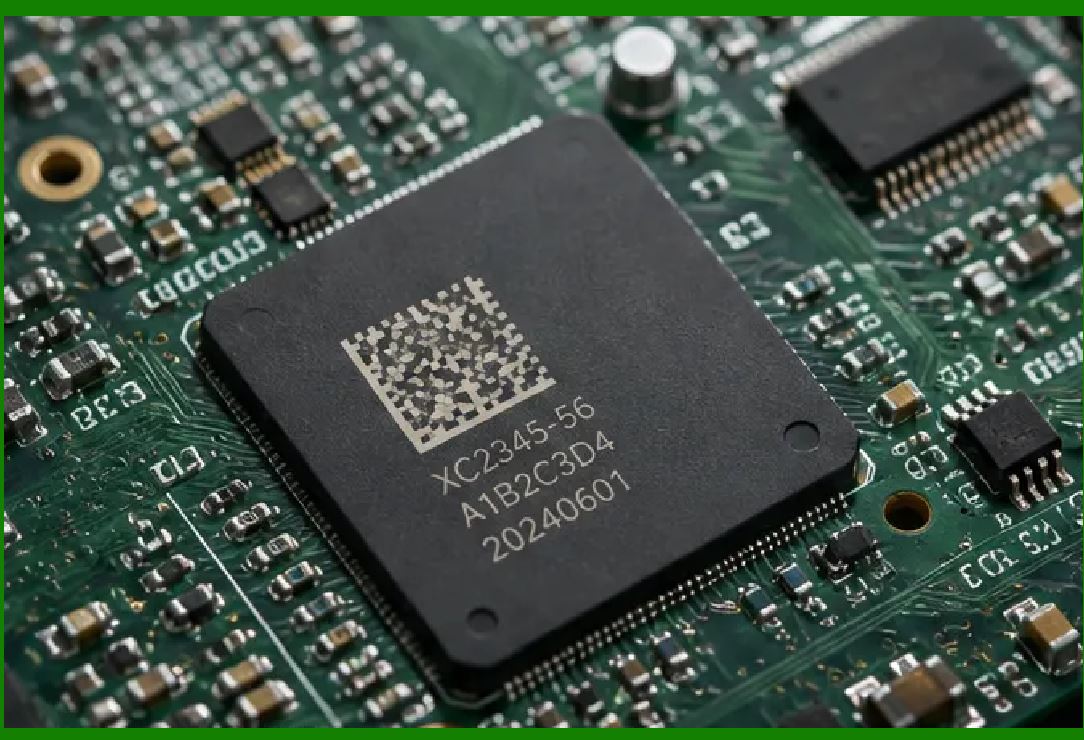
A GS1 DataMatrix code is a compact, two-dimensional barcode that can hold a large amount of data in a small space . Unlike linear barcodes that store data only horizontally, DataMatrix codes use a square or rectangular grid of black and white modules to encode information in both dimensions . This allows them to store significantly more data while occupying minimal space on a label or package. |
The 'GS1' designation means the code follows GS1 standards for data structure. This ensures that any compliant scanner can interpret the code's contents, making them interoperable across the global supply chain . The code uses GS1 Application Identifiers (AIs) to identify each data element, such as AI (01) for GTIN, AI (10) for batch/lot number, AI (17) for expiration date, and AI (310x) for net weight . |

|
Chapter 3: Data Fields for Fresh Produce |
A GS1 DataMatrix code on fresh produce can include a variety of data fields that enable comprehensive traceability : |
GTIN (Global Trade Item Number): Uniquely identifies the product |
Batch or Lot Number: Identifies the specific production batch |
Expiration/Best-Before Date: Enables automated expiry management |
Net Weight: For variable-weight items sold at retail |
Grower ID: Identifies the farm or producer |
Country of Origin: Where the product was grown |
Harvest Date: When the produce was picked |
Price: For point-of-sale use |
This wealth of data in a single scannable code allows retailers to automate inventory management, implement dynamic pricing for items approaching expiration, and conduct rapid, targeted recalls . |

|
Chapter 4: Printing Technologies for Produce Labels |
Applying DataMatrix codes to fresh produce requires specialized printing technologies. For individual fruit labels, high-resolution thermal inkjet (TIJ) printers are commonly used to print the code directly onto the label. These systems can handle variable data---such as unique serial numbers or batch codes---that change from label to label . |
For punnets and packaging, a variety of marking technologies are used, including thermal transfer printers, inkjet systems, and laser marking. The choice depends on the substrate (paper, plastic, or cardboard) and the production speed required. The 2D codes must be printed with sufficient resolution and contrast to be reliably scanned at each point in the supply chain . |

|
Chapter 5: Reading DataMatrix Codes in Retail |
Reading DataMatrix codes on fresh produce requires imaging scanners capable of decoding 2D symbols . Unlike laser-based scanners that can only read linear barcodes, imaging scanners capture an image of the code and decode it using image processing algorithms. Modern retail point-of-sale systems are increasingly being upgraded to support 2D scanning, a transition driven by GS1's Sunrise 2027 initiative . |
The initiative, which aims to enable scanning of 2D barcodes at retail checkout by 2027, does not phase out 1D barcodes but encourages dual marking during a transition period . Major US retailers including Walmart, Target, and Kroger have signaled their readiness, with Kroger becoming the first major US retailer to begin scanning 2D codes at checkout . |

|
Part Two: American and Global Applications in Action |
Chapter 6: Woolworths Australia - Reducing Food Loss by 40% |
While based in Australia, the Woolworths implementation of GS1 DataMatrix codes provides a powerful case study for US retailers and producers. In August 2019, Woolworths, the largest retailer in Australia and New Zealand serving approximately 20 million customers weekly across more than 1,000 stores, launched a pilot project applying GS1 DataMatrix codes to fresh meat and poultry products . By early 2022, the technology was integrated into more than half of the meat products in all stores. |
The results were remarkable. Woolworths reduced food loss by 40% and increased productivity by 21% . The DataMatrix code stores critical product information including GTIN, best-before date, batch information, net weight, and price. This enables automated expiration date management---employees can identify products approaching their best-before dates, discount them appropriately, and reduce waste . |
The traceability benefits are equally significant. Recalls can be conducted quickly and specifically, targeting only affected batches rather than entire product lines . This saves time, resources, and strengthens consumer trust. The company has described the transition as one of the biggest changes to the produce industry since the 1970s, with implications for all suppliers . |

|
Chapter 7: The Transition to 2D Barcodes in US Retail |
The US retail industry is undergoing a similar transformation, driven by GS1's Sunrise 2027 initiative . During a session at PACK EXPO East 2026, GS1 representatives emphasized that 2D barcodes, including QR codes and GS1 DataMatrix, are the future of product identification . While 1D barcodes are not being phased out, 2D barcodes add critical context by storing additional data like batch numbers and expiration dates . |
The transition is particularly important for fresh food management. With deeper information from 2D barcodes, retailers can better manage perishable inventory, implement automated markdowns for items approaching expiration, and prevent the sale of expired or recalled products . Kroger has already begun scanning 2D codes at checkout, signaling that the future is arriving faster than many expected . |

|
Chapter 8: FSMA Rule 204 and Traceability |
The FDA's Food Safety Modernization Act (FSMA) Rule 204 establishes additional traceability recordkeeping requirements for certain foods . The rule, which applies to companies that manufacture, process, pack, or hold foods on the Food Traceability List (FTL), requires them to maintain records containing key data elements (KDEs) and establish traceability lot codes (TLCs) for each traceable food item. |
GS1 US has developed extensive resources to help companies comply with FSMA Rule 204 using GS1 Standards . These include guidance documents, e-learning modules, and readiness checklists that explain how to apply GS1 Standards for traceability, including the use of GTINs, batch/lot numbers, and EPCIS event data sharing. DataMatrix codes are a key technology for encoding the TLC and other KDEs in a scannable format, enabling efficient data capture throughout the supply chain . |

|
Chapter 9: Consumer Transparency and Digital Passports |
Beyond supply chain traceability, DataMatrix codes on fresh produce can also enhance consumer transparency. The 'Trust Your Food' app, developed in collaboration with Italy's Poligrafico, allows consumers to scan a DataMatrix code on product labels to verify authenticity and access supply chain information . While currently focused on premium products like PDO wines and chocolate, similar applications could extend to fresh produce, allowing consumers to verify origin and production methods. |
The ability to provide this level of transparency differentiates premium products and builds consumer trust . For retailers looking to differentiate their own label brands, traceability guarantees authenticity and quality to the consumer. As one industry expert noted, traceability is not just a cost and compliance issue---it is a means of achieving competitive advantage . |

|
Chapter 10: The Future of Produce Traceability |
The adoption of DataMatrix codes on fresh produce is accelerating, driven by regulatory requirements, consumer expectations, and the operational benefits demonstrated by early adopters. The Sunrise 2027 initiative ensures that US retailers will have the scanning infrastructure to read these codes at checkout . Companies that have not yet transitioned their packaging lines to support 2D codes need to act now, as the equipment requirements---high-resolution printing, variable data capability, and inline verification---are significantly different from traditional 1D barcode printing . |
Looking ahead, the integration of DataMatrix codes with blockchain technology could further enhance traceability, creating an immutable record of each product's journey from farm to table. The ability to track individual punnets or cases, rather than entire lots, will enable even more targeted recalls and reduce food waste . |

|
Detailed Summary |
DataMatrix codes are transforming fresh produce traceability by encoding critical information directly on product labels or punnets. This compact two-dimensional barcode can store farm origin, harvest date, batch information, net weight, and use-by dates in a format that is machine-readable and interoperable across the global supply chain . The technology enables rapid, targeted recalls based on specific batches rather than entire product lines, reducing waste and protecting consumers . |
The adoption of DataMatrix codes in fresh produce is part of a broader industry shift toward 2D barcodes, driven by GS1's Sunrise 2027 initiative and regulatory frameworks like the FDA's FSMA Rule 204 . Major retailers, including Kroger, have already begun scanning 2D codes at checkout, signaling that the future is arriving now . |
The benefits are measurable. Woolworths Australia, a pioneer in applying GS1 DataMatrix codes to fresh produce, reduced food loss by 40% and increased productivity by 21% . Automated expiration date management, improved recall efficiency, and enhanced supply chain visibility are key drivers of these results . |
For US producers and retailers, the transition to DataMatrix codes requires investment in new printing and scanning equipment. 2D codes require higher resolution and precision than traditional 1D barcodes, and the variable data they carry---batch numbers, expiration dates, serial numbers---must be printed inline in real time . Verification systems are essential to ensure that each code meets GS1 quality standards before products leave the line . |

|
The DataMatrix code on fresh produce is more than just a barcode. It is a digital passport that connects the physical product to its entire history, enabling a safer, more efficient, and more transparent food supply chain. As the industry moves toward full implementation, this tiny square of dots will play an outsized role in protecting public health and reducing waste. |
 cs@easiersoft.com