DataMatrix Decoded: A Technical Deep-Dive |
Executive Summary |
In the tire industry, a single defective product can lead to massive recalls, legal liability, and irreversible damage to brand reputation. The ability to trace a tire from its raw materials through manufacturing, distribution, and ultimately to the vehicle on which it is installed is not just a best practice---it is a regulatory requirement. The U.S. TREAD Act, enacted in the wake of the Firestone tire recalls, mandates that tire manufacturers implement tracking systems to link tire serial numbers to Vehicle Identification Numbers (VINs). To meet this need, the industry has turned to DataMatrix codes, which are molded into tire sidewalls during vulcanization or laser-engraved after production. |
The unique challenge of tire marking lies in the material itself. Rubber is dark, curved, and flexible, making it difficult to read conventional printed labels. The vulcanization process subjects any marking to extreme heat and pressure, demanding a solution that is permanent yet remains readable for the life of the tire, which can be a decade or more. DataMatrix codes, with their high data density, built-in error correction, and ability to be read under low-contrast conditions, have emerged as the ideal carrier for this critical traceability data. Whether molded in during the curing process, laser-engraved with high-contrast markings, or applied as a specialized label, these codes store the DOT code, plant ID, compound recipe, and other essential information for liability tracking and lifecycle management. |
This article explores the technical foundations of DataMatrix tire marking, the regulatory drivers, and the real-world applications that are transforming tire manufacturing, distribution, and even motorsports. |
|
Part One: The Technical Challenges of Tire Marking |
Chapter 1: Why Tires Need Permanent Identification |
Tires are subject to some of the harshest conditions of any automotive component. They experience extreme temperatures, constant abrasion, exposure to road salts and chemicals, and tremendous mechanical stress. A paper label or conventional barcode would not survive this environment. Furthermore, the tire industry has a long and complex supply chain. A tire may be manufactured in one country, shipped to a vehicle assembly plant in another, installed on a vehicle, and later sold as a replacement---all while potentially spanning a decade of use. |
To ensure accountability and support safety recalls, tire manufacturers must have a system that links an individual tire to its manufacturing history. The U.S. TREAD Act requires this traceability . As an early patent for tire labeling noted, 'recent tire recalls ordered by the National Highway Traffic Safety Administration (NHTSA) were much wider than necessary because no data existed as to which tire lots and/or tire manufacturing dates had been installed on specific vehicles' . This regulatory landscape drives the need for a permanent, machine-readable identifier on every tire. |
|
Chapter 2: The Marking Area and Surface Conditions |
A tire presents a unique marking surface. The sidewall is curved, made of a dark, flexible, non-porous rubber compound, and may be covered in mold-release agents. These factors make conventional printed labels difficult to apply and read. As a result, the tire industry has explored numerous identification technologies, each with its limitations. |
Molded-in markings: Like the DOT code, these are raised or recessed text molded into the tire during vulcanization. While durable, they are low-density and cannot store the complex data required for modern traceability. |
Bumpy barcodes: These are raised barcode symbols molded into the tire surface. However, their 'low data density' prevents them from incorporating the required data storage volume . |
RFID tags: Passive RFID tags can be embedded in tires, but this solution is 'prohibitively expensive' and susceptible to damage from the heat and pressure of vulcanization . |
Labels: The Automotive Industry Action Group (AIAG) published a 'tire and wheel identification standard' that proposed using a 2D DataMatrix label on a tire sidewall, which would later be removed after assembly . |

|
Chapter 3: The DataMatrix Solution |
DataMatrix codes offer the ideal combination of durability, data density, and readability. Unlike linear barcodes that are easily damaged, DataMatrix codes use Reed-Solomon error correction, which allows them to be decoded even if up to 30% of the code is damaged. This is crucial for tires, where sidewall abrasion or minor cuts could otherwise render a code unreadable. A 2D DataMatrix code can encode the tire's serial number, DOT code, plant ID, and compound recipe, providing a complete 'digital birth certificate' for the tire. |

|
Part Two: Technologies for Creating DataMatrix Codes on Tires |
Chapter 4: Laser Engraving |
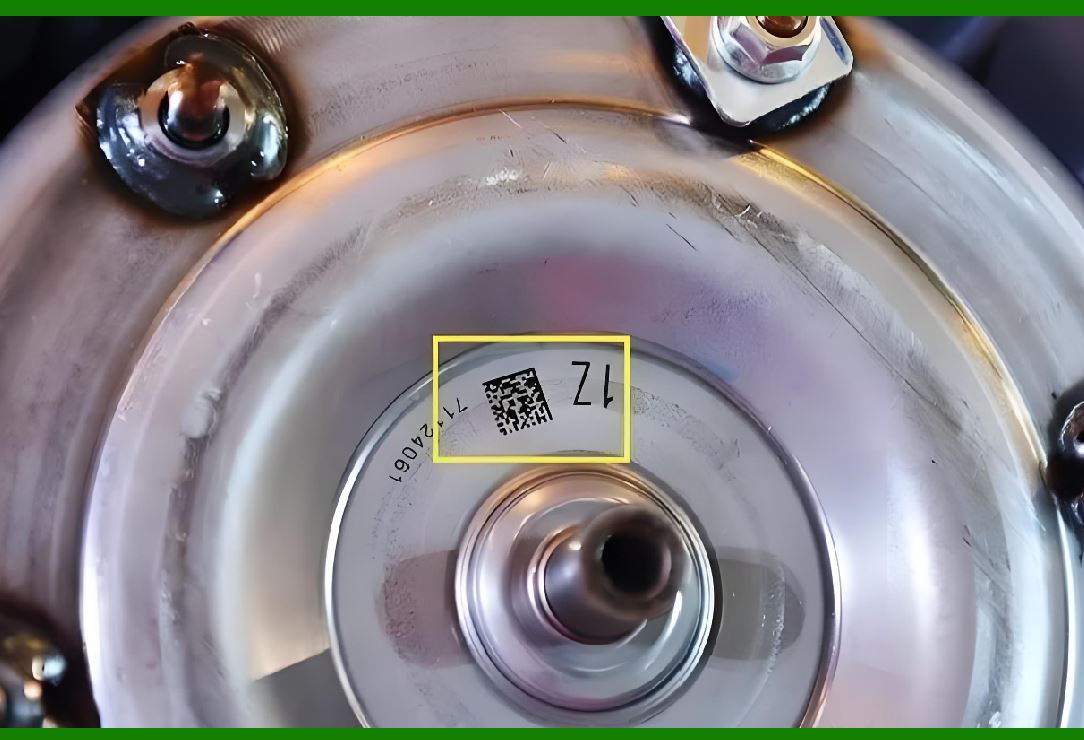
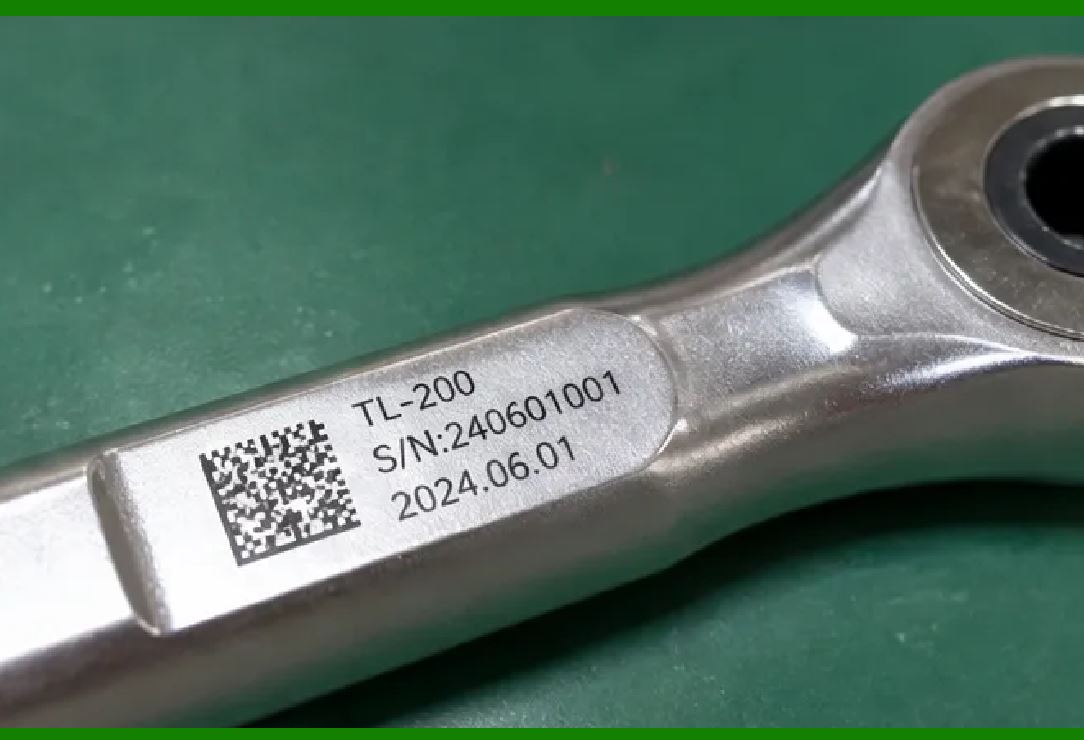
A landmark development in tire traceability was the introduction of laser engraving for DataMatrix codes. As reported in 2014, the German company 4JET Technologies GmbH developed a novel laser marking process that can engrave an individual DataMatrix code in tire sidewalls . The SCANNECT solution uses a proprietary process to create a 'deep black marking on the bottom of the engraving, providing enough contrast to be read with cameras in mobile devices' . |
This was a significant breakthrough. Previously, laser marking on black rubber typically produced only low-contrast marks. The SCANNECT process creates a code that can be read by most smartphone camera apps using public-domain software, eliminating the need for specialized hardware . This enables a 'one-of-a-kind product identifier that can directly link to a web-based customer-relationship-management (CRM) database' . The crisp laser markings are 'recessed into the surface of the tire and hence protected from wear' . |
A more recent example of this technology's impact comes from the tire and wheel tracking industry. As described in a 2026 solution architecture document, a single misread DOT code on a cured sidewall can have significant compliance and cost implications . Laser-engraved DataMatrix codes, integrated with computer vision AI, are now being used to read tire identification numbers and link them to records in compliance with the TREAD Act, ECE regulations, and IATF 16949 . These systems are deployed at every stage of the tire lifecycle: from green-tire barcode reading at the curing-press loader to reading the DOT code at the tire-and-wheel assembly cell . |
Another system, REA's CO2 laser marking system, 'works with material removal and engraves consumable-free captive markings for lifelong product identification' . Thus, a 2D code applied to the sidewall of the tire can be read automatically and provide conclusions about the history of the tire for traceability. |
|
Chapter 5: Molded-in Marking |
While laser engraving is a powerful tool for post-production marking, there are also solutions that embed the DataMatrix code directly into the tire during vulcanization. For instance, a patent from 2003 describes a system for 'tire identification label' where a label printed with a 2D DataMatrix symbology is applied to a tire sidewall . While that specific invention was a label, the concept of embedding a high-density code into the tire itself is an ongoing area of development. |
|
Chapter 6: Labels for Specialized Applications |
For applications where a permanent, molded-in code is not necessary, such as in motorsports or distribution, specialized DataMatrix labels are used. Symbology, Inc., a Minnesota-based GS1 US Solution Partner, offers 'Race Day' labels for the auto racing industry . These durable labels with 2D DataMatrix barcodes are used to uniquely identify racing tires allotted to each race . The built-in error correction of the DataMatrix code ensures successful scanning even under the demanding conditions of a racetrack . |
In Russia, a nationwide mandate for tire marking requires that each tire is labeled with a label with a unique DataMatrix code, registered in a government monitoring system . This system, known as Chestny ZNAK, is designed to trace the supply chain from manufacturer to end user and prevent counterfeiting . The 'Law on Mandatory Mark' has made labeling mandatory for tires to trace the supply chain and prevent counterfeit products and gray imports . The goal is to guarantee the authenticity and declared quality of goods being purchased . For example, the Yokohama Rubber Company, which operates distribution centers in Russia and globally, uses CipherLab's RK95 handheld scanners to manage these DataMatrix codes on tires . This shows how technology and regulation combine to enforce end-to-end traceability. |

|
Chapter 7: Scanning DataMatrix Codes on Tires |
Reading DataMatrix codes on tires presents its own set of challenges. Tires of different sizes are often transported together, and variations in reading distance due to differences in tire size can cause focus issues, leading to reading errors . To overcome this, specialized logistics code readers are used. The KEYENCE SR-5000 Series, for example, has a 'deep depth of field' that allows it to read DataMatrix codes on tires without the need for adjustment, even when the distance to the reader varies . Its proprietary algorithm can 'reliably decode even challenging codes printed on low-contrast materials like rubber or on curved surfaces' . This dramatically improves the accuracy of process and inventory management in the tire industry. |

|
Part Three: Applications in the Tire Lifecycle |
Chapter 8: Manufacturing and Traceability |
At the tire manufacturing plant, DataMatrix codes are a cornerstone of quality control and regulatory compliance. The codes are used to track 'green-tire 2D DataMatrix reads at the building drum, through conveyors, at the curing-press loader, and through the 150-180C cure, so compound lot and build spec stay linked to the cured tire' . This ensures that if a defect is found in a finished tire, the manufacturer can trace it back to the specific compound lot, building drum, and curing press. |
The codes also integrate with X-ray inspection tunnels and tire uniformity machines. 'A single misread DOT code on a cured sidewall, illegible green-tire 2D DataMatrix at the curing-press loader, or wrong-mold-number stamp can mean a TREAD Act Early Warning Reporting exposure, a curing-press hold that costs a full shift, or an IATF 16949 field-return warranty claim on a tier-one program' . |

|
Chapter 9: Distribution and Inventory Management |
For tire distribution centers and warehouses, DataMatrix codes enable efficient inventory management. The Yokohama Rubber Company, for example, uses CipherLab's RK95 industrial mobile computers to scan DataMatrix barcodes on tires in their distribution centers . Each tire has its 'own identity barcode for easy tracking' . This allows the company to manage inventory accurately and quickly, reducing errors and improving efficiency. The implementation of 250 devices in Yokohama's distribution centers allows users to work more productively and more accurately . An additional 230 devices were purchased by Yokohama as gifts to supply chain partners for inventory and order-placing applications . |

|
Chapter 10: Vehicle Assembly |
At the OEM vehicle assembly plant, the DataMatrix code on the tire must be linked to the vehicle's VIN. This requires a reliable scanning system that can read the code at high speed and under the demanding conditions of a manufacturing line. The DOT code must be read 'at the OEM tire-and-wheel-assembly cell (rubber-on-rubber, automotive-plant lighting, under 20-30 second cycle time) and pair it with the wheel spec code for tire-and-wheel-to-VIN traceability' . |

|
Chapter 11: The Aftermarket and End-of-Life |
The DataMatrix code continues to be valuable even after the tire is sold to a consumer. Laser-engraved QR codes that can be read by smartphones are a prime example . As described in the 2014 4JET announcement, 'end customers can retrieve valuable technical and commercial information about their tire specs, find suitable replacements, or enter online marketplaces to replace or sell used tires' . This opens up direct communication channels between the manufacturer and the end customer for warranty extensions, promotions, and product education. |
|
Detailed Summary |
The application of DataMatrix codes to tire manufacturing and lifecycle management is a powerful example of how a technology can be adapted to solve the unique challenges of a specific industry. The tire industry, driven by safety regulations like the TREAD Act and the need for efficient supply chain management, has embraced the DataMatrix as the ideal carrier for permanent, machine-readable identification. The physical constraints of the tire---its dark, curved, and flexible rubber surface---make other identification methods like paper labels impractical. DataMatrix codes, with their high data density and robust error correction, can be permanently applied through various means. |
The technology has evolved from the early days of applying labels, as described in a 2003 patent , to the current state-of-the-art, where laser systems can engrave high-contrast DataMatrix codes that are readable by standard smartphones . These codes serve as a 'digital birth certificate,' containing the DOT code, plant ID, and compound recipe, and they are integrated into every stage of a tire's life. |
At the manufacturing plant, DataMatrix codes, often using AI-powered vision systems, are read at the curing press and through X-ray and uniformity stations, ensuring that defects are traceable back to the specific production parameters . The adoption of Industry 4.0 platforms allows for real-time logging and fault-tolerant data exchange between devices, even when network connectivity is intermittent . |
In distribution centers, rugged mobile computers with advanced imaging capabilities are used to scan DataMatrix codes on tires of varying sizes, updating inventory records and facilitating order fulfillment . |
At the vehicle assembly plant, scanners read the DataMatrix code and pair it with the wheel spec code, creating a record that links the tire to the vehicle's VIN for liability and recall management . |
In the aftermarket, laser-engraved codes that can be read by smartphones offer end customers direct access to tire information and facilitate communication with the manufacturer . Specialized applications, such as in motorsports, use durable DataMatrix labels to track tires for competitive racing . |
|
The adoption of DataMatrix in the tire industry is not just a technological upgrade; it is a response to a regulatory demand for accountability and a business imperative for efficiency and customer engagement. By providing an indelible link between the physical tire and its digital data, the DataMatrix ensures that every tire is traceable, every recall is targeted, and every customer is informed. |
 cs@easiersoft.com