DataMatrix Decoded: A Technical Deep-Dive |
Executive Summary |
In the solar energy industry, where panels are expected to generate power reliably for 25 years or more, traceability is not a convenience---it is a necessity. Every solar panel must be identifiable throughout its lifecycle, from silicon wafer to installation and eventual recycling. Laser-etched DataMatrix codes on panel frames, junction boxes, or even the active cell area provide this essential link, storing critical information such as panel serial numbers, IV-curve data, and warranty start dates. |
The application of DataMatrix to solar components presents unique technical challenges. Wafers are thin and brittle, requiring precise laser parameters to create readable marks without compromising structural integrity . The marks must survive high-temperature processing, chemical etching, and decades of outdoor exposure to UV radiation, temperature extremes, and moisture . Yet the benefits are profound: a single scan of a DataMatrix code on a solar panel can reveal its complete manufacturing history, electrical performance data, and installation location, enabling warranty management, rapid field diagnosis, and even circular economy initiatives . |
Industry standards have emerged to ensure interoperability. SEMI PV29 defines the position and size of two-dimensional matrix symbols on silicon wafers, specifying the 14 by 14 DataMatrix format as a means to uniquely identify wafers throughout the manufacturing process . The SEMI standard supplements serial alphanumeric marking with a machine-readable code to improve the chances of successful reading, even if gridlines partially obscure the code . |
This article explores the technical foundations of DataMatrix marking in the solar industry, the standards that govern it, and the real-world applications that demonstrate how this technology is enabling a more transparent, reliable, and sustainable solar supply chain. |

|
Part One: Technical Foundations of Solar Panel Traceability |
Chapter 1: Why Solar Panels Need Permanent Traceability |
Solar panels are long-term infrastructure investments. A typical utility-scale solar installation involves thousands of panels, each expected to generate electricity for a quarter-century or more. Manufacturers must be able to trace defective panels back to specific production batches, material lots, and manufacturing conditions. Warranty claims require proof of product authenticity and installation date. Utility operators need to know the exact specifications of each panel in their arrays. And as the industry moves toward circular economy principles, recyclers need to know the material composition of panels at end-of-life . |
Traditional paper labels or inkjet printing cannot meet these demands. They fade, peel, or become illegible after years of exposure to sunlight, rain, and temperature cycling. Laser-etched DataMatrix codes, by contrast, are permanent and machine-readable, capable of surviving the entire lifecycle of the panel . |

|
Chapter 2: The DataMatrix Symbology for Solar |
The DataMatrix ECC200 code is the de facto standard for solar traceability . This two-dimensional symbology offers several key advantages for solar applications: |
High Data Density: A DataMatrix code can encode a substantial amount of information in a very small area---typically 2 by 2 millimeters for a 14 by 14 code . This is critical for solar cells, where space is limited and shading must be minimized. |
Error Correction: Reed-Solomon error correction provides approximately 25% redundancy, allowing the code to be read even if part of it is obscured by gridlines, damaged during processing, or degraded over time . |
Robustness: The data content is scrambled and strategically distributed over the whole code area to achieve a high level of robustness against missing dots, disturbance, or code corruption . |
The typical DataMatrix sizes for solar applications include 14 by 14 modules, 12 by 26, and 8 by 32 . The 14 by 14 format with an edge length of approximately 2 by 2 millimeters has emerged as a preferred standard . |

|
Chapter 3: Industry Standards - SEMI PV29 |
SEMI PV29, the 'Specification for Front Surface Marking of PV Silicon Wafers with Two-Dimensional Matrix Symbols,' provides the formal framework for DataMatrix marking in the solar industry . This standard was developed by the Photovoltaic - Automation Global Technical Committee and published in February 2012. |
Key provisions of SEMI PV29 include: |
Position and Size: The specification defines the position of the two-dimensional matrix symbols on the wafer surface, excluding the possibility of gridlines occluding the code . |
Serial Alphanumeric Supplement: The DataMatrix code is supplemented by a serial alphanumeric marking. If gridlines block the two-dimensional code, the alphanumeric code provides a fallback for human reading . |
Reading Window: The specification defines a reading window to increase the probability of successful code reading . |
Lifecycle Traceability: The mark is designed to uniquely identify wafers throughout the manufacturing process chain and their complete life cycle . |
The standard notes that negative effects from laser marking, such as increased wafer breakage or reduced solar cell efficiency, have not been found in careful investigations performed on a large number of wafers and solar cells . This confirms that DataMatrix marking can be implemented without compromising product quality. |

|
Chapter 4: Laser Marking Technologies |
Laser marking is the preferred technology for applying DataMatrix codes to solar components because it is permanent, high-speed, and compatible with a variety of materials. |
Chapter 4.1: Laser Parameters and Optimization |
The best results for DataMatrix marking on silicon wafers have been achieved with Nd:YAG lasers operating at a wavelength of 1064 nanometers, with pulse durations between 20 and 50 nanoseconds, power between 5 and 30 watts, and creating dots 100 micrometers in diameter and between 10 and 30 micrometers deep (before etching) . Great care must be taken to ensure that laser markings do not affect the electrical parameters of a cell, for example through shunts that could occur if the laser markings are burned too deeply into the silicon wafer rather than being written within a specified range of permitted depths . |
Chapter 4.2: Write Process Optimization |
The readability of laser markings depends heavily on optimization of the write process. Without an optimized writing process, readability falls short of mass production requirements, which far exceed 90 percent . Optimization is achieved through iterative learning, a process that improves as production volume increases . |
Chapter 4.3: Reading Process Optimization |
Optimization of the reading process is equally important. While conventional dot matrix readers used blue LED illumination, experiments revealed that read rates could be improved by using red LED illumination, particularly downstream of wet bench processes where the wafer surface chemistry has changed . Readability was further improved by optimizing shutter speed to regulate exposure time . |
Chapter 4.4: 'On the Fly' Marking |
For high-volume solar production, laser marking systems must operate at line speed without interrupting production. Leading systems can mark 2D codes 'on the fly'---marking wafers while they move through the production line . This capability, combined with high-speed scanning technology, guarantees high efficiency and throughput with minimal impact on cycle time . |

|
Chapter 5: Mechanical Integrity and Marking Impact |
A critical concern for solar wafer marking is whether the laser process creates micro-cracks or weakens the silicon. Extensive testing has confirmed that DataMatrix laser marking does not compromise wafer strength. In 'ball-on-ring' tests designed to measure breakage force, any cracks that occurred were not due to the laser marking because they appeared between individual markings rather than across them . Tests simulating the stress of actual mass production---including twist tests with approximately 70% of the pre-determined breakage force---found no microscopic cracks attributable to the laser marking process . |
For silicon blocks and wafers, marks are typically engraved to a depth of at least 70 to 90 micrometers to ensure they survive subsequent processing steps such as wet bench etching, oxidation, and heating . |

|
Part Two: Applications Across the Solar Lifecycle |
Chapter 6: Semiconductor-Level Traceability |
Traceability begins at the wafer level. Each silicon wafer, whether monocrystalline or polycrystalline, is laser-marked with a DataMatrix code that uniquely identifies it throughout the manufacturing chain . This allows manufacturers to track individual wafers through the complex sequence of processing steps---cleaning, texturing, diffusion, edge isolation, anti-reflective coating deposition, contact printing, and firing. |
The SEMI PV29 standard provides the framework for this wafer-level marking, specifying the position, size, and content of the DataMatrix symbols on the front surface of the wafers . By marking wafers early in the production process, manufacturers can trace any quality issue back to its source, enabling rapid corrective action and continuous improvement. |

|
Chapter 7: Solar Cell Marking |
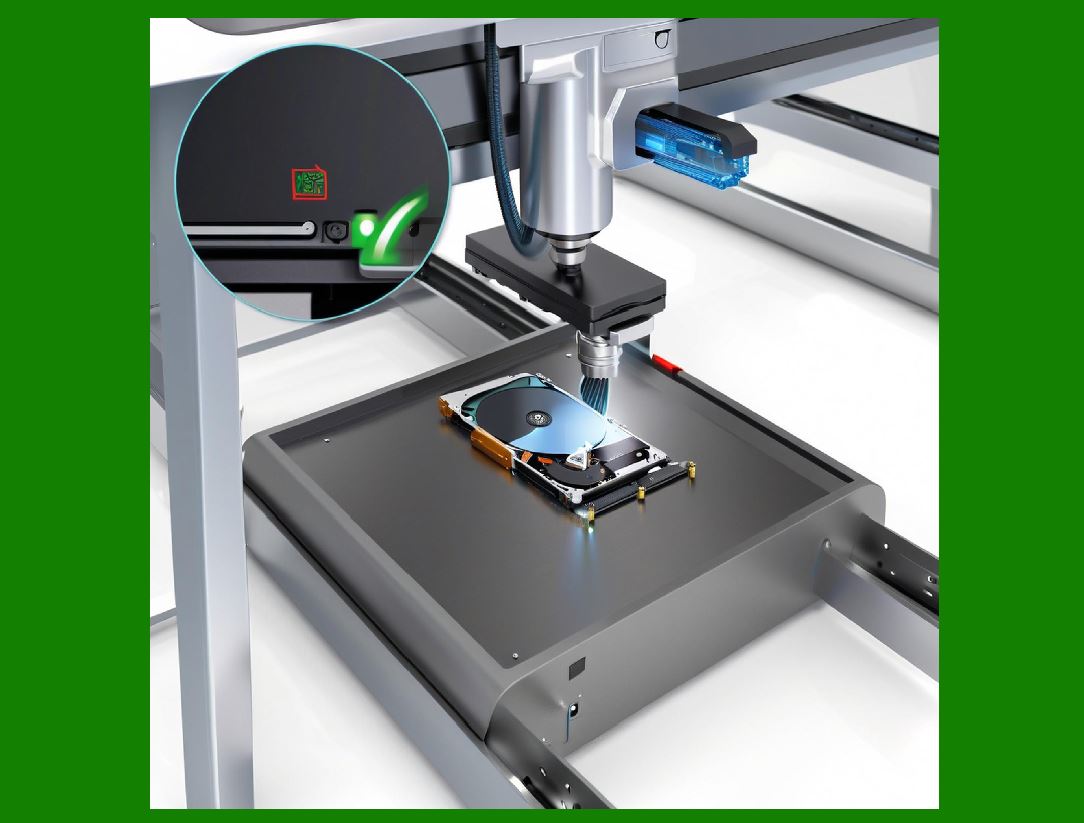
DataMatrix codes are also applied directly to individual solar cells. In a patent example, a 14 by 14 DataMatrix code measuring approximately 2 by 2 millimeters is placed in the active zone of a solar cell, with the bus bars and fingers routed around the marking area . The code consists of a plurality of punctiform depressions in the wafer surface . |
Marking at the cell level enables traceability that persists even after cells are assembled into modules. The code is placed in the active zone of the cell to ensure it remains readable even after the cell is integrated into a module . Laser parameters are carefully controlled to ensure the marking survives subsequent processing steps while remaining readable through automated optical inspection systems . |
|
Chapter 8: Module-Level Marking |
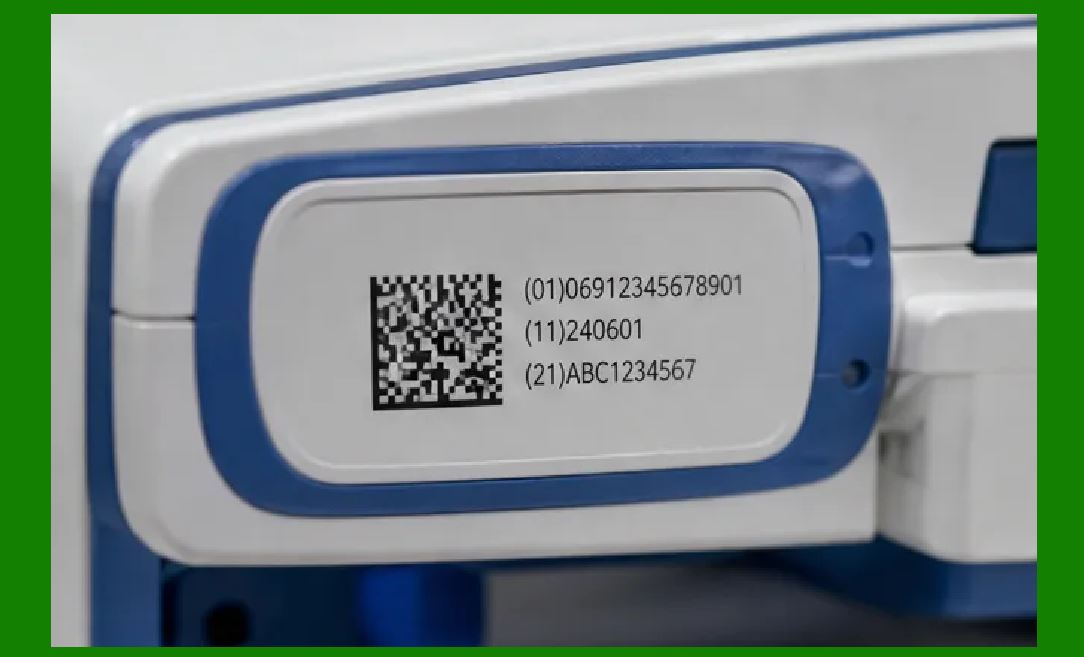
At the module level, DataMatrix codes are typically laser-etched on the aluminum frame, the junction box, or directly on the backsheet or glass. These marks encode the module serial number, which is linked to a database containing the full manufacturing history: the individual cell IDs, the bill of materials, and the electrical test results from flash testing. |
For aluminum frames, high-power fiber lasers achieve depth etching that resists corrosion from salt spray, moisture, and temperature cycling . For glass surfaces, cold laser processes minimize heat-affected zones, ensuring that light transmission loss is less than 0.1% while still producing durable marks resistant to UV aging . For junction boxes, CO2 lasers mark electrical parameters and safety information on plastic surfaces, maintaining legibility across temperature ranges from -40 to 85 degrees Celsius . |
|
Chapter 9: Integrated Vision and Traceability Systems |
The full traceability chain requires integration of marking and reading systems with manufacturing execution systems (MES). The DataMan 302 ID reader, specifically designed for solar traceability, features integrated, bank-controlled blue illumination for reading 2D DataMatrix codes on photovoltaic wafers . With a resolution of 1,280 by 1,024 pixels, it is ideal for decoding laser-marked ECC-200 codes complying with SEMI PV29 . |
The DataMan 300 series can decode multiple codes within one image, even when presented at an angle, and handles variations in code marking, damaged clocking patterns, and codes degraded during manufacturing . Flexible lens options allow the same reader model to be used for applications ranging from reading codes within confined spaces to scanning codes at high speed as they are presented by robotic handling devices . |

|
Chapter 10: Installation and Field Management |
The use of DataMatrix codes extends beyond manufacturing into field operations. During installation, workers can scan the DataMatrix code on each panel to automatically populate serial numbers in commissioning reports or monitoring software . This reduces human error and creates a digital registry of exactly which panel is in which location. |
Asset management platforms, often using mobile apps, can scan DataMatrix codes to log maintenance or track replacements . The ability to use a smartphone for field scanning eliminates the need for specialized hardware, making field logistics feasible with minimal friction . As one analysis notes, 'QR codes make such field logistics feasible with minimal friction since no special device is needed beyond a phone' . |

|
Chapter 11: Anti-Counterfeit Measures |
As the solar industry grows, counterfeit and substandard modules are an increasing concern. DataMatrix codes, combined with secure verification systems, provide a defense against counterfeiting. In December 2021, leading manufacturer LONGi began marking every module with a QR-coded serial number, instructing customers to verify the code on their website . This move set a de facto industry standard that others are following to eliminate fake panels . |
Some companies are now combining DataMatrix codes with blockchain verification, where each module's ID is recorded on a blockchain ledger . Scanning the DataMatrix can cross-verify the ledger for an extra layer of security . While blockchain use is still nascent, the concept of an immutable traceability record is gaining traction for high-value components like solar modules . |

|
Chapter 12: End-of-Life and Recycling Traceability |
Forward-looking initiatives are extending traceability to module end-of-life and recycling. The U.S. Department of Energy has funded projects to develop standardized PV module tags with DataMatrix codes to track modules from 'cradle to grave'---raw material to end-of-life recycling . The concept is that a recycler decades from now could scan the code and know exactly what materials are in the panel (glass, silicon, metals) and perhaps who to contact for take-back programs . This facilitates the circular economy by enabling the recovery and reuse of valuable materials from retired solar panels. |

|
Chapter 13: American and Global Manufacturers |
Major solar manufacturers have embraced DataMatrix traceability as a standard practice. Energy America, recognized as a BloombergNEF Tier 1 manufacturer, employs advanced traceability systems with 2D codes on its modules . The company's Tier 1 status reflects strong financial stability and large-scale projects, typical of manufacturers that have implemented sophisticated quality control and traceability . |
ALLTEC, a provider of laser marking systems, supplies equipment for direct marking on monocrystalline and polycrystalline solar cells, as well as on thin-film cell substrates . Their systems apply 2D DataMatrix codes 'on the fly' without stopping the production line, enabling high throughput with best achievable marking quality . |
Videojet offers a full range of laser markers---CO2, Nd:YAG, and fiber systems---for solar applications . Their systems are used for direct marking of solar wafers, marking on thin-film cell substrates, and even drilling holes for backside contacts . Case studies demonstrate implementations across Europe, including a Norwegian facility marking raw silicon blocks after cutting, a German solar panel manufacturer applying 2D codes on solar modules, and a Swedish facility marking thin-film cell glass . |

|
Detailed Summary |
DataMatrix codes have become an essential technology for traceability in the solar energy industry, enabling manufacturers, installers, and recyclers to track panels throughout their entire lifecycle. The DataMatrix ECC200 symbology, with its high data density and robust Reed-Solomon error correction, is ideal for the demanding conditions of solar manufacturing and long-term outdoor exposure . |
The technical implementation is governed by industry standards. SEMI PV29 defines the position and size of DataMatrix symbols on silicon wafers, ensuring that marks can be read reliably throughout manufacturing and after years of service . The standard requires a 14 by 14 DataMatrix code as the preferred format, supplemented by a serial alphanumeric marking for human-readable fallback . |
Laser marking is the preferred technology for applying DataMatrix codes to solar components. Optimized laser parameters---typically Nd:YAG lasers at 1064 nanometers with pulse durations of 20 to 50 nanoseconds and depths of 10 to 30 micrometers---create readable marks without compromising wafer strength or cell efficiency . Systems can mark 'on the fly' at production speeds, enabling high-volume manufacturing . |
Real-world applications span the entire solar lifecycle. At the semiconductor level, each wafer receives a unique DataMatrix code that enables full traceability through production . On individual cells, 2 by 2 millimeter codes in the active zone remain readable after module assembly . On finished panels, codes on frames, junction boxes, and backsheets store serial numbers linked to manufacturing data and warranty records . |
The benefits are tangible. During installation, scanning DataMatrix codes reduces human error and creates accurate digital registries . In the field, maintenance teams can quickly identify specific panels for diagnosis or replacement . Anti-counterfeit verification protects brands and consumers . And at end-of-life, DataMatrix codes enable efficient recycling by providing material composition information . |

|
From the silicon wafer to the recycling facility, DataMatrix codes on solar panels provide the digital thread that connects a physical product to its complete history. This tiny pattern of dots enables the transparency, accountability, and sustainability that the solar industry---and the planet---depends on. |
 cs@easiersoft.com