The Humble QR Code: A Technical Deep-Dive and Its Multispectral Industrial Applications |
Chapter 51 | Future - Color QR & High-Capacity |
Brief Summary: This chapter explores the next frontier of QR code technology: multicolor and high-capacity systems that dramatically increase data density beyond traditional black-and-white formats. It provides a technical yet accessible overview of how technologies like four-color CMYK multiplexing and microscopic spectral encoding are pushing the boundaries of what a QR code can contain. The narrative explains the ISO standardization efforts underway to enable these advanced codes for critical applications such as vaccine passports and high-resolution medical imaging. Through detailed examples from U.S. vaccine credential programs, advanced materials research, and anti-counterfeiting innovations, the chapter demonstrates that the future of QR codes is far more colorful and data-rich than its monochrome past. |
|
Introduction: Beyond Black and White |
Since its invention in 1994, the QR code has been defined by its stark simplicity: a grid of black modules on a white background. This binary scheme, encoding one bit of information per module, has proven remarkably versatile. Yet, as the world demands ever more data in ever smaller spaces---from vaccine passports that must encode complex health records to medical imaging that requires high-resolution annotations---the limitations of this monochrome format have become increasingly apparent. |
The maximum capacity of a traditional black-and-white QR code, at its largest size (Version 40), is approximately 4,296 alphanumeric characters . While impressive, this is insufficient for storing a high-resolution medical image or a comprehensive health record with multiple vaccination and test results. To meet these growing needs, researchers and standards bodies are pioneering the next generation of QR technology: multicolor and high-capacity codes. |
These advanced systems move beyond the binary paradigm. A four-color CMYK (Cyan, Magenta, Yellow, Black) QR code, for example, can encode up to four times the data of a black-and-white code of the same size, because each module can represent four possible states rather than just two. More exotic techniques, such as spectral multiplexing using molecular dyes and two-photon lithography, push data density to mind-boggling levels---potentially encoding the equivalent of thousands of conventional QR codes in a space smaller than a grain of rice . |
This chapter provides a technical yet accessible deep-dive into the future of QR codes. We will explore the principles of color multiplexing, the emerging ISO standards for these high-capacity systems, and their real-world applications in vaccine credentials, medical imaging, and anti-counterfeiting. Through detailed examples from U.S. government programs, advanced materials research, and patented security technologies, we will see how the humble QR code is evolving into a multi-layered, high-density data carrier. |

|
Part I: The Technical Foundations of Multicolor QR Codes |
The transition from monochrome to multicolor QR codes is not merely a cosmetic change; it is a fundamental shift in how information is encoded, read, and decoded. |
1.1. The Color Multiplexing Principle |
A traditional black-and-white QR code encodes one bit of information per module: black equals '1,' white equals '0.' A four-color QR code using CMYK (Cyan, Magenta, Yellow, and Black) can encode two bits per module (four possible states), effectively doubling the data density compared to a two-color system. An eight-color system, incorporating primary color combinations, can encode three bits per module, yielding even higher capacity . |
Color multiplexing takes this concept further by superimposing multiple independent QR codes into a single composite image. Each color channel---red, green, and blue, for example---encodes its own distinct data stream. The full color code contains all these layers, but specialized decoding software can separate the channels and read each code independently. As described in a 2025 research publication, 'color multiplexing enables the superimposition of distinct QR codes within a single composite image by assigning unique chromatic identifiers to individual modules' . This approach leverages the red, green, and blue channels to encode independent data streams, exponentially increasing the system's data capacity. |
The practical result is dramatic: a Version 2 color-multiplexed QR code (25x25 modules) can achieve a theoretical data capacity equivalent to a conventional QR code with up to 625x625 modules . This means that a small, visually compact code can hold the equivalent of a much larger traditional code. |

|
1.2. Microscopic and Spectral Encoding |
Beyond macroscopic color codes, researchers are developing microscopic QR codes that integrate spatial geometry, molecular signatures, and colorimetric encoding within extremely small modules. A 2025 study published in ACS Applied Polymer Materials describes a microscale, color-multiplexed QR code system fabricated via two-photon lithography (TPL), achieving module sizes of just 15 micrometers . |
These ultra-small codes incorporate Raman-active perylene dyes, which provide molecular 'fingerprints' that can be read using spectroscopy. This creates an additional orthogonal readout channel, enhancing both data density and security. The estimated data density of this system is approximately 1.77 x 10^139 bits per square millimeter, roughly 1.48 x 10^11 times higher than that of an inkjet-printed Version 2 QR code . This is the equivalent of storing the entire text of thousands of novels in a space smaller than a postage stamp. |

|
1.3. ISO Standardization and the Path to Industry Adoption |
For any new QR code technology to achieve widespread adoption, it must be standardized. The International Organization for Standardization (ISO) and the International Electrotechnical Commission (IEC) are actively working to incorporate high-capacity and color QR codes into the official specifications. |
The most recent standard, ISO/IEC 18004:2024, specifies the requirements for the conventional QR code symbology, including both QR Code and Micro QR Code formats . However, new work items are under development to address color and high-density variants. The ISO/IEC JTC 1/SC 31 committee, which oversees automatic identification and data capture standards, has agreed to new work proposals for 'New 2D colour barcode: JAB code' and other advanced formats . |
The standardization process for color QR codes involves defining encoding methods, error correction rules, and decoding algorithms that can reliably read codes under varying lighting conditions and color reproduction fidelity. This is a non-trivial challenge, as color perception varies across devices and environmental conditions. However, the potential benefits---massively increased data capacity in a compact form factor---make this effort a priority for the committee. |

|
Part II: The American Application Landscape |
The future of QR codes is not merely theoretical; it is already being deployed in the United States in several key application areas. Vaccine credentials, medical imaging, and anti-counterfeiting are leading the charge. |
2.1. Vaccine Passports: The SMART Health Card Revolution |
The COVID-19 pandemic accelerated the adoption of digital vaccine credentials, and QR codes became the primary interface for sharing vaccination status. In the United States, multiple states adopted the SMART Health Card framework, which uses QR codes to encode verified vaccination records. |
New York's Excelsior Pass: New York was the first state to launch a vaccine passport program, the Excelsior Pass, developed in partnership with IBM . The pass consists of three core elements: the user's name, a green checkmark, and a QR code. To prove vaccination or a negative test result, users simply display the QR code on their mobile device for scanning . Behind the scenes, the app connects with credentialed health authorities to verify the information, and the QR code is refreshed periodically to ensure validity . |
California and the SMART Health Card: California issues a QR code that links to a registry, allowing residents to access their digital COVID-19 verification record . The QR code generated by the system contains a cryptographically signed payload that can be verified by any SMART Health Card-compliant reader. Washington state's 'WA Verify' system also uses SMART Health Card QR codes, allowing users to save their codes to mobile wallets or as PDFs . |
Multi-State Adoption: Other states, including Pennsylvania, New Jersey, and the District of Columbia, have adopted the VaccineCheck platform, which integrates QR codes for digital verification . Louisiana has incorporated vaccine verification into its LA Wallet app, which also holds users' driver's licenses . These diverse state implementations, while varying in user interface, all rely on the same core QR code infrastructure to securely share health data. |
The SMART Health Card QR codes represent an early, practical deployment of high-capacity QR codes. While conventional black-and-white codes sufficed for storing vaccination records with a few dates and vaccine types, the expansion to include multiple boosters, test results, and recovery certificates pushes the capacity limits. This is driving interest in color and high-density codes that can accommodate more complex health records. |

|
2.2. Medical Imaging: Annotations and Data Storage |
Medical imaging is another domain where high-capacity QR codes offer transformative potential. Traditional medical images, such as X-rays, CT scans, and MRIs, are accompanied by extensive metadata, annotations, and patient information. Embedding this data directly into the image itself, rather than relying on external databases, could improve accessibility, portability, and security. |
Embedding Annotations in Images: A research article from Vilnius University proposes a novel method for annotating medical images using QR codes . The method embeds semantic annotations directly into the image data, allowing the annotations to travel with the image and be accessible offline. The authors use a series of QR codes to distribute the annotation, taking advantage of the industrial-grade detection, resilience, and error correction capabilities of QR codes . This is particularly useful in scenarios such as research, lectures, clinical meetings, and telemedicine, where access to central medical databases may be limited or unavailable. |
High-Capacity for Large Datasets: While a single QR code can store a moderate amount of text (approximately 2,953 bytes), multiple QR codes can be combined to store larger datasets. The research demonstrates that embedding multiple QR codes into an image is feasible while maintaining acceptable image quality . This layered approach is analogous to color multiplexing---multiple data streams are aggregated into a single visual field. |
The Need for Color and High Density: As medical imaging data grows in size and complexity, the demand for higher-density QR codes will intensify. Color multiplexing and microscopic encoding could allow entire medical reports, 3D imaging data, and patient histories to be embedded directly into diagnostic images. This could revolutionize medical record portability, enabling patients to carry their complete medical history on a single image or printed document. |

|
2.3. Anti-Counterfeiting and Security: The CHQR Project |
The Department of Defense (DoD) and the Defense Logistics Agency (DLA) have a critical need to combat counterfeit components and tampered packaging in the military supply chain. The CHQR (Color Holographic Quick Response) project, developed by HNu Photonics LLC with support from Raytheon Integrated Defense Systems, addresses this need through an innovative combination of color QR codes and holographic imaging technology . |
The Technology: CHQR combines RGB 3-Layer QR codes with holographic imaging technology to create features that are 'extremely difficult for counterfeiters to replicate' . The technology enables cost-effective, easy-to-use anti-tampering labeling that can detect counterfeit labels and tampered packaging. The system is designed for pervasive application throughout the DLA supply chain, from supply centers to individual deployed warfighters . |
Commercial Applications: Beyond defense, the CHQR technology has 'substantial commercial marketplace' potential, spanning pharmaceuticals, electronics, and medical devices . The color multiplexing approach ensures that each layer of the QR code contains distinct information, and the holographic component provides a physical authentication layer that cannot be easily copied. |
Implications for Security: The CHQR project demonstrates that color and high-capacity QR codes are not just about storing more data; they are about creating multi-layered security systems. By encoding different data streams in different color channels and combining digital with physical security features, these advanced codes offer a robust defense against counterfeiting and tampering---a critical requirement in regulated industries. |

|
2.4. Accessibility Innovations: NaviLens Color Codes |
While not a pure high-capacity QR code, NaviLens technology represents a related innovation that uses large, colorful codes to improve accessibility for visually impaired users. In 2022, Kellogg's introduced NaviLens codes on its product packaging in the U.S. market . |
How NaviLens Works: NaviLens codes are colorful, high-contrast optical tags that can be detected and read by a smartphone app from up to several feet away . Unlike traditional QR codes, which require precise alignment and close proximity, NaviLens codes are designed to be readable from a distance and at various angles. The app provides audio feedback, reading product names, nutritional information, and instructions in multiple languages. For visually impaired consumers, this is a significant improvement over conventional QR codes, which are difficult to locate and read. |
Broader Implications: NaviLens demonstrates that the evolution of QR codes is not solely about data density; it is also about usability and inclusivity. The large, color-coded format is more accessible to users with visual impairments, and the long-range detection capability enables a broader range of interaction scenarios---from navigating public spaces to locating products on store shelves. |

|
Part III: The Standardization Landscape and the Path Forward |
The future adoption of color and high-capacity QR codes depends on robust international standards that ensure interoperability, reliability, and security. |
3.1. ISO/IEC 18004:2024 and Beyond |
The latest version of the QR code standard, ISO/IEC 18004:2024, provides the specification for conventional QR codes, including both full-size QR Code and Micro QR Code formats . The standard defines data character encoding methods, error correction rules (Reed-Solomon, with four levels ranging from 7% to 30% recovery capacity), symbol formats, and reference decoding algorithms . |
The standard also includes optional features such as structured append (which allows up to 16 QR codes to be combined to represent a single logical data set), extended channel interpretations (for non-default character sets), reflectance reversal (light-on-dark codes), and mirror imaging . These features provide a foundation for more advanced variants. |
3.2. The Path to Color Standardization |
The ISO/IEC JTC 1/SC 31 committee is actively working on standardizing new 2D color barcodes . The 'JAB code' is mentioned as one such development, along with the Han Xin Code, which originated in China. The standardization process involves defining color encoding schemes, error correction algorithms adapted for color channels, and decoding methods that account for color reproduction variations across devices. |
One of the key challenges in color QR code standardization is ensuring reliable reading under diverse lighting conditions and on varied substrates. A color code that scans perfectly on a phone screen in a well-lit room may fail on a printed label in dim light. The standard must address these practical constraints to enable widespread deployment. |
3.3. Challenges to Adoption |
Despite the promise of color and high-capacity QR codes, several challenges must be addressed: |
Scanner Compatibility: Most existing QR code scanners are designed for black-and-white codes. Widespread adoption of color QR codes will require either new scanners or software updates to existing apps. |
Printing Quality: Color reproduction is more complex than black-and-white printing. Variations in ink, paper, and printing processes can affect the accuracy and readability of color QR codes. |
Cost: Color QR codes, especially those using advanced materials (e.g., Raman-active dyes), may be more expensive to produce than conventional codes. |
User Education: Users will need to be educated about the existence of these new codes and how to interact with them. A color code is not inherently understood as a data carrier in the same way a conventional QR code is. |

|
Part IV: The Workflow in Action |
To illustrate the future of QR codes, let's walk through two scenarios: one involving a high-capacity color QR code for vaccine verification, and one involving a microscopic spectral QR code for anti-counterfeiting. |
Scenario 1: SMART Health Card Verification |
The Setting: A traveler arriving at a U.S. airport. The traveler, Sarah, has been vaccinated and received a digital SMART Health Card via her state's health registry. The card includes a QR code. |
Step 1 - Generation: Sarah's state health authority verifies her vaccination records. The system generates a cryptographically signed payload containing her name, date of birth, vaccination dates, vaccine type, and lot numbers. This payload is encoded in a QR code. The QR code is a conventional black-and-white code (sufficient for current use cases). |
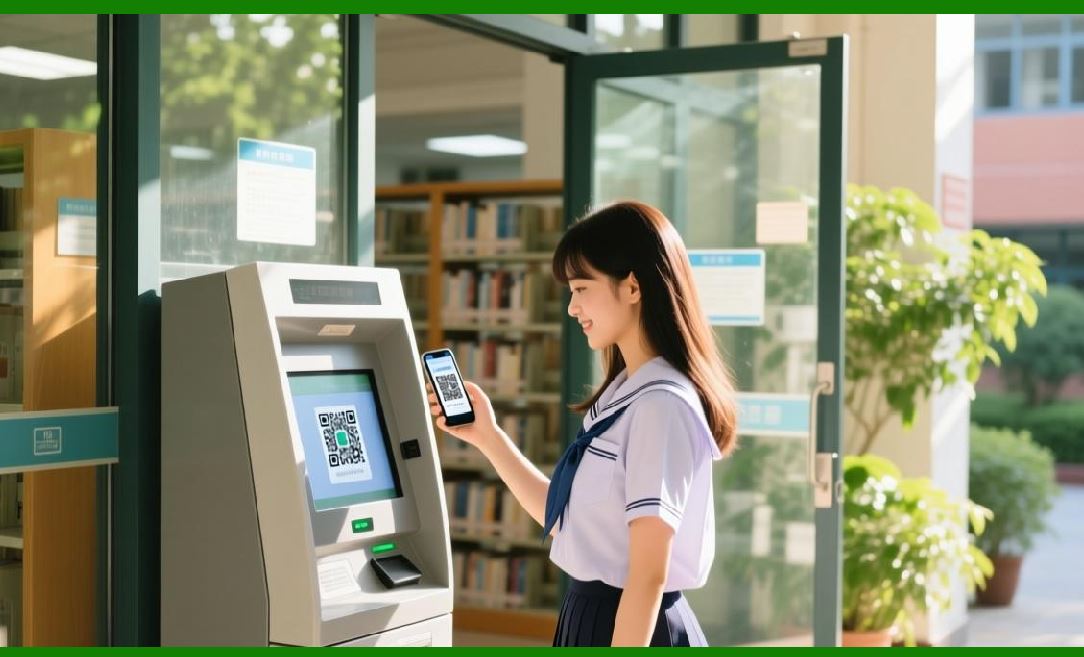
Step 2 - Presentation: Sarah approaches a customs or screening checkpoint. She opens the health app on her phone and displays the QR code. |
Step 3 - Scanning: The security officer uses a SMART Health Card scanner (a smartphone app or dedicated device) to scan the QR code. |
Step 4 - Verification: The scanner decodes the payload, verifies the cryptographic signature using the health authority's public key, and displays the verified vaccination status. The result is a simple 'Pass' or 'Fail' indication. |
Step 5 - Future Evolution: As vaccination records become more complex (multiple boosters, different vaccine types, test results, recovery certificates), the QR code capacity may be exceeded. A color or high-density QR code could accommodate this extended data while maintaining a compact form factor. |
|
Scenario 2: CHQR Anti-Counterfeiting Verification |
The Setting: A military warehouse receiving a shipment of electronic components. |
Step 1 - Tagging: The manufacturer applies a CHQR (Color Holographic Quick Response) label to each component. The label combines an RGB 3-Layer QR code with a holographic element . Each color layer encodes distinct information: one layer might contain the part number and manufacturer, another layer might contain the lot number and date of manufacture, and a third layer might contain a secure authentication token. |
Step 2 - Receiving Inspection: A logistics specialist at the DLA warehouse scans the CHQR label using a specialized scanner or a smartphone app. The scanner reads all three color channels simultaneously. |
Step 3 - Authentication: The scanner decodes the data from each color layer and verifies the information against the DLA's secure database. It also checks the holographic element for authenticity. |
Step 4 - Verification: If all checks pass, the scanner displays a 'Verified' status. If any layer fails the check, or if the holographic element is missing or damaged, the component is flagged for further inspection. |
Step 5 - Deployment: Verified components are cleared for deployment to military units. The use of CHQR labels ensures that counterfeit or tampered components are detected before they enter the supply chain, protecting warfighter safety. |

|
Part V: Conclusion |
The future of QR codes is vibrant, colorful, and incredibly data-rich. From the standardized SMART Health Card QR codes that have become a cornerstone of vaccine verification, to the microscale spectral codes that can encode vast amounts of data in a space smaller than a grain of rice, the technology is evolving to meet the growing demands of an interconnected world. |
Color multiplexing, molecular encoding, and microscopic fabrication are no longer just theoretical concepts; they are being developed and standardized for real-world applications. The CHQR project, funded by the U.S. Department of Defense, demonstrates that color QR codes are being deployed today to protect military supply chains. The SMART Health Card framework, adopted by multiple U.S. states, demonstrates that QR codes are capable of handling complex health records, albeit at the limits of conventional capacity. |
As ISO standards evolve to encompass these new formats, we can expect to see color QR codes in passports, medical images, pharmaceutical packaging, and countless other applications. The humble square will continue to be a silent, essential bridge between the physical and digital worlds, but it will no longer be monochrome. It will be a multi-layered, high-capacity carrier of the critical data that powers modern life. |

|
Detailed Summary |
This chapter has explored the future of QR code technology, focusing on high-capacity and color-multiplexed systems that dramatically increase data density beyond traditional black-and-white formats. |
We began by examining the limitations of conventional QR codes, which have a maximum capacity of approximately 4,296 alphanumeric characters . These constraints are becoming apparent in applications such as vaccine passports, which must encode complex health records, and medical imaging, which requires high-resolution annotations and metadata. |
We then detailed the technical foundations of multicolor QR codes. Color multiplexing allows multiple independent QR codes to be superimposed into a single composite image, with each color channel encoding its own data stream . This approach exponentially increases data capacity, enabling a Version 2 color code to achieve the equivalent capacity of a much larger conventional code. We also explored microscopic and spectral encoding, where two-photon lithography and Raman-active molecular dyes enable ultra-high-density codes with estimated data densities of 1.77 x 10^139 bits/mm2 . The ongoing standardization efforts by ISO/IEC JTC 1/SC 31 were noted as a critical step toward industry adoption . |

|
The core of the chapter focused on real-world American applications: |
Vaccine Credentials: We examined the SMART Health Card framework, adopted by states including New York (Excelsior Pass), California, Washington, and Louisiana . These systems use cryptographically signed QR codes to enable secure, offline verification of vaccination and test status. |
Medical Imaging: We reviewed research on embedding semantic annotations directly into medical images using QR codes, allowing annotations to travel with the image and be accessible offline . |
Anti-Counterfeiting: We detailed the CHQR project, funded by the Defense Logistics Agency, which combines RGB 3-Layer QR codes with holographic imaging to detect counterfeit labels and tampered packaging in military supply chains . |
Accessibility: We noted NaviLens technology, which uses large, colorful, highly scannable codes to improve accessibility for visually impaired users, as exemplified by Kellogg's packaging in the U.S. market . |
Through a detailed workflow scenario, we illustrated a military logistics specialist verifying a component using a CHQR label, demonstrating the multi-layer security and verification capabilities of color QR codes. |
|
In conclusion, the QR code is evolving from a simple binary carrier into a multi-layered, high-density, and colorful data platform. From vaccine passports to anti-counterfeiting labels to medical imaging annotations, the applications are diverse and transformative. As ISO standards evolve and scanning technology matures, color QR codes will become a ubiquitous and essential tool for secure, high-capacity data storage and verification. |
 cs@easiersoft.com