Barcode Technology

Barcode History

Barcode Label Paper

Barcode Printer

Barcode Application

Inventory Management

AI Barcode QRCode

Barcode Scanner

Barcode Software

Barcode Software B

Barcode Software C

Barcode Software D

Barcode Software E

New Technology A

New Technology B

Robot Technology

Barcode Types

Barcode Types B

Barcode Types C

Barcode Types D

Barcode Types E

Barcode Types F

Electronic Technology

Psychology at Work

Barcode Technology and Barcode Software Related   <<< Back to Directory <<<

Encoding of the Code 93 barcode

Encoding of the Code 93 barcode involves several key steps and rules to generate the barcode symbol from alphanumeric characters. This detailed process ensures that the barcode is correctly encoded and can be accurately decoded by a scanner. Let's delve into the encoding principles of Code 93:

1. Character Set

Code 93 can encode the following characters:

Uppercase letters (A-Z)

Numeric digits (0-9)

Special characters: - (dash), $ (dollar), % (percent), . (dot), / (slash), + (plus)

2. Start/Stop Characters

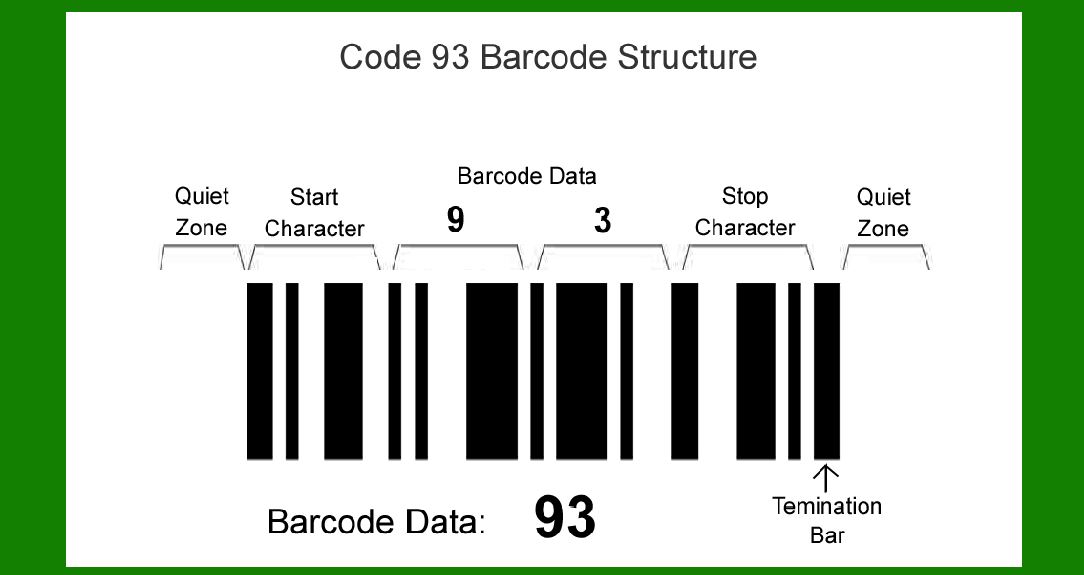
Code 93 includes special start and stop characters to indicate the beginning and end of the barcode. These characters are necessary for the barcode scanner to identify where the barcode begins and ends. The start and stop characters in Code 93 are represented by asterisks (*) and can also appear within the encoded data.

3. Check Characters

Code 93 uses two check characters (C and K) to provide error detection capabilities. These check characters help verify the accuracy of the barcode during scanning. They are calculated based on the weighted sum of all characters in the barcode, using specific encoding values.

4. Character Mapping

Each character in Code 93 is mapped to a specific pattern of bars and spaces. This mapping defines how each alphanumeric character is represented in the barcode symbol. The mapping ensures that the barcode scanner can interpret the correct data from the barcode.

5. Encoding Rules

The encoding of Code 93 follows specific rules:

Each character is represented by a series of nine modules (bars and spaces).

Each module is either narrow (one unit wide) or wide (two units wide).

Each character is composed of three bars and three spaces.

Each character's encoding includes a start/stop pattern, character encodings, and check characters.

6. Start Character Encoding

The start character (*) in Code 93 initiates the barcode and signals the start of a new barcode symbol. Its encoding pattern is unique and differs from standard character encoding patterns.

7. Character Conversion

Characters to be encoded in Code 93 are converted into the corresponding barcode patterns using tables that define the sequence of bars and spaces for each character. For example:

The character 'A' might be represented by the pattern 101011110.

The character '1' might be represented by the pattern 101110010.

8. Check Character Calculation

After encoding the data characters (including start and stop characters), the check characters C and K are calculated based on a weighted sum formula:

C = (sum of values of characters * 1) % 47

K = (sum of values of characters * 2) % 47

Where each character has a numeric value assigned according to its position in the character set.

9. Stop Character Encoding

The stop character (*) indicates the end of the barcode symbol. Its encoding pattern is similar to the start character but is visually distinct to avoid confusion with data characters.

Example Encoding Process

Let's encode the alphanumeric string 'CODE93':

1.Data Characters: 'CODE93'

C = 12 (value of 'C') + 15 (value of 'O') + 4 (value of 'D') + 5 (value of 'E') + 9 (value of '9') + 3 (value of '3') = 48

2.Check Characters Calculation:

C = (48 * 1) % 47 = 1

K = (48 * 2) % 47 = 2

3.Encoding Sequence:

Start Character: *

Data Characters: C, O, D, E, 9, 3

Check Characters: C = 1, K = 2

Stop Character: *

4.Character Encoding:

Convert each character and its corresponding check characters into barcode patterns using predefined encoding tables.

5.Final Barcode Symbol:

Combine the start character, encoded data characters, check characters, and stop character to form the complete Code 93 barcode symbol.

Conclusion

Encoding of the Code 93 barcode involves converting alphanumeric data into a specific pattern of bars and spaces using start, data, check, and stop characters. Each character has a unique encoding sequence defined by encoding rules and tables, ensuring accurate and reliable data representation in the barcode symbol. The inclusion of check characters enhances error detection capabilities, crucial for reliable barcode scanning in various applications.


EasierSoft Barcode Label Design & Bulk Printing Software

---- Use Excel Data to Batch Print Barcodes on Label Sheets or Roll Labels  

---- How to use this barcode software

Download:  Free Barcode Software + Barcode Label Designer

Download Free Barcode Software at Softonic

     Download at CNET

Once you obtain a GS1/UPC/EAN barcode, or other barcode type and QR code, you can use our free software to batch print barcode labels onto Roll label paper using a professional label printer, or to batch print barcodes onto Avery 5160 label sheets using a regular laser or inkjet printer. Our software has free and paid versions.

The free version fully meets your needs for batch printing GS1/UPC/EAN barcodes. The paid version can import data from Excel and databases to batch print barcode labels with different values.

How to Start

Input Data

Import Excel Data

Print Barcode

Barcode Format

Label Designer

All Screen Shot

Export Barcode Image

Save Template

Output Word Excel

How to Use & FAQ:

Example: Print barcodes to 5162 label

Example: Print barcodes to 5163 label

Example: Print barcodes to 5164 label

Example: Print portrait orientation 5164

Example: Print barcodes to 5167 label

Example: Print barcodes to 5168 label

Example: Print portrait orientation 5168

Example: Print barcodes to 5169 label

Example: Print barcodes to 5660 label

Example: Print barcodes to 5661 label

Example: Print barcodes to 5662 label

Example: Print barcodes to 5663 label

Example: Print barcodes to 5664 label

Example: Print portrait orientation 5664

Example: Print barcodes to 5873 label

Example: Print barcodes to 5874 label

Two ways to import Excel data

Import Excel Data - Pro Edition

Import Excel Data - Std Edition

Import Data from Excel - Detail

Load Data From Excel File

Data Editing Table

Copy Data From Excel

Four ways to input barcode data

Add ASCII Key E

Input Multiple Lines of Text for Barcodes

Generates Sequential Serial Numbers

Import or copy data from Excel sheets

Special sequence number generation

Std Details: Simple Input Form

Std Details: Multiple Line Text Input

Details: Sequence Barcode Generator

Examples: Sequence Barcode Generator

Import Data From Excel Spreadsheet

Barcode Data Correspondence Diagram

Data Editor

Editing a Single Row Data in Form

Batch Editing Multiple Rows of Data

Batch Data Editing - Example 2

Design & print complex barcode labels

Configuring Text Elements on Label

Configuring Barcode Elements on Label

Configuring Image Elements on Label

Setting Line Elements on Label

Designing Labels for 5164 Sheet

Advanced Page Layout Settings

Add Barcode Elements to a Label

Configuring Parameters of a Barcode

Entering Multiple Values for a Barcode

Print barcode labels

Highlights

Excel integration: Import data directly from Excel to generate and print barcodes in bulk.

Label designer: Create complex labels with multiple barcodes, text, logos, and shapes.

Batch printing: Print thousands of barcodes at once using standard inkjet/laser printers or professional barcode printers.


Flexible editions:

Standard Edition: Simple batch printing with Excel data.

Professional Edition: Adds command-line automation for workflow integration.

Label Designer Edition: Advanced design features for complex labels.


Why Choose Our Barcode Solutions?

Cost-effective: Free online generator and permanent free desktop version available.

Easy to use: No technical expertise required—just input data and print.

Versatile: Supports nearly all 1D and 2D barcode types, including QR codes.

Trusted: Recommended by CNET and widely downloaded by users worldwide.


Suitable Use Cases

Small businesses and startups needing quick barcode labels for products.

Retailers and online sellers managing inventory with batch barcode printing.

Manufacturers requiring sequential or custom barcode labels for packaging.

Educational and testing environments where barcodes are used for tracking.


CONTACT

cs@easiersoft.com

If you have any question, please feel free to email us.


https://free-barcode.com


<<< Back to Directory <<<     Barcode Generator     Barcode Freeware     Privacy Policy