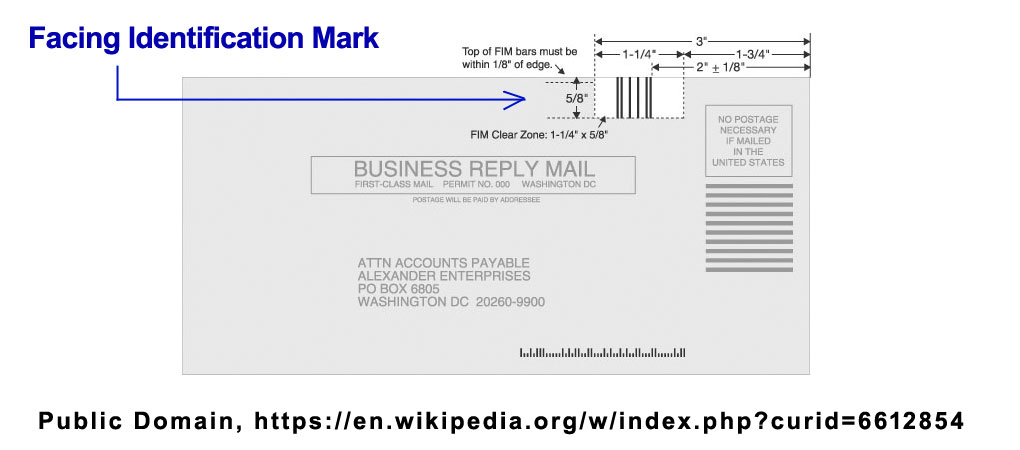
The Facing Identification Mark (FIM) Barcode is a specialized type of barcode used primarily in the postal service industry to automate the sorting and processing of mail. |
It serves as a critical component in ensuring accurate and efficient delivery of mail items across various postal systems worldwide. This detailed exploration will cover the technology, structure, encoding standards, applications, benefits, and examples of the Facing Identification Mark Barcode. |
|
Overview of Facing Identification Mark Barcode |
Definition and Purpose |
The Facing Identification Mark Barcode, commonly referred to as FIM Barcode or simply FIM, is a type of barcode used by postal services to identify and sort mail. Unlike traditional consumer-oriented barcodes, FIM is designed specifically for use by postal automation systems to assist in the handling and processing of mail items efficiently. |
History and Development |
The development of FIM Barcodes can be traced back to the evolution of automated mail processing technologies in postal services globally. It represents a significant advancement in the automation of mail sorting, enabling postal agencies to handle large volumes of mail with increased accuracy and speed. |

|
Technology and Structure |
Barcode Specifications |
FIM Barcodes are characterized by their specific format and encoding standards, tailored to meet the requirements of postal sorting machines. The barcode typically consists of a series of bars and spaces arranged in a specific pattern that encodes information readable by optical scanners. |
Encoding Standards |
The encoding standards for FIM Barcodes are governed by international postal standards organizations such as the Universal Postal Union (UPU) and national postal authorities. These standards ensure uniformity and compatibility across different postal systems, facilitating seamless mail processing and delivery. |
Barcode Types and Variants |
There are several types and variants of FIM Barcodes, each serving specific purposes within the postal sorting process. Variants may differ in terms of encoding density, format, and compatibility with different types of sorting equipment used by postal agencies. |

|
Applications and Use Cases |
Sorting and Processing Efficiency |
FIM Barcodes play a crucial role in automating the sorting and processing of mail within postal facilities. By encoding essential information about mail items, such as destination codes or sorting instructions, FIM Barcodes enable sorting machines to quickly and accurately route mail to its intended destination. |
Integration with Postal Systems |
FIM Barcodes are integrated into the operational workflows of postal systems worldwide, from initial mail acceptance to final delivery. They streamline the handling of bulk mailings, improve delivery accuracy, and reduce operational costs associated with manual sorting and processing. |

|
Benefits and Advantages |
Operational Efficiency |
The adoption of FIM Barcodes enhances operational efficiency within postal facilities by reducing manual handling and sorting of mail. This results in faster processing times, improved throughput, and enhanced overall productivity of postal operations. |
Enhanced Tracking and Traceability |
FIM Barcodes enable enhanced tracking and traceability of mail items throughout the postal delivery process. By encoding specific routing and destination information, postal agencies can monitor the movement of mail from collection to delivery, providing customers with real-time status updates. |
Cost Savings |
The automation enabled by FIM Barcodes helps postal agencies achieve significant cost savings by minimizing labor-intensive sorting tasks and optimizing resource utilization. This cost-effective approach contributes to the sustainability and competitiveness of postal services in a rapidly evolving market. |

|
Examples of Use |
International Postal Systems |
FIM Barcodes are widely used by international postal systems, including national postal agencies and private courier services. They are integral to the efficient handling of cross-border mail flows and international shipments, ensuring timely and accurate delivery to recipients worldwide. |
Domestic Mail Services |
Within domestic mail services, FIM Barcodes facilitate the rapid sorting and distribution of mail within a country's postal network. They are employed across various mail classes, including letters, parcels, and bulk mailings, to streamline processing and improve delivery performance. |

|
Future Trends and Innovations |
Technological Advancements |
Advancements in barcode scanning technologies and data analytics are driving innovation in the field of postal automation. Future developments may include the integration of advanced sensors, artificial intelligence (AI), and machine learning algorithms to further optimize mail processing efficiency and service reliability. |
Sustainability Initiatives |
Postal agencies are increasingly focusing on sustainability initiatives to reduce carbon emissions and environmental impact. FIM Barcodes support these efforts by enabling more efficient transportation and delivery routes, thereby minimizing the ecological footprint of postal operations. |

|
Conclusion |
The Facing Identification Mark Barcode represents a critical innovation in postal automation technology, facilitating the efficient sorting, processing, and delivery of mail items within global postal networks. By encoding essential information and streamlining operational workflows, FIM Barcodes contribute to enhanced service reliability, cost savings, and customer satisfaction in the postal industry. As postal services continue to evolve in response to technological advancements and changing consumer expectations, FIM Barcodes will remain indispensable in supporting the efficient and sustainable delivery of mail worldwide. |
 cs@easiersoft.com