Proposed Structure: |
1.Introduction to Data Matrix Barcodes |
2.History and Evolution of Data Matrix |
3.Technical Overview |
4.Data Encoding Techniques |
5.Symbol Sizes and Formats |
6.Error Correction with ECC200 |
7.Decoding Algorithms and Processes |
8.Printing and Marking Technologies |
9.Reading Technologies and Imaging Devices |
10.Applications Across Industries |
11.Regulatory and Standards Compliance |
12.Data Matrix vs. Other 2D Codes |
13.Security and Authentication Features |
14.Case Studies and Real-World Deployments |
15.Future Trends and Innovations |
|
Let's begin with the first few thousand words from the start: |
1. Introduction to Data Matrix Barcodes |
1.1 |
Data Matrix is a type of two-dimensional (2D) barcode consisting of black and white 'modules' arranged in a square or rectangular pattern. It was developed to encode a large amount of data in a small physical space. Unlike traditional linear (1D) barcodes, which represent information in a sequence of vertical bars and spaces, Data Matrix codes encode information in both the horizontal and vertical dimensions. This results in a much higher data density, enabling the encoding of hundreds or even thousands of characters in a compact area. |
1.2 |
The term 'Data Matrix' generally refers to a family of 2D matrix symbologies, with the most widely implemented and standardized version being Data Matrix ECC200. This version incorporates error correction capabilities based on Reed-Solomon algorithms, providing enhanced robustness and enabling successful decoding even when parts of the symbol are damaged or obscured. |
1.3 |
Data Matrix barcodes are widely used in industries such as electronics, pharmaceuticals, aerospace, automotive, and logistics. Their popularity stems from their capacity to store a great deal of data in a small area, their durability under harsh conditions, and their ability to be directly marked onto surfaces using techniques like laser etching or dot peening. |
1.4 |
From the perspective of machine vision and automatic identification and data capture (AIDC) systems, Data Matrix is considered one of the most reliable and versatile symbologies. It supports a wide range of encoding character sets, including ASCII, C40, Text, X12, EDIFACT, and Base256, thereby making it suitable for diverse types of data. |
1.5 |
Moreover, the Data Matrix barcode is ISO/IEC standardized, specifically under ISO/IEC 16022. This international standard defines its structure, encoding rules, error correction methodology, and decoding procedures, ensuring global compatibility and interoperability across different software and hardware systems. |
|
2. History and Evolution of Data Matrix |
2.1 |
The development of the Data Matrix code can be traced back to the late 1980s and early 1990s. The technology was originally conceived and developed by International Data Matrix, Inc. (ID Matrix), a company based in the United States. The goal was to create a compact and robust barcode symbology that could overcome the limitations of traditional 1D barcodes. |
2.2 |
During this period, many industries began seeking solutions to mark small items, such as integrated circuits, medical instruments, and automotive parts, with machine-readable codes. Traditional barcodes could not meet the miniaturization and data capacity needs, leading to the emergence of 2D barcodes like Data Matrix. |
2.3 |
Data Matrix quickly gained traction in high-reliability sectors, especially in the aerospace and defense industries, where the ability to mark parts directly and retain data integrity over time was critical. One of the key milestones in its adoption was the inclusion of Data Matrix in MIL-STD-130, a United States Department of Defense standard for item unique identification (IUID). |
2.4 |
With the acquisition of ID Matrix by Siemens AG and subsequently Microscan Systems, Data Matrix technology underwent further development, standardization, and integration into global supply chains. These developments culminated in its inclusion in the ISO/IEC 16022 standard, which formalized its structure and encoding methodology. |
2.5 |
Today, the use of Data Matrix is ubiquitous in contexts that demand reliable data encoding in small spaces. The growth of traceability requirements, serialized item tracking, and anti-counterfeiting measures has only accelerated its relevance in the global market. |

|
3. Technical Overview |
3.1 |
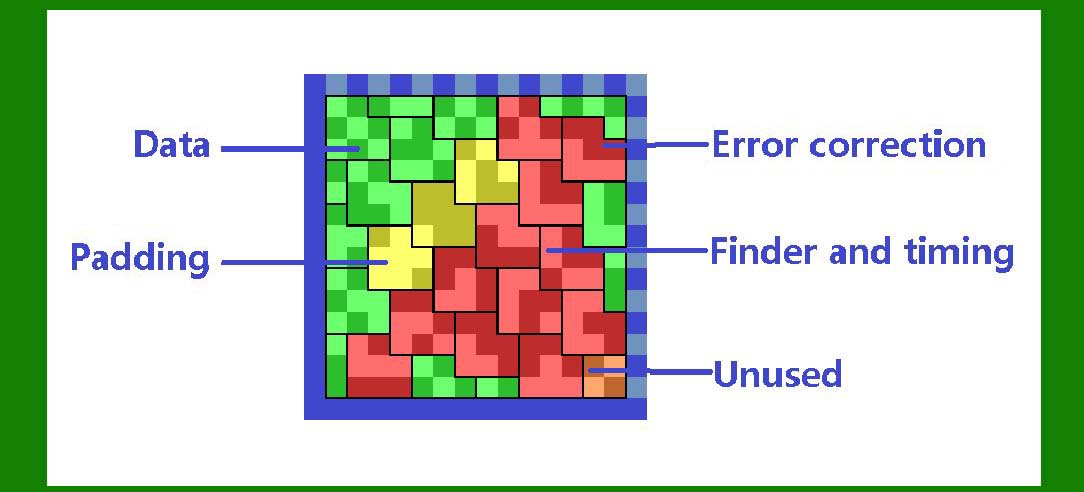
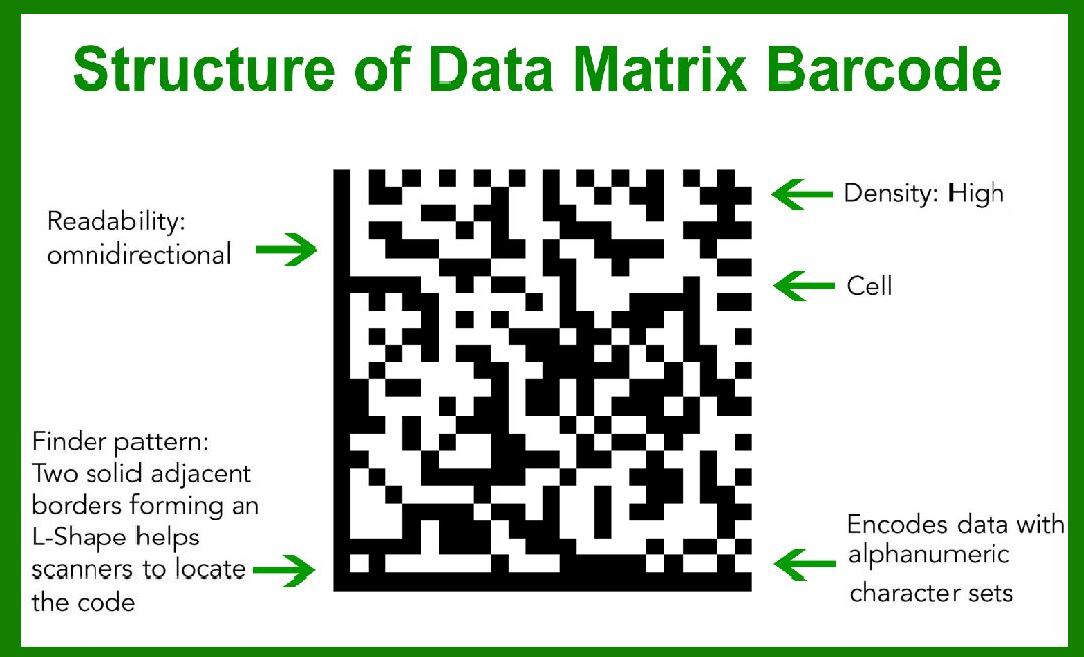
A Data Matrix symbol is composed of individual square elements called modules, which can be either black or white. These modules are arranged in a grid that forms the body of the symbol. The overall structure includes a 'finder pattern' and 'timing patterns' that help scanners locate and decode the symbol accurately. |
3.2 |
The finder pattern consists of two solid adjacent borders that form an L-shaped pattern on the left and bottom sides of the symbol. This pattern is used by decoding algorithms to determine the orientation and position of the barcode. |
3.3 |
The opposite two borders are composed of alternating black and white modules. These are the timing patterns, which help in sampling the symbol during the scanning process and correcting for any skew or distortion that may occur during image capture. |
3.4 |
Inside the symbol, the modules encode data and error correction codewords. The symbol can be square or rectangular, and its size ranges from as small as 10¡Á10 modules to as large as 144¡Á144 modules (in the ECC200 standard). Each increase in size allows more data and error correction to be stored. |
3.5 |
The maximum data capacity of a square Data Matrix symbol is approximately 3,116 numeric characters, 2,335 alphanumeric characters, or 1,556 bytes of binary data. The rectangular format supports fewer characters but is useful in applications with limited height or width. |
3.6 |
The ECC200 error correction system used in modern Data Matrix symbols employs the Reed-Solomon algorithm. This method allows recovery of data even if a significant portion of the barcode is damaged, depending on the amount of error correction applied. |
3.7 |
Data Matrix codes can be printed on labels, engraved into metal, etched onto glass, or marked on plastics using a wide variety of techniques, including inkjet, laser, thermal transfer, or dot peen. This makes them ideal for direct part marking (DPM) applications, where the symbol must survive the life of the part. |
3.8 |
One of the unique features of Data Matrix is its ability to maintain readability even under challenging conditions such as low contrast, distortion, curvature of the substrate, or partial obstruction. This robustness is a key reason for its adoption in critical industries. |

|
4. Data Encoding Techniques |
4.1 |
The process of encoding information in a Data Matrix barcode involves transforming the input data into a series of binary values, which are then mapped into modules of the symbol. Data encoding in Data Matrix is more advanced than in traditional barcodes, as it supports various character sets and specialized encoding schemes. |
4.2 |
Data Matrix uses several encoding modes to represent different types of data. These modes include: |
ASCII Encoding: Used for alphanumeric characters, including uppercase letters, digits, and a range of special characters. |
C40 Encoding: Optimized for European languages, this mode allows more efficient encoding of characters by using fewer bits per character. |
Text Encoding: A variant of C40 encoding, specifically designed for applications in which characters are predominantly textual. |
X12 Encoding: Used for encoding data in the ANSI X12 standard format, which is common in electronic data interchange (EDI) applications. |
EDIFACT Encoding: Similar to X12 encoding but used for the UN/EDIFACT messaging format, which is common in international trade. |
Base256 Encoding: Used for encoding arbitrary binary data, such as images, which may not be representable in traditional alphanumeric encoding schemes. Base256 allows each byte of data to be represented by a single Data Matrix module. |
4.3 |
The encoding process begins by dividing the input data into blocks. These blocks are then translated into codewords based on the chosen encoding mode. In the case of Base256 encoding, this allows for the direct representation of binary data (like images or encrypted messages) in a readable form. Each block is mapped into a grid of modules, creating the two-dimensional structure. |
4.4 |
To ensure compatibility across different systems and use cases, Data Matrix barcodes can store not only textual data but also information that corresponds to a binary payload. This flexibility makes Data Matrix an ideal choice for applications that require the storage of complex or structured data formats, such as serialized part numbers, URLs, or even small digital files. |
4.5 |
One critical advantage of Data Matrix's encoding system is its ability to efficiently compress data. For example, Base256 encoding is highly space-efficient, enabling the inclusion of large binary datasets (like images or firmware) in relatively small symbols. Additionally, the use of error correction coding allows Data Matrix to maintain data integrity even when part of the symbol is missing or obscured. |
4.6 |
Encoding data in Data Matrix involves several layers of structure. First, the data is transformed into a binary stream, which is then mapped to a 2D grid. The codewords are interspersed with error correction bits, which are calculated using the Reed-Solomon algorithm to improve data recovery in case of symbol damage. |
4.7 |
The efficient encoding and error correction capabilities of Data Matrix barcodes make them highly suitable for use in environments where space is at a premium and the barcode may be subjected to wear, abrasion, or partial obfuscation. Industries like pharmaceuticals, aerospace, and automotive rely on the resilience of Data Matrix encoding to ensure the accuracy and legibility of critical information even in harsh environments. |

|
5. Symbol Sizes and Formats |
5.1 |
The Data Matrix barcode symbology can be printed in various sizes, depending on the data requirements and the available space. The size of a Data Matrix barcode is determined by the number of modules it contains, which can vary from 10¡Á10 modules to as large as 144¡Á144 modules (for ECC200 symbols). The size of the Data Matrix symbol is directly related to the amount of data it encodes and the desired level of error correction. |
5.2 |
There are specific versions of Data Matrix, ranging from smaller symbols with fewer modules (lower capacity) to larger ones with more modules (higher capacity). A typical symbol might have the following dimensions: |
10x10: This is the smallest size, capable of storing up to 6 characters of data. |
12x12, 14x14, 16x16, etc.: These sizes increase the data storage capacity in increments of approximately 2-4 characters for each additional module. These sizes are suitable for small data requirements, such as product serial numbers or lot codes. |
24x24, 32x32, 36x36, etc.: These medium-size symbols are capable of encoding hundreds of characters and are commonly used in inventory management, product labeling, and asset tracking. |
144x144: The largest available size for a Data Matrix barcode, capable of encoding thousands of characters, including complete files, long serial numbers, and other large datasets. |
5.3 |
The decision on which symbol size to use depends on the type of data being encoded, the space available for printing, and the intended use case. Smaller Data Matrix symbols are often used for labeling tiny items like electronic components or surgical instruments, while larger symbols are suitable for larger items or when more data needs to be encoded. |
5.4 |
In practical applications, a symbol's size must be chosen with careful consideration of the printing method, the physical size of the product, and the expected scan distance. If the symbol is too large for the available space or too small to be read at a distance, it can lead to issues with decoding accuracy. |
5.5 |
Rectangular symbols are also possible, where the width and height ratios of the grid are not equal. This format is particularly useful in situations where space constraints require a long, narrow barcode, or in packaging and labeling applications where height limitations exist. For example, rectangular Data Matrix symbols might be used to encode URLs or tracking numbers on shipping packages, where a narrow barcode may fit more easily on the label. |
5.6 |
The variation in symbol sizes and formats also allows Data Matrix barcodes to be used across a wide range of applications. Smaller symbols can be used for direct part marking (DPM) on microelectronics, while larger ones can accommodate more data for industrial applications such as component traceability, inventory control, and anti-counterfeiting measures. |

|
6. Error Correction with ECC200 |
6.1 |
One of the standout features of Data Matrix barcodes is the inclusion of error correction through the ECC200 standard. The ECC200 error correction system is based on the Reed-Solomon algorithm, a powerful and widely used error-correcting code (ECC) that ensures data integrity even when parts of the barcode are damaged, dirty, or obscured. |
6.2 |
The Reed-Solomon error correction algorithm works by adding redundant information (called 'error correction codewords') to the data being encoded. When a Data Matrix barcode is scanned, the decoding software checks the integrity of the data by comparing the codewords with the expected values. If discrepancies are found (e.g., due to partial damage or distortion of the barcode), the missing or damaged data can be reconstructed using the error correction codewords. |
6.3 |
The amount of error correction applied to a Data Matrix symbol can vary. The higher the level of error correction, the more robust the barcode becomes in terms of recovering lost or damaged information. However, this also increases the size of the barcode. The error correction level can be chosen based on the anticipated risks of damage to the symbol (e.g., exposure to abrasion, extreme temperatures, or contaminants). |
6.4 |
The Reed-Solomon algorithm used in ECC200 provides a high level of protection, even allowing for recovery of data from symbols that have up to 30% of their modules damaged. This makes Data Matrix highly reliable in environments where barcodes are subjected to wear and tear, such as manufacturing floors, shipping docks, or outdoor installations. |
6.5 |
Data Matrix codes with error correction are especially useful for applications where barcode scanning must be highly reliable, even in less-than-ideal conditions. Examples include the aerospace industry (where parts are subjected to extreme temperatures and mechanical stress), the automotive industry (where barcodes are applied to components subject to corrosion or physical impact), and healthcare (where medical devices must maintain legible barcodes throughout their lifecycle). |

|
7. Decoding Algorithms and Processes |
7.1 |
The decoding process of a Data Matrix barcode is a sophisticated operation that involves identifying the symbol, interpreting its data, and correcting any errors that may be present in the barcode. The algorithms used to decode a Data Matrix barcode rely heavily on the structure of the symbol, the location of its timing patterns, and the error correction mechanism built into the ECC200 standard. |
7.2 |
When a Data Matrix barcode is scanned, the first step in the decoding process is image capture. A scanner or imaging device (such as a camera or barcode reader) captures an image of the barcode, which is then processed by the decoding software. The image is usually analyzed for contrast, clarity, and the presence of the signature finder patterns (the L-shaped patterns along two sides of the symbol). |
7.3 |
Once the symbol is located, the decoding algorithm identifies the orientation and size of the barcode based on the finder patterns. The next step is to extract the data modules from the barcode. In a Data Matrix symbol, each module corresponds to a bit of data-either a 1 (black) or a 0 (white). The modules are grouped into a grid that corresponds to the structure of the Data Matrix symbol. |
7.4 |
The software uses the timing patterns and finder patterns to interpret the grid of modules, adjusting for any distortion or rotation in the image. The symbol may not always be perfectly aligned when captured, so the decoding algorithm compensates for skew and rotation, ensuring that the data is accurately extracted. |
7.5 |
After the grid of modules is identified, the data is decoded according to the appropriate encoding scheme used in the Data Matrix barcode. The algorithm checks which encoding method was used (e.g., ASCII, Base256, Text, C40, etc.) and applies the necessary rules to convert the binary data into human-readable text, numbers, or binary payloads. |
7.6 |
A key part of the decoding process is error correction. If the barcode has been damaged (e.g., scratched or partially obscured), the Reed-Solomon error correction system kicks in. The error correction codewords stored within the Data Matrix symbol allow the decoding algorithm to reconstruct the missing or damaged data. The Reed-Solomon algorithm can handle up to 30% damage in a Data Matrix barcode, making it one of the most resilient 2D barcode technologies available. |
7.7 |
The decoding software checks the error correction codewords for discrepancies and uses them to correct the data. In some cases, the algorithm may detect multiple areas of damage and apply a series of corrective operations to ensure the integrity of the decoded data. The process of correcting errors is transparent to the user, with the barcode scanner providing the final result as if the barcode were fully intact. |
7.8 |
In cases where the symbol is completely unreadable (e.g., due to excessive damage or poor printing quality), the decoding algorithm will return an error message or prompt the user to rescan the barcode. However, in most real-world situations, the error correction system is sufficient to handle minor damage and allow successful decoding. |
7.9 |
Decoding algorithms have become more sophisticated over time, incorporating machine learning techniques and image processing capabilities to improve accuracy in challenging environments. Modern barcode readers can handle distorted, rotated, or low-contrast Data Matrix symbols with ease, allowing for quick and reliable data capture. |
7.10 |
The flexibility of the decoding process in Data Matrix barcodes allows them to be used in a wide range of applications, from high-volume industrial use cases to handheld consumer-grade barcode scanners. Whether the symbol is printed on a product label or directly marked on a part, the decoding system ensures that the data is extracted accurately, even under suboptimal conditions. |

|
8. Printing and Marking Technologies |
8.1 |
The printing and marking of Data Matrix barcodes is a critical component of their use in real-world applications. Given the wide range of materials and environments in which Data Matrix codes are used, there are several methods for printing or marking them on products. These techniques must ensure that the Data Matrix symbol is legible, durable, and scannable throughout the lifecycle of the product. |
8.2 |
Common printing methods for Data Matrix codes include: |
Thermal Transfer Printing: This method uses heat to transfer ink from a ribbon onto the surface of a label. Thermal transfer printing produces high-quality, durable prints that are resistant to smudging, fading, and scratching. It is commonly used in label printing for logistics, inventory, and product tracking. |
Laser Marking: Laser etching or engraving is often used for direct part marking (DPM) of Data Matrix codes on metals, plastics, and other durable materials. Laser marking creates high-contrast, permanent marks that are resistant to wear and corrosion. It is ideal for industries such as aerospace, automotive, and manufacturing, where parts must be marked directly with a barcode. |
Inkjet Printing: Inkjet printers use liquid ink to create the barcode image on labels or products. This method is generally used for high-speed, low-cost printing of Data Matrix codes. However, inkjet-printed barcodes may not be as durable as those created through thermal transfer or laser marking, particularly when exposed to harsh conditions. |
Dot Peen Marking: Dot peening involves using a pneumatically powered stylus to create a series of tiny dots on the surface of a material. This method is often used for marking metals and plastics, particularly in industrial applications. Dot peen marking is durable and resistant to environmental factors like abrasion, but the resolution is lower than that of laser marking. |
Flexographic Printing: Used in high-volume packaging applications, flexographic printing involves applying ink to flexible printing plates that transfer the ink to substrates such as cardboard or plastic. This method is commonly used for packaging and labeling, where high-quality, scannable Data Matrix codes must be applied at scale. |
8.3 |
The choice of printing or marking method depends on several factors, including the type of material, the required durability of the mark, the printing volume, and the specific environmental conditions in which the barcode will be used. For example, laser marking is often preferred for products that will undergo extreme conditions (e.g., high heat, chemical exposure) due to its permanent nature, while thermal transfer printing is commonly used for labeling products in logistics and retail. |
8.4 |
For direct part marking, one of the key considerations is the resolution of the printing method. The finer the resolution of the print (i.e., the more precise the marking), the smaller and more readable the Data Matrix code can be. Direct part marking (DPM) allows manufacturers to encode important information such as serial numbers, part numbers, and maintenance records directly onto components, improving traceability and reducing the need for external labels. |
8.5 |
One important consideration when printing Data Matrix codes is ensuring that the print quality meets the ISO/IEC standards for barcode readability. Poorly printed or distorted Data Matrix codes can result in decoding failures, leading to delays and errors in scanning. This is particularly critical in industries like pharmaceuticals and aerospace, where precision is essential for safety and compliance. |
8.6 |
To ensure print quality, many barcode printers are equipped with built-in quality control features, such as automatic contrast adjustment, alignment checks, and image quality analysis. These features help ensure that the printed Data Matrix codes meet the required specifications for size, contrast, and clarity, minimizing the likelihood of scanning issues in the field. |

|
9. Reading Technologies and Imaging Devices |
9.1 |
To decode a Data Matrix barcode, specialized reading technologies and imaging devices are required. These devices use a combination of hardware (such as laser scanners or cameras) and software (decoding algorithms) to capture and interpret the barcode's data. The reading process involves scanning the barcode, interpreting the data, and converting it into a usable format for the end user. |
9.2 |
There are two primary types of readers used for scanning Data Matrix codes: laser scanners and imaging-based readers (camera-based devices). |
Laser Scanners: Traditional laser scanners use a laser beam to illuminate the barcode. The laser is reflected off the barcode's surface and detected by a sensor. Laser scanners are highly efficient at reading barcodes in good condition, but their ability to decode damaged or distorted symbols is limited compared to imaging-based readers. Laser scanners are most commonly used for 1D barcodes, but some advanced models also support 2D codes like Data Matrix. |
Imaging-Based Readers (Camera-Based Devices): These readers use a digital camera or CCD sensor to capture an image of the barcode. Imaging-based readers are much more versatile than laser scanners, as they can decode both 1D and 2D barcodes (including Data Matrix) from a variety of angles, distances, and orientations. They are also better equipped to handle damaged, distorted, or low-contrast barcodes. Imaging-based readers use software algorithms to decode the barcode by analyzing the image and identifying the modules, patterns, and data. |
9.3 |
Camera-based readers can also provide advanced features like auto-focus, multi-code scanning, and the ability to decode barcodes in difficult environments (e.g., poor lighting, complex backgrounds). Some devices are equipped with optical character recognition (OCR) capabilities that enable them to decode text-based information in addition to barcode symbols. |
9.4 |
The choice of reader depends on several factors, including the application requirements, the environment in which the reader will be used, and the physical characteristics of the barcode. Imaging-based readers are generally more flexible and reliable for reading Data Matrix codes in real-world conditions, especially when dealing with a variety of sizes, print qualities, and orientations. |

|
10. Application Areas and Use Cases |
10.1 |
Data Matrix barcodes are highly versatile and used across a wide range of industries and applications due to their compact size, high data density, and resilience. The primary advantages of Data Matrix barcodes-such as small physical footprint, robustness, and error correction-make them ideal for applications where space is limited, or durability is required. |
10.2 |
Some of the most common application areas for Data Matrix barcodes include: |
Manufacturing and Industrial Applications: In manufacturing, Data Matrix barcodes are used for direct part marking (DPM), tracking parts, components, and finished products throughout the production process. Their small size and ability to encode large amounts of data make them ideal for marking products with serial numbers, part numbers, and traceability information. |
Aerospace and Automotive Industries: Both the aerospace and automotive industries rely on the ability to track critical components throughout their lifecycle. Data Matrix codes are often marked directly on parts using laser marking or dot peen technology, ensuring that even small, high-precision parts are traceable. These industries use Data Matrix barcodes for applications such as tracking vehicle parts, maintenance records, and compliance documentation. |
Pharmaceutical and Medical Device Industries: The pharmaceutical industry has strict requirements for traceability and regulatory compliance. Data Matrix codes are commonly used on pharmaceutical packaging to encode information such as batch numbers, expiration dates, and unique serial numbers. Medical device manufacturers also use Data Matrix codes for labeling individual components with serial numbers, production information, and other critical data. This ensures product safety and compliance with regulations like the FDA's UDI (Unique Device Identification) system. |
Retail and Logistics: Data Matrix barcodes are used in retail and logistics for inventory management, product tracking, and shipping. Their high data density allows for the inclusion of extensive product information in a small space, which is particularly useful for applications such as shelf labeling, package tracking, and point-of-sale (POS) systems. Data Matrix barcodes are also used for tracking parcels in the supply chain, enabling more efficient and accurate inventory control. |
Electronics and Consumer Goods: The electronics industry uses Data Matrix barcodes to label parts and components, particularly in cases where traditional 1D barcodes would be too large. Small electronic components, such as resistors, capacitors, and semiconductors, are often marked with Data Matrix codes for tracking, quality control, and counterfeit prevention. |
Document Management and Security: Data Matrix barcodes are used in document management systems for indexing and tracking paper-based records. They can encode URLs, QR codes, and even documents for secure access. Legal documents, contracts, and records can be labeled with Data Matrix barcodes to facilitate scanning and easy retrieval. Additionally, Data Matrix barcodes are used for access control and authentication, particularly in secure environments like government agencies or financial institutions. |
10.3 |
The flexibility of Data Matrix barcodes extends beyond traditional labeling and tracking applications. In some cases, they are used to encode entire files or even small multimedia content. For example, Data Matrix barcodes can encode encrypted data, software updates, and images for secure and efficient transmission in applications such as asset management and authentication. |
10.4 |
In retail, Data Matrix barcodes provide an efficient solution for encoding product information such as pricing, manufacturer details, and product attributes. This is particularly useful for small items, such as jewelry, cosmetics, or electronics, where space for a traditional barcode is too limited. Additionally, Data Matrix codes can be used for loyalty programs and promotions, where customers can scan codes to access discounts or coupons. |

|
11. Advantages of Data Matrix Over Other Barcode Technologies |
11.1 |
Data Matrix barcodes offer several advantages over other barcode technologies, particularly in terms of size, capacity, and durability. These advantages make them the preferred choice for many industries and applications. |
11.2 |
Some of the key benefits of using Data Matrix barcodes include: |
High Data Density: Data Matrix barcodes can encode a large amount of data in a small space. Unlike 1D barcodes, which can only store a limited amount of information (usually just a number or a code), Data Matrix barcodes can store hundreds or even thousands of characters, including both text and binary data. This makes them suitable for applications requiring more complex or detailed data storage, such as in pharmaceuticals, automotive manufacturing, and aerospace. |
Compact Size: Data Matrix barcodes are small and can be printed or marked on tiny items, such as electronic components, medical devices, and parts in the aerospace industry. Their small size allows them to be used in situations where space is at a premium, such as on small labels or directly marked onto products. |
Error Correction: The built-in Reed-Solomon error correction in the ECC200 standard ensures that Data Matrix codes are highly resilient to damage, dirt, or distortion. This is a significant advantage over other barcode types that do not include such robust error correction mechanisms. In environments where barcodes are subjected to abrasion, exposure to chemicals, or environmental stress, Data Matrix codes maintain their readability and reliability. |
Versatility in Encoding: Data Matrix barcodes support a variety of encoding schemes, including ASCII, C40, and Base256, allowing them to encode a wide range of data types. Whether it's alphanumeric data, binary data, or special characters, Data Matrix can efficiently encode and decode the required information. |
High-Speed Scanning: Data Matrix barcodes can be scanned quickly and reliably, even when printed at small sizes. This is especially important in high-volume applications, such as manufacturing, logistics, and retail, where quick and accurate data capture is essential to efficiency. |
Two-Dimensional Format: Unlike traditional 1D barcodes, which only encode data in one direction, Data Matrix barcodes use a 2D grid that allows for greater flexibility in data storage. This two-dimensional format also makes Data Matrix codes more tolerant of physical damage, as the data can be recovered from different parts of the symbol. |
Wide Range of Scanning Devices: Data Matrix codes can be read by a wide variety of devices, including laser scanners, imaging-based readers, and mobile phone cameras. This broad compatibility ensures that Data Matrix barcodes can be used across a wide range of industries and applications, from retail to manufacturing to healthcare. |
11.3 |
Data Matrix codes also offer advantages in terms of their aesthetic flexibility. They can be printed or marked in various colors, shapes, and sizes to suit specific branding or design needs. For example, they can be customized to blend in with the product packaging or promotional material while maintaining their scannability. |
11.4 |
The resilience of Data Matrix barcodes, particularly in terms of their ability to withstand damage and contamination, makes them the ideal choice for applications in harsh environments. Whether used in automotive parts, industrial machinery, or outdoor equipment, Data Matrix codes maintain high reliability and accuracy even in challenging conditions. |

|
12. Future Trends and Developments |
12.1 |
As technology continues to evolve, the use and capabilities of Data Matrix barcodes are expected to expand even further. With advancements in barcode reading technology, such as the integration of machine learning and artificial intelligence, Data Matrix codes will become even more efficient and accurate in real-world applications. |
12.2 |
Some potential future trends in the use of Data Matrix barcodes include: |
Integration with IoT (Internet of Things): Data Matrix barcodes are poised to play a critical role in the growing field of IoT. By encoding data related to product performance, maintenance schedules, and environmental conditions, Data Matrix barcodes can help connect physical assets with digital systems for real-time monitoring and tracking. This will be particularly beneficial in industries like manufacturing, logistics, and agriculture, where equipment and products are increasingly monitored and managed through IoT devices. |
Enhanced Security and Anti-Counterfeiting Measures: As the need for product authentication and anti-counterfeiting measures increases, Data Matrix barcodes may be integrated with technologies such as cryptography, blockchain, and digital signatures. These technologies can help ensure the authenticity of products and prevent counterfeiting, particularly in industries like pharmaceuticals, luxury goods, and electronics. |
Integration with Augmented Reality (AR): The combination of Data Matrix barcodes with AR technology has the potential to revolutionize user interactions with physical products. By scanning a Data Matrix barcode, users could gain access to detailed product information, instructions, videos, or interactive experiences through AR-enabled devices such as smartphones or AR glasses. |
Improved Mobile Scanning Capabilities: With the increasing adoption of smartphones as barcode scanners, Data Matrix barcodes will continue to benefit from improvements in mobile scanning technology. As smartphones become more powerful and capable of handling advanced image processing, mobile scanning of Data Matrix barcodes will become faster, more reliable, and more ubiquitous. |

|
13. Regulatory Standards and Compliance |
13.1 |
Data Matrix barcodes are governed by several international standards that ensure their interoperability and correct usage across various industries. These standards ensure that Data Matrix codes meet specific quality, size, and readability criteria, making them reliable for a wide range of applications, especially in regulated sectors like pharmaceuticals and aerospace. |
13.2 |
The primary standards governing Data Matrix barcodes include: |
ISO/IEC 16022: This is the international standard that defines the Data Matrix barcode format and its requirements for encoding, error correction, and physical dimensions. ISO/IEC 16022 specifies the technical characteristics of the Data Matrix symbol, including its matrix size (the number of rows and columns), the module size, and the error correction capabilities. This standard is critical for ensuring the proper encoding and decoding of Data Matrix codes and is widely adopted by industries around the world. |
ISO/IEC 15415: This standard provides the specifications for the quality of 2D barcodes, including Data Matrix. It specifies the minimum standards for print quality, readability, and error tolerance. ISO/IEC 15415 ensures that Data Matrix codes can be reliably scanned, even when printed at small sizes or under difficult conditions. It also outlines the criteria for assessing the quality of printed barcodes, such as contrast, reflectance, and clarity. |
ISO/IEC 15416: This standard provides the specifications for the quality of 1D barcodes, including Code 39 and Code 128, and is often referenced alongside the standards for 2D barcodes like Data Matrix. It defines the parameters for assessing the readability and print quality of these barcodes. |
13.3 |
In addition to these general barcode standards, Data Matrix codes play a critical role in industry-specific regulations: |
FDA UDI (Unique Device Identification): The U.S. Food and Drug Administration (FDA) has mandated that medical devices be labeled with a Unique Device Identifier (UDI) to improve traceability and safety. Data Matrix codes are commonly used to encode UDIs, as they can store a large amount of data in a small symbol. This standard ensures that medical devices are identifiable throughout their lifecycle, which is crucial for patient safety, regulatory compliance, and recall management. |
GS1 Standards: GS1, a global organization that develops supply chain standards, has incorporated Data Matrix codes into its framework for tracking and tracing products. The use of Data Matrix barcodes in supply chains is often driven by GS1's standards, which ensure that products are accurately identified, tracked, and traced throughout the supply chain. |
13.4 |
The use of Data Matrix barcodes in regulated industries such as pharmaceuticals, medical devices, and aerospace is closely tied to compliance with these international and industry-specific standards. Adherence to these standards ensures that Data Matrix barcodes can be reliably used for traceability, quality control, and regulatory reporting. |
13.5 |
Regulatory bodies often require that Data Matrix barcodes meet specific criteria for error correction, readability, and durability. For example, in the pharmaceutical industry, Data Matrix codes must be able to withstand environmental conditions such as exposure to moisture, chemicals, and temperature fluctuations while remaining scannable. This makes the built-in error correction and high tolerance for damage of Data Matrix codes particularly valuable in highly regulated sectors. |

|
14. Data Privacy and Security Considerations |
14.1 |
As the use of Data Matrix barcodes grows in applications such as healthcare, retail, and logistics, there is an increasing focus on data privacy and security. Since Data Matrix codes can encode a wide range of data, including sensitive personal, medical, or financial information, ensuring the security of this data is paramount. |
14.2 |
There are several key considerations related to the privacy and security of Data Matrix codes: |
Encryption: For applications that involve the storage of sensitive information, such as medical records or financial transactions, Data Matrix codes can be encrypted to protect the encoded data. Encryption ensures that even if the barcode is scanned by unauthorized parties, the data remains inaccessible without the appropriate decryption key. |
Secure Data Transmission: In some applications, Data Matrix codes are used to facilitate the transmission of data between devices or systems. To protect the integrity and confidentiality of this data, secure protocols (e.g., HTTPS, SSL/TLS) should be used when transmitting the information encoded in the Data Matrix code. This is especially important in industries like banking, healthcare, and e-commerce. |
Authentication and Anti-Counterfeiting: Data Matrix codes are frequently used for product authentication and anti-counterfeiting purposes. This is particularly important in sectors like pharmaceuticals, luxury goods, and electronics. By integrating Data Matrix codes with digital signatures, blockchain technology, or other secure authentication methods, organizations can ensure that the products are legitimate and not counterfeit. |
Access Control: In some cases, Data Matrix codes may be used for secure access to facilities, devices, or systems. When used in access control applications, Data Matrix codes can help prevent unauthorized access by encoding information such as user credentials or access permissions. For example, Data Matrix codes may be used to grant access to secured areas, devices, or confidential information in a controlled and traceable manner. |
14.3 |
While Data Matrix codes themselves do not inherently offer strong security features, they can be paired with other security measures (such as encryption and authentication protocols) to provide a higher level of data protection. This makes them suitable for applications where security and privacy are a concern, such as in healthcare, finance, and high-value product tracking. |
14.4 |
As the use of Data Matrix codes continues to expand, it is likely that more advanced security features will be incorporated into the technology. For example, the integration of biometric authentication, digital signatures, or even smart contracts (via blockchain) could further enhance the security of Data Matrix codes in sensitive applications. |

|
15. Impact on Supply Chain and Inventory Management |
15.1 |
The integration of Data Matrix barcodes in supply chain and inventory management has had a profound impact on the efficiency, accuracy, and traceability of operations. In industries such as manufacturing, logistics, and retail, Data Matrix codes have become an essential tool for tracking products and components at every stage of the supply chain. |
15.2 |
Some of the key ways in which Data Matrix barcodes have improved supply chain and inventory management include: |
Real-Time Tracking: Data Matrix codes allow for the real-time tracking of products, parts, and shipments. By scanning Data Matrix codes at various points in the supply chain, companies can gain immediate insights into the location, status, and condition of goods. This enables more efficient inventory management, reduces delays, and helps prevent stockouts or overstocking. |
Accuracy and Efficiency: Data Matrix codes provide a higher level of accuracy compared to traditional 1D barcodes, which reduces errors in inventory management and product tracking. Since Data Matrix codes can store more data in a small space, they are capable of encoding detailed information such as batch numbers, serial numbers, and manufacturing dates. This makes it easier to manage complex inventories and track products at a granular level. |
Improved Traceability: The ability to encode large amounts of data in a compact barcode allows companies to trace the history of products more effectively. This is particularly important in industries like pharmaceuticals, food, and aerospace, where product traceability is essential for safety, quality control, and compliance with regulations. |
Counterfeit Prevention: In industries like pharmaceuticals and luxury goods, Data Matrix barcodes are often used to prevent counterfeiting. The high data density and error correction capabilities of Data Matrix codes make them harder to replicate and alter than traditional 1D barcodes. By incorporating authentication measures such as digital signatures or blockchain, Data Matrix codes can help ensure the authenticity of products and prevent the circulation of counterfeit goods. |
15.3 |
As supply chains become more complex and globalized, the need for reliable, scalable, and secure tracking systems has never been greater. Data Matrix barcodes offer an effective solution for improving the visibility and traceability of goods throughout the supply chain, providing companies with valuable insights into their operations and enabling more informed decision-making. |
15.4 |
With the continued adoption of IoT and automation technologies, the role of Data Matrix barcodes in supply chain management will likely expand even further. For example, Data Matrix codes could be integrated with IoT sensors to provide real-time data on environmental conditions (e.g., temperature, humidity) during transportation, ensuring that products are handled in compliance with quality standards. |

|
16. Technological Advancements and Innovations |
16.1 |
Data Matrix barcodes, like many other technologies, continue to evolve as advancements in printing, scanning, and data encoding technologies emerge. Innovations in areas such as laser etching, high-speed imaging, and multi-dimensional data storage are influencing the future of Data Matrix barcodes. These advancements are making the codes even more versatile, resilient, and efficient for use in a wider array of applications. |
16.2 |
Some notable technological innovations impacting Data Matrix barcodes include: |
Advanced Printing Technologies: Traditional printing methods, such as inkjet and laser printing, are being enhanced by the development of more precise and high-resolution printing techniques. New technologies, like micro-engraving and laser etching, allow Data Matrix codes to be directly marked onto products with higher durability. This is particularly useful in industries such as aerospace, automotive, and medical device manufacturing, where part marking needs to withstand harsh environments. |
3D Barcodes: An emerging trend is the use of 3D barcodes, where the Data Matrix symbol is encoded in three-dimensional space. This allows for more data to be stored within a smaller volume, making it ideal for use in applications such as microchips, semiconductors, and other miniaturized components. These 3D barcodes can be encoded onto the surfaces of objects using advanced laser techniques, making them difficult to replicate or counterfeit. |
Augmented Reality (AR) Integration: Another area of innovation is the integration of Data Matrix codes with augmented reality (AR) systems. By scanning a Data Matrix code with an AR-enabled device, users can interact with additional multimedia content, such as videos, product demos, and interactive 3D models. This could transform retail, advertising, and product information systems by enabling richer, more immersive consumer experiences. |
Machine Learning for Barcode Recognition: The use of machine learning (ML) and artificial intelligence (AI) is advancing the ability of barcode scanners to recognize Data Matrix codes in challenging environments. For example, advanced ML algorithms can help scanners quickly and accurately detect and decode damaged or distorted Data Matrix symbols, improving scan reliability in real-world conditions. This technology also enables automated quality control systems to verify the accuracy of printed Data Matrix codes during manufacturing. |
Blockchain and Secure Tracking: As industries such as pharmaceuticals, food, and luxury goods seek more secure means of product traceability, blockchain technology is being integrated with Data Matrix codes for enhanced supply chain security. By embedding blockchain hashes within Data Matrix codes, companies can provide a tamper-proof and auditable record of a product's journey from manufacturer to consumer, ensuring that every step of the process is verified and transparent. |
16.3 |
These advancements in Data Matrix barcode technology are reshaping the ways in which barcodes are used in various industries. The incorporation of AR, machine learning, and blockchain is opening new possibilities for enhancing the capabilities of barcodes and offering more secure, engaging, and data-rich experiences for users and organizations alike. |

|
17. Challenges and Limitations |
17.1 |
While Data Matrix barcodes offer numerous advantages, there are still several challenges and limitations that users and organizations must contend with. These challenges can impact the effectiveness and efficiency of Data Matrix codes, especially when used in certain environments or applications. |
17.2 |
Some of the primary challenges and limitations include: |
Printing Quality and Resolution: Although Data Matrix codes are small and can store a significant amount of data, their readability depends heavily on the quality of the printed or marked symbol. Low-resolution printers or poor-quality marking methods can result in distorted or unreadable codes. High-resolution printing equipment is often required to ensure that the Data Matrix codes are legible and scannable, especially when printed on small or irregular surfaces. |
Physical Damage and Contamination: While Data Matrix barcodes are known for their resilience to damage, they are not impervious to physical wear and contamination. Scratches, dirt, and other forms of damage can render the barcode unreadable. For industries that require high durability, such as aerospace or automotive, the physical integrity of the Data Matrix code must be carefully considered, and additional protective measures (e.g., coating, lamination) may be necessary to preserve the barcode's functionality over time. |
Scanning Challenges in Low-Light or Harsh Environments: While Data Matrix barcodes are highly adaptable to different scanning conditions, scanning them in low-light environments or when they are physically damaged can still present challenges. Although advances in imaging technology have improved the ability to scan damaged barcodes, extreme environmental conditions (such as exposure to chemicals or extreme temperatures) may still limit the performance of certain barcode readers. |
Complexity in Integration with Legacy Systems: In some cases, companies may face challenges in integrating Data Matrix barcodes into their existing infrastructure, particularly if they have legacy systems that rely on older barcode technologies (e.g., 1D barcodes). Transitioning to Data Matrix codes requires upgrading scanning hardware, software, and database systems to handle the new barcode format. This transition may require significant investment in time and resources. |
Barcode Size: While the compact size of Data Matrix codes is often an advantage, there are cases where this small size can be limiting. For example, very tiny Data Matrix codes can be challenging to scan accurately without high-quality imaging systems. Additionally, there are physical limitations to how much data can be encoded in a Data Matrix code, even though it can store far more data than a traditional 1D barcode. |
17.3 |
Despite these challenges, Data Matrix barcodes continue to be widely adopted across various industries due to their significant advantages in data density, compactness, and error correction. As technology advances, many of these challenges are being addressed with improved hardware, software, and printing technologies. |

|
18. Future Prospects and Growth Opportunities |
18.1 |
Looking ahead, the future prospects for Data Matrix barcodes are bright, with continued growth anticipated across various industries. As the demand for more efficient, secure, and accurate tracking solutions increases, Data Matrix codes will likely play an even more critical role in areas such as inventory management, logistics, product authentication, and traceability. |
18.2 |
Some of the key growth opportunities for Data Matrix barcodes include: |
Increased Adoption in Healthcare and Pharmaceuticals: With the ongoing push for better patient safety, compliance, and traceability, Data Matrix codes are expected to see wider adoption in healthcare and pharmaceuticals. The ability to encode extensive product information, such as batch numbers, serial numbers, and expiration dates, makes Data Matrix barcodes ideal for use in medical device labeling, pharmaceutical packaging, and clinical trials. The need for compliance with regulations such as the UDI system (Unique Device Identification) in the United States and the EU Medical Device Regulation will continue to drive this growth. |
Advancements in Automation and IoT: As industries increasingly adopt automation and IoT systems, the role of Data Matrix barcodes in real-time tracking, data exchange, and asset management will continue to expand. Data Matrix codes can be used in combination with IoT sensors to monitor the condition of products (e.g., temperature, humidity, shock), providing greater insight into the state of assets and inventory throughout the supply chain. In industries such as logistics, agriculture, and manufacturing, this integration will help streamline operations and reduce waste. |
Counterfeit Protection and Authentication: With the growing concerns over counterfeit products in industries like pharmaceuticals, luxury goods, and electronics, the use of Data Matrix codes for authentication and anti-counterfeiting will continue to increase. By incorporating advanced security features such as encryption, digital signatures, and blockchain, Data Matrix codes can offer a reliable means of verifying the authenticity of products and preventing fraud. |
Consumer Engagement and Marketing: Data Matrix codes are increasingly being used in marketing and consumer engagement initiatives. By integrating Data Matrix barcodes with mobile apps, brands can offer consumers interactive experiences such as exclusive promotions, product information, or loyalty rewards. The widespread use of smartphones and mobile barcode scanning apps will further drive the adoption of Data Matrix codes in this space. |
18.3 |
As new technologies emerge and industries continue to evolve, Data Matrix barcodes are well-positioned to meet the demands of future applications. The ability to encode large amounts of data in a compact, durable, and scannable format ensures that Data Matrix barcodes will remain an essential tool for a wide range of industries in the years to come. |
 cs@easiersoft.com