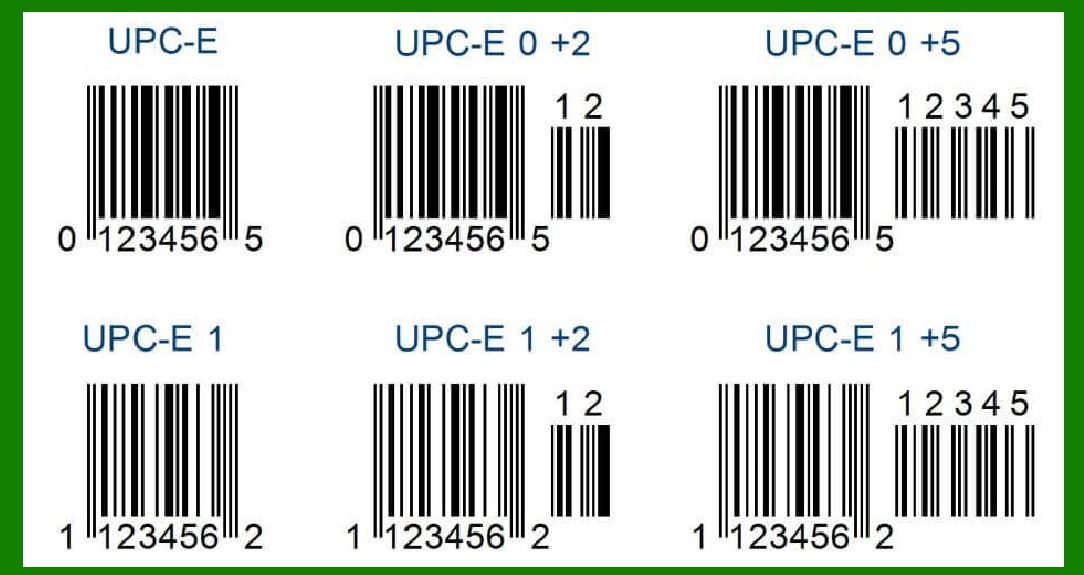
The UPC-E barcode is a condensed version of the UPC-A barcode, designed for smaller packages where space is a constraint. The UPC-E format is used primarily in the retail industry and is a variation of the Universal Product Code (UPC) system. Here are the key details about UPC-E barcodes: |
|
To allow the use of UPC barcodes on smaller packages, where a full 12-digit barcode may not fit, a zero-suppressed version of UPC was developed, called UPC-E, in which the number system digit, all trailing zeros in the manufacturer code, and all leading zeros in the product code, are suppressed. |
This symbology differs from UPC-A in that it only uses a 6-digit code, does not use M (middle) guard pattern, and the E (end) guard pattern is formed as space-bar-space-bar-space-bar, i.e. UPC-E barcode follows the pattern SDDDDDDE. The way in which a 6-digit UPC-E relates to a 12-digit UPC-A, is determined by UPC-E numerical pattern and UPC-E parity pattern. It can only correspond to UPC-A number system 0 or 1, the value of which, along with the UPC-A check digit, determines the UPC-E parity pattern of the encoding. With the manufacturer code digits represented by M's, and product code digits by P's. |

|
Structure and Composition |
1.Size and Digits: The UPC-E barcode contains 8 digits in total. These digits include 6 data digits, a check digit, and an implicit number system digit which is always '0' in UPC-E. |
2.Number System Digit: The number system digit (NSD) is implicitly 0 in UPC-E. If the product is coded using a different NSD in the UPC-A format, it cannot be converted to UPC-E. |
3.Encoding Method: UPC-E achieves its compact size by compressing a full 12-digit UPC-A code. This compression removes extra zeros found in certain positions of the UPC-A code. The exact method of compression depends on the pattern of digits in the UPC-A code. |

|
Compression Rules |
The transformation from UPC-A to UPC-E is determined by the values and positions of the zero digits in the manufacturer's code and product code in the UPC-A barcode. The general rules for compression are: |
If the last three digits of the manufacturer code are 000, 100, or 200: UPC-A: XXX000YYYZZZ UPC-E: XXXYYY0ZZ XXX represents the manufacturer code, YYY represents the product code, and ZZZ represents the check digit. |
If the last three digits of the manufacturer code are 300, 400, 500, 600, 700, 800, or 900: UPC-A: XXX0000YYYZZ UPC-E: XXXYYY3ZZ |
If the last three digits of the manufacturer code are 001, 002, ... 009: UPC-A: XXX00100YZZ UPC-E: XXXYYY4ZZ |
If the last two digits of the manufacturer code are 10, 20, 30, ... 90: UPC-A: XXX00000YZZ UPC-E: XXXYYY5ZZ |
If the last digit of the manufacturer code is 1, 2, ... 9: UPC-A: XXX000000YZ UPC-E: XXXYYY6YZ |

|
Check Digit Calculation |
The check digit is calculated using a specific algorithm which ensures the barcode is correctly read by scanners. It's determined based on the first 11 digits of the UPC-A code before compression to UPC-E format. Here's a simplified version of how it's typically calculated: 1.Sum of odd-positioned digits: Sum the digits in the odd positions (1st, 3rd, 5th, etc.) and multiply by 3. 2.Sum of even-positioned digits: Sum the digits in the even positions (2nd, 4th, 6th, etc.). 3.Add the two sums together. 4.Determine the check digit: The check digit is the number which, when added to the result, makes the total a multiple of 10. |

|
Benefits and Usage |
Space Efficiency: UPC-E is particularly useful for small packages where a full UPC-A barcode would not fit. Compatibility: UPC-E barcodes are widely supported by retail scanners, ensuring smooth integration with existing point-of-sale systems. |

|
Example Conversion |
For example, if you have a UPC-A barcode like 04210000526, it can be compressed to 042526 in UPC-E format. The implicit number system digit and check digit are derived to make it a valid 8-digit UPC-E barcode, resulting in 04252605 where '0' is the NSD and '5' is the check digit. Visual Representation |

|
UPC-E barcodes, like UPC-A, consist of a series of vertical bars and spaces of varying widths. They are typically represented with guard patterns at the start, middle, and end to help scanners properly detect and read the barcode. In summary, the UPC-E barcode is a compact version of the UPC-A barcode, optimized for smaller packaging, maintaining all necessary information in a reduced space while being fully compatible with retail scanning systems. |
 cs@easiersoft.com