To describe the Cronto Visual Cryptogram (CVC) in detail, including its origins, functionality, and application in e-banking, we need to cover several aspects comprehensively. |
Here's a detailed exploration of the Cronto Visual Cryptogram, commonly known as photoTAN: |
Introduction to Cronto Visual Cryptogram (CVC) |
The Cronto Visual Cryptogram, often referred to as photoTAN, represents a specialized form of visual barcode technology developed for secure transaction signing in e-banking systems. Originally conceived from research conducted at the University of Cambridge by Igor Drokov, Steven Murdoch, and Elena Punskaya, this technology addresses the critical need for enhancing transaction security in electronic banking environments. |
|
Origins and Development |
The development of Cronto Visual Cryptogram can be traced back to the early 2000s when concerns over online banking security were rising. Traditional methods of transaction authentication, such as PINs and passwords, were proving increasingly vulnerable to sophisticated cyber threats like phishing and man-in-the-middle attacks. In response, researchers at the University of Cambridge explored novel approaches to secure transaction verification. |
Researchers Behind Cronto Visual Cryptogram |
1.Igor Drokov: A key figure in the development of Cronto Visual Cryptogram, Igor Drokov contributed significantly to the cryptographic and mathematical foundations of the technology. 2.Steven Murdoch: Known for his expertise in computer security and cryptography, Steven Murdoch played a pivotal role in designing the security protocols embedded within the Cronto Visual Cryptogram. 3.Elena Punskaya: Her expertise in applied mathematics and cryptography contributed to the theoretical underpinnings of the Cronto Visual Cryptogram, ensuring robustness against various attacks. |

|
What is Cronto Visual Cryptogram? |
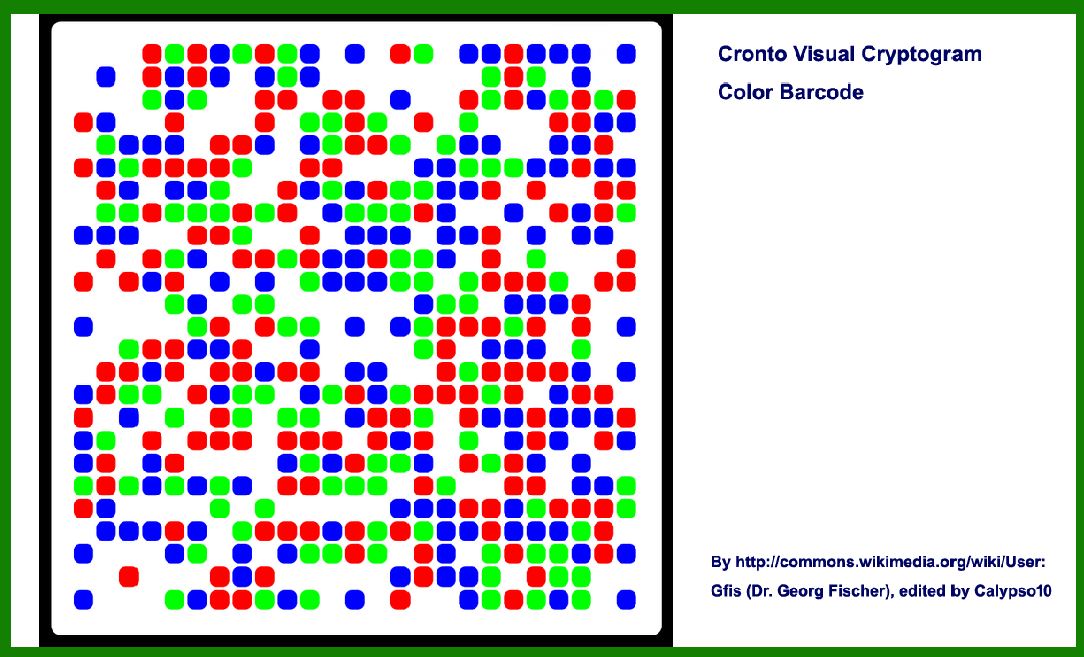
The Cronto Visual Cryptogram is a type of two-dimensional color barcode that encodes encrypted transaction data. Unlike traditional one-dimensional barcodes, which are typically used for inventory management and retail purposes, Cronto Visual Cryptogram serves a specific purpose in the realm of secure transaction authentication. |
Key Features and Components: |
1.Color Barcode Format: Instead of using black and white lines, Cronto Visual Cryptogram utilizes a matrix of colored dots arranged in a grid pattern. This design not only enhances visual appeal but also plays a crucial role in encoding complex transaction information. 2.Encryption of Transaction Data: Before being encoded into the visual barcode, transaction data such as the recipient, amount, and other pertinent details are encrypted using advanced cryptographic algorithms. This ensures that sensitive information remains secure and tamper-proof during transmission. 3.Challenge-Response Mechanism: The encrypted transaction data embedded within the Cronto Visual Cryptogram serves as a challenge to the user. To authenticate a transaction, the user must decode this information using a dedicated security token or mobile app and generate a corresponding Transaction Authentication Number (TAN). |

|
Functionality and Use Cases |
Transaction Signing in E-Banking: |
The primary application of Cronto Visual Cryptogram lies in e-banking systems, where it serves as a robust method for transaction signing. Here's how it typically works: |
1.Initiation of Transaction: When a user initiates a financial transaction, whether it's a fund transfer or bill payment, the bank generates a unique set of transaction details. 2.Encryption and Encoding: These transaction details are encrypted and encoded into a Cronto Visual Cryptogram, which is then displayed to the user on a computer screen or mobile device. 3.User Interaction: The user, equipped with a security token or a mobile app specifically designed to decode Cronto Visual Cryptograms, scans the barcode using their device's camera. 4.Generation of TAN: The security token or app deciphers the encrypted data and computes a Transaction Authentication Number (TAN) based on cryptographic algorithms embedded within the token or app. 5.Transaction Authorization: The user enters the generated TAN into their e-banking interface to authorize the transaction. This TAN serves as proof that the user has verified and approved the specific transaction details encoded in the Cronto Visual Cryptogram. |

|
Advantages of Cronto Visual Cryptogram: |
Enhanced Security: By employing encryption and challenge-response mechanisms, Cronto Visual Cryptogram mitigates the risks associated with unauthorized transaction attempts and phishing attacks. User-Friendly: Compared to traditional TAN lists or SMS-based authentication methods, Cronto Visual Cryptogram provides a streamlined and intuitive user experience, leveraging smartphone cameras for seamless interaction. Tamper-Proof Design: The cryptographic protocols underlying Cronto Visual Cryptogram ensure that even if intercepted, the encoded transaction data remains unreadable and unusable without the corresponding decryption keys. |

|
Technical Underpinnings |
Encryption and Decryption: |
The security of Cronto Visual Cryptogram hinges on robust encryption techniques such as AES (Advanced Encryption Standard) or RSA (Rivest-Shamir-Adleman). These algorithms ensure that sensitive transaction details are transformed into ciphertext before being embedded into the visual barcode. |
Challenge-Response Authentication: |
The challenge-response mechanism employed by Cronto Visual Cryptogram requires the user to possess a secure token or mobile app capable of decoding the barcode and computing a valid TAN. This process involves: |
Barcode Scanning: The user scans the Cronto Visual Cryptogram displayed on their screen using their device's camera. Decryption and Computation: The security token or app decrypts the encrypted data and applies cryptographic operations to generate a unique TAN for the transaction. |
Security Token Integration: |
To facilitate seamless interaction with Cronto Visual Cryptogram, banks often distribute dedicated security tokens to their customers. These tokens are designed to: |
Store Encryption Keys: Critical cryptographic keys required for decoding Cronto Visual Cryptogram and generating TANs are securely stored within the hardware of the security token. Generate TANs: Upon scanning the barcode, the token performs the necessary computations internally to produce a valid TAN, which is then displayed on the token's screen or transmitted wirelessly to the user's device. |

|
Implementation and Adoption |
Banking Industry Integration: |
Since its inception, Cronto Visual Cryptogram has gained traction among leading financial institutions worldwide. Banks and financial service providers integrate this technology into their e-banking platforms to: |
Enhance Security Measures: By replacing less secure authentication methods, such as static passwords or SMS-based TANs, with Cronto Visual Cryptogram, banks bolster their defenses against online fraud and cyber attacks. Compliance with Regulatory Standards: The adoption of Cronto Visual Cryptogram aligns with regulatory mandates aimed at strengthening the security and integrity of electronic banking transactions, such as PSD2 (Revised Payment Services Directive) in Europe. |
User Adoption and Experience: |
While initially unfamiliar to users accustomed to traditional TAN methods, Cronto Visual Cryptogram offers several advantages in terms of: |
Accessibility: Leveraging the camera functionality of smartphones, Cronto Visual Cryptogram eliminates the need for specialized hardware devices beyond the user's mobile device. Simplicity: The process of scanning a visual barcode and entering a generated TAN into the banking interface is straightforward, reducing the likelihood of user error or confusion. |

|
Challenges and Considerations |
Security Concerns: |
While Cronto Visual Cryptogram enhances transaction security, challenges remain in: |
Secure Distribution: Ensuring the secure distribution of security tokens and mobile apps capable of decoding Cronto Visual Cryptogram is crucial to mitigating the risk of unauthorized access or interception. Cyber Threats: Ongoing advancements in cybercrime necessitate continuous updates to encryption protocols and security measures embedded within Cronto Visual Cryptogram technology. |
User Education: |
To maximize the effectiveness of Cronto Visual Cryptogram, banks must invest in: |
User Training: Educating customers about the benefits and proper usage of Cronto Visual Cryptogram to foster confidence and adoption. Technical Support: Providing robust technical support channels to address user queries and troubleshooting related to the technology. |

|
Future Trends and Innovations |
Evolution of Authentication Methods: |
As the landscape of digital banking evolves, Cronto Visual Cryptogram is likely to: |
Integrate Biometric Authentication: Future iterations may incorporate biometric identifiers, such as fingerprint or facial recognition, to further enhance transaction security and user convenience. Blockchain Integration: Leveraging blockchain technology could provide additional layers of transparency and immutability to transaction verification processes utilizing Cronto Visual Cryptogram. |
Expansion Beyond Banking: |
Beyond e-banking, Cronto Visual Cryptogram holds potential applications in: |
Secure Document Authentication: Verifying the authenticity of sensitive documents, such as legal contracts or medical records, through encrypted visual barcodes. E-commerce Security: Enhancing the security of online transactions and digital payments in e-commerce platforms by integrating Cronto Visual Cryptogram as a verification method. |

|
Conclusion |
The Cronto Visual Cryptogram, born out of academic research at the University of Cambridge, represents a significant advancement in transaction authentication technology within the e-banking sector. By combining encryption, challenge-response mechanisms, and visual barcode technology, Cronto Visual Cryptogram enhances security while maintaining user accessibility and convenience. As financial institutions continue to prioritize cybersecurity and regulatory compliance, Cronto Visual Cryptogram is poised to play a pivotal role in safeguarding electronic transactions against evolving threats in the digital age. |
 cs@easiersoft.com