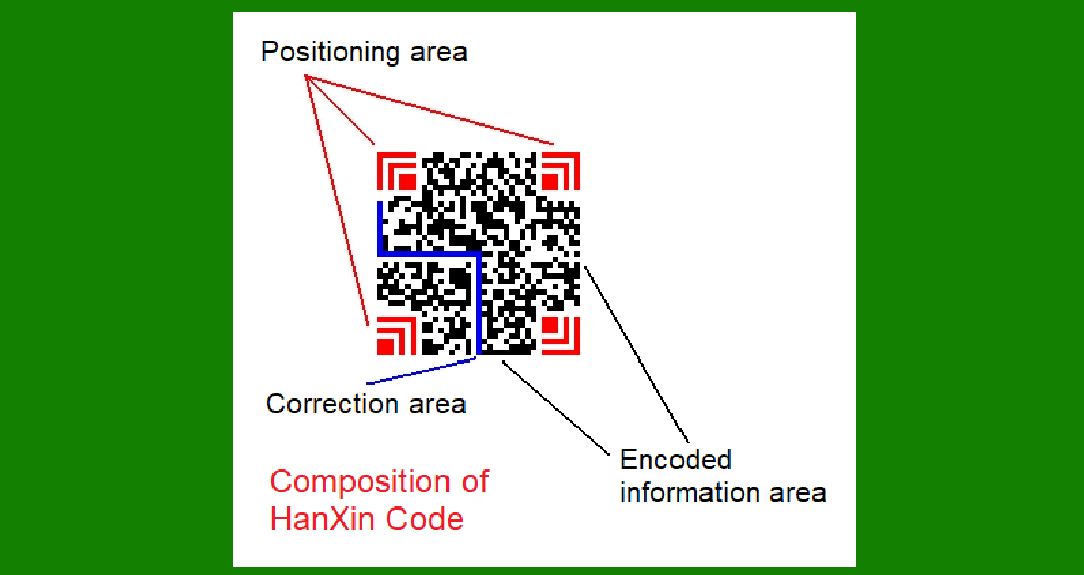
The Hanxin Code is a sophisticated barcode system developed in China for the purpose of addressing specific needs within the logistics, retail, and security industries. As a Chinese proprietary technology, the Hanxin Code serves various purposes in encoding and decoding data that relates to product tracking, inventory management, and digital content delivery. A thorough understanding of the Hanxin Code involves breaking it down into several key sections, such as its history, encoding and decoding mechanisms, technical specifications, applications, benefits, challenges, and its integration into existing systems. Below is an in-depth exploration of the Hanxin Code in alignment with your request. |
|
1. Introduction to Hanxin Code |
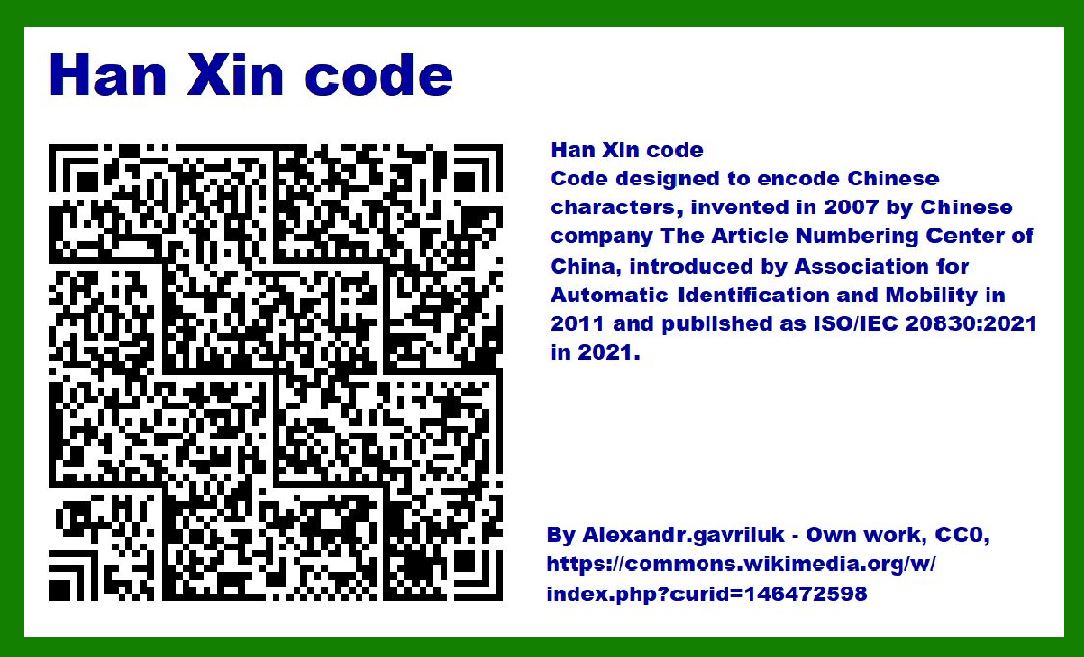
Hanxin Code, also known as the Hanxin 2D barcode, was developed by researchers at the National Laboratory of Digital Switching in China. It is a 2D matrix code that is part of China's ongoing efforts to improve data encoding technologies for various applications, particularly in e-commerce, logistics, and security. Its unique features include high data density, error correction capabilities, and quick scanning. |
Unlike traditional 1D barcodes, the Hanxin Code employs a two-dimensional structure, allowing it to store more information in a smaller space. This makes it highly efficient for applications where space is limited, such as product packaging, identification cards, and inventory labels. |
|
2. Historical Context and Development |
The Hanxin Code was developed in the early 2000s as part of China’s broader efforts to advance its technological infrastructure, particularly in the fields of information systems and logistics management. During this time, China’s domestic market was growing rapidly, and there was an increasing demand for a reliable, high-capacity barcode system that could cater to the complex needs of both manufacturing and logistics sectors. |
The development of the Hanxin Code was driven by the need to create a barcode system that could provide improved security, reduce counterfeit issues, and accommodate the specific needs of China’s growing digital economy. Over time, the system was enhanced to improve data density, increase resistance to scanning errors, and optimize its use in diverse applications. |

|
3. Technical Features of Hanxin Code |
3.1. Matrix Structure |
The Hanxin Code is designed as a two-dimensional matrix barcode. It consists of black and white modules arranged in a grid pattern. Each module represents a bit of data, and the arrangement of these modules within the matrix allows the encoding of substantial amounts of information. The code is read by scanners that interpret the pattern of black and white cells in a manner similar to QR codes. |
3.2. High Data Capacity |
One of the defining features of the Hanxin Code is its ability to store a large amount of data. Hanxin Codes can encode up to 2,000 characters of information. This makes it particularly useful for applications where large amounts of data need to be stored in a compact form, such as storing product details, serial numbers, and QR-like information for quick scanning. |
3.3. Error Correction |
Hanxin Code employs Reed-Solomon error correction, a widely-used algorithm in modern barcode technologies. This error correction ability enables the Hanxin Code to remain readable even if part of the code is damaged or obscured. The Reed-Solomon error correction algorithm ensures that the code can be read accurately even if 30% or more of the code is corrupted or missing, making it highly reliable in industrial and real-world applications. |
3.4. Encoding Flexibility |
The Hanxin Code can encode various types of data, including: |
Numeric data |
Alphanumeric characters |
Special symbols |
URLs and web addresses |
This flexibility makes it versatile and suitable for use in multiple industries, including retail, healthcare, logistics, and security. |

|
4. Design and Layout |
The design of the Hanxin Code consists of several key components that aid in the efficient encoding and decoding of data. These include: |
Positioning Markers: These are used to orient the barcode when it is scanned, ensuring proper alignment. |
Data Cells: These are the individual black-and-white modules that represent the encoded data. |
Error Correction Codes: These codes are embedded into the Hanxin Code to ensure data integrity even if parts of the barcode are obscured or damaged. |
Quiet Zone: The area surrounding the Hanxin Code that ensures the scanner can easily identify and read the code without interference from other nearby markings. |

|
5. Encoding Process |
5.1. Data Conversion |
To encode data into the Hanxin Code, the data first undergoes a conversion process that turns it into binary code. This binary data is then arranged into a two-dimensional grid of modules. Depending on the size of the Hanxin Code, the grid can range from small codes with a few hundred modules to larger codes with thousands of modules. |
5.2. Error Correction Insertion |
After the data is converted into binary code, Reed-Solomon error correction codes are added to the data. This ensures that even if some of the code is unreadable due to damage or interference, the original data can still be reconstructed with a high degree of accuracy. |
5.3. Final Output |
The final Hanxin Code consists of the data modules arranged in a grid pattern. Each module represents a single bit of information, with black cells representing a binary '1' and white cells representing a binary '0'. The Hanxin Code is then ready to be printed or digitally embedded for scanning. |

|
6. Decoding Process |
6.1. Scanner Reading |
To decode the Hanxin Code, a barcode scanner or a smartphone camera is used to capture an image of the barcode. The scanner reads the pattern of black and white modules and interprets the binary data. |
6.2. Error Correction Application |
Once the scanner captures the image, the error correction algorithm is applied to the data. This step is critical, especially in cases where parts of the barcode may be damaged or obscured. |
6.3. Data Retrieval |
After error correction, the decoded binary data is converted back into the original data format (e.g., text, URL, or numeric values). The decoded information is then displayed on the scanner’s screen or used by the system to perform the desired action, such as displaying product details or processing payment. |

|
7. Applications of Hanxin Code |
7.1. Product Tracking |
One of the primary applications of the Hanxin Code is in product tracking within the supply chain. The code’s ability to store large amounts of data makes it ideal for encoding detailed product information, including manufacturing data, serial numbers, expiration dates, and batch numbers. |
7.2. Retail and Inventory Management |
In the retail and inventory management industries, Hanxin Code is used to efficiently track products, manage stock levels, and speed up checkout processes. Its high data capacity allows retailers to store additional information such as promotions, prices, and product details directly in the barcode. |
7.3. Healthcare |
The healthcare industry has also adopted the Hanxin Code for tracking medical supplies, equipment, and patient records. The ability to store detailed patient information and medication data in a compact barcode is crucial for maintaining patient safety and improving hospital management efficiency. |
7.4. Security and Anti-Counterfeiting |
Due to its high data density and error correction capabilities, the Hanxin Code is used in security applications to prevent counterfeiting. It can encode detailed authentication information that can be verified by authorized scanners, helping to reduce the circulation of fake products in the market. |
7.5. Digital Content Delivery |
Hanxin Codes are also used to deliver digital content. For example, QR-like codes may be embedded on posters, packaging, or advertisements to direct consumers to a URL, an application, or multimedia content. This application is widely used in marketing and e-commerce. |

|
8. Benefits of Hanxin Code |
8.1. High Data Capacity |
The Hanxin Code’s ability to encode large amounts of data in a small, compact format is one of its most significant advantages. It enables the storage of a range of information that would not fit into traditional 1D barcodes. |
8.2. Improved Data Integrity |
With built-in error correction, the Hanxin Code provides greater data integrity than many other barcode formats. It ensures that even if the code is damaged or partially obscured, it can still be reliably decoded. |
8.3. Versatility |
The Hanxin Code is highly versatile, with applications across a wide range of industries, from logistics to healthcare. Its ability to store multiple types of data (numeric, alphanumeric, etc.) makes it adaptable for many different use cases. |
8.4. Ease of Integration |
Due to its compatibility with existing barcode scanners and smartphone cameras, the Hanxin Code can be easily integrated into existing systems without the need for significant upgrades or changes to hardware. |

|
9. Challenges and Limitations |
9.1. Printing and Scanning Quality |
For optimal scanning, the quality of the printing process and the scanner is crucial. Low-quality printing may result in unreadable codes, and some older or lower-end scanners may struggle to decode Hanxin Codes, especially if the codes are damaged or printed too small. |
9.2. Standardization |
Although the Hanxin Code is widely used in China, it faces challenges in terms of global adoption. Standardization issues may arise when Hanxin Codes need to be compatible with international barcode systems, which may limit their use in cross-border logistics and retail. |
9.3. Awareness and Training |
While the Hanxin Code offers numerous advantages, widespread adoption requires educating industries and businesses on how to effectively use the technology. This includes understanding how to generate, print, and scan Hanxin Codes efficiently. |

|
10. Future Developments and Prospects |
Looking forward, the Hanxin Code is expected to evolve with advancements in scanning technologies, data compression techniques, and artificial intelligence. Future developments could include more sophisticated error correction algorithms, faster decoding speeds, and improved compatibility with emerging technologies like the Internet of Things (IoT) and blockchain. |
Additionally, as China continues to lead in technology innovation, the adoption of Hanxin Code is likely to expand beyond domestic borders, further integrating it into global supply chains and digital ecosystems. |
This detailed description covers the fundamental aspects of the Hanxin Code, from its creation and technical specifications to its applications, benefits, and challenges. |

|
Let's take a much deeper dive into each section of the Hanxin Code, expanding on the information to provide a more comprehensive and thorough exploration of the technology. |
1. Introduction to Hanxin Code |
The Hanxin Code (汉信码) is a Chinese-developed, high-capacity 2D barcode designed to handle modern data encoding and scanning requirements for industries like logistics, e-commerce, and security. It was created to cater to the growing demand for efficient, reliable, and compact data storage and retrieval solutions. |
Unlike traditional 1D barcodes, which only store linear data, the Hanxin Code utilizes a 2D matrix structure, allowing for a far more efficient use of space. The basic principle is simple: data is stored in the form of black and white cells arranged in a grid, where each cell represents a single bit of information. The capacity for storing multiple types of data, including alphanumeric characters, numerical data, and special symbols, makes it versatile across applications. |
China’s rapid development in the e-commerce, logistics, and manufacturing sectors necessitated a scalable, error-resilient barcode system, hence the creation of the Hanxin Code. |

|
2. Historical Context and Development |
The Hanxin Code was born out of the National Laboratory of Digital Switching in China in the early 2000s. At that time, China was experiencing rapid growth in areas like consumer goods, retail, and online services. The need for a robust, scalable barcode system became evident as the traditional 1D barcodes used in retail and logistics were not sufficient for handling the increasing complexity of product information, which included serial numbers, batch numbers, pricing, and other metadata. |
The Hanxin Code was developed as a China-specific solution, with a strong focus on scalability, security, and error correction. This system's primary objective was to address the gaps left by international barcode standards like UPC (Universal Product Code) and EAN-13, which were more suited for simple retail and tracking applications but struggled to meet the needs of an expanding, tech-driven society. |
Over time, the Hanxin Code was iteratively improved, introducing features such as advanced error correction and more robust encoding capacity to cope with real-world challenges in industries such as pharmaceuticals, automotive, and telecommunications. |

|
3. Technical Features of Hanxin Code |
3.1. Matrix Structure |
The Hanxin Code is fundamentally a two-dimensional barcode. Unlike 1D barcodes, which encode data linearly in a horizontal fashion, the Hanxin Code uses both horizontal and vertical axes to store data in a grid format. This allows it to store significantly more information in the same amount of space. |
A typical Hanxin Code matrix is made up of rows and columns, and each cell in the matrix represents either a 1 or a 0, which can be either black or white. This two-dimensional structure enables the Hanxin Code to store much larger datasets compared to 1D barcodes. Additionally, it provides redundant data and improved readability by encoding data in multiple orientations, which enhances scanning performance in various environments. |
The matrix structure also supports the addition of positioning markers, which help scanners locate and interpret the barcode correctly, even when the code is partially obscured or distorted. |
3.2. High Data Capacity |
A defining feature of the Hanxin Code is its high data capacity. Unlike 1D barcodes, which may only store 10–20 characters, the Hanxin Code can encode up to 2,000 characters of data. This includes both alphanumeric characters and special symbols. This vast data storage capacity makes it ideal for encoding detailed product specifications, customer information, or extensive tracking data. |
For example, a product tracking Hanxin Code might store: |
Product ID |
Manufacturing date |
Serial number |
Expiration date |
Batch number |
Safety guidelines |
These features are particularly useful in industries like pharmaceuticals, where regulations demand the tracking of various product details. |
3.3. Error Correction |
The error correction mechanism embedded in the Hanxin Code is a key feature that differentiates it from traditional barcode systems. Using the Reed-Solomon algorithm, the Hanxin Code can correct errors introduced by factors like: |
Physical damage (e.g., scratches, smudges) |
Poor printing quality |
Scanning issues (e.g., misalignment or low scanner quality) |
Reed-Solomon error correction allows the Hanxin Code to recover up to 30% of the data even if parts of the code are unreadable. This ability significantly increases the reliability of the barcode, making it more resilient in real-world applications, especially in environments where barcodes are subject to wear and tear. |
3.4. Encoding Flexibility |
Hanxin Code is highly versatile in terms of data types. It can encode: |
Numeric data: Ideal for serial numbers or batch numbers. |
Alphanumeric characters: Useful for product descriptions or tracking codes. |
URLs and web addresses: Perfect for embedding digital content such as product information or promotional URLs. |
Binary data: Can encode binary files, such as images or encryption keys. |
This flexibility allows the Hanxin Code to serve a variety of use cases, from simple product tracking to complex digital content delivery. |

|
4. Design and Layout |
4.1. Positioning Markers |
Positioning markers are vital components of the Hanxin Code. These markers act as guides that help scanners correctly align the barcode for reading. This is especially important in cases where the code might be distorted or skewed. These markers enable scanners to recognize the orientation of the code and compensate for any misalignment, ensuring accurate data capture. |
4.2. Data Cells |
The data cells are the fundamental units of the Hanxin Code. Each cell represents a bit of data—either 1 (black) or 0 (white). These cells are arranged in a matrix layout, allowing the Hanxin Code to represent large amounts of information within a compact space. |
4.3. Error Correction Codes |
Error correction codes are embedded in the Hanxin Code to enhance its robustness. These codes are used by scanners to reconstruct data in the event of damage or distortion. They are placed in redundant cells throughout the matrix to ensure that if some data is lost, it can be recovered from the surrounding cells. |
4.4. Quiet Zone |
The quiet zone refers to the area surrounding the Hanxin Code that is free of any markings. This zone ensures that the barcode is easily identifiable by scanners. Without a quiet zone, the scanner may mistakenly interpret nearby patterns as part of the barcode, leading to errors in decoding. |

|
5. Encoding Process |
5.1. Data Conversion |
The first step in the encoding process is data conversion. Data, whether it is text, numbers, or other information, is converted into binary format (i.e., a series of 1s and 0s). This binary data is then arranged into a matrix grid. The number of rows and columns in the matrix depends on the amount of data to be encoded. |
5.2. Error Correction Insertion |
After the binary data is generated, the Reed-Solomon error correction codes are inserted into the matrix. These codes are carefully calculated and placed in specific areas of the matrix to ensure that the data can be recovered even in the event of partial damage. |
5.3. Final Output |
Once the data and error correction codes are inserted, the final Hanxin Code is created. This is a two-dimensional grid, consisting of black and white cells, which can be printed onto product labels, packaging, or digital media. The size of the grid varies based on the amount of data encoded—larger grids are used for more extensive information. |

|
6. Decoding Process |
6.1. Scanner Reading |
The process of decoding the Hanxin Code begins when a barcode scanner or smartphone camera reads the image of the barcode. The scanner detects the grid of black and white modules and interprets the pattern. |
6.2. Error Correction Application |
Once the image is captured, the scanner applies error correction. It uses the Reed-Solomon algorithm to identify any damaged or missing parts of the code and attempts to reconstruct the data accurately. |
6.3. Data Retrieval |
After error correction, the decoded binary data is converted back into its original format (text, numbers, or URL). The information is then presented to the user or system, which can take further actions based on the retrieved data, such as displaying product details or processing a transaction. |

|
7. Applications of Hanxin Code |
7.1. Product Tracking |
In the manufacturing and logistics sectors, the Hanxin Code is used extensively for product tracking. The ability to store detailed product information, including serial numbers, manufacturing dates, and batch numbers, makes it ideal for use in supply chains. It allows companies to track products from production to distribution. |
7.2. Retail and Inventory Management |
Retailers use Hanxin Code to manage inventory efficiently. With its high data capacity, the code can store detailed product descriptions, pricing, and stock levels. It enables faster and more accurate inventory control and improves the speed of checkout by reducing the need for manual input. |
7.3. Healthcare |
In healthcare, the Hanxin Code is used for tracking medical supplies, patient records, and medication. It ensures that hospitals and clinics can quickly access patient data and track medical supplies in real-time. This is crucial for patient safety and operational efficiency. |
7.4. Security and Anti-Counterfeiting |
The Hanxin Code's ability to store detailed information and its error-correction capabilities make it an excellent choice for anti-counterfeiting. It is widely used in high-value goods like pharmaceuticals, electronics, and luxury items, where counterfeit prevention is critical. |
7.5. Digital Content Delivery |
In the digital marketing industry, Hanxin Code is used to embed URLs or QR-like codes on physical products or advertisements. These codes can lead consumers directly to online content, promotions, or product pages, enhancing the customer experience. |

|
8. Benefits of Hanxin Code |
8.1. High Data Capacity |
One of the primary advantages of the Hanxin Code is its high data capacity, which allows it to store significantly more information than traditional barcodes. This is especially beneficial for industries where large amounts of data need to be encoded and retrieved quickly. |
8.2. Improved Data Integrity |
The error correction mechanism ensures that data can be recovered even if the barcode is damaged or poorly printed. This makes the Hanxin Code highly reliable for applications where data integrity is critical. |
8.3. Versatility |
The Hanxin Code is a versatile technology that can be used across a wide range of industries, from logistics and retail to healthcare and security. Its ability to encode a variety of data types makes it adaptable to many different needs. |
8.4. Ease of Integration |
The Hanxin Code is compatible with existing scanning systems and can be integrated into existing infrastructure with minimal effort. Its compatibility with smartphones and barcode scanners ensures that it can be easily adopted without the need for significant upgrades. |

|
9. Challenges and Limitations |
9.1. Printing and Scanning Quality |
The Hanxin Code requires high-quality printing for optimal scanning performance. Low-quality prints can lead to decoding failures, especially for small codes or those printed on complex surfaces. |
9.2. Standardization |
While the Hanxin Code is widely used in China, its adoption in other countries has been limited due to standardization issues. Its proprietary nature means that international compatibility with systems like UPC or EAN-13 can be problematic. |
9.3. Awareness and Training |
Adoption of the Hanxin Code requires industry-wide awareness and training. Users must understand how to generate, print, and scan Hanxin Codes effectively to fully benefit from the technology. |

|
10. Future Developments and Prospects |
As the world moves toward smart manufacturing, IoT, and blockchain technologies, the Hanxin Code is likely to evolve. Future developments could include: |
Enhanced error correction algorithms |
Faster scanning technologies |
Integration with smart devices and automated systems |
The Hanxin Code is set to play a key role in China’s digital economy and may become a significant player in global barcode systems in the future. |
This expanded exploration offers a detailed breakdown of the Hanxin Code across its development, features, applications, benefits, and future potential. |
|
Detail of Design and Layout |
4. Design and Layout of Hanxin Code |
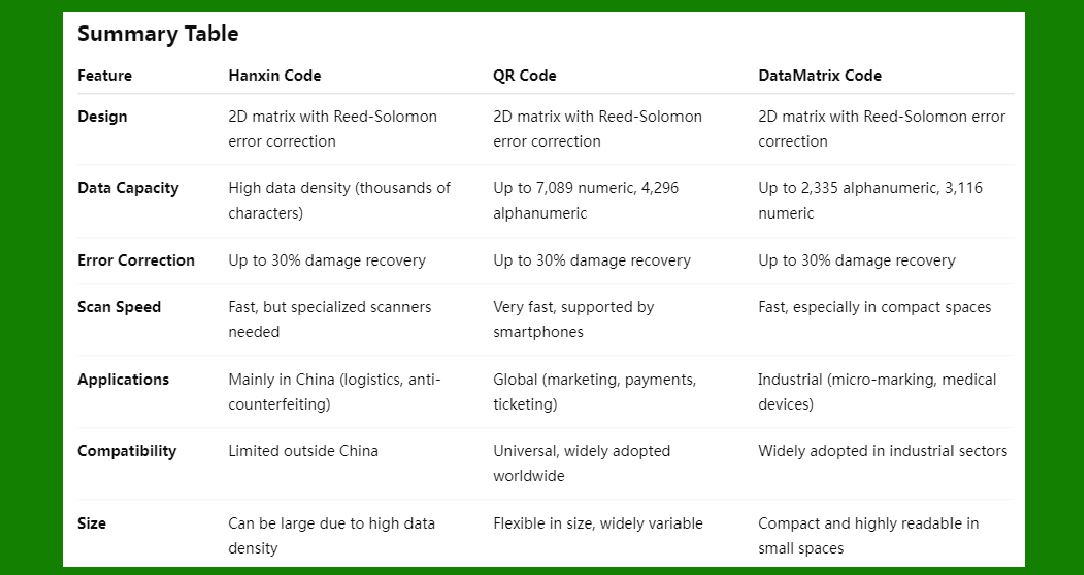
The design and layout of the Hanxin Code are fundamental to its function, ensuring that it can encode and store large amounts of data in a compact and error-resilient format. The structure of the Hanxin Code was carefully designed to maximize data density while maintaining high scan reliability across various environments and conditions. Below is a detailed exploration of the key design elements and layout components of the Hanxin Code. |
4.1 Matrix Structure |
At the core of the Hanxin Code is its matrix structure, which forms the visual representation of the barcode. Unlike traditional 1D barcodes, which represent data linearly (one-dimensional), the Hanxin Code uses a two-dimensional grid to store information. This allows the Hanxin Code to encode data in both the horizontal and vertical axes, providing a higher data density. |
Components of the Matrix Structure: |
Rows and Columns: The Hanxin Code is made up of multiple rows and columns of black-and-white cells, arranged in a grid. Each cell represents a bit of data (either 1 or 0, represented by black and white, respectively). |
Cell Size: The size of the individual cells in the matrix can vary depending on the specific implementation and the amount of data encoded. The number of cells (both rows and columns) increases as the amount of data to be encoded grows. This enables the Hanxin Code to store anywhere from a few hundred to over 2,000 characters of data. |
Cell Layout: Each cell in the matrix corresponds to a binary digit (bit). The collection of these bits across both dimensions allows for compact storage of larger datasets than what a 1D barcode would be able to hold. The arrangement of these bits forms a pattern that can be scanned and interpreted by barcode scanners. |
The matrix layout allows the barcode to store data in multiple orientations. This means that even if the code is slightly rotated or misaligned during scanning, modern scanners can still correctly interpret the data, as long as the position markers (explained below) are intact. |
4.2 Positioning Markers |
Positioning markers are crucial for the correct orientation and alignment of the Hanxin Code. These markers enable barcode scanners to quickly detect and decode the Hanxin Code, even if it is slightly distorted or misaligned. |
Types of Positioning Markers: |
Alignment Marks: These are special modules within the matrix that help the scanner detect the orientation and positioning of the code. The scanner uses these marks to determine whether the code is aligned properly and correct any distortions in the image capture process. |
Finder Patterns: These are similar to positioning markers and are typically located at fixed positions within the Hanxin Code. Their purpose is to help the scanner locate the code within the field of view, ensuring accurate reading. If the Hanxin Code is rotated or skewed, these finder patterns guide the decoding algorithm to interpret the data correctly. |
Positioning markers ensure that the Hanxin Code remains scannable under various conditions, such as when it is printed on different surfaces, when the code is partially obscured, or when there is slight misalignment during scanning. |
4.3 Data Cells and Encoding |
The data cells within the Hanxin Code represent the actual information that is encoded. Each data cell corresponds to a binary digit (bit), and these bits are arranged in a grid pattern. |
Key Components of the Data Cells: |
Bit Representation: The bits of data are represented by black and white cells. A black cell represents a binary '1', and a white cell represents a binary '0'. |
Data Partitioning: The information within the matrix is partitioned into multiple regions for different purposes, such as: |
Data region: Where the actual encoded data (numeric, alphanumeric, or binary) is stored. |
Error correction region: Where error correction information is embedded, which allows for recovery of corrupted or damaged data. |
Format information region: This part contains control information, such as the encoding format and error correction level used. |
Encoding Process: The encoding process in Hanxin Code is based on transforming data (whether text, numbers, or other types) into binary data, which is then mapped to the grid of black and white cells. This transformation process may involve converting alphanumeric characters into binary ASCII codes or other encoding schemes, depending on the type of data. |
Since each cell in the matrix is either black or white, scanners can detect the pattern formed by the arrangement of these cells. This pattern is read as a stream of binary digits, which is then converted back into the original data. |
4.4 Error Correction Codes |
Error correction is a key feature of the Hanxin Code, providing redundancy and ensuring that the data can be recovered even if parts of the barcode are damaged or unreadable. The Hanxin Code uses the Reed-Solomon error correction algorithm, which is a widely adopted method in many modern barcode and QR code systems. |
How Error Correction Works: |
Reed-Solomon Codes: These codes add redundant information into the matrix, allowing the Hanxin Code to self-repair when parts of the code are obscured or damaged. For example, even if up to 30% of the barcode is corrupted or unreadable, the Reed-Solomon algorithm can reconstruct the missing data. |
Error Correction Cells: In the Hanxin Code, some cells in the matrix are dedicated to error correction rather than storing the actual data. This ensures that the scanner can still decode the information accurately even in the presence of damage. |
By embedding error correction directly within the matrix, the Hanxin Code is highly reliable, even in environments where codes are frequently exposed to physical wear, dirt, or distortion. |
4.5 Quiet Zone |
A quiet zone is the area of blank space around the Hanxin Code that separates the barcode from any other markings, ensuring that scanners can easily identify and read the barcode. The quiet zone helps prevent interference from nearby graphics or text, which could cause errors during the scanning process. |
Features of the Quiet Zone: |
Margin Space: The quiet zone should be sufficiently wide to create a clear boundary between the barcode and its surroundings. This margin helps scanners recognize the start and end of the barcode. |
Standard Dimensions: In many barcode standards, including the Hanxin Code, the quiet zone is typically at least 4 times the width of the smallest module (the smallest black or white cell). This ensures that the scanner can easily isolate the barcode from surrounding elements. |
The quiet zone is especially important in environments where multiple barcodes or symbols are printed close together, such as packaging or labels with various other markings. |
4.6 Modules and Layers |
In the Hanxin Code, each module corresponds to one bit of information. These modules are arranged in layers, where each layer of the matrix represents a different piece of data or control information. |
Types of Layers in the Hanxin Code: |
Data Layer: This is where the actual data to be encoded is stored. It includes numeric, alphanumeric, or binary data, depending on the type of encoding. |
Error Correction Layer: This layer contains the Reed-Solomon error correction codes, which allow for error correction during the decoding process. |
Format Layer: This is where the barcode stores information about the encoding format, error correction level, and other attributes. |
The layers are designed to be interdependent, with data in one layer influencing the decoding of data in other layers. This design maximizes the efficiency of both encoding and decoding processes. |
4.7 Size and Shape Variability |
The size and shape of the Hanxin Code can vary depending on the data capacity and the use case. |
Size: Hanxin Codes can be printed in various sizes depending on how much data needs to be encoded. Larger codes will have more rows and columns, and therefore a higher data capacity. |
Shape: The Hanxin Code is typically a square matrix, but it can be adapted to fit specific shape requirements based on the application (e.g., circular versions for specific packaging needs). |
This adaptability makes the Hanxin Code versatile for different environments, including small product labels or large industrial tracking systems. |
Summary |
The design and layout of the Hanxin Code are optimized for high data capacity, error resilience, and versatility. Its matrix structure allows for large amounts of information to be stored in a compact form, while features like positioning markers, error correction, and quiet zones ensure reliable scanning even in adverse conditions. The modular nature of the Hanxin Code, combined with its ability to adapt to various sizes and shapes, makes it suitable for a wide range of applications, from retail and logistics to security and digital content delivery. |

|
Detail of Encoding Process |
5. Encoding Process of Hanxin Code |
The encoding process of the Hanxin Code is a crucial step in transforming raw data (such as text, numeric values, or binary data) into a structured 2D barcode format. The encoding process involves converting the data into a binary form, arranging the binary digits into a grid of modules (cells), and applying error correction codes to ensure data integrity. The process follows a series of well-defined steps, each of which plays a key role in ensuring that the final Hanxin Code is accurate, efficient, and resilient to damage. |
Below, we will break down each stage of the encoding process in great detail. |
5.1 Data Conversion |
The first step in encoding the Hanxin Code is converting the input data into a binary format. This is where raw data (whether it is text, numbers, or other information) is transformed into a sequence of 0s and 1s, which can be mapped onto the grid of black and white cells. |
Key Steps in Data Conversion: |
Character Mapping: If the data consists of text or alphanumeric characters, each character is mapped to a corresponding binary value using a standardized encoding scheme, such as ASCII (American Standard Code for Information Interchange). For example, the letter 'A' is represented by the binary code 01000001 in ASCII. |
Numeric Conversion: If the data consists of numbers, each numeric digit (0–9) is also converted into a binary representation. For example, the number '3' is represented as 0011 in binary form. |
Special Symbols: Symbols such as punctuation marks or special characters (e.g., '!','@','') are converted into their respective binary equivalents based on a specific encoding scheme. |
Data Conversion Example: |
If the input data is the string 'ABC123', it will be converted into the following binary sequence using ASCII encoding: |
A → 01000001 |
B → 01000010 |
C → 01000011 |
1 → 00110001 |
2 → 00110010 |
3 → 00110011 |
The binary representation for the string 'ABC123' would be: |
01000001 01000010 01000011 00110001 00110010 00110011 |
5.2 Data Arrangement into Matrix (Grid) |
Once the data has been converted into binary form, the next step is to arrange the binary sequence into a two-dimensional matrix of cells, where each cell will represent either a 1 (black) or 0 (white). The matrix represents the Hanxin Code’s layout, with rows and columns of cells arranged in a grid. |
Key Steps in Data Arrangement: |
Grid Dimensions: The dimensions of the grid depend on the amount of data to be encoded. For instance, a Hanxin Code with a higher data capacity will require more rows and columns. A standard 2D matrix will have a defined number of rows and columns (e.g., 16x16, 32x32, 64x64), but larger codes can support grids of up to 256x256 or higher. |
Mapping Binary Data: The binary sequence is mapped onto the grid of cells, starting from the top-left corner and proceeding row by row. Each binary bit (either 0 or 1) corresponds to a single cell in the grid. A 1 (black) represents a filled cell, and a 0 (white) represents an empty cell. |
Data Arrangement Example: |
For the binary string 01000001 01000010 01000011 00110001 00110010 00110011, this data would be arranged in a grid format, such as: |
0 1 0 0 0 0 0 1 |
0 1 0 0 0 0 1 0 |
0 1 0 0 0 0 1 1 |
0 0 1 1 0 0 0 1 |
... |
If the binary sequence is longer than the available cells in the grid, the grid size will be adjusted to fit the required data. The grid size directly impacts how much data the Hanxin Code can store, with larger grids able to encode more information. |
5.3 Error Correction Insertion |
One of the most important features of the Hanxin Code is its error correction capabilities. The Reed-Solomon error correction algorithm is applied to the encoded data to ensure that the barcode can still be scanned accurately even if part of it is damaged or corrupted. |
Key Steps in Error Correction Insertion: |
Error Correction Data: Reed-Solomon codes are calculated based on the binary data already placed in the matrix. These codes create redundant data (extra bits) that can help restore lost or corrupted information. The Reed-Solomon algorithm works by adding parity check data to the barcode, which can be used to rebuild missing or incorrect data during decoding. |
Error Correction Cells: The error correction data is embedded into the barcode at specific locations, often in the form of additional rows or columns of cells. These additional cells store the redundant data that allows the Hanxin Code to recover up to 30% of lost or damaged data. |
For example, if part of the barcode is smudged or obscured (due to dirt, scratches, or distortion), the error correction algorithm allows the system to use the redundant bits to reconstruct the lost parts of the data, ensuring that the correct information can still be read from the barcode. |
Reed-Solomon Example: |
Consider a case where part of a code is missing due to damage, but the Reed-Solomon error correction provides enough redundant data in the form of extra bits that enable the barcode scanner to accurately restore the missing information. |
5.4 Final Output: Barcode Creation |
After the data and error correction are inserted, the final Hanxin Code is ready for output. This output is a complete two-dimensional matrix consisting of black and white cells arranged in a grid. This barcode can now be printed or displayed digitally for scanning. |
Key Steps in Final Output: |
Encoding Format: The matrix is structured to follow a specific encoding format that scanners recognize. This format includes both the data (actual encoded information) and the error correction information. |
Quiet Zone: A clear quiet zone (empty space around the barcode) is added to ensure that scanners can easily distinguish the barcode from other surrounding elements. This space helps avoid interference from nearby images or text, which could result in misreads. |
Size and Shape: The final barcode can vary in size depending on the data it contains. Larger barcodes will have more rows and columns in their matrix and will take up more physical space when printed. The shape is typically square, but in some cases, it can be adapted to different dimensions to fit specific packaging or label requirements. |
Once these steps are completed, the final Hanxin Code is a fully functional 2D barcode that can be scanned by a barcode scanner or smartphone camera, which will interpret the encoded data and convert it back to its original form. |
5.5 Optional Steps: Compression and Optimization |
In some cases, additional steps are applied to optimize or compress the data before encoding. These steps can reduce the total amount of data required for encoding and make the barcode more efficient for certain applications. |
Key Steps in Data Compression and Optimization: |
Data Compression: In certain use cases, the data to be encoded might be compressed to reduce the size of the barcode. Compression algorithms, such as Huffman coding or Lempel-Ziv (LZ), can be applied to reduce the size of the data before it is converted into binary form. This is especially useful when encoding large datasets, like digital content or media files, in a barcode. |
Dynamic Optimization: In some advanced cases, the encoding process might be dynamically optimized based on the specific scanning environment. For instance, adjustments might be made to the error correction level based on the physical quality of the printing surface or expected scan conditions. |
5.6 Encoding Flexibility: Handling Different Data Types |
The Hanxin Code is versatile in terms of the data types it can encode, and the encoding process is adapted to handle these various formats efficiently. This includes handling alphanumeric data, URLs, binary data, and other types of structured information. |
Alphanumeric Data: Alphanumeric data (letters and numbers) is typically encoded using ASCII or ISO-8859-1 encoding schemes. This allows both letters (A-Z, a-z) and numbers (0-9) to be included in the Hanxin Code. |
Binary Data: Hanxin Code can also encode binary files like images, documents, or even executable code, though this may involve additional encoding schemes such as Base64 or Hex encoding before the data is converted into binary form. |
URLs and Web Addresses: For URLs or web addresses, the Hanxin Code uses standard URL encoding methods to transform the URL into a binary format that can be mapped onto the barcode. |
Data Example: |
For a URL like http://www.example.com, the encoding process will first convert the URL into a binary form using a standard URL encoding technique. The binary data is then mapped onto the Hanxin Code matrix, where it can |
be scanned and interpreted by barcode scanners or smartphones to instantly navigate to the website. |
Summary of Encoding Process |
To summarize, the encoding process of the Hanxin Code involves several key steps: |
Data Conversion: The raw data (text, numbers, binary files, URLs, etc.) is first converted into a binary format, typically using encoding schemes like ASCII, Base64, or other formats as needed. |
Data Arrangement into a Matrix: The binary data is mapped into a two-dimensional grid or matrix of cells, where each cell represents a binary digit (0 or 1). The matrix size is determined based on the amount of data to be encoded. |
Error Correction Insertion: Reed-Solomon error correction codes are added to the matrix to allow for recovery of damaged or corrupted data. This redundancy helps ensure the Hanxin Code remains readable even if part of it is obscured or damaged. |
Final Output: Once the data and error correction information are embedded, the Hanxin Code is formed as a matrix of black and white cells. The barcode is now ready to be printed or displayed digitally for scanning. |
Optional Compression and Optimization: In some cases, additional compression algorithms are applied to reduce the size of the barcode and optimize its performance for specific scanning environments. |
Encoding Flexibility: The Hanxin Code is versatile in handling various types of data, including alphanumeric characters, binary data, URLs, and other structured information. |
This step-by-step process allows the Hanxin Code to store large amounts of information in a compact and efficient format, making it a powerful tool for a wide range of applications in logistics, retail, healthcare, and security. |
|
Detail of Decoding Process |
6. Decoding Process of Hanxin Code |
The decoding process of the Hanxin Code is critical to accurately retrieving the encoded data from the 2D barcode. Once the Hanxin Code is scanned, the data must be interpreted and converted back into its original form (e.g., text, numeric data, URLs). This process involves a series of precise steps to ensure the correct data is extracted, even in the presence of errors or distortions. |
The decoding process can be broken down into several key stages: image capture, data recognition, error correction, data reconstruction, and final output. Below, we will detail each step in the decoding process, explaining the mechanisms that ensure the Hanxin Code is reliably read and interpreted. |
6.1 Image Capture |
The first step in decoding the Hanxin Code involves capturing an image of the barcode. This is done using a barcode scanner or smartphone camera. The scanner or camera takes a picture of the barcode, which is typically a 2D matrix of black and white cells arranged in a grid. |
Key Aspects of Image Capture: |
Scanner or Camera: The image can be captured using a dedicated barcode scanner or a smartphone camera with specialized software. Most modern scanners are equipped with 2D imaging sensors, which can read both 1D and 2D barcodes, including Hanxin Code. |
Image Quality: The quality of the captured image is crucial for accurate decoding. If the barcode is damaged, blurred, or partially obscured, it may lead to errors in the decoding process. |
Orientation and Alignment: The Hanxin Code may be scanned at various orientations, and the scanner must be capable of detecting the barcode even if it is rotated or tilted. This is where the positioning markers (discussed below) play an essential role. |
6.2 Data Recognition |
Once the image is captured, the next step is to recognize the data encoded in the Hanxin Code. This involves identifying the individual modules (cells) of the barcode and interpreting the pattern of black and white cells that represent binary digits. |
Key Steps in Data Recognition: |
Positioning Markers Detection: Before interpreting the data, the scanner looks for positioning markers or finder patterns in the Hanxin Code. These markers help the scanner quickly locate the barcode within the captured image and identify its orientation, even if the code is skewed or rotated. Positioning markers are usually located at specific fixed points within the matrix. |
Grid Detection: Once the positioning markers are identified, the scanner analyzes the captured image to detect the layout of the matrix (the grid of black and white cells). The scanner defines the boundaries of the Hanxin Code and calculates the size of the grid (e.g., 16x16, 32x32, 64x64 cells). |
Bit Interpretation: Each cell in the matrix corresponds to a binary digit (bit): a black cell represents a 1, and a white cell represents a 0. The scanner converts the pattern of black and white cells into a binary stream of data. This binary stream is the initial step toward decoding the actual information. |
Example: |
If the matrix is recognized as a 16x16 grid, the scanner processes the image row by row, translating the pattern of cells into a binary sequence. For instance: |
Row 1: 1 0 1 1 0 1 0 1 |
Row 2: 0 1 0 1 1 1 0 0 |
6.3 Error Correction |
One of the most important features of the Hanxin Code is its built-in error correction. The Reed-Solomon algorithm embedded in the Hanxin Code enables the scanner to recover missing or damaged data, ensuring that even if parts of the barcode are unreadable, the correct data can still be decoded. |
Key Steps in Error Correction: |
Error Detection: Once the binary data is extracted from the barcode, the scanner checks the data against the error correction codes stored in the matrix. These codes are the redundant bits that were added during the encoding process to ensure that any corrupted or missing data can be reconstructed. |
Reed-Solomon Algorithm: The Reed-Solomon algorithm is used to identify and correct errors. This error correction method works by comparing the captured data with the redundancy (error correction codes) to identify patterns that indicate corrupted or missing parts of the barcode. |
Error Repair: If the barcode is partially damaged or some cells are missing, the Reed-Solomon algorithm can use the error correction data to restore the missing information. This process can correct up to 30% of the barcode, ensuring that the data is still readable even if parts of the barcode are distorted or obscured. |
Example: |
If part of the matrix is damaged (e.g., a few black cells are missing), the error correction algorithm uses the surrounding data to reconstruct the missing information. The system does not discard the data but instead reconstructs it, allowing the scanner to return the correct result. |
6.4 Data Reconstruction |
After error correction, the binary data is reconstructed and interpreted to retrieve the original encoded information. This is the stage where the data is converted back into its original format, such as text, numeric data, or a URL. |
Key Steps in Data Reconstruction: |
Reversing the Binary Conversion: The binary sequence extracted from the Hanxin Code is translated back into its original form. For example, if the data encoded in the barcode was a string of ASCII text, the binary stream is converted back into characters using the appropriate encoding scheme. |
Character Decoding: If the encoded data represents text, the binary data is converted back into readable characters using the ASCII or other encoding formats. For example, the binary sequence 01000001 would be decoded as the letter 'A'. |
Numeric and Special Data: If the Hanxin Code encoded numeric data or other types of structured data (e.g., a URL or binary file), the reconstructed binary stream is converted back into the original data format. For example, a URL like http://www.example.com would be reconstructed from the binary data. |
6.5 Final Output |
Once the data is successfully decoded and reconstructed, the final output is provided to the user or system. This could involve displaying the data on a screen, using the data to update inventory records, or triggering actions like redirecting to a website if the data encoded in the barcode was a URL. |
Key Steps in Final Output: |
Display: If the decoded data is text or a URL, it can be shown on the scanner or smartphone screen for the user to view. For example, if the barcode encoded a product ID, the scanner might display the product name or description. |
Action Triggering: If the barcode encoded a URL, the system could automatically open a web page in a browser. Similarly, if the barcode contains inventory or shipment data, the system may update relevant records or trigger actions like restocking or shipment tracking. |
Data Processing: In business applications, the decoded data may be fed into an enterprise system, such as an ERP (Enterprise Resource Planning) or CRM (Customer Relationship Management) system, to trigger specific actions, such as inventory management or order processing. |
6.6 Handling Multiple Orientations and Skewed Codes |
Hanxin Codes are designed to be orientation-independent, meaning they can be scanned and decoded even if they are rotated, skewed, or misaligned during scanning. This is made possible by the positioning markers and finder patterns, which help the scanner locate the barcode and adjust for any misalignment. |
Key Features for Handling Misalignment: |
Positioning Markers: These markers, typically located at the corners or fixed points of the barcode, help the scanner understand the orientation of the Hanxin Code. The scanner can then rotate or adjust the scanned image to match the proper orientation of the barcode. |
Multiple Scanning Directions: The Hanxin Code can be scanned in any direction, allowing scanners to read the barcode from left to right, top to bottom, or even at an angle. This flexibility enhances the usability of the barcode, especially in dynamic environments where precise positioning of the barcode might not be guaranteed. |
Summary of Decoding Process |
To summarize, the decoding process of the Hanxin Code involves several stages: |
Image Capture: A scanner or camera captures an image of the barcode. |
Data Recognition: The scanner locates and decodes the binary data from the matrix of black and white cells. |
Error Correction: Using the Reed-Solomon error correction algorithm, the system detects and repairs any errors in the barcode. |
Data Reconstruction: The binary data is converted back into the original data format (text, numeric, URLs, etc.). |
Final Output: The decoded data is displayed or used to trigger specific actions. |
Throughout the decoding process, the Hanxin Code ensures data integrity, reliability, and flexibility, making it highly resilient to damage or distortion. These features allow the Hanxin Code to function effectively in real-world applications across industries like logistics, retail, and healthcare. |

|
Comparison of Hanxin Code, QR Code, and DataMatrix Code |
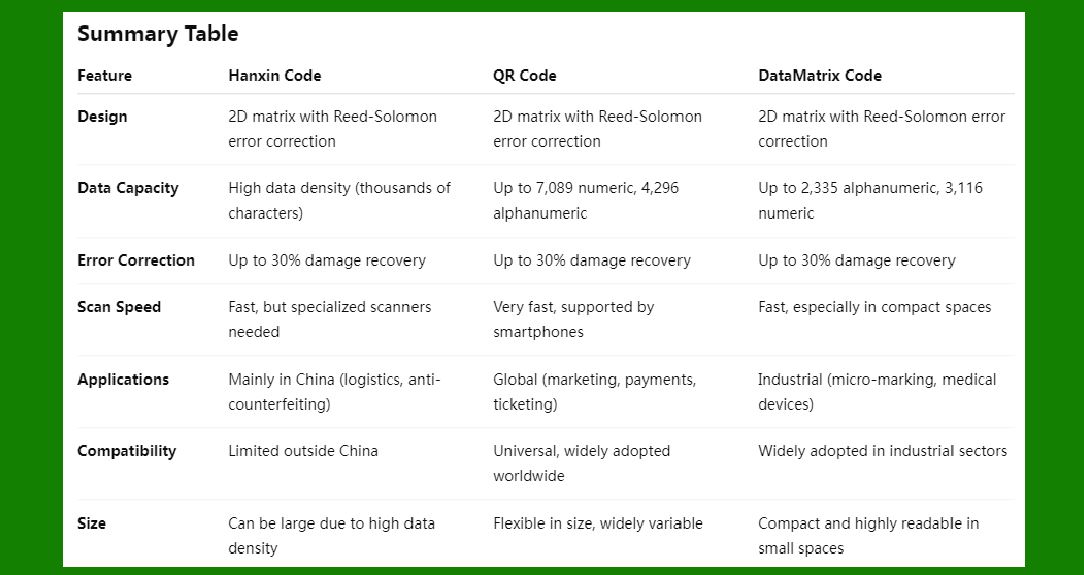
When it comes to 2D barcodes, Hanxin Code, QR Code, and DataMatrix Code are some of the most widely used technologies. Each of these barcode systems has unique features, benefits, and applications, making them suitable for different use cases. Below is a detailed comparison of these three barcode technologies based on key characteristics such as data capacity, error correction, design and layout, speed and efficiency, scanability, application areas, and compatibility. |
1. Design and Layout |
Hanxin Code: |
The Hanxin Code is a 2D matrix barcode consisting of black and white cells arranged in a square or rectangular grid. |
It incorporates positioning markers and uses a matrix format similar to the QR Code. |
Error correction and redundant data are embedded using Reed-Solomon codes, similar to the QR Code's approach, to allow for recovery of lost or damaged data. |
The Hanxin Code’s design is optimized for higher data density, often in the context of Chinese domestic applications. |
QR Code: |
A 2D matrix barcode, typically square in shape, consisting of black and white modules arranged in a grid. |
Contains positioning markers at three corners to assist in orientation and alignment, ensuring that the barcode can be scanned regardless of its rotation or skew. |
Features a quiet zone (margin area around the barcode) to minimize errors from nearby text or graphics. |
Error correction is built in, using Reed-Solomon error correction, which allows up to 30% of the data to be lost or damaged without losing information. |
DataMatrix Code: |
A 2D matrix barcode made up of black and white cells arranged in a square or rectangular grid, similar to both Hanxin and QR codes. |
Uses positioning patterns and a corner locator to ensure proper orientation. |
Error correction is provided by the Reed-Solomon algorithm, which helps recover data even when a portion of the code is damaged. |
It is particularly well-suited for very small spaces due to its compact design. |

|
2. Data Capacity |
Hanxin Code: |
High data capacity, especially suited for encoding large amounts of data in a compact space. |
Typically designed to handle large datasets, including alphanumeric characters, numeric values, and even binary data. |
The capacity can range from a few hundred characters up to several thousand depending on the matrix size. |
QR Code: |
The QR Code is well-known for its flexibility in data capacity. It can store from up to 7,089 numeric characters, 4,296 alphanumeric characters, or 2,953 bytes of binary data. |
The actual capacity depends on the version (size of the QR Code) and error correction level chosen. |
QR Codes are available in multiple sizes, ranging from 21x21 to 177x177 modules. |
DataMatrix Code: |
DataMatrix Code also supports a wide range of data capacities, capable of storing up to 2,335 alphanumeric characters or 3,116 numeric characters in a compact format. |
The maximum capacity can be adjusted depending on the grid size (e.g., 8x8 to 144x144 cells). |
The DataMatrix Code is particularly effective when space is at a premium, which is why it is used in micro-marking and small labels. |
|
3. Error Correction |
Hanxin Code: |
Uses Reed-Solomon error correction, which can restore data even if up to 30% of the barcode is damaged or missing. |
The error correction mechanism ensures high reliability in harsh environments where barcodes may get scratched or blurred. |
QR Code: |
QR Codes use Reed-Solomon error correction as well, and their error correction capabilities allow them to recover from up to 30% damage. |
The error correction level can be adjusted to balance between data capacity and the level of fault tolerance required (levels include L, M, Q, and H). |
DataMatrix Code: |
DataMatrix Code also uses Reed-Solomon error correction, similar to the QR Code and Hanxin Code. |
It can recover up to 30% of its data if it is damaged, ensuring robust performance even in demanding conditions. |
|
4. Scanability and Speed |
Hanxin Code: |
Hanxin Code generally performs well under optimal conditions with specialized scanners, especially in environments where high data density is required. |
It may be less commonly supported on mainstream scanners outside of China, where its usage is more widespread. |
QR Code: |
Very fast scan speeds, with the ability to be scanned from various angles and orientations. Positioning markers help improve the efficiency of scanning. |
Highly compatible with smartphone cameras, making it popular for use in mobile apps and digital marketing. |
Widely supported across the globe, including in smartphones, point-of-sale systems, and ticketing solutions. |
DataMatrix Code: |
DataMatrix Code can be read at very fast speeds, especially when used with high-resolution scanners. |
Compact size allows it to be read quickly, even in small or cramped spaces. |
Great for industrial applications, including marking small components or parts (e.g., microchips, medical devices) that require efficient scanning. |
|
5. Applications |
Hanxin Code: |
Primarily used in China and specialized for domestic markets, with applications in logistics, product tracking, and anti-counterfeiting. |
It has found use in industries requiring high data capacity and robust error correction, such as pharmaceuticals, luxury goods, and high-tech industries. |
QR Code: |
Global use, employed in applications ranging from retail (product labeling), advertising, ticketing, payments, and authentication (e.g., for websites and digital content). |
The mobile-friendly nature of QR Codes makes them ideal for marketing campaigns, payment systems (e.g., WeChat, Alipay, PayPal), and contactless transactions. |
Commonly used for URLs, event tickets, contactless payments, and smart packaging. |
DataMatrix Code: |
Used widely in industries that require small, compact codes, including manufacturing, aerospace, medical devices, electronics, and automotive. |
Particularly effective for marking very small items, where a QR Code or Hanxin Code would be too large. |
Frequently used in track and trace applications, such as for surgical instruments, microelectronics, and inventory management in compact packaging. |
|
6. Compatibility |
Hanxin Code: |
Primarily used in China, its compatibility with international standards may be limited. |
Scanners and devices outside of China might not natively support Hanxin Code, making it less widely adopted outside its region. |
QR Code: |
Universal compatibility. QR Codes are supported by almost all modern mobile phones, point-of-sale systems, and barcode scanners worldwide. |
International standard: QR Code has become a global standard for 2D barcodes, and its usage is widespread across many industries. |
DataMatrix Code: |
Global compatibility. DataMatrix is widely supported by scanners across various industries worldwide. |
ISO standard: DataMatrix has become an international standard for 2D barcodes and is used extensively in industries such as healthcare, manufacturing, and electronics. |
|
7. Printing and Readability |
Hanxin Code: |
Can be printed on various materials, though it requires high-resolution printing to ensure that the small cells and error correction modules are correctly represented. |
High-density layout can make it challenging to print at very small sizes. |
QR Code: |
Very flexible in terms of printing and readability. Can be printed on everything from paper to packaging to electronics. |
Easily readable, even when printed at a smaller size, thanks to its error correction and positioning markers. |
DataMatrix Code: |
Highly versatile and can be printed at small sizes while maintaining readability. This makes it perfect for applications where space is limited, such as small parts or microchips. |
Its compact nature allows it to be etched or engraved on small items, providing excellent durability and long-term readability. |
Summary Table |
|
Conclusion |
Each barcode system—Hanxin Code, QR Code, and DataMatrix Code—has distinct strengths and is suited to specific applications. While the QR Code is the most widely recognized and used globally, especially in marketing and payments, the DataMatrix Code excels in small-item tracking and industrial applications due to its compact size. The Hanxin Code is well-suited for the Chinese market, where it is used for high data-density applications, offering robust error correction and high data capacity. Understanding these differences is crucial when selecting a barcode system for a particular use case. |
 cs@easiersoft.com