1. Introduction to UPC Barcode |
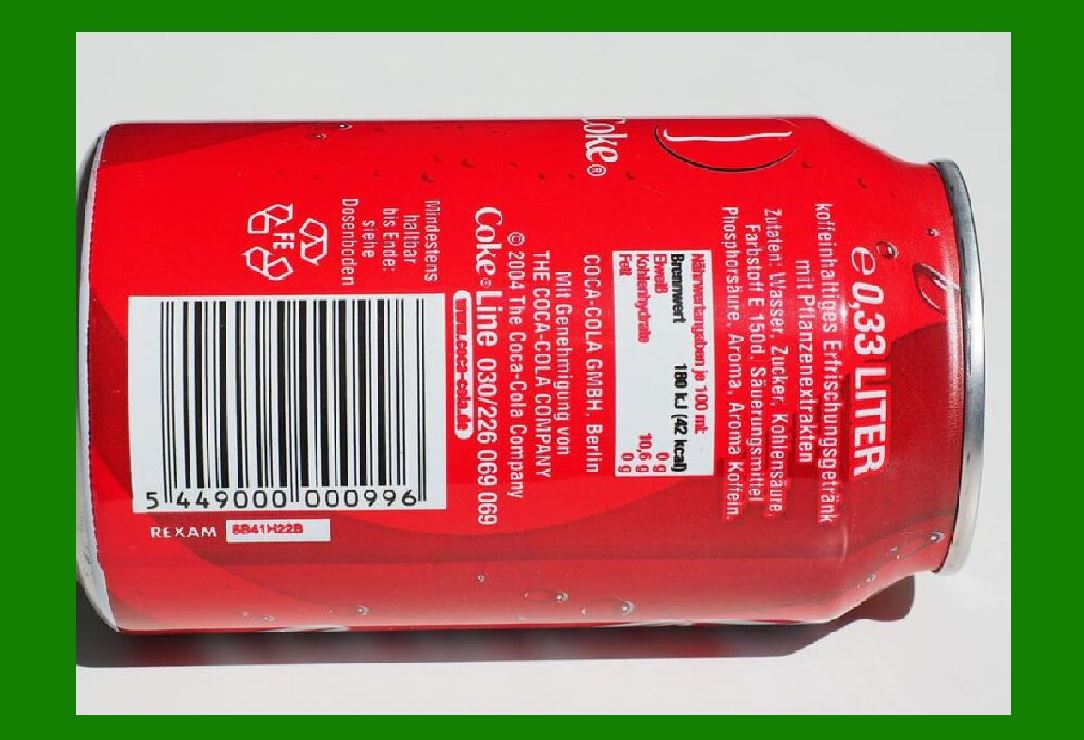
The UPC (Universal Product Code) is a widely used barcode system that plays a crucial role in the world of retail and product identification. It is a linear barcode symbology used primarily for tracking trade items in stores. Its widespread use has transformed inventory management, point-of-sale (POS) systems, and logistics, offering a quick and efficient way to identify products. UPC codes are essential for automating processes like checkout, stock control, and distribution. |
This barcode is composed of a series of vertical bars, each representing data that is decoded by barcode scanners. Its design allows for easy identification by both humans and machines, making it a critical component of the global supply chain. Over time, UPC barcodes have evolved, but their basic structure and function have remained consistent. |
|
2. History of the UPC Barcode |
The inception of the UPC barcode can be traced back to the early 1970s when the retail industry recognized the need for a more efficient system of tracking products. Prior to the barcode system, the manual tracking of inventory and prices was slow, prone to human error, and labor-intensive. The idea of using a barcode for product identification emerged from a collaborative effort between retailers, manufacturers, and technology companies. |
The first major milestone came in 1973 when IBM developed the first version of the barcode. However, it wasn't until 1974 that the first real-world implementation of the UPC barcode occurred. A pack of Wrigley¡¯s gum became the first item ever scanned at a checkout in a grocery store in Ohio, marking the official launch of the UPC system. |
By the mid-1970s, the Uniform Code Council (UCC), now known as GS1, was established to oversee the adoption and management of UPC codes across the United States. This organization helped standardize the system, ensuring that each UPC was unique and could be used universally across different retailers and manufacturers. |
|
3. UPC Barcode Structure |
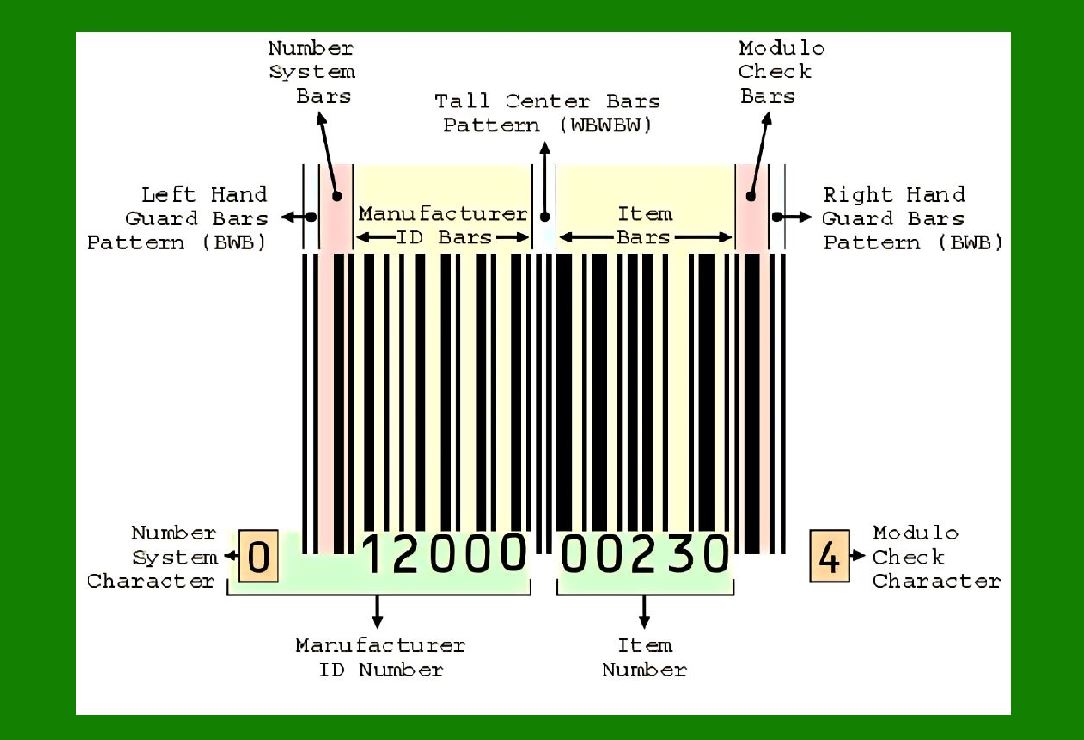
The structure of a UPC barcode is simple yet efficient. It consists of 12 digits, each of which holds specific meaning. The standard UPC-A barcode includes the following elements: |
Left Guard Bar (Start Character): This is a distinct set of black and white bars that signal the beginning of the barcode. It helps the scanner differentiate the barcode from surrounding text or graphics. |
First Six Digits (Manufacturer Identification Number): The first six digits of the UPC code identify the manufacturer or supplier of the product. These digits are assigned by GS1, and they ensure that the product can be traced back to the correct company. Each manufacturer has a unique code, which is crucial for supply chain and inventory management. |
Next Five Digits (Product Code): The next five digits represent the specific product number assigned by the manufacturer. These digits are unique to each product that the manufacturer sells. This allows retailers to accurately track and differentiate between different products. |
Check Digit: The final digit of the UPC is known as the check digit. It is used to verify that the barcode was scanned correctly. This digit is calculated through a mathematical algorithm based on the other 11 digits in the barcode. The check digit helps ensure that the UPC is not misread or corrupted. |
Right Guard Bar (End Character): Similar to the start character, this set of bars signals the end of the UPC code. |
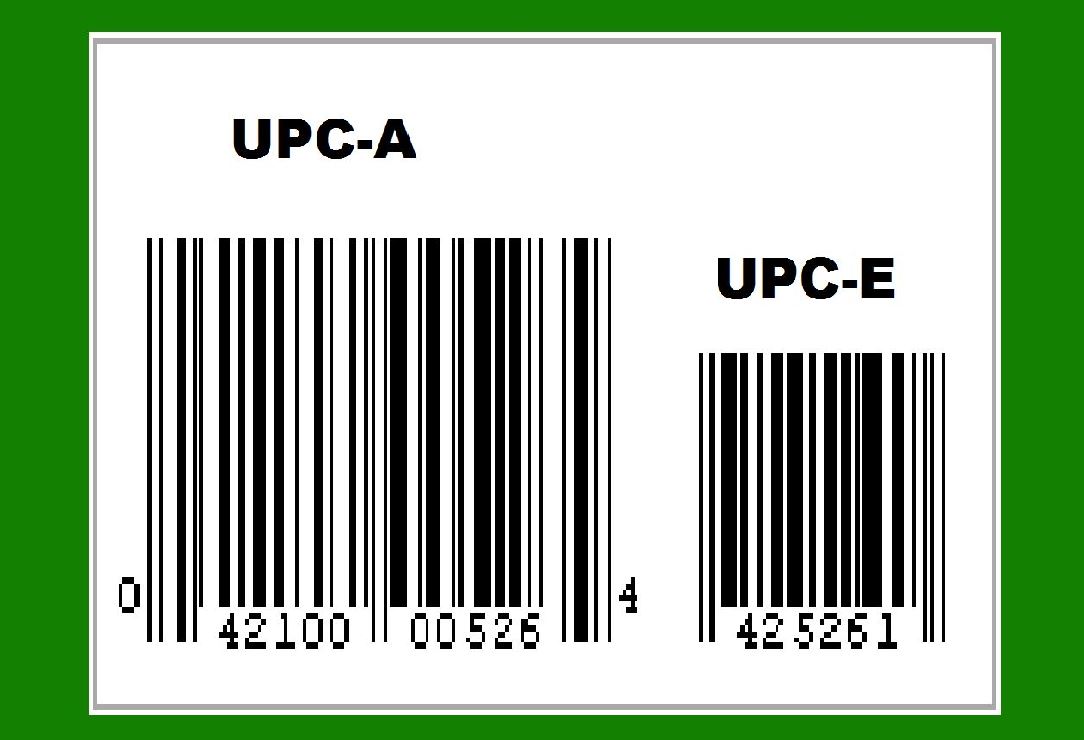
The above structure is used in the UPC-A barcode. There is also a UPC-E barcode, which is a compressed version used for smaller items with limited space. UPC-E reduces the number of digits by omitting leading zeros. |
|
4. UPC Barcode Types |
While the UPC-A barcode is the most commonly used version, there are other variants: |
UPC-A: The standard 12-digit barcode used for retail items. It includes all the information: the manufacturer number, product number, and check digit. |
UPC-E: A 6-digit barcode that is used primarily for small products or products where space is limited. UPC-E is a compressed version of UPC-A that omits certain digits, such as leading zeros, to reduce the size. |
EAN-13: Although technically not a UPC code, the EAN-13 barcode is often used alongside UPC barcodes in international markets. It contains 13 digits, including a country identifier. |
EAN-8: Similar to UPC-E, the EAN-8 barcode is used for very small products. It contains 8 digits and is typically found on smaller retail items. |
|
5. How UPC Barcodes Work |
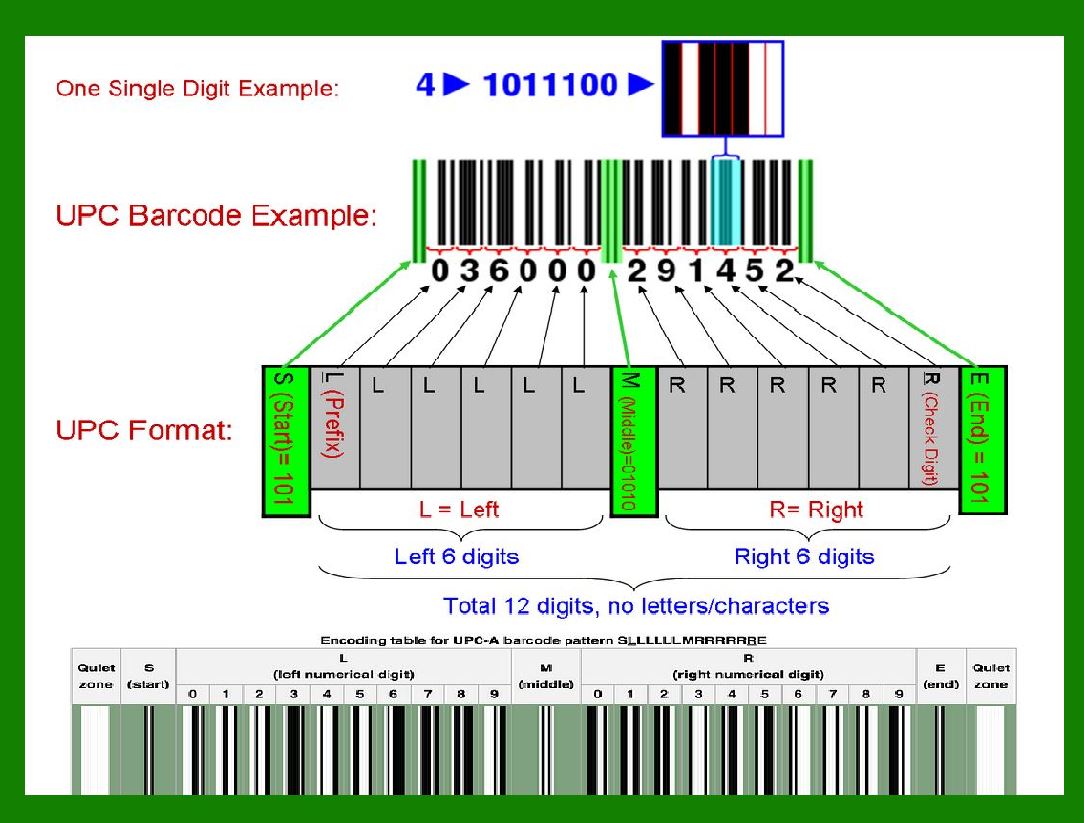
UPC barcodes function by encoding data into a series of vertical bars and spaces of varying widths. These bars represent binary data, which can be interpreted by barcode scanners. The scanner shines light onto the barcode, and the varying widths of the bars reflect light differently. The scanner converts these light variations into electrical signals, which are then decoded into the corresponding digits. |
When a barcode is scanned at a POS terminal, the system reads the code and matches it to an item in the store's database. This process triggers actions like displaying the product price, updating the inventory, and printing a receipt. |

|
6. Benefits of UPC Barcodes |
UPC barcodes offer numerous advantages in various industries, especially in retail and logistics. Some of the key benefits include: |
Efficiency: UPC barcodes streamline the checkout process by automating the identification and pricing of products. |
Accuracy: Barcodes reduce human error, ensuring that the correct product and price are processed. |
Inventory Management: UPC barcodes make inventory tracking easier by allowing retailers to quickly scan items and update stock levels. |
Cost Reduction: By automating data entry and reducing the time spent on manual tasks, UPC barcodes help businesses save money on labor costs. |
Supply Chain Integration: The widespread adoption of UPC barcodes allows for smoother communication and tracking across the supply chain, ensuring timely deliveries and accurate stock levels. |

|
7. Applications of UPC Barcodes |
UPC barcodes have a wide range of applications in the retail, logistics, and manufacturing industries. Some examples of where UPC barcodes are used include: |
Retail Stores: The most common application of UPC barcodes is at retail checkout counters, where they enable fast and accurate product identification. |
Inventory Management: Businesses use UPC barcodes to track products throughout their supply chain, from the manufacturer to the retailer and ultimately to the consumer. |
Online Retail: E-commerce platforms use UPC barcodes to catalog products, manage stock, and streamline order fulfillment. |
Logistics and Shipping: Manufacturers and distributors use UPC barcodes to track packages and shipments, ensuring that goods reach their destination on time. |
Libraries: Many libraries use UPC barcodes to track books and other materials within their collections. |
Pharmaceuticals: The UPC system is used in the pharmaceutical industry to track medications, ensuring they are accurately dispensed and stored. |

|
8. Challenges and Limitations of UPC Barcodes |
Despite their widespread use and benefits, UPC barcodes have some limitations: |
Limited Data Capacity: UPC barcodes are limited to storing only 12 digits of information, which is not sufficient for more complex data needs. This has led to the development of alternative barcode systems like QR Codes and DataMatrix, which can store much more data. |
Susceptibility to Damage: UPC barcodes are vulnerable to damage. If a barcode is scratched, smudged, or torn, it may become unreadable, leading to operational delays. |
Size Limitations: Although UPC barcodes are compact, they may not be suitable for very small products, which require even more compact barcode versions like UPC-E or EAN-8. |

|
9. The Future of UPC Barcodes |
As technology continues to evolve, so too does the world of product identification. While UPC barcodes are likely to remain a core part of retail and logistics for the foreseeable future, there are emerging technologies that could complement or even replace them in certain contexts. |
RFID Technology: Radio Frequency Identification (RFID) tags are gaining popularity in industries where UPC barcodes have limitations. Unlike UPC barcodes, which require direct line-of-sight scanning, RFID tags can be read without direct contact, improving efficiency in inventory management and tracking. |
Smart Labels: The rise of smart labeling, including technologies like QR Codes and NFC (Near Field Communication), offers a more data-rich experience compared to UPC barcodes. These technologies allow for the storage of more information and facilitate consumer engagement. |
Mobile Scanning: With the advent of smartphones, mobile barcode scanning has become increasingly common. This opens up new possibilities for consumers to engage with products by scanning UPC codes with their phones, accessing detailed information, and even making purchases directly. |

|
10. Conclusion |
The UPC barcode has become an integral part of the retail landscape, offering significant improvements in efficiency, accuracy, and cost management. Its widespread adoption has revolutionized the way products are tracked and sold across various industries. As new technologies emerge, the UPC barcode will continue to play a key role in the global supply chain while evolving alongside newer solutions. |
This concludes the detailed explanation of the UPC barcode, but it's important to remember that its continued innovation and integration with other technologies will shape the future of retail and product identification. |

|
Comparison of UPC and EAN Barcodes |
The UPC (Universal Product Code) and EAN (European Article Number) barcodes are two of the most widely used barcode systems in the world for identifying products in retail and logistics. Though they share many similarities, there are also key differences between the two. Here is a detailed comparison between UPC and EAN barcodes. |
1. History and Origins |
UPC Barcode: |
Developed in 1973 by the Uniform Code Council (UCC) in the United States. |
It was designed to automate the identification of products, reduce human error, and speed up the checkout process in retail stores. The first practical implementation of the UPC barcode occurred in 1974 when a pack of Wrigley¡¯s gum was scanned at a checkout counter in Ohio. |
EAN Barcode: |
The EAN barcode originated in Europe in the early 1970s under the leadership of the European Article Numbering Association (EAN). It was specifically created to accommodate the needs of European retailers, though it has since become widely adopted globally. |
The EAN system was initially established as an alternative to the UPC system to serve European markets. |

|
2. Number of Digits |
UPC Barcode: |
UPC-A is the most common form, which consists of 12 digits. |
The digits include a manufacturer identification number, a product code, and a check digit. |
EAN Barcode: |
EAN-13 is the standard form and consists of 13 digits. This includes: |
A country prefix (assigned to a particular country or region), |
A manufacturer number, |
A product code, and |
A check digit. |
EAN-8, a compressed version, uses only 8 digits, typically for small products. |

|
3. Geographic Usage |
UPC Barcode: |
Primarily used in North America, especially the United States and Canada. |
It is the dominant barcode format in these countries, though international retailers may also adopt it for consistency across markets. |
EAN Barcode: |
EAN-13 is the standard barcode used in Europe, Asia, and most of the rest of the world. |
It is the most widely used barcode format globally, including in countries like the United Kingdom, Germany, Australia, and Japan. EAN-13 is also widely adopted in international trade. |

|
4. Structure and Components |
UPC Barcode: |
UPC-A consists of 12 digits: |
The first 6 digits represent the manufacturer code (assigned by GS1). |
The next 5 digits represent the product code (assigned by the manufacturer). |
The final digit is the check digit (used to verify that the barcode is correctly scanned). |
EAN Barcode: |
EAN-13 consists of 13 digits: |
The first 3 digits are the country prefix (indicating the country or region where the manufacturer is registered). |
The next 4-6 digits represent the manufacturer code. |
The subsequent 4-6 digits represent the product code. |
The final digit is the check digit (calculated using a modulo 10 algorithm, similar to the UPC check digit). |

|
5. Check Digit Calculation |
UPC Barcode: |
The check digit in the UPC-A barcode is calculated using a specific algorithm that involves summing the digits at odd and even positions separately, then applying a formula. |
EAN Barcode: |
The check digit for EAN-13 is also calculated in the same way as the UPC check digit, using the modulo 10 system. However, because the EAN-13 barcode contains an extra digit, the calculation is slightly adjusted to accommodate the additional number. |

|
6. Compatibility |
UPC Barcode: |
The UPC-A is commonly used in North America and is not directly compatible with EAN-13 since UPC only has 12 digits compared to EAN-13¡¯s 13 digits. However, the data encoded in both can be the same, and some modern systems allow for cross-compatibility. |
EAN Barcode: |
The EAN-13 barcode can be used globally and is recognized universally, including in the United States, where the UPC-A is more prevalent. EAN-13 barcodes can be converted into UPC by dropping the leading zero of the country prefix. However, UPC-A cannot be easily converted into EAN-13 without modification. |

|
7. Printing and Physical Appearance |
UPC Barcode: |
The UPC-A barcode contains 12 digits, typically formatted with a wider gap between the digits. |
The UPC-E version is a compact version of the UPC-A, using only 6 digits and designed for smaller products. |
EAN Barcode: |
The EAN-13 barcode is slightly longer, with 13 digits, making it visually longer than a UPC-A barcode. |
The EAN-8 version is similar in size to UPC-E but contains only 8 digits. |

|
8. Global Reach and Adoption |
UPC Barcode: |
The UPC barcode system is heavily used in North American retail and supply chains. However, with globalization, many international retailers now also use UPC codes, especially in global e-commerce platforms. |
EAN Barcode: |
The EAN-13 system is recognized as the international standard. It is used by retailers, manufacturers, and distributors around the world for product identification. |

|
9. Usage in Different Sectors |
UPC Barcode: |
Retail: UPC is primarily used for tracking products in retail stores in the United States and Canada. Its major application is at the point of sale (POS) for product identification and checkout. |
Inventory Management: UPC codes are widely used in warehouse management systems and supply chain tracking in North America. |
EAN Barcode: |
Retail and Logistics: EAN-13 is used in global retail, logistics, and supply chain management, where it is used for product identification, inventory control, and supply chain visibility across borders. |
Global E-commerce: The EAN barcode is more commonly used in international e-commerce transactions, as it is accepted globally by marketplaces like Amazon, eBay, and Alibaba. |

|
10. Technological Considerations |
UPC Barcode: |
UPC-A is well-suited for retail applications and works efficiently with scanners and point-of-sale systems. However, the relatively low data capacity (just 12 digits) limits its ability to store detailed product information. |
EAN Barcode: |
EAN-13 offers greater flexibility in encoding product data due to the 13-digit capacity, which provides more space for coding country and manufacturer details. This is especially useful in international trade, where the additional country prefix helps identify the origin of products. |

|
11. Regulatory and Standards Bodies |
UPC Barcode: |
The UPC system is regulated by GS1 US, a branch of the global organization GS1. GS1 is responsible for assigning UPC codes to manufacturers and ensuring the proper use of UPC barcodes. |
EAN Barcode: |
The EAN-13 system is regulated by GS1, a global non-profit organization that manages the assignment of EAN-13 codes across many countries. GS1 is responsible for the international standardization of EAN codes and their use in commerce. |
Conclusion: |
While both UPC and EAN barcodes serve the same fundamental purpose¡ªidentifying and tracking products in retail and supply chain systems¡ªthere are key differences rooted in their geographic origins, number of digits, and global usage. |
The UPC barcode is mainly used in North America, while the EAN barcode is more commonly adopted worldwide. |
The UPC-A code contains 12 digits, while the EAN-13 code contains 13 digits, allowing for a slightly broader range of information. |
EAN-13 is generally considered the global standard, while UPC codes are more prevalent in the U.S. and Canada. |
Both barcodes are widely used and recognized, and advancements in technology allow for the integration of both types in global supply chains and retail environments. |

|
In-Depth Analysis of the UPC Barcode Structure |
The UPC (Universal Product Code) barcode is a linear barcode system primarily used for product identification and inventory management in retail environments. It has a standardized format consisting of 12 digits, each of which carries specific data, from identifying the manufacturer to encoding the actual product information. |
In this section, we will go deep into the detailed structure of the UPC-A barcode format (the standard format), exploring each part of the code and explaining how they contribute to the overall functionality. |
1. Overview of UPC-A Structure |
The UPC-A barcode is made up of a 12-digit numerical code. It is visually represented by a series of black bars and white spaces, each of which represents data that is decoded by barcode scanners. |
Here¡¯s the breakdown of the structure: |
Total Length: 12 digits |
Component Parts: |
Left Guard Bar (Start of Barcode) |
Manufacturer Identification Number (Prefix) |
Product Code |
Check Digit |
Right Guard Bar (End of Barcode) |

|
2. Left Guard Bar (Start Character) |
Purpose: The left guard bar marks the beginning of the barcode, providing a reference point for barcode scanners. |
Appearance: This component consists of a series of two vertical bars. The bars are typically thicker than the other bars used in the barcode, making them easily distinguishable. |
Functionality: The start character indicates to the scanner that the sequence of bars and spaces to follow is a valid UPC code. The guard bars are used by scanners to synchronize and identify the correct orientation of the barcode. |
In a typical UPC-A barcode, the left guard bars are as follows: |
mathematica |
| | (Thick bar) |
|
3. Manufacturer Identification Number (Prefix) |
Length: The manufacturer number is typically made up of 6 digits. |
Purpose: The first part of the UPC code is dedicated to identifying the manufacturer or company responsible for producing the product. This number is assigned by the GS1 organization (a global barcode standardizing body). |
Assignment: These digits are assigned based on the manufacturer's registration with GS1. Each manufacturer gets a unique identification number that helps distinguish their products from others in the marketplace. |
Example: A manufacturer might be assigned the number 123456. |
The manufacturer number is crucial for tracking and managing inventory, as it links directly to a company¡¯s database, allowing for efficient product identification. |
Structure: |
123456 (6 digits) |
|
4. Product Code |
Length: The next 5 digits represent the product code. |
Purpose: The product code is assigned by the manufacturer and represents a specific product. It identifies the individual item being sold or distributed. |
Assignment: Unlike the manufacturer number, the product code is unique to each product within a manufacturer¡¯s catalog. It is assigned based on the internal cataloging and inventory management system used by the manufacturer. |
Example: A product may have the product code 78901. |
The product code, combined with the manufacturer number, allows retailers and suppliers to uniquely identify products within a large catalog, making it easier to track stock levels, sales, and shipments. |
Structure: |
78901 (5 digits) |
|
5. Check Digit |
Length: 1 digit (final digit of the 12-digit UPC code) |
Purpose: The check digit is a mathematical value that is used to validate the accuracy of the barcode. It ensures that the UPC has been correctly scanned and that the data has not been corrupted or misread. |
How It Works: The check digit is calculated using a weighted sum algorithm that involves all the digits in the UPC code, excluding the check digit itself. The algorithm is as follows: |
Multiply the digits in odd positions by 3 (1st, 3rd, 5th, etc.). |
Multiply the digits in even positions by 1 (2nd, 4th, 6th, etc.). |
Sum all the results. |
The check digit is the value that, when added to the sum, makes it a multiple of 10. |
The check digit provides error detection and ensures that the UPC code can be accurately read and processed by systems. |
Example Calculation: |
For the UPC code 123456789012: |
Step 1: Add the odd-positioned digits (1st, 3rd, 5th, etc.): |
(1 + 3 + 5 + 7 + 9 + 1) = 26 |
Step 2: Multiply this sum by 3: |
26 * 3 = 78 |
Step 3: Add the even-positioned digits (2nd, 4th, 6th, etc.): |
(2 + 4 + 6 + 8 + 0 + 2) = 22 |
Step 4: Add this to the previous result: |
78 + 22 = 100 |
Step 5: The check digit is the value that, when added to 100, gives a multiple of 10. In this case, the check digit would be 0. |
Structure: |
0 (check digit) |
|
6. Right Guard Bar (End Character) |
Purpose: The right guard bar marks the end of the UPC barcode and signals the scanner to stop reading. Similar to the left guard bar, the end character is an essential part of the barcode¡¯s structural integrity. |
Appearance: The right guard bar consists of a series of two vertical bars that are typically thicker than the standard bars used within the barcode, indicating the end of the data. |
Functionality: The guard bars help scanners correctly read and decode the barcode by signaling the beginning and end of the data sequence. |
In a typical UPC-A barcode, the right guard bars are as follows: |
| | (Thick bar) |
|
7. Visual Representation of the UPC-A Barcode |
When these components are put together, they form the UPC-A barcode. The barcode is visually represented as a series of vertical bars (black) and spaces (white), each of varying thickness. The bars represent binary data (1s and 0s), while the spaces represent the separation between the bars. |
A UPC-A barcode might look like this when written out visually (this is a simplified representation): |
| | 123456 78901 0 | | |
|
8. General Flow of UPC Barcode Structure |
To summarize the sequence of the UPC-A barcode structure: |
Left Guard Bar (Start) |
Manufacturer Identification Number (6 digits) |
Product Code (5 digits) |
Check Digit (1 digit) |
Right Guard Bar (End) |
Each section has a specific function in the barcode's overall operation, allowing it to be scanned, decoded, and utilized in point-of-sale systems, inventory management systems, and global logistics. |
|
9. Encoding Process of UPC-A Barcodes |
The encoding process for the UPC-A barcode involves converting the 12-digit numerical data into a sequence of bars and spaces. Each number (0-9) is represented by a unique pattern of bars. These patterns are standardized according to the GS1 system to ensure consistent interpretation across all industries. |
The barcode encoding rules are designed such that the scanner can easily distinguish between different numbers based on the width and spacing of the bars. |
Conclusion |
The UPC-A barcode is a straightforward yet highly effective system for product identification. Its 12-digit structure allows for the inclusion of both manufacturer information and product data, while the check digit ensures data accuracy and prevents scanning errors. The guard bars ensure correct scanning orientation and help maintain the integrity of the barcode. The system¡¯s simplicity and reliability have made UPC codes the standard for product identification in North America, and the general principles are adaptable to a wide variety of industries. |
|
Comparison of UPC (1D) and 2D Barcodes |
1D (UPC) barcodes and 2D barcodes serve similar purposes¡ªencoding information about products or items¡ªbut they differ significantly in their structure, capabilities, and applications. While UPC barcodes are linear (1D), 2D barcodes are matrix-based and can encode much more information. In this comparison, we will explore the key differences, advantages, and use cases of 1D UPC barcodes versus 2D barcodes like QR codes, DataMatrix, PDF417, and others. |
1. Structure and Data Encoding |
UPC (1D) Barcode: |
Linear Format: A UPC barcode is a one-dimensional (1D) barcode, represented by a series of vertical bars and spaces of varying widths. The information is encoded in a linear sequence, with the data being represented by different patterns of bars (1s) and spaces (0s). |
Data Capacity: A UPC-A barcode, for example, can encode only 12 digits, which typically include the manufacturer's identification, the product number, and a check digit. |
One-Dimensional: The data is stored along a single axis (left to right), making it inherently limited in terms of how much information can be encoded. |
2D Barcode: |
Matrix Format: 2D barcodes are represented in a two-dimensional grid consisting of squares, dots, or hexagons, allowing for data storage both horizontally and vertically. Common examples of 2D barcodes include QR codes, DataMatrix, PDF417, Aztec, and MaxiCode. |
Data Capacity: 2D barcodes can store significantly more information. For example, a QR code can encode up to 7,089 characters or 4,296 bytes of data, far exceeding the capacity of a 1D barcode like UPC. |
Two-Dimensional: The data is encoded in both dimensions, which enables a much higher data density. This makes 2D barcodes suitable for applications that require more information, such as URLs, product descriptions, or even digital files. |
|
2. Physical Size and Space Efficiency |
UPC (1D) Barcode: |
Fixed Size: A UPC barcode, whether UPC-A or UPC-E, has a fixed size depending on the number of digits and the required spacing between bars. |
Space Consumption: While a UPC-A barcode requires 12 digits, it needs a significant length to accommodate these digits in a linear fashion. The barcode is generally longer, especially when compared to smaller 2D barcodes. |
Scaling: As the data volume increases, the length of the barcode also increases, which can make it less efficient for small items with limited space. |
2D Barcode: |
Compact Size: 2D barcodes like QR codes or DataMatrix are more space-efficient and can encode large amounts of data in a compact square or rectangular area. A QR code, for example, can hold a lot of data in a small 2D matrix, allowing it to be easily scaled for larger or smaller items. |
Data Density: 2D barcodes are much more space-efficient when encoding large amounts of data because they can store information in both the horizontal and vertical dimensions. |
|
3. Data Storage Capacity |
UPC (1D) Barcode: |
Limited Capacity: The 12-digit capacity of UPC barcodes means they are designed to handle only basic information about a product, such as the manufacturer's code, product ID, and a check digit. It cannot store detailed descriptions, URLs, or any complex data types. |
Fixed Data Type: Typically, UPC barcodes encode numeric data only and are mainly used for identification and tracking in retail and logistics. |
2D Barcode: |
High Capacity: 2D barcodes are capable of encoding alphanumeric data, binary data, and even binary files. For example, QR codes can hold URLs, text, contact information, Wi-Fi credentials, or even event tickets. |
Multiple Formats: In addition to alphanumeric characters, some 2D barcodes like PDF417 can store multiple data types, including images and multi-line text. |
|
4. Error Correction and Data Recovery |
UPC (1D) Barcode: |
Minimal Error Correction: 1D barcodes like UPC rely on their check digit to verify the correctness of the code and detect scanning errors. However, once a UPC code is damaged (scratched, faded, or distorted), it often becomes unreadable, and there is little room for error recovery. |
2D Barcode: |
Advanced Error Correction: Many 2D barcodes, like QR codes, include advanced error correction algorithms (such as Reed-Solomon error correction) that can recover data even if part of the code is damaged. In some cases, a 2D barcode can still be read even if up to 30% of the code is obscured or damaged. |
Redundancy: This added error correction makes 2D barcodes more reliable in harsh environments where the code might be exposed to wear and tear. |
|
5. Scanning Requirements |
UPC (1D) Barcode: |
Line-of-Sight Scanning: UPC barcodes require line-of-sight scanning. The barcode must be scanned in a straight line, and the scanner must align directly with the barcode's horizontal orientation. |
One-Dimensional Scanners: UPC barcodes can be read by basic laser scanners or imager scanners. The scanner only needs to read in one dimension (left to right). |
Orientation: Because UPC codes are linear, they must be properly oriented for accurate scanning. |
2D Barcode: |
Multi-Dimensional Scanning: 2D barcodes can be scanned from multiple angles. This is because they store data in both dimensions, which allows the scanner to read the barcode in various orientations, making it more flexible and versatile. |
Smartphone Scanners: 2D barcodes, particularly QR codes, can be scanned using smartphone cameras, making them highly accessible for consumers. 2D barcodes can be scanned using imagers or camera-based scanners, which can read the data from almost any angle, orientation, or surface. |
|
6. Applications and Use Cases |
UPC (1D) Barcode: |
Primary Use: UPC barcodes are most commonly used in retail environments, where the primary purpose is to identify products, facilitate inventory management, and speed up the checkout process. |
Common Areas: |
Retail stores |
Supermarkets |
Warehouse management |
Inventory control systems |
Limitations: UPC codes are limited to product identification and cannot store rich data like URLs, promotional information, or multimedia content. |
2D Barcode: |
Broader Range of Uses: 2D barcodes have much broader applications than UPC barcodes, particularly in digital environments and for consumer engagement. They are used for: |
QR codes: Often used in marketing, advertising, and mobile payments. They can link users to websites, provide product information, offer discounts, or store contact details. |
DataMatrix: Commonly used in industrial and logistics applications for tracking small items or high-value products. |
PDF417: Used for applications that require the encoding of large data sets, such as in transportation (boarding passes, ID cards) and government-issued documents. |
Versatility: 2D barcodes are used in a variety of fields beyond retail, such as healthcare, tourism, advertising, event management, and mobile apps. |
|
7. Cost and Implementation |
UPC (1D) Barcode: |
Lower Cost: UPC barcodes are relatively inexpensive to produce, especially since they only require printing a simple set of bars on labels or packaging. |
Established System: UPC barcodes have been in use for decades, making them a standard in many industries, especially in retail. |
2D Barcode: |
Higher Data Density but More Costly: While 2D barcodes might cost slightly more to produce and print (especially in terms of label design), they offer far greater flexibility, higher data capacity, and can be generated dynamically for various digital purposes. |
Flexibility: The ability to encode more information means that 2D barcodes can potentially replace multiple 1D barcodes in certain applications, reducing the need for multiple code types. |
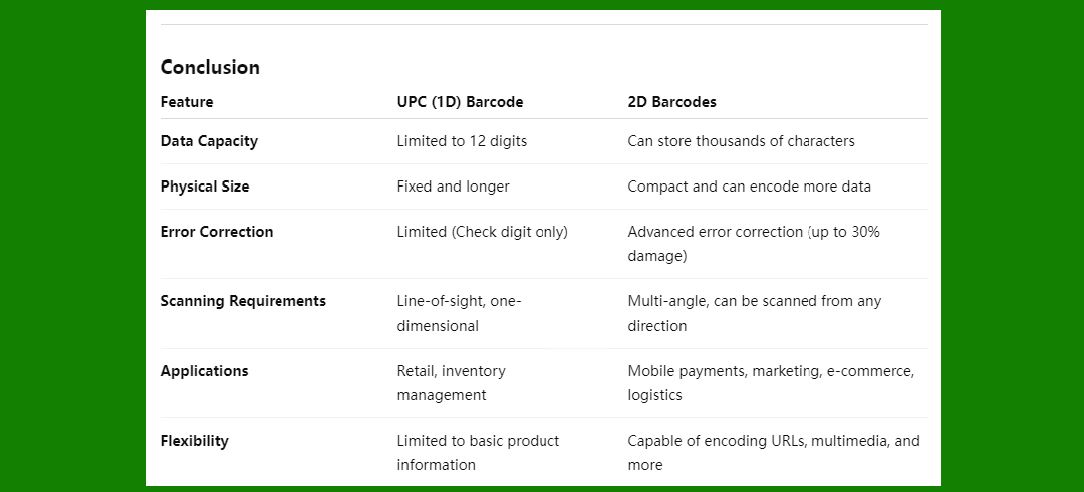
Conclusion |
|
In summary, UPC barcodes are still crucial in retail for simple product identification, but 2D barcodes offer much more versatility and capacity, making them suitable for a broader range of applications, from mobile payments to product tracking, and beyond. The decision to use either depends on the specific needs of the business or application, with 2D barcodes often seen as a more future-proof choice for data-rich environments. |
|
Comparison of UPC Barcode and Code 128 Barcode |
Both the UPC barcode and the Code 128 barcode are widely used for product identification and data encoding, but they have distinct differences in terms of their data structure, applications, and capabilities. Below, we will compare UPC barcodes (which are 1D barcodes) with Code 128 (a high-density 1D barcode), highlighting their key differences and common use cases. |
1. General Overview |
UPC Barcode: |
Type: 1D Linear Barcode. |
Length: Typically 12 digits (for UPC-A). |
Primary Use: Primarily used for retail product identification, especially in North America. |
Data Encoding: Encodes numeric data only (0-9), focusing on simple product identification. |
Symbology: Uses a fixed format with 6 digits for the manufacturer and 5 digits for the product code, plus a check digit. |
Code 128 Barcode: |
Type: 1D Linear Barcode, but with a much denser encoding system. |
Length: The length can vary based on the amount of data to be encoded (a typical Code 128 barcode can be much shorter or longer than a UPC barcode). |
Primary Use: Versatile barcode used across various industries, including logistics, inventory, pharmaceuticals, and healthcare. |
Data Encoding: Can encode alphanumeric data (letters, digits, special characters), offering a broader range of applications than the UPC barcode. |
Symbology: Supports three different encoding modes¡ªCode Set A, Code Set B, and Code Set C, allowing for flexible encoding of numeric and alphanumeric data. |
|
2. Data Encoding and Capacity |
UPC Barcode: |
Limited Data: The UPC-A format contains 12 digits, which limits its data capacity to simple numeric information. |
6 digits for the manufacturer identification. |
5 digits for the product code. |
1 digit as a check digit (used for error detection). |
Data Type: Numeric only¡ªUPC barcodes are used primarily for identifying products and do not encode special characters or alphanumeric values. |
Code 128 Barcode: |
High Data Density: Code 128 can encode a wider variety of data, including numeric (0-9), alphabetic (A-Z), and extended ASCII characters (such as punctuation marks, symbols, etc.). |
Flexible Encoding: Code 128 offers three encoding schemes: |
Code Set A: Encodes uppercase letters, digits, and control characters. |
Code Set B: Encodes uppercase and lowercase letters, digits, and special characters. |
Code Set C: Optimized for encoding pairs of digits (numeric-only), offering a more compact representation when encoding numbers. |
Data Capacity: Depending on the length of the barcode, Code 128 can store up to 128 characters (including digits, letters, and symbols), far exceeding the capacity of a UPC barcode. |
|
3. Size and Density |
UPC Barcode: |
Standard Size: A UPC-A barcode typically has a fixed size (due to the fixed 12-digit length) and is slightly longer than other 1D barcodes, making it suitable for products with space for a standard barcode. |
Less Data Density: Since it encodes only numeric digits, the barcode density is relatively low compared to Code 128, leading to a longer barcode to accommodate 12 digits. |
Code 128 Barcode: |
Variable Size: Code 128 is more flexible in size, depending on the data it needs to encode. It can be compressed and made shorter than the equivalent UPC barcode for the same amount of information (especially when using Code Set C for numeric data). |
Higher Density: Code 128 barcodes can encode more data in a smaller space than UPC barcodes, allowing them to be more space-efficient while maintaining clarity. |
|
4. Error Detection |
UPC Barcode: |
Check Digit: The UPC barcode includes a check digit that helps verify the integrity of the scanned code. This check digit is calculated using a mathematical formula, ensuring the barcode is read correctly. |
Error Correction: UPC barcodes offer basic error detection via the check digit but do not have robust error correction capabilities. If part of the barcode is damaged or unreadable, the code may not be recognized. |
Code 128 Barcode: |
No Check Digit Requirement: While Code 128 does not have a mandatory check digit like UPC, it still has a checksum option to verify the accuracy of the barcode. |
Error Detection: Code 128 provides error detection through its checksum feature, allowing scanners to ensure that the data has been read correctly, but it lacks the advanced error correction seen in 2D barcodes (like QR codes). |
|
5. Applications and Use Cases |
UPC Barcode: |
Retail: The UPC-A barcode is primarily used in retail environments to track products at the point of sale (POS). It is also widely used in inventory management, where simplicity and speed are key. |
Global Standard: UPC barcodes are the most widely used barcode type for consumer products in North America (U.S. and Canada), and they serve as the standard for consumer products in retail. |
Limitations: UPC barcodes are designed mainly for product identification in retail and cannot store detailed information or alphanumeric data. |
Code 128 Barcode: |
Logistics and Shipping: Code 128 is commonly used in warehousing, shipping, and logistics industries because it can efficiently store a large amount of information in a compact form. |
Inventory Management: Like UPC, Code 128 is used for inventory tracking, but it offers much more flexibility in terms of data encoding (including product codes, locations, batch numbers, etc.). |
Healthcare: Code 128 is widely used in healthcare for patient tracking, medication labeling, and inventory control due to its ability to store both numbers and letters. |
Versatility: Code 128 is more versatile than UPC and is used across a variety of industries like automotive, pharmaceuticals, and manufacturing. |
|
6. Scanning Requirements |
UPC Barcode: |
Simple Scanning: UPC barcodes are easily scanned by standard laser scanners or imagers, which only need to scan in one direction (left-to-right). The barcode needs to be properly aligned and unobstructed to be read. |
Fixed Length: Since UPC codes are of a fixed length, scanners can quickly identify and decode the information. |
Code 128 Barcode: |
Flexible Scanning: Code 128 can be scanned by both laser scanners and image-based scanners, allowing for multi-directional scanning. This flexibility makes it easier to scan from different angles and under different conditions. |
Variable Length: Code 128 barcodes have a variable length, so scanners must be capable of reading different lengths of barcodes based on the encoded data. |
|
7. Cost and Implementation |
UPC Barcode: |
Low Cost: UPC barcodes are generally less expensive to produce, especially for consumer products in retail. The simplicity of the format keeps costs low for printing and implementing. |
Standardization: UPC barcodes are widely accepted and standardized across retailers, making them cost-effective for businesses dealing with high-volume consumer goods. |
Code 128 Barcode: |
Higher Flexibility but Slightly Higher Cost: While Code 128 barcodes are more versatile and compact, they might be slightly more expensive to produce and implement, especially for small businesses with varied applications. |
Industry Adoption: The higher flexibility and capacity make Code 128 a better choice for specialized industries (logistics, manufacturing, healthcare), which might justify the slightly higher implementation cost. |
|
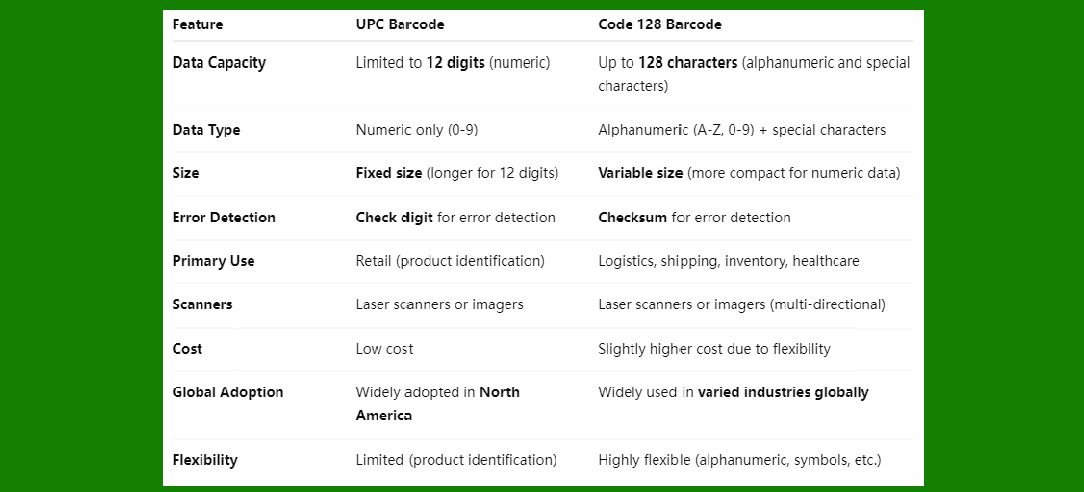
8. Summary Table of Differences |
|
Conclusion: |
While both UPC barcodes and Code 128 barcodes are 1D barcodes used for data encoding, they serve different needs and offer varying levels of flexibility and data capacity: |
UPC barcodes are designed for retail product identification, offering simplicity and ease of use but with limited data capacity and flexibility. |
Code 128 barcodes, on the other hand, are much more versatile, capable of encoding a wide range of data types, making them ideal for logistics, inventory, and healthcare industries, where more detailed information is required. |
For organizations requiring flexibility, higher data capacity, and more complex data, Code 128 is the better choice, whereas UPC remains a standardized, cost-effective solution for high-volume consumer goods in retail environments. |
|
Comparison of UPC Barcode and Code 39 Barcode |
The UPC barcode and the Code 39 barcode are both 1D barcodes used for encoding product information, but they differ significantly in terms of their data capacity, structure, applications, and usage. Below is a detailed comparison of the two: |
1. General Overview |
UPC Barcode: |
Type: 1D Linear Barcode. |
Length: Fixed length of 12 digits for UPC-A (with variations such as UPC-E for shorter codes). |
Primary Use: Retail product identification in North America, primarily for scanning at point of sale (POS). |
Data Encoding: Encodes numeric data only (0-9). |
Symbology: Used globally for product identification in consumer goods. |
Code 39 Barcode: |
Type: 1D Linear Barcode. |
Length: Variable length, typically between 1 and 43 characters. |
Primary Use: Used in a wide range of industries including inventory management, logistics, automotive, pharmaceuticals, and military. |
Data Encoding: Can encode alphanumeric data (A-Z, 0-9), plus a few special characters. |
Symbology: Code 39 is highly flexible and can encode letters, numbers, and a small set of special characters. |
|
2. Data Encoding and Capacity |
UPC Barcode: |
Limited Data: UPC barcodes like UPC-A encode only numeric digits (0-9) and are typically 12 digits long. |
Fixed Format: UPC codes have a fixed format: 6 digits for the manufacturer code and 5 digits for the product code, with a 1 digit check digit for error detection. |
Limited Use Cases: Since UPC codes encode only numbers, they are restricted in their application, mostly in retail for product identification. |
Code 39 Barcode: |
Higher Capacity: Code 39 can encode alphanumeric data, including upper-case letters (A-Z), digits (0-9), and a small set of special characters: -, ., space, $, /, +, %. |
Variable Length: The length of a Code 39 barcode is variable, meaning it can accommodate different amounts of data depending on the application. |
Data Flexibility: Since Code 39 can encode letters, numbers, and special symbols, it offers more flexibility for a wide range of industries beyond retail. |
|
3. Size and Density |
UPC Barcode: |
Fixed Size: The size of a UPC-A barcode is generally fixed because of its 12-digit length, and it is typically longer in comparison to other barcodes when encoded with a small amount of data. |
Less Dense: Since UPC encodes only 12 digits, it is relatively low density and requires more space for its encoding than some other barcode formats. |
Code 39 Barcode: |
Variable Size: The size of a Code 39 barcode is variable based on the amount of data encoded. A longer string of data will result in a longer barcode. |
More Dense: Code 39 tends to be less dense than other 1D barcodes like Code 128, but its ability to encode both letters and numbers means it requires more space per character than a numeric-only format like UPC. |
|
4. Error Detection and Check Digits |
UPC Barcode: |
Check Digit: The UPC-A barcode includes a check digit (the 12th digit), calculated through a modulo 10 formula. This helps verify that the barcode has been scanned correctly and that the data is accurate. |
Error Detection Only: UPC barcodes use the check digit for error detection, but they do not support advanced error correction mechanisms. |
Code 39 Barcode: |
No Built-in Error Detection: Code 39 barcodes do not have a check digit by default, meaning there is no automatic mechanism for error detection. This can sometimes lead to scanning errors if the barcode is damaged or if there are misprints. |
Optional Check Digit: Some implementations of Code 39 do include a check digit as an optional feature for error detection. In those cases, the check digit is calculated similarly to UPC, but it is not part of the core specification. |
Error Correction: Like UPC, Code 39 does not provide advanced error correction, though this can be supplemented with additional checks in specific applications. |
|
5. Applications and Use Cases |
UPC Barcode: |
Primary Use: Retail product identification in North America, mainly for point-of-sale (POS) scanning in supermarkets, retail stores, and online transactions. |
Limited to Numeric Data: UPC barcodes are used primarily for tracking products where numeric data suffices, making it ideal for consumer goods such as groceries, clothing, and electronics. |
Global Standard for Retail: UPC is recognized globally but is most commonly used in North American retail environments. |
Code 39 Barcode: |
Wide Range of Industries: Code 39 is used in a broader range of industries than UPC, including: |
Logistics and Warehousing: For inventory management and shipment tracking. |
Healthcare: For patient ID labels, medication packaging, and medical equipment tracking. |
Automotive: Used for parts tracking and inventory management in the automotive industry. |
Military and Aerospace: For equipment identification and asset management in defense and aerospace industries. |
Data Flexibility: Code 39¡¯s ability to encode both letters and numbers allows it to be used for applications requiring more complex identifiers, such as serial numbers and alphanumeric product IDs. |
|
6. Scanning Requirements |
UPC Barcode: |
Simple Scanning: UPC barcodes are typically scanned with standard laser scanners or imagers that read the code from left to right in a single direction. |
Orientation: The barcode must be properly aligned horizontally to be read correctly by scanners. |
Fixed Length: Since UPC codes are of a fixed length, scanners do not need to adjust for different lengths. |
Code 39 Barcode: |
Multi-Directional Scanning: Code 39 barcodes can be scanned in any direction (multi-directional scanning), which increases flexibility in scanning. They can be read with both laser scanners and imager-based scanners. |
Orientation Flexibility: Code 39 is less sensitive to orientation than UPC because of its variable length and more flexible nature. |
Reading Distance: Code 39 can be scanned from longer distances compared to UPC due to its higher data density. |
|
7. Cost and Implementation |
UPC Barcode: |
Lower Cost: UPC barcodes are generally inexpensive to produce, particularly because they are standardized in retail environments and supported by a global infrastructure. |
Widely Adopted in Retail: UPC barcodes are ubiquitous in the retail industry, particularly in North America, where they serve as the primary product identification system. |
Code 39 Barcode: |
Higher Flexibility, Potentially Higher Cost: While Code 39 barcodes are still relatively inexpensive, they tend to have a higher production cost in certain applications due to their ability to encode both letters and numbers. |
Adoption in Specialized Industries: Code 39 is widely used in manufacturing, healthcare, and logistics, though it is less standardized for consumer goods than UPC. |
|
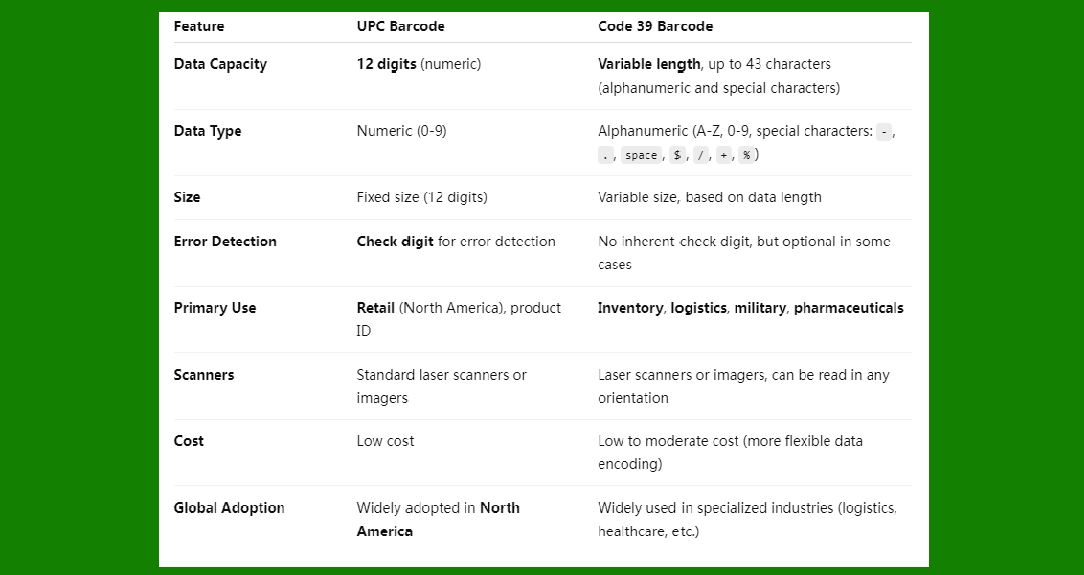
8. Summary Table of Differences |
|
Conclusion: |
UPC barcodes are simple, numeric-only barcodes designed primarily for retail product identification and consumer goods. Their fixed format and check digit make them highly reliable for high-volume retail applications, but they are limited in terms of data encoding flexibility. |
Code 39 barcodes are more flexible, allowing the encoding of alphanumeric data and special symbols. This makes them suitable for industries that require more complex identifiers, such as inventory tracking, logistics, and healthcare. While they are less compact than Code 128 or other high-density barcodes, they are still widely used due to their simplicity, versatility, and compatibility across industries. |
Ultimately, the choice between UPC and Code 39 will depend on the specific needs of the application, with UPC being ideal for retail and Code 39 better suited for logistics, inventory management, and industries requiring more complex product identification. |
 cs@easiersoft.com