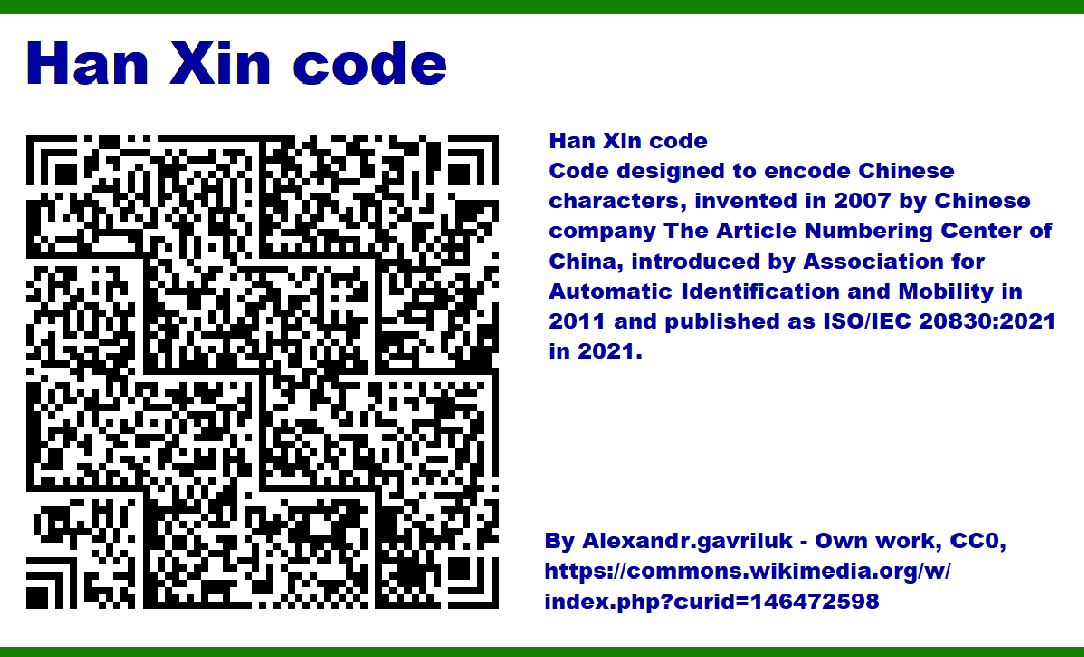
The Han Xin Code, developed in 2007 by the Chinese company The Article Numbering Center of China (ANCC), represents a significant advancement in the encoding of Chinese characters into a machine-readable format. |
This code was introduced by the Association for Automatic Identification and Mobility (AIM) China in 2011 and later standardized as ISO/IEC 20830:2021 in 2021. It aims to provide a comprehensive solution for encoding Chinese characters and has applications across various industries, including logistics, retail, and beyond. |
Introduction to Han Xin Code |
The Han Xin Code addresses the unique challenges posed by encoding Chinese characters, which are complex and numerous compared to alphanumeric characters typically used in Western barcodes. Traditional barcodes such as UPC and QR codes are primarily designed for alphanumeric data, making them inefficient for encoding Chinese text due to the large character set and the complexity of each character. |
|
Development and Design Principles |
Origins and Development |
The development of Han Xin Code was driven by the need for a barcode system that could efficiently encode Chinese characters while remaining compatible with existing barcode technology. The Article Numbering Center of China (ANCC), recognizing this need, undertook the task of designing a barcode specifically tailored to Chinese language requirements. |
Design Principles |
1.Character Set and Encoding: Han Xin Code utilizes a specific encoding scheme optimized for Chinese characters. It supports a wide range of characters, including traditional and simplified Chinese characters, as well as other characters used in the Chinese language. 2.Error Correction: Like other modern barcode systems, Han Xin Code incorporates error correction techniques to ensure data integrity. This is crucial in environments where barcodes may be partially obscured or damaged. 3.Compactness and Scalability: Efficiency in terms of space utilization is another key design principle. Han Xin Code aims to be compact while accommodating a large amount of data, making it suitable for applications ranging from consumer products to industrial logistics. |

|
Technical Specifications |
Structure and Format |
Han Xin Code can encode both numeric and alphanumeric data, but its primary strength lies in encoding Chinese characters efficiently. It uses a combination of bars and spaces arranged in a specific pattern, which can be scanned and decoded by barcode readers equipped with Han Xin Code decoding capabilities. |
Encoding Chinese Characters |
The encoding process involves converting Chinese characters into a binary format that the barcode reader can interpret. Each character is assigned a unique sequence of bars and spaces, allowing for quick and accurate decoding. |
Error Correction |
To enhance reliability, Han Xin Code employs error correction techniques. These techniques involve adding redundant information to the barcode, enabling the barcode reader to correct errors caused by minor damage or distortion. |
Size and Scalability |
Han Xin Code is designed to be scalable, accommodating different sizes depending on the application requirements. It can be printed on various surfaces and materials, from packaging labels to identification cards, without compromising readability. |

|
Applications |
Industry Adoption |
Han Xin Code has gained traction in industries where the accurate encoding of Chinese characters is critical. This includes: |
Retail: Product labeling and inventory management. Logistics: Package tracking and management. Healthcare: Patient identification and medication management. Government: Document authentication and identification. |
Advantages Over Traditional Barcodes |
Chinese Language Support: Unlike traditional barcodes, Han Xin Code is optimized for encoding Chinese characters, eliminating the need for multiple barcodes or additional labeling systems. Efficiency: It offers greater data capacity and efficiency in space utilization compared to traditional barcode systems when encoding Chinese text. Standardization: As an ISO/IEC standard, Han Xin Code enjoys international recognition and compatibility, ensuring interoperability across different regions and industries. |

|
Implementation and Usage |
Printing and Scanning |
Han Xin Code can be printed using standard barcode printing equipment on various surfaces, including paper, plastic, and metal. Barcode scanners equipped with Han Xin Code decoding capabilities can read and interpret the encoded data quickly and accurately. |
Integration with Information Systems |
Incorporating Han Xin Code into existing information systems typically involves integrating barcode scanning devices with backend databases and software applications. This integration allows for seamless data capture and utilization across different business processes. |

|
Future Developments and Trends |
Continued Innovation |
The evolution of Han Xin Code continues with ongoing research and development aimed at improving its efficiency, expanding its applications, and addressing emerging technological trends. Future developments may focus on enhancing error correction capabilities, supporting new character sets, and integrating with emerging technologies such as Internet of Things (IoT) devices. |
Global Adoption |
With its standardization as ISO/IEC 20830:2021, Han Xin Code is poised for increased adoption on a global scale. As international businesses and industries recognize the advantages of a standardized Chinese character encoding system, the demand for Han Xin Code solutions is expected to grow. |

|
Conclusion |
The Han Xin Code represents a significant advancement in barcode technology specifically tailored to meet the challenges of encoding Chinese characters. Developed with a focus on efficiency, reliability, and compatibility, it has emerged as a crucial tool in various industries where accurate data capture and management are essential. As it continues to evolve and gain acceptance globally, Han Xin Code is set to play a vital role in shaping the future of barcode technology, particularly in regions where Chinese language support is critical. |
This detailed overview provides a comprehensive understanding of the Han Xin Code, covering its development, technical specifications, applications, and future prospects in the field of automatic identification and mobility. |
 cs@easiersoft.com