PDF417, a two-dimensional barcode symbology, has emerged as a pivotal technology in the realm of government-issued identification documents worldwide. This detailed examination will delve into the intricacies of PDF417, its application in various government-issued IDs, and its critical role in enhancing security and efficiency in identification and border control processes. |
|
Overview of PDF417 Technology |
PDF417, or Portable Data File 417, is a stacked linear barcode symbol format used in a variety of applications, prominently in identification documents. Unlike traditional linear barcodes that encode data in a single row, PDF417 can store a significant amount of information vertically and horizontally across multiple rows and columns. This capability allows it to encode large amounts of data, including alphanumeric and binary data, within a relatively small space. |
Initially developed by Symbol Technologies in 1991, PDF417 has gained widespread adoption due to its robust error correction capability and high data capacity. It is capable of encoding up to 1,850 alphanumeric characters or over 2,700 numeric digits, making it suitable for applications requiring extensive data storage in a compact form factor. |

|
Government Adoption of PDF417 in Identification Documents |
United States: RealID Compliant Driver's Licenses and IDs |
In the United States, PDF417 has been selected by the Department of Homeland Security (DHS) as the barcode technology for RealID compliant driver's licenses and state-issued identification cards. RealID is a set of standards for state-issued driver's licenses and identification cards that was introduced as a result of the Real ID Act of 2005, aimed at improving the security and reliability of state-issued IDs. |
PDF417 barcodes integrated into RealID compliant IDs serve as a digital repository for essential personal information of the cardholder. This information typically includes the individual's full name, date of birth, address, driver's license or identification card number, and in some cases, biometric data such as a facial image or fingerprint data. The utilization of PDF417 facilitates secure identity verification and validation processes, enabling authorities to quickly and accurately verify the authenticity of the ID and the identity of the bearer. |
RealID compliant IDs are crucial for various purposes, including domestic air travel and access to federal facilities, where strict identification standards are enforced. The PDF417 barcode plays a pivotal role in enabling automated verification processes at security checkpoints, enhancing both security measures and operational efficiency. |

|
International Applications: Visas and Border Crossing Cards |
Beyond the United States, PDF417 technology is widely utilized in international travel documents such as visas and border crossing cards issued by various governments. For instance, the State of Israel incorporates PDF417 barcodes into its visas and border crossing cards issued to foreign visitors and residents. |
These documents encode comprehensive information about the visa or cardholder, including passport details (such as passport number and issuing country), visa type, validity dates, and issuing authority. The use of PDF417 facilitates seamless processing at border control checkpoints, where immigration officers can swiftly scan and verify the encoded information against databases and watchlists, ensuring rigorous security checks while expediting the entry and exit procedures for travelers. |

|
Technical Aspects of PDF417 |
Structure and Encoding |
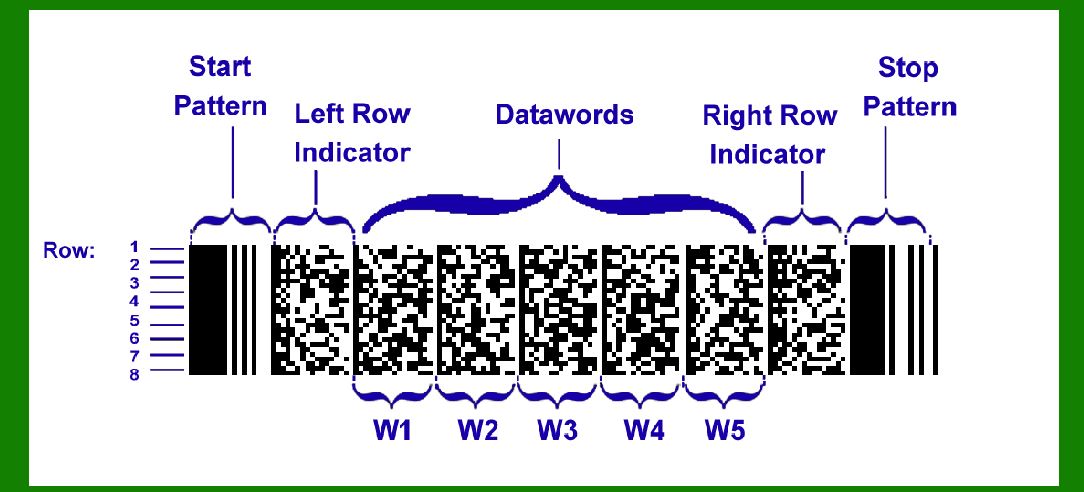
PDF417 barcodes consist of multiple rows of linear barcodes stacked on top of each other. Each row can contain up to 30 codewords, with each codeword representing a specific set of data or instructions. The barcode structure includes start and stop patterns, error correction codewords, and data codewords organized in clusters. |
Error correction is a critical feature of PDF417, allowing the barcode to remain readable even if part of the code is damaged or obscured. This is achieved through Reed-Solomon error correction algorithms, which add redundancy to the encoded data, enabling the barcode reader to reconstruct the original information accurately. |
Data Capacity and Efficiency |
One of the key advantages of PDF417 is its high data capacity relative to its size. The barcode can encode large amounts of information in a compact space, making it ideal for applications where physical size constraints exist, such as on plastic identification cards. The ability to encode both alphanumeric and binary data ensures versatility in encoding various types of information, from simple text to complex data structures like biometric templates. |

|
Benefits of PDF417 in Government Identification |
Enhanced Security |
PDF417 enhances the security of government-issued identification documents through several mechanisms: |
Data Encryption: Personal information encoded in PDF417 barcodes can be encrypted to prevent unauthorized access and tampering. Authentication: The barcode facilitates quick and reliable authentication of the ID and the identity of the bearer by enabling automated verification processes. Anti-counterfeiting Measures: Advanced printing techniques and secure issuance processes can be integrated with PDF417 to deter counterfeiting and fraud attempts. |

|
Operational Efficiency |
The adoption of PDF417 in government IDs streamlines operational processes in various ways: |
Automated Data Entry: Scanning PDF417 barcodes eliminates the need for manual data entry, reducing errors and improving data accuracy. Faster Processing Times: Quick scanning and verification of PDF417 barcodes expedite ID checks at checkpoints, reducing waiting times for travelers and enhancing overall operational efficiency. Interoperability: PDF417's standardized format ensures compatibility with a wide range of barcode scanning devices and software systems, facilitating seamless integration into existing infrastructure. |

|
Challenges and Considerations |
While PDF417 offers significant advantages for government identification, several challenges and considerations must be addressed: |
Standardization: Ensuring consistent encoding and decoding standards across different jurisdictions and applications is crucial for interoperability and usability. Data Security: Safeguarding the privacy and security of the encoded information against unauthorized access and malicious tampering is paramount. Technological Advances: As technology evolves, ongoing updates and improvements to barcode scanning devices and software may be necessary to maintain compatibility and effectiveness. |

|
Future Trends and Innovations |
Looking ahead, advancements in barcode technology, including PDF417, are expected to continue enhancing the capabilities and applications of government-issued identification documents. Key trends and innovations may include: |
Integration with Mobile Devices: The integration of PDF417 with mobile devices and digital wallets could enable secure digital ID solutions, enhancing convenience for users and improving accessibility to government services. Blockchain Integration: Leveraging blockchain technology for secure storage and verification of PDF417-encoded data could further enhance data integrity and security. Biometric Integration: Enhanced integration of biometric data (e.g., fingerprints, facial recognition) within PDF417 barcodes could strengthen identity verification processes and reduce reliance on separate biometric identification methods. |

|
Conclusion |
In conclusion, PDF417 barcode technology has become indispensable in the realm of government-issued identification documents worldwide. From RealID compliant driver's licenses in the United States to visas and border crossing cards internationally, PDF417 enhances security, facilitates efficient identification processes, and supports seamless integration into modern technological infrastructures. As governments and industries continue to innovate, PDF417 is poised to play a pivotal role in shaping the future of secure and efficient identification solutions globally. |
 cs@easiersoft.com