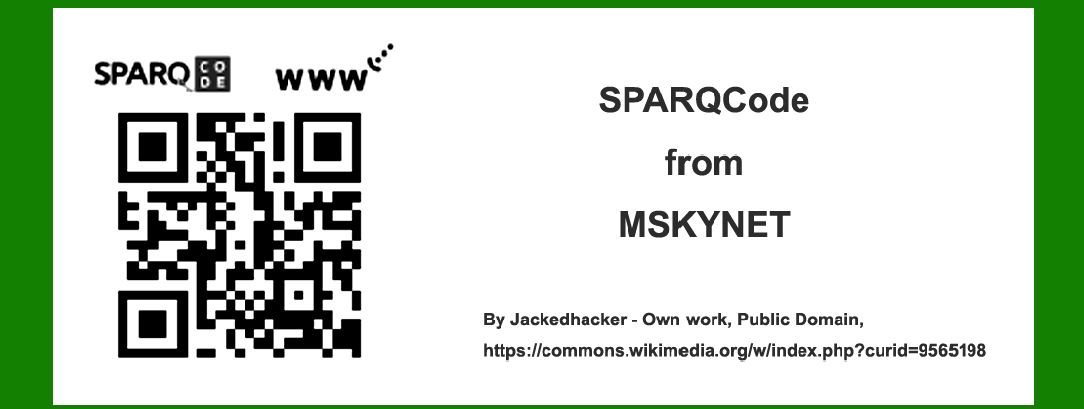
SPARQCode is a proprietary QR code encoding standard developed by MSKYNET, Inc., designed to enhance data storage and retrieval capabilities compared to traditional QR codes. |
Here's a detailed exploration of SPARQCode technology: |
|
Introduction to QR Codes |
QR (Quick Response) codes are two-dimensional barcodes that store data horizontally and vertically in a grid of black squares on a white background. They were first developed by Denso Wave in 1994 for tracking vehicles during manufacturing and have since become widely used for various applications, including marketing, payments, and inventory management. |

|
Evolution and Development of SPARQCode |
SPARQCode represents an evolution in QR code technology, aiming to improve upon existing standards by enhancing data capacity, error correction capabilities, and application flexibility. Developed by MSKYNET, Inc., SPARQCode addresses specific limitations of traditional QR codes while maintaining compatibility with QR code readers already in use. |

|
Key Features of SPARQCode |
1.Enhanced Data Capacity: SPARQCode offers higher data storage capacity compared to traditional QR codes. This is achieved through more efficient encoding techniques and optimization of data representation within the code matrix. 2.Advanced Error Correction: Error correction algorithms in SPARQCode are robust, allowing for reliable data retrieval even when the code is damaged or partially obscured. This is crucial for applications where code readability might be compromised. 3.Versatile Application: SPARQCode supports a wide range of applications across industries, including but not limited to marketing, logistics, healthcare, and authentication. Its versatility makes it suitable for both consumer-facing and enterprise-level use cases. 4.Security Features: In addition to data capacity and error correction, SPARQCode may include enhanced security features such as encryption and digital signatures, ensuring data integrity and authenticity in sensitive applications. 5.Customization Options: MSKYNET, Inc. provides customization options for SPARQCode implementations, allowing businesses to integrate branding elements, track analytics, and tailor the user experience to specific requirements. |

|
Technical Specifications of SPARQCode |
Encoding Structure |
SPARQCode retains the basic structure of QR codes but optimizes the encoding process to maximize data storage efficiency. It uses a combination of modules (black squares) and alignment patterns to organize data within the code matrix. |
Data Capacity |
The data capacity of SPARQCode depends on several factors, including the version (size) of the code and the encoding mode used. It supports various data types, including alphanumeric, binary, and kanji characters, with higher versions accommodating more data. |
Error Correction |
Error correction in SPARQCode is implemented using Reed-Solomon codes, a widely used method for correcting errors in data transmission. This allows the code to withstand damage or distortion up to a certain threshold, ensuring accurate data retrieval. |
Versioning and Compatibility |
SPARQCode versions are backward compatible with existing QR code readers, ensuring seamless integration into existing infrastructure while offering enhanced features to users who upgrade to SPARQCode-compatible readers. |

|
Applications of SPARQCode |
Marketing and Advertising |
SPARQCode is used extensively in marketing campaigns to deliver digital content such as URLs, coupons, and multimedia content directly to consumers' smartphones. Its high data capacity and error correction capabilities ensure reliable content delivery across various advertising mediums. |
Supply Chain and Logistics |
In logistics, SPARQCode facilitates inventory management, asset tracking, and product authentication. Its ability to store product information, batch numbers, and expiry dates simplifies supply chain operations and enhances traceability from manufacturing to distribution. |
Healthcare and Pharmaceuticals |
In healthcare, SPARQCode is used for patient identification, medication management, and medical device tracking. It improves efficiency in healthcare workflows by providing instant access to patient records and treatment protocols via secure QR code scanning. |
Security and Authentication |
SPARQCode's security features make it suitable for applications requiring data integrity and authentication. It is used in ticketing systems, access control, and secure document management where verifying the authenticity of QR codes is essential. |

|
Implementation and Integration |
MSKYNET, Inc. provides SDKs (Software Development Kits) and APIs (Application Programming Interfaces) for developers to integrate SPARQCode functionality into mobile apps, websites, and enterprise systems. This facilitates rapid deployment and customization according to specific business requirements. |

|
Future Trends and Innovations |
The future of SPARQCode technology involves ongoing advancements in data compression, encryption techniques, and integration with emerging technologies such as augmented reality (AR) and blockchain. These innovations aim to further enhance security, usability, and interoperability across diverse industries. |

|
Conclusion |
SPARQCode represents a significant advancement in QR code technology, offering enhanced data capacity, robust error correction, and versatile application possibilities. Developed by MSKYNET, Inc., SPARQCode is poised to expand its presence across various sectors, driving innovation in digital marketing, supply chain management, healthcare, and security applications. As businesses and consumers increasingly rely on QR codes for information access and interaction, SPARQCode's capabilities ensure reliable performance and seamless integration into evolving digital ecosystems. |
 cs@easiersoft.com