The Application of Barcode Technology in Electronic Factory Material Management - A Deep Dive into Chapter 15: Sub-Assembly and Module Integration |
Executive Summary (Chapter 15 Preview) |
In electronics manufacturing, the final product is rarely a single printed circuit board. It is a complex assembly of multiple boards, modules, cables, sensors, displays, and mechanical enclosures, all integrated into a finished device. This chapter explores how barcode technology manages the complexity of sub-assembly and module integration - the process of linking multiple 'child' boards and components into a 'parent' final assembly. We will examine the concept of parent-child traceability, where each sub-assembly is assigned a unique barcode that is digitally linked to the barcodes of its constituent components and to the final product's unique identifier. This hierarchical traceability is essential for quality investigations, targeted recalls, counterfeit prevention, and regulatory compliance. Real-world examples from Micron Corporation, Prodrive Technologies, and the principles of serialization and aggregation will illustrate how American and European contract manufacturers implement barcode-driven sub-assembly tracking. We will also explore how automated registration systems, like Neotel's NEO SCAN PLUS, create unique digital identities for incoming reels, enabling end-to-end traceability from the component level through sub-assembly integration to the finished product. |
|
Chapter 15: Sub-Assembly and Module Integration |
15.1 The Complexity of the Finished Product |
Imagine a modern industrial control system, a medical diagnostic device, or a high-end automotive electronic control unit. It is not a single circuit board. It is an assembly of multiple boards - a main processor board, a power supply board, a sensor interface board, a display driver board - all interconnected by cables and housed in a protective enclosure. Each board has its own unique barcode and its own production history, recorded through the WIP tracking processes described in previous chapters. The challenge of sub-assembly integration is to link these individual 'child' boards and components into a single 'parent' final assembly, preserving the traceability of each constituent part while creating a complete record for the finished product. |
This chapter explores how barcode technology enables this hierarchical traceability. We will examine the concept of parent-child traceability, where digital links are created between the unique identifiers of sub-assemblies and the final product's identifier. We will explore the processes of aggregation and serialization, which are used to link components across multiple packaging and assembly levels. And we will look at real-world examples of how American and global contract manufacturers implement these systems to support quality, compliance, and counterfeit prevention. |
|
15.2 The Concept of Parent-Child Traceability |
Parent-child traceability is a method of maintaining the hierarchy of components, sub-assemblies, and finished products. In simple terms, 'child' items are the smallest units - individual PCBs, components, or sub-assemblies. 'Parent' items are containers or assemblies that group child units - a sub-assembly that contains multiple boards, a carton that contains multiple units, or a pallet that contains multiple cartons . |
Each child item is given a unique identifier, often a serial number encoded in a barcode, QR code, or Data Matrix symbol. When these child items are grouped into a parent unit, that unit also receives its own unique code. The system then logs the relationship between them. If one carton (the parent) contains fifty units (the children), that linkage is stored digitally. By scanning the parent barcode, the system can instantly identify all associated children, and vice versa . |
In the context of sub-assembly integration, the principle is the same but applied to the product structure itself. A final assembly (the parent) contains multiple PCBs and sub-assemblies (the children). Each child has its own unique barcode, which is scanned and linked to the parent's unique identifier when the assembly is built. This creates a complete digital record of the product's genealogy. |
|
15.3 Why Parent-Child Traceability Matters |
The benefits of parent-child traceability extend far beyond simple record-keeping. In modern electronics manufacturing, it is a critical capability for quality, compliance, and risk management . |
15.3.1 Full Supply Chain Visibility |
With parent-child hierarchies, it is possible to trace the full journey of a product, from the component level through sub-assembly integration to the finished device and beyond. Every transfer, every repackaging, every scan is recorded, creating a digital thread that enhances transparency and accountability . This is particularly vital in regulated sectors where track and trace is not just an operational choice but a legal requirement. |
15.3.2 Targeted Recalls and Risk Mitigation |
If a defect is discovered in a component or sub-assembly, parent-child traceability allows for a targeted recall. Instead of recalling thousands of finished products, the manufacturer can isolate the specific parent assemblies that contain the defective child units and act quickly . This mitigates both reputational and financial risk, a critical element of brand protection and consumer trust. Without this traceability, a company might be forced to recall a much larger, and more expensive, range of products to be safe. |
15.3.3 Counterfeit Prevention |
Counterfeiters often target individual components or attempt to infiltrate packaging layers. With parent-child traceability, the moment a mismatch is detected - for example, a component claiming to be from a specific lot but missing from the digital registry - the product can be flagged as unauthorized . Combined with product authentication technologies, such as secure QR codes or digital fingerprints, this provides a powerful layered defense against fakes [citation:4, citation:7]. |
15.3.4 Regulatory Compliance |
Many industries, particularly those with high stakes like aerospace, medical devices, and automotive manufacturing, have strict regulatory requirements for traceability. These regulations often mandate that manufacturers can provide a complete history of a product's lifecycle, including the origin of its constituent components . A well-documented parent-child traceability system ensures compliance and helps avoid penalties. In the medical device industry, for example, the FDA's Unique Device Identification (UDI) rule is built on this principle. In the pharmaceutical world, parent-child aggregation is mandated by the US DSCSA and EU FMD to ensure supply chain integrity . |
|
15.4 The Sub-Assembly Integration Workflow: Linking the Children to the Parent |
The process of sub-assembly integration in a barcode-enabled factory follows a structured workflow. While specifics vary, the core steps are consistent across most electronics manufacturers. |
15.4.1 Building the Children: Sub-Assembly Production |
Each sub-assembly - a PCB, a power supply module, a sensor board - is produced on the SMT line. As described in earlier chapters, each board is assigned a unique barcode or Data Matrix code, and its production history is recorded through in-process scans. The child identifier is the link back to the board's complete digital history. |
15.4.2 Integration and Scanning |
When the sub-assemblies are brought together for final integration, the operator scans the barcode of each child unit. This scan confirms that the correct sub-assembly is being used and links it to the work order. |
15.4.3 Creating the Parent: The Final Assembly |
The parent assembly - the final product - is assigned its own unique barcode or serial number. This identifier is typically applied as a label on the enclosure or, in some cases, laser-etched directly onto the product. |
15.4.4 Digital Linking |
The system creates a digital link between the parent barcode and the child barcodes. This is the core of the parent-child traceability relationship. The database records that the parent assembly contains specific child sub-assemblies, with their lot numbers, serial numbers, and complete production histories . |
15.4.5 End-of-Line Testing and Recording |
The final assembly undergoes end-of-line testing - functional test, safety test, and perhaps burn-in. The test results are linked to the parent barcode. If the product fails, the system can trace the failure back to the specific sub-assembly or component, using the parent-child links . |
15.4.6 Packaging and Aggregation |
The parent assembly is then packaged. The unit-level barcode (the parent) is linked to a case-level barcode (a new, higher-level parent), and the case-level barcode is linked to a pallet-level barcode. This extends the parent-child traceability to the shipping and distribution stages [citation:4, citation:10]. This process, known as 'aggregation,' enables efficient supply chain scanning: a worker can scan the pallet label to confirm the authenticity and movement of all units inside, without scanning every individual product . |

|
15.5 Real-World Example: Micron Corporation's Electromechanical Assembly |
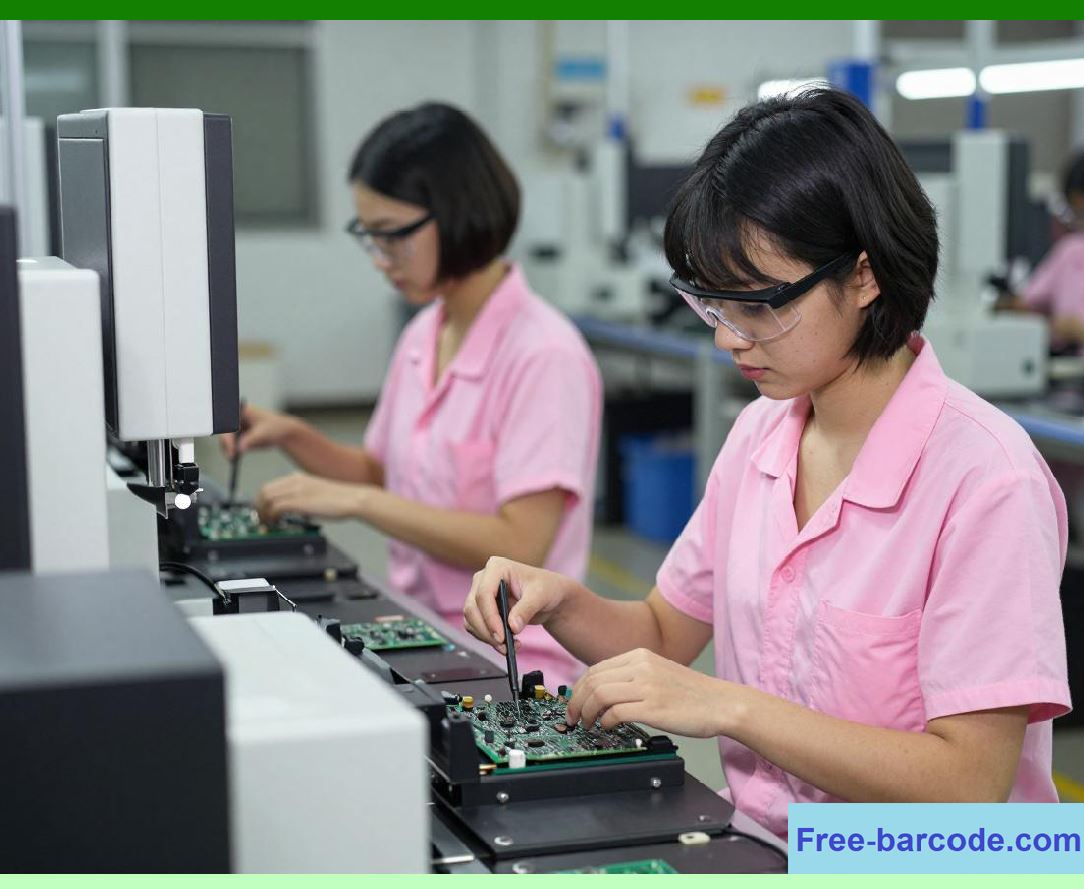
Micron Corporation, based in Norwood, Massachusetts, provides a practical example of sub-assembly integration in an American contract manufacturing environment. Micron offers electromechanical assembly and 'box build' services, integrating electronics into final enclosures with wiring, harnessing, labeling, verification, and pack-out . |
15.5.1 From Boards to Finished Goods |
Micron combines SMT and through-hole expertise with mechanical integration to build sub-assemblies and complete products. The process includes routing and securing wiring, applying labels and documentation, performing functional test and burn-in, and packing units to the customer's distribution specification . |
15.5.2 Sub-Assembly and Integration |
The company produces 'modular builds' - standoffs, fans, heatsinks, connectors, switches, displays, brackets, and cable management - produced as modules to streamline final integration . This modular approach relies on the traceability of each module to ensure that the correct sub-assemblies are used in the final product. |
15.5.3 Documentation and Traceability |
Crucially, Micron maintains 'routers/travelers, torque specs, label maps, and as-built records maintained for repeatability and quality audits' . The as-built records link the final assembly to the specific sub-assemblies and components used, creating the parent-child traceability record required for quality audits and regulatory compliance. |
15.5.4 Labeling and Serialization |
Micron applies 'safety/agency labels, serialization/barcodes, documentation packs, and finished-goods packaging' . The serialization/barcodes are the physical identifiers that enable the parent-child digital links. The company's 'customer-specific labeling, acceptance criteria, and records retention' demonstrate the ability to tailor the traceability system to specific regulatory or customer requirements. |
|
15.6 Real-World Example: Prodrive Technologies' PCB Traceability |
Prodrive Technologies, a European technology company with state-of-the-art manufacturing capabilities, provides a relevant example of PCB-level traceability that is the foundation for sub-assembly integration. While headquartered in the Netherlands, Prodrive serves global markets, including the American automotive, medical, and military sectors . |
15.6.1 Laser-Etched Data Matrix Codes |
Prodrive and its customers require that the PCBs manufactured and integrated are marked with two-dimensional Data Matrix codes. These codes are laser-etched directly onto the PCBs during the manufacturing process . Laser etching ensures durability - the code will survive the assembly and integration processes and remain readable for the life of the product. |
15.6.2 In-Line Traceability |
To ensure the quality and readability of these codes, Prodrive developed a scan conveyor with an integrated DPM barcode reader. This system decodes the Data Matrix codes at each stage of the PCB manufacturing process, ensuring that all codes are readable and marked correctly, and that any issues are addressed immediately . This in-line verification is the foundation for sub-assembly integration, ensuring that the child boards have a valid, readable identifier that can be linked to the parent assembly. |
15.6.3 Full Supply Chain Traceability |
Sam de Bruijn, Sales Manager at Prodrive, explained the strategic importance: 'While more and more processes are automated, full supply chain traceability of each component is increasingly important. We have been able to develop an innovative solution... which increases the flexibility and quality of our production process, while ensuring traceability at each step of the production process and beyond' . This 'beyond' includes the sub-assembly and final integration stages, where the child board's Data Matrix code is linked to the parent assembly's serial number. |
|
15.7 Real-World Example: Neotel's UID-Based Material Closed Loop |
Neotel Technology, a South Korean company with a strong presence in the Chinese and global electronics markets, provides an example of how unique identification (UID) is generated and managed at the component level, enabling end-to-end parent-child traceability. |
15.7.1 NEO SCAN PLUS: Creating the UID |
The NEO SCAN PLUS is a fully automatic material registration workstation that operates at Step 1 of the SMT material loop. It automatically generates a unique ID (UID) for every incoming reel . With this digital identity established, all subsequent storage, retrieval, counting, and return operations achieve precise tracking and intelligent scheduling . |
15.7.2 Automatic Barcode Recognition and Labeling |
The system uses an 11MP high-resolution industrial camera with AI deep learning algorithms to automatically recognize supplier barcodes (1D/2D, QR, Datamatrix, Code128, etc.), even if damaged or in any orientation. It then automatically prints and applies a new label with the UID . This ensures that every component has a standardized, machine-readable identifier that can be used for traceability. |
15.7.3 The Closed Loop |
After registration, materials are auto-stored in the SMD BOX automated storage system. When a work order is released, the system retrieves the correct materials and delivers them to the line. After production, remaining materials are counted using an X-ray counter and returned to storage, ready for the next cycle . This closed-loop material management, driven by the UID, ensures that every component is tracked from receiving through production, and every final assembly can be traced back to the specific reels that supplied its components. |
|
15.8 The Importance of Serialization and Aggregation |
Serialization and aggregation are the key principles that enable parent-child traceability at scale. Serialization means assigning a unique, non-repeating serial number to each individual unit. Aggregation means linking these serialized units into hierarchical relationships - units into cases, cases into pallets, and sub-assemblies into final products [citation:7, citation:10]. |
15.8.1 Serialization: The Foundation |
Serialization is the most powerful weapon in the battle against counterfeiting . Unique serial numbers are designated to each product through complex algorithms that originate from a separate database integrated with the manufacturer's production line. These serial numbers follow the product as it moves along the supply chain so it can be reliably traced back to the source . This form of parent-child serial number relationship provides a quick way to determine if the source is valid before the product reaches the customer. |
15.8.2 Aggregation: Efficiency and Compliance |
Aggregation enables efficient supply chain scanning. Instead of scanning every single product unit, a warehouse worker scans only the case or pallet label to confirm the authenticity and movement of all units inside . This saves time and reduces labor costs. Aggregation is mandatory for pharmaceutical serialization in many markets (EU FMD, US DSCSA) and is increasingly adopted for electronics, automotive parts, and luxury goods . In the electronics industry, the same principles apply: a final assembly (the product) is a parent of its sub-assemblies; a shipping carton is a parent of multiple final assemblies; and a pallet is a parent of multiple cartons. Each level has its own unique barcode, and the relationships are stored digitally. |
|
15.9 The Benefits of Barcode-Driven Sub-Assembly Traceability |
The benefits of implementing barcode-driven sub-assembly traceability are substantial and directly support quality, compliance, and efficiency [citation:4, citation:8]: |
Complete Product Genealogy: Every final assembly can be traced back to its constituent sub-assemblies, components, and lots. |
Targeted Recalls: If a defect is found, the manufacturer can recall only the affected products, reducing cost and reputational damage. |
Counterfeit Prevention: Serialized tracking and parent-child verification make it extremely difficult for counterfeit components to enter the supply chain undetected. |
Regulatory Compliance: The system provides the audit trail required by FDA, ISO, and other regulatory bodies. |
Operational Efficiency: Knowing the exact location and status of every sub-assembly at any given time streamlines logistics and production scheduling. |
Customer Confidence: The ability to provide a complete traceability record is a mark of quality and builds customer trust. |
|
15.10 Comparing American and Global Approaches |
Both American and global contract manufacturers have embraced barcode-driven sub-assembly traceability, though with some differences in implementation. |
15.10.1 American Emphasis: Compliance and Customer-Specific Requirements |
American manufacturers, particularly those serving medical, aerospace, and defense markets, often emphasize the compliance and audit-readiness aspects. As Micron Corporation's example shows, customer-specific labeling, acceptance criteria, and as-built records are maintained for quality audits and regulatory compliance . The system is designed to produce 'audit-ready' records that satisfy rigorous inspections. |
15.10.2 Global Emphasis: Automation and Closed-Loop Systems |
Global companies like Neotel, serving the broader Asian and global markets, emphasize automation and closed-loop material management. The NEO SCAN PLUS system operates 24/7 unattended, automatically generating UIDs, printing labels, and integrating with AGVs and automated storage systems . The focus is on creating a seamless, fully automated material flow from receiving to production to returns, with the UID as the thread that ties it all together. |
|
15.11 The Future of Sub-Assembly Integration |
The future of sub-assembly integration is moving toward greater automation, intelligence, and integration with the digital twin. |
Automated Integration: Robotics and automated guided vehicles will increasingly handle the physical integration of sub-assemblies, reducing human intervention and increasing consistency. |
AI-Driven Verification: Machine learning algorithms will verify that the correct sub-assemblies are being integrated, detecting anomalies that might escape human inspection. |
Blockchain-Based Traceability: The parent-child relationships could be recorded on a blockchain, creating an immutable record that cannot be altered or disputed. |
Digital Twin Integration: The parent-child traceability data will feed into a digital twin of the finished product, enabling simulation, predictive maintenance, and lifecycle management. |

|
Detailed Summary of Chapter 15 |
This chapter has provided a comprehensive examination of sub-assembly and module integration - the process of linking multiple 'child' boards and components into a 'parent' final assembly. We began by establishing that a finished electronic product is rarely a single board; it is a complex assembly of multiple sub-assemblies, cables, sensors, and enclosures. The challenge of sub-assembly integration is to preserve the traceability of each constituent part while creating a complete record for the finished product. |
We introduced the concept of parent-child traceability. Child items are the smallest units - individual PCBs or sub-assemblies. Parent items are assemblies or containers that group child units - a final assembly, a carton, or a pallet. Each child and parent has a unique identifier, and the system records the relationship between them. This enables full supply chain visibility, targeted recalls, counterfeit prevention, and regulatory compliance. |
We described the sub-assembly integration workflow: building the children (sub-assemblies with their unique barcodes), scanning each child at integration, creating the parent (the final assembly's unique identifier), digitally linking the parent and child barcodes, testing and recording results, and packaging with aggregation. This process creates a complete digital record of the product's genealogy. |
We profiled real-world examples. Micron Corporation (Norwood, MA) provides electromechanical assembly and 'box build' services, integrating electronics into final enclosures with labeling, serialization, and as-built records maintained for quality audits and repeatability. Prodrive Technologies (Netherlands, with global reach) uses laser-etched Data Matrix codes on PCBs and in-line verification to ensure traceability at each step, supporting sub-assembly integration. Neotel Technology (South Korea/global) uses the NEO SCAN PLUS system to automatically generate UIDs for incoming reels, creating a digital identity that enables end-to-end traceability from the component level through production to returns, as part of a closed-loop material management system. |
We explored the importance of serialization and aggregation. Serialization assigns unique, non-repeating serial numbers to each unit. Aggregation links these units into hierarchical relationships. This enables efficient supply chain scanning, compliance with regulatory mandates, and effective anti-counterfeit defenses. We noted that aggregation is mandatory for pharmaceutical serialization in many markets and is increasingly adopted for electronics. |
We compared American and global approaches: American manufacturers often emphasize compliance and customer-specific audit-readiness, while global companies like Neotel emphasize automation and closed-loop systems. Finally, we looked to the future of automated integration, AI-driven verification, blockchain-based traceability, and digital twin integration. |

|
The bottom line is that barcode-driven sub-assembly traceability is essential for modern electronics manufacturing. It enables full product genealogy, targeted recalls, counterfeit prevention, and regulatory compliance. It is the foundation for building complex, high-quality electronic products with confidence and accountability, linking the component-level traceability described in earlier chapters to the final product that reaches the customer. |
 cs@easiersoft.com