The Application of Barcode Technology in Electronic Factory Material Management - A Deep Dive into Chapter 2: Why Barcode, Not RFID (Yet) | Executive Summary (Chapter 2 Preview) | In the world of automatic identification and data capture, a quiet but persistent debate simmers: should a factory invest in barcode technology or leap directly to Radio Frequency Identification (RFID)The proponents of RFID paint an alluring picture - tags that can be read without line-of-sight, through cardboard and plastic, simultaneously by the dozen. It sounds like the future. Yet, walk onto the floor of any major American electronics factory - from the sprawling contract manufacturing campuses in Texas to the defense-focused assembly lines in Massachusetts - and you will find that barcodes remain the undisputed workhorse. This is not a matter of conservatism or lagging technology adoption. It is a deliberate, data-driven choice rooted in hard economics, operational reliability, and the specific physics of electronics manufacturing. This chapter argues that while RFID has its place, it is not a wholesale replacement for barcodes in the electronics industry. We will dissect the practical reasons: the prohibitive cost of tagging hundreds of millions of passive components, the fundamental physics problem of RFID in a metal-rich and high-frequency environment, the lack of global standardization across the supplier base, and the fact that barcodes, especially modern two-dimensional symbologies, are far more capable than their simple stripes suggest. We will explore how American companies like Eaton have built global operations on barcode-based systems, and how other technologies - such as machine vision - are used to complement, not replace, the barcode's role as the primary digital key to the material master database. | 
| Chapter 2: Why Barcode, Not RFID (Yet) | 2.1 The Allure of the Invisible Read | Every production manager, at some point, has looked at a barcode scanner and asked: 'Why do I have to point this thingWhy can't it just work automatically' This is the promise of RFID. In a perfect world, a pallet of components would roll through a dock door, and an overhead antenna would instantly read every single item on it - no scanning, no aiming, no human intervention required. This vision, often promoted by technology vendors, seems like the inevitable evolution of material tracking. The technology exists; it is proven in retail for high-value items like clothing and in logistics for tracking shipping containers. Why, then, has it not become the default in electronics manufacturing | The answer lies not in a rejection of the new but in a sober assessment of the return on investment and the specific, unforgiving environment of an electronics factory. RFID offers a set of advantages that are undeniably attractive. Its ability to read multiple tags simultaneously allows for 'bulk reading,' which could, in theory, slash the time required for cycle counts and receiving. Passive RFID tags do not require a battery; they are powered by the reader's signal. They can be embedded in labels or even directly into products. However, when we move from theory to practice, especially in the context of surface-mount technology and high-volume production, the romantic appeal of RFID collides with a harsh reality of physics, standards, and cost. | 
| 2.2 The Cost Barrier: A Penny for a Part, a Quarter for a Tag | The most immediate and decisive factor is the economics of the components themselves. Let us consider the scale. A typical smartphone contains over one thousand individual passive components - resistors, capacitors, inductors. These are not complex, multi-dollar integrated circuits; they are commodity parts that cost fractions of a cent. A reel of 10,000 ceramic capacitors, a common sight in an electronics factory, might have a total value of fifty dollars. That means each capacitor is priced at half a cent. A passive RFID tag, in high-volume purchases, still costs between twenty and fifty cents. That is a hundred times the cost of the component it is meant to identify. | For a factory that consumes ten million such reels a year, the cost of tagging each reel with an RFID inlay would run into the millions of dollars - not counting the readers, antennas, printers, and middleware. On a net profit margin of three to five percent, which is typical for the electronics manufacturing services industry, that is an impossible cost to absorb. Barcodes, on the other hand, are practically free. The cost of the ink or thermal ribbon used to print a barcode is less than one cent. The label substrate itself is equally inexpensive. This is not a marginal difference; it is a fundamental, order-of-magnitude barrier to RFID adoption. | Furthermore, even if one were to tag each component reel, the tag would need to survive the factory's harsh environments. Electronics manufacturing involves extreme heat - the reflow oven melts solder at temperatures exceeding 250 degrees Celsius. The tags must survive cleaning cycles with isopropyl alcohol and exposure to flux and dust. High-temperature RFID tags exist, but they are significantly more expensive than standard tags, compounding the cost problem. Barcode labels, printed on durable polyester or polyimide substrates with resin ribbon, can survive this environment with relative ease and at a fraction of the cost. | 
| 2.3 The Physics Problem: Metal and Interference | Even if the cost were magically resolved, a more fundamental obstacle remains: the physics of radio frequency in a metal-rich environment. UHF RFID, the most common type for supply-chain applications, operates in the 860-960 MHz band. Radio waves at this frequency are reflected and absorbed by metals and conductive materials. An electronics factory is a veritable sea of metal. The components themselves are housed in reels with metal hubs. The racks that store them are steel. The conveyor belts have metal frames. The printed circuit boards are full of copper traces and ground planes. | When a UHF RFID tag is placed on a metal surface, the tag's performance degrades dramatically. The metal detunes the antenna, reducing its read range and causing inconsistent performance. Special 'on-metal' tags are available, but they include a ferrite or foam layer to isolate the antenna from the metal, adding further to the cost and thickness. Placing an RFID tag on a reel of capacitors, nestled in a metal rack, next to hundreds of other reels, creates a nightmare of interference. The reader might read the wrong tag, or none at all. This is not a theoretical issue; it is a well-documented problem that has caused many RFID pilots to fail in industrial settings. | In contrast, barcodes are not affected by metal. They are an optical technology. As long as the scanner's light beam can see the black-and-white pattern, the code can be read. A humble barcode on a metal reel hub works just as well as one on a cardboard box. This physical robustness is a non-negotiable requirement in a factory. An unreliable read is worse than no read, as it can lead to mis-picks and data corruption. The barcode's immunity to the factory's material composition is a silent but decisive advantage. | 
| 2.4 The Standardization Deadlock | Another critical factor is the lack of a universally mandated RFID standard across the global electronics supply chain. Barcodes are governed by the GS1 system, a set of global standards that are so widely adopted they are the de facto language of commerce. Every major component supplier - Murata, Texas Instruments, Samsung, TDK - prints barcodes on their packaging. These barcodes follow the GS1-128 or GS1 DataMatrix standards, encoding the Global Trade Item Number (GTIN), lot number, date code, and quantity. When a shipment arrives at an American factory, the receiving system is pre-configured to decode this standard format. | RFID, however, is a patchwork of standards and proprietary solutions. While there is an EPCglobal standard, its adoption is nowhere near universal. A supplier in Japan might use one tag standard, while a supplier in Mexico uses another. The factory would then need multiple reader configurations and middleware to handle the different formats, creating complexity instead of simplifying it. Many suppliers are unwilling to invest in RFID infrastructure because their customers have not mandated it. This creates a chicken-and-egg problem that has stalled widespread adoption. | Barcodes sidestep this problem entirely. They are universal. A Code 128 barcode printed in Shenzhen looks exactly the same as one printed in Detroit and can be read by the same off-the-shelf scanner. This interoperability is the bedrock of efficient global logistics. As the GS1 guidelines state, barcodes allow for 'global interoperability' and 'unique identification,' ensuring that a product is identified consistently from factory to customer. Until RFID achieves this level of ubiquitous, low-cost standardization, it cannot replace barcodes. | 
| 2.5 The Complementary Role of Machine Vision | The discussion of barcode versus RFID often misses the point that barcodes are not alone in the factory. They are increasingly paired with machine vision systems. In modern American electronics factories, cameras are used not just to read barcodes but to inspect components, verify placement, and check for defects. This is not a replacement for barcodes but a powerful complement. | Consider the case of Innovar Systems in Ohio, a supplier of traceability systems. They worked with a Fortune 500 circuit breaker manufacturer to implement a system that uses a smart camera to verify the quality of Data Matrix marks on products. The camera is not just reading the code; it is grading the print quality of the code itself. This ensures that the mark is durable enough to be read throughout the product's lifecycle. The solution integrated barcode readers into the test equipment, providing unit-level traceability that allowed the company to 'cross-reference returned product by scanning the components to confirm authenticity and to retrieve historical production data for each unique serial number'. | This is the true power of a modern tracking system - not choosing between barcode and vision, but using vision to enhance the barcode's readability and reliability. Similarly, a vision system can read a barcode that is rotated or partially damaged, extending the tolerance of the overall system. Barcodes provide the digital identity; vision systems ensure that identity is captured correctly and consistently. They are partners, not competitors. | 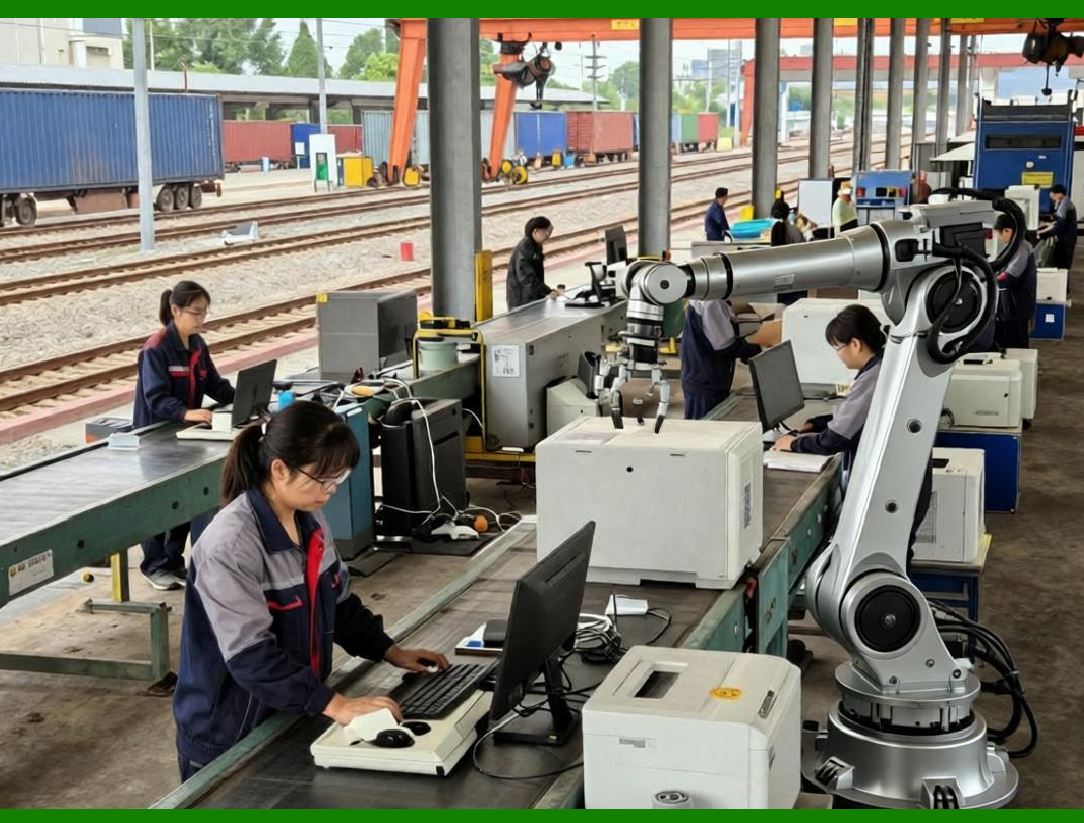
| 2.6 The Centralized Labeling Infrastructure of a Global Giant | To understand the maturity and power of barcode-based systems, one need look no further than Eaton Corporation, a global power management leader headquartered in Cleveland, Ohio. Eaton's Electrical Sector manufactures circuit breakers, panel boxes, and other critical equipment across five plants, six service centers, and satellite operations around the world. They face a classic multinational challenge: ensuring consistent, accurate labeling in dozens of facilities, each with its own legacy systems and local printers. | Eaton's solution was a testament to the barcode's robustness and scalability. They implemented a centralized labeling system using enterprise software that accepts data from their ERP systems (running on AS/400 and Oracle platforms) and translates it into standardized barcode labels. The system is configured so that when a plant in Greenwood needs labels, a file is sent from Cleveland, and the labels begin printing in Greenwood within three seconds. | This system supports over 250 label designs in multiple languages, all driven from a single instance of the software. This is not possible with a disparate, unproven RFID infrastructure. This enterprise-level approach shows that barcode technology is not a 'legacy' solution but a powerful, standardized platform capable of supporting global operations. It provides the reliability and speed that a company like Eaton demands. As an Eaton IT analyst put it, 'We've designed a scalable labeling system that can support all our international operations from a single location'. The barcode is the universal output of this highly complex, distributed system. | 
| 2.7 The Evolution: From 1D to 2D Barcodes | When we speak of barcodes, many people still picture the simple vertical stripes of a UPC code on a cereal box. However, the barcodes used in modern electronics factories are a far more sophisticated technology. The industry is rapidly moving away from linear (1D) barcodes toward two-dimensional (2D) symbologies, especially Data Matrix codes. This is driven by the need to encode more information in a smaller space. | A Data Matrix code is a square or rectangular grid of black and white dots that can hold up to 2,335 alphanumeric characters. This is a staggering amount of data compared to a 1D barcode. For a circuit board that is physically shrinking, space is at a premium. A 2D Data Matrix can be laser-etched directly onto a PCB's surface, taking up only a few millimeters, yet it can encode a full serial number, part number, and lot information that can be read even if the code is partially damaged. | This direct part marking (DPM) is critical in electronics. The Data Matrix code's error correction capability is one of its greatest strengths. In the Data Matrix standard, a significant percentage of the code is dedicated to error correction codewords, allowing the reader to reconstruct the data even if a portion of the symbol is obscured or damaged. This is essential for components that go through reflow ovens and wave soldering, where labels can become discolored or scratched. The Electronics Components Industry Association has even developed a specific 2D barcode specification for the industry, further solidifying the barcode's place. | 
| 2.8 The Real Cost of Failure: Counterfeits and Traceability | One of the most compelling reasons for maintaining and upgrading barcode systems is the fight against counterfeit components. The global electronics supply chain is a tempting target for counterfeiters. A fake integrated circuit, re-marked to look like a high-value part, can infiltrate a factory and cause catastrophic failure down the line. The Department of Defense and commercial entities have been grappling with this problem for years. | Barcode traceability, especially when coupled with a secure database, provides the primary defense. A system that reads a barcode and instantly verifies it against a manufacturer's database can flag suspicious date codes or formats. For example, a barcode might encode a date code using a format that was not in use at the claimed manufacturing time. The system can detect this anachronism and reject the part. | The Innovar Systems case study illustrates this perfectly. Their customer was concerned with 'a dramatic rise of counterfeit product in the marketplace' and implemented a system to 'defend the integrity of its products by implementing a system to verify product authenticity'. The solution was not a futuristic RFID or AI system, but a combination of inkjet marking (to apply the code) and machine vision to verify its quality, ensuring that every unit could be traced back to its origin. This is a tangible, real-world benefit that barcode technology provides today, without the cost and complexity of RFID. | 
| 2.9 The Future: AI and Predictive Maintenance | If barcodes are not being replaced by RFID, how are they evolvingThe next frontier is not in the code itself but in how the code is read and managed. Artificial intelligence is beginning to play a role in barcode reading. AI-powered vision systems can learn to read barcodes that are damaged, distorted, or poorly printed, far exceeding the capabilities of traditional decoding algorithms. This reduces the number of 'no-read' events, which are a major cause of production delays and manual intervention. | Furthermore, AI can be applied to predictive maintenance of the marking and printing equipment. The case study from Innovar Systems shows that a smart camera can grade the quality of a barcode mark and provide 'trending data that can be used to alert maintenance personnel when the inkjet marking system requires attention'. This is a primitive form of predictive maintenance. In the future, this data will be fed into a larger AI model that predicts exactly when a printer head will fail or a ribbon will run out, allowing maintenance to be scheduled proactively, before quality degrades. The barcode itself becomes a diagnostic tool. | 
| 2.10 Summary and The Path Forward | To conclude this chapter, we return to the central question: why barcode, not RFIDThe answer is now clear and multifaceted. First, the cost is prohibitive for a high-volume, low-margin industry. Second, the physics of RFID makes it unreliable in a metal-rich, high-frequency environment. Third, the lack of global standardization on RFID prevents the seamless interoperability that barcodes provide. Fourth, barcodes are not a static technology; they have evolved into powerful 2D data carriers like Data Matrix that are more capable and more suitable for electronics than ever before. | RFID will likely find its niche in the electronics factory for specific, high-value applications - perhaps for tracking expensive test equipment, finished goods, or returnable containers. It may also be useful for tracking high-value assemblies, where the cost of the tag is a small fraction of the product's value. However, for the vast, chaotic stream of passive components and sub-assemblies that fuel the production line, the barcode remains the king. | American factories, from Innovar Systems in Ohio to Eaton in Cleveland, have proven that barcode systems are not just surviving but thriving. They are the foundation of unit-level traceability, counterfeit prevention, and globalized production. They are cost-effective, reliable, and standardized. The future of material management in electronics manufacturing is not a wholesale switch to RFID but an intelligent integration of technologies - where barcodes are the digital identity, machine vision is the trusted witness, and AI is the predictive analyst. The next chapters will explore the practical implementation of this powerful combination, from label design to warehouse management. | 
| Detailed Summary of Chapter 2 | This chapter has undertaken a comprehensive analysis of a critical question in modern manufacturing: why barcode technology remains the dominant form of identification in electronics factories, despite the marketing and allure of Radio Frequency Identification (RFID). We began by acknowledging the theoretical advantages of RFID, such as its ability to read multiple tags without line-of-sight, promising to streamline processes like receiving and cycle counting. | However, we dissected the practical, operational, and economic barriers that prevent RFID from usurping the barcode in this specific industry. The primary barrier is cost. We highlighted the vast disparity between the value of the average passive component and the cost of a durable RFID tag. With components costing fractions of a penny, adding a multi-cent tag is financially impossible, whereas the cost of a printed barcode is negligible. | We then addressed the harsh physical environment of the electronics factory. The prevalence of metal in racks, reels, and conveyors, combined with the high-frequency radio waves used by UHF RFID, creates a hostile environment where RFID signals are reflected and absorbed, leading to inconsistent and unreliable reads. Barcodes, as an optical technology, are immune to these challenges, ensuring consistent performance. | The chapter also emphasized the critical role of global standardization. Barcodes, governed by the GS1 system, are a universal language in the supply chain. This ensures that any component from any supplier can be read by any standard scanner. The electronics industry has further adopted sophisticated 2D symbologies like Data Matrix, which pack a massive amount of data into a tiny footprint and include robust error correction, making them ideal for direct part marking on PCBs. RFID, by contrast, lacks this universal adoption and interoperability, creating a fragmented, complex landscape for the factory floor. | We supported these arguments with concrete examples of successful barcode implementation at the enterprise level. The case of Eaton Corporation, a global leader in power management, demonstrated the power of a centralized, barcode-based labeling system that supports hundreds of label designs and printing locations worldwide, all coordinated from a single headquarters in Cleveland, Ohio. This showcases the scalability and reliability of the technology for global operations. Additionally, the Innovar Systems case study in Ohio illustrated how barcode technology, enhanced with machine vision, is deployed to combat counterfeiting and ensure product authenticity, a critical concern for high-reliability industries. | 
| Finally, we explored the future trajectory, arguing that barcode technology is not obsolete but is evolving alongside complementary technologies. We discussed how AI-powered vision systems are improving read rates on damaged codes and enabling predictive maintenance of print equipment. We concluded that the future of material tracking in electronics is not an 'either-or' scenario between barcode and RFID, but a strategic integration of multiple technologies. Barcodes provide the foundational, cost-effective, and universal identity. Machine vision provides the intelligence to read and verify that identity. AI provides the analytical capability to anticipate failures and optimize performance. For the foreseeable future, the humble barcode will remain the undisputed backbone of material management in the American electronics factory, a testament to the enduring value of a simple, reliable, and deeply standardized solution. |
|
 cs@easiersoft.com