1. Introduction to RFID and the Challenge of Data Collision |
Radio Frequency Identification (RFID) technology has become a cornerstone in various fields, from supply chain management and retail to healthcare and access control systems. It enables wireless communication between an RFID reader and RFID tags, which are small devices containing data that can be read or written to by the reader. |
However, one significant challenge in RFID systems arises when multiple RFID tags are within the reader's range simultaneously. This scenario leads to a phenomenon known as 'data collision,' where the signals transmitted by multiple tags interfere with one another. When this happens, the data sent by the tags can become corrupted or unreadable, which can result in errors or loss of information. For RFID to function reliably in environments with multiple tags-such as warehouses or stores-it's essential to prevent or mitigate data collisions. |
To address this issue, RFID readers employ anti-collision algorithms. These algorithms enable the reader to distinguish between the signals from multiple tags and ensure that each tag's response is received accurately and sequentially. Without such mechanisms, the effectiveness of RFID systems would be significantly reduced, especially in high-density tag environments. |
|
2. Understanding RFID Communication |
Before delving into error detection and anti-collision, it is important to understand the basic communication process between an RFID reader and tags. |
RFID Tags: RFID tags consist of a microchip and an antenna. The microchip stores data, while the antenna is used to transmit and receive radio waves. There are two types of RFID tags: active and passive. Active tags have a battery to power the chip and communication processes, while passive tags rely on the reader's radio frequency signal to power their communication. |
RFID Reader: The reader is the device responsible for transmitting the radio signal that powers the tags (in the case of passive tags) and receiving responses from the tags. The reader sends out a query signal that prompts the tags to respond with their stored data. |
RFID Communication Process: In simple terms, the RFID reader sends a signal to the tags, and each tag responds by transmitting its unique identification data back to the reader. This is typically a one-to-one communication, where the reader queries each tag individually and receives a response. |
However, in environments where many tags are present, such as a retail store with hundreds or thousands of items, the communication between the reader and tags can quickly become more complex. |
|
3. The Problem of Data Collision |
Data collision in RFID systems occurs when two or more RFID tags transmit their data to the reader at the same time. Because RFID signals use the same frequency band, overlapping transmissions can cause interference, leading to the reader receiving corrupted or garbled data. This can occur in several scenarios: |
Multiple Tags Within Range: In crowded environments, multiple tags may be within the read range of a single RFID reader at once. If these tags respond simultaneously, their signals can overlap and interfere with each other. |
Signal Overlap: RFID tags usually transmit data in the form of modulated radio waves. If two tags send their signals at exactly the same time or too close to each other in time, the reader may not be able to distinguish between them, resulting in data corruption. |
Environment Factors: Physical obstructions, interference from other radio-frequency devices, or reflective surfaces can exacerbate the problem of signal interference, leading to more frequent collisions. |

|
4. Anti-Collision Mechanisms |
To prevent data collision and ensure accurate communication, RFID systems employ anti-collision mechanisms. These algorithms allow the RFID reader to manage multiple tags within its range and ensure that only one tag responds at a time. Several techniques have been developed to address this issue: |
4.1. ALOHA Protocol |
One of the earliest methods developed to manage data collisions in RFID systems is the ALOHA protocol. ALOHA is a simple communication protocol where each tag independently sends its data to the reader at random intervals. If the reader does not acknowledge the transmission (indicating that a collision has occurred), the tag retries its transmission after a random delay. |
The key idea of the ALOHA protocol is that tags do not coordinate with one another; instead, they act independently. While this is a straightforward approach, it can lead to inefficiencies in environments with a large number of tags. The random back-off time can result in many retransmissions, reducing the system's overall throughput. |
4.2. Slotted ALOHA |
Slotted ALOHA improves upon the original ALOHA protocol by introducing time slots. In this system, time is divided into discrete intervals, and tags are synchronized to transmit their data at the beginning of these intervals. By using time slots, the likelihood of collision is reduced, as tags now know when they are allowed to transmit. |
However, even with time slots, collisions can still occur if two or more tags transmit at the same time within a given time slot. Slotted ALOHA does not completely eliminate collisions but does reduce their frequency compared to the unslotted version. |
4.3. Binary Tree Protocol |
The Binary Tree protocol is another anti-collision method that is widely used in RFID systems. In this approach, the RFID reader and the tags use a binary tree structure to coordinate access to the communication channel. Initially, the reader sends a command that instructs all tags to either respond or remain silent based on a particular binary condition (e.g., a 0 or 1 bit). After the initial round of responses, the reader divides the tags into two groups based on the binary responses (e.g., all tags that responded with a 0 bit and all those that responded with a 1 bit). |
The process of dividing the tags into smaller groups and having them transmit one by one continues until all tags have been successfully identified and their data has been transmitted. The Binary Tree protocol reduces the possibility of collision by minimizing the number of tags attempting to communicate at the same time. |
4.4. Dynamic Framed ALOHA (DFA) |
Dynamic Framed ALOHA (DFA) is an advanced version of ALOHA that dynamically adjusts the frame size to accommodate varying numbers of tags within the range of the reader. In DFA, the RFID reader and tags first determine the number of tags in the system based on a preliminary polling phase. Based on this estimate, the reader adjusts the time frame (or slot size) for tag communication to optimize throughput and minimize collisions. |
The key advantage of DFA over traditional ALOHA is that it adapts to the number of tags, leading to more efficient use of time slots and reducing the likelihood of collisions as the system's load changes. |
4.5. Time Division Multiple Access (TDMA) |
Time Division Multiple Access (TDMA) is another anti-collision technique that is used in some RFID systems, especially those designed for high-density environments. TDMA divides time into fixed slots, where each tag is assigned a specific time slot in which it can transmit its data. Because each tag transmits only during its allocated time slot, the likelihood of collision is greatly reduced. |
The TDMA approach requires synchronization between the reader and the tags, so each tag knows when it is its turn to transmit. In high-density environments, TDMA can be highly effective in reducing collisions and improving overall system performance. |
4.6. Code Division Multiple Access (CDMA) |
In some advanced RFID systems, Code Division Multiple Access (CDMA) is used as a means of reducing collisions. CDMA allows multiple tags to transmit at the same time but in a way that their signals can be distinguished based on unique codes assigned to each tag. This method involves assigning a unique code to each tag so that the reader can separate the signals from multiple tags, even if they are transmitted simultaneously. |
CDMA is particularly useful in environments where high-density tag populations are common. It has the advantage of allowing simultaneous communication from multiple tags, which improves system throughput compared to methods like ALOHA or TDMA. |
|
5. Error Detection Mechanisms in RFID |
Error detection is critical in RFID systems to ensure the accuracy and integrity of the data being transmitted. There are several error detection techniques used in RFID systems to handle corrupted data due to collisions, interference, or other issues. |
5.1. Parity Checking |
Parity checking is a simple error detection method used to ensure that the transmitted data has not been corrupted. In this technique, a parity bit is added to the data being transmitted. The parity bit ensures that the total number of 1's in the data is either even or odd, depending on the parity scheme being used. |
When the RFID reader receives the data, it checks the parity bit to ensure that the data is consistent with the expected parity. If the parity is incorrect, the reader knows that an error has occurred and can request a retransmission from the tag. |
5.2. Cyclic Redundancy Check (CRC) |
Cyclic Redundancy Check (CRC) is another common error detection method used in RFID systems. CRC involves generating a checksum based on the data being transmitted. This checksum is a mathematical representation of the data and is sent along with the data transmission. |
When the RFID reader receives the data and checksum, it can use the same algorithm to calculate a CRC value based on the received data. If the calculated CRC value matches the checksum sent by the tag, the data is considered valid. If the values do not match, the reader detects an error and may request a retransmission. |
5.3. Error Correction Codes |
In more sophisticated RFID systems, error correction codes (ECC) are employed to not only detect errors but also to correct them. These codes are designed to add redundancy to the transmitted data, allowing the reader to reconstruct the original data even if some of it is corrupted. |
One example of error correction codes is the Hamming code, which adds extra bits to the data stream to provide error correction capability. If a small number of bits are corrupted during transmission, the reader can use the Hamming code to identify and correct the errors, ensuring that the data is accurately received. |

|
6. Conclusion |
In conclusion, RFID systems face significant challenges when it comes to managing data collisions, especially in environments where many tags are present. However, through the use of various anti-collision algorithms such as ALOHA, TDMA, Binary Tree, and CDMA, RFID readers can mitigate the effects of signal interference and ensure that data from multiple tags is transmitted without corruption. Additionally, error detection mechanisms such as parity checking, CRC, and error correction codes play a crucial role in maintaining data integrity and ensuring reliable RFID communication. |
As RFID technology continues to evolve and is implemented in increasingly complex environments, the development of more advanced and efficient anti-collision techniques and error detection methods will be essential to ensure the continued success and reliability of RFID systems. |

|
Challenges Facing RFID Systems in Error Detection and Anti-Collision |
Despite the significant advances in RFID technology, the system still faces several challenges, particularly in error detection and anti-collision in complex environments. These challenges need to be addressed for RFID to remain a reliable solution, especially as applications become more widespread and the density of tags increases. Below are some of the key challenges RFID systems face in this domain: |
1. High Tag Density |
One of the most significant challenges is managing environments with a high density of RFID tags. In scenarios like large warehouses, retail stores, or libraries, the number of tags within the reader's range can easily run into the hundreds or even thousands. When many tags are responding simultaneously, the likelihood of data collisions increases, which can overwhelm the reader's ability to distinguish between signals. |
Impact: In high-density environments, anti-collision algorithms like ALOHA, TDMA, or CDMA may not be sufficient to handle the volume of tags efficiently. As more tags respond in a short period, the system may experience slower read times, increased retransmissions, and lower throughput, which can lead to delays and reduced overall system efficiency. |
Solution: One potential solution is the implementation of dynamic and adaptive anti-collision algorithms, such as Dynamic Framed ALOHA (DFA), that can adjust to the real-time number of tags in the environment. However, these approaches require sophisticated systems to effectively balance load and reduce interference. |
2. Signal Interference and Environmental Obstacles |
RFID signals are sensitive to interference from physical obstacles, electromagnetic noise, and other RF devices operating in the same frequency spectrum. In environments with reflective surfaces, metal objects, or dense materials, the reader might struggle to communicate with tags or differentiate between their signals. |
Impact: Signal interference can lead to incomplete or corrupt data transmission, which makes it harder to identify tags accurately. Additionally, tags might not always receive the reader's query, or the signals may become garbled when they reflect off surfaces and arrive at the reader with a delay. |
Solution: To mitigate this, RFID systems may need to use advanced error correction techniques, such as forward error correction (FEC) and signal processing algorithms, to improve the robustness of the communication link. Additionally, antennas with more specialized designs (e.g., directional antennas) or advanced multi-path handling techniques may be used to avoid interference from physical obstacles. |
|
3. Power Constraints of Passive Tags |
Passive RFID tags rely entirely on the radio frequency (RF) energy emitted by the reader for power. While this makes passive RFID tags lightweight and inexpensive, it also means their power is limited, which can affect their performance, especially in terms of signal strength and response time. |
Impact: In environments with many tags, passive RFID tags may have trouble transmitting their data due to power limitations. Weak signals could also result in failed tag readings or delayed responses. In the case of anti-collision, tags with weak signals may not be able to transmit at the right time or at the required signal strength, exacerbating the problem. |
Solution: One approach is to use active RFID tags in situations where higher performance is required. Active tags have their own power source, allowing them to transmit stronger signals and reduce the likelihood of collision. However, this adds to the cost and complexity of the system. |
4. Synchronization Challenges in Anti-Collision Mechanisms |
Many anti-collision methods, such as Time Division Multiple Access (TDMA), require precise synchronization between the reader and the tags to ensure that each tag transmits its data in the correct time slot. Achieving this synchronization becomes difficult when the number of tags increases or when tags have different power levels and communication ranges. |
Impact: Without perfect synchronization, even TDMA or slotted ALOHA can lead to timing errors, causing multiple tags to transmit in the same time slot and resulting in collisions. In systems using ALOHA, if the random backoff times are not appropriately managed, too many retries might cause further delays. |
Solution: Enhanced synchronization techniques, including hybrid protocols that combine multiple anti-collision strategies or the use of additional hardware to monitor tag behavior, may help reduce the effects of desynchronization. Some systems may also use a master-slave communication model to ensure the reader coordinates tag transmissions more effectively. |
|
5. Real-Time Processing and Scalability |
As the number of tags grows, RFID systems face scalability challenges, particularly with real-time data processing. Anti-collision algorithms that work well in smaller systems can become less efficient as the number of tags and data increases. This can result in slower processing times, increased latency, and lower throughput. |
Impact: In large-scale RFID applications, such as asset tracking, inventory management, or access control systems, the system must be able to handle high tag counts in real-time. The reader must rapidly process multiple signals and perform error detection and correction to ensure accurate and timely data transmission. |
Solution: Implementing parallel processing techniques or cloud-based solutions can help handle the data from large numbers of tags. Additionally, machine learning algorithms could be leveraged to predict tag behavior and optimize anti-collision and error detection processes in real-time. |
6. Increased Power Consumption in Anti-Collision Algorithms |
Many of the advanced anti-collision techniques, such as Binary Tree or CDMA, require additional computational resources for both the reader and the tags. For instance, some algorithms require multiple rounds of communication, processing, and error checking, which can increase power consumption-particularly for passive RFID tags that are limited in their ability to draw power. |
Impact: This can limit the lifespan and efficiency of passive tags, particularly in long-term applications such as asset tracking or supply chain management, where tags are expected to last for many years without battery replacements. |
Solution: Minimizing the energy consumption of anti-collision algorithms can be achieved through algorithm optimization, such as reducing the number of communication rounds or implementing low-power modes for the tags. For active tags, incorporating energy-efficient protocols and hardware could help mitigate the power cost of increased computation. |
|
7. Security and Privacy Concerns |
As RFID technology is used in more applications, the security and privacy of the data being transmitted become significant concerns. Since RFID systems rely on wireless communication, they are susceptible to eavesdropping, spoofing, and unauthorized access. In the context of anti-collision and error detection, this becomes an issue when malicious actors attempt to interfere with or hijack the system. |
Impact: Hackers can potentially cause false readings, interfere with tag communications, or exploit vulnerabilities in the anti-collision mechanism to manipulate the system. This could lead to data corruption, fraud, or unauthorized access to sensitive information. |
Solution: Advanced encryption techniques and secure communication protocols, such as public-key cryptography, can be implemented to ensure the integrity and confidentiality of RFID communications. Furthermore, anti-collision algorithms may need to incorporate additional authentication mechanisms to ensure that only authorized tags communicate with the reader. |
8. Environmental and Regulatory Constraints |
RFID operates in specific radio frequency bands, and these frequencies may be subject to regulations that vary by region. For example, the European Union, the United States, and other countries may have different legal requirements regarding the power output and frequency range for RFID systems. |
Impact: Variations in regulatory requirements can make it challenging to deploy global RFID systems or to design systems that operate in a wide range of environments without interference. Additionally, environmental factors such as weather conditions, temperature variations, and electromagnetic radiation can affect RFID signal performance. |
Solution: RFID systems must be designed to operate within these regulatory constraints while ensuring optimal performance. This might involve using adaptive frequency hopping or other techniques to mitigate interference and meet regional regulations. Additionally, more research may be required into materials or designs that can better shield the RFID signals from environmental disturbances. |
|
9. Complexity in Tag Identification and Data Management |
In some RFID applications, especially those involving thousands of tags in motion, it can be challenging to maintain accurate tag identification. The anti-collision algorithms must be efficient enough to distinguish between tags in different conditions (e.g., moving tags or tags with low power), while simultaneously ensuring data integrity. |
Impact: As RFID systems scale up, the ability to efficiently identify and track individual tags becomes increasingly difficult. The system needs to be able to keep track of tags that enter and leave the reader's range, all while preventing the risk of misidentifying or failing to detect certain tags. |
Solution: Combining RFID with other technologies such as real-time location systems (RTLS) or machine vision could help improve the accuracy of tag identification. Additionally, using multi-modal data processing (combining RFID with barcode, sensor, or GPS data) may provide more robust tracking and identification capabilities. |
10. Cost of Implementation and Maintenance |
While the cost of RFID tags has decreased significantly, implementing and maintaining a robust RFID system with effective anti-collision and error detection mechanisms can still be expensive. This is particularly true in large-scale or complex environments where multiple readers, antennas, and servers are required to manage data and communication. |
Impact: Organizations may be hesitant to adopt RFID on a large scale due to the high upfront costs associated with infrastructure, installation, and ongoing maintenance. For example, more sophisticated anti-collision protocols may require higher-end hardware or additional software for real-time processing. |
Solution: Reducing costs may involve using scalable RFID systems that can grow with the organization's needs. Alternatively, adopting cloud-based solutions for data processing and management can help reduce the need for on-premise infrastructure and simplify maintenance. |

|
Conclusion |
In summary, while RFID systems have evolved significantly, they continue to face several challenges in error detection and anti-collision. These challenges include managing high tag density, signal interference, synchronization issues, power constraints, and security concerns. As RFID applications expand into increasingly complex and dynamic environments, it will be critical |
|
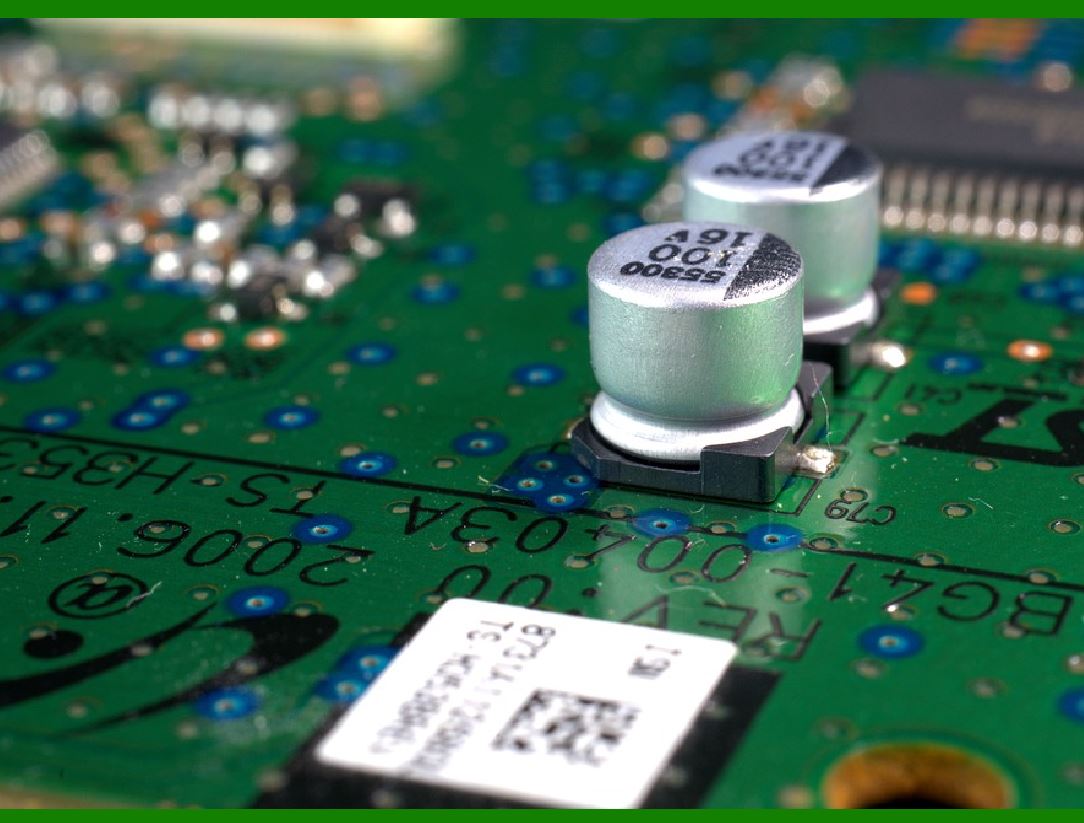
What is the difference between this part of the circuit and a barcode reader? |
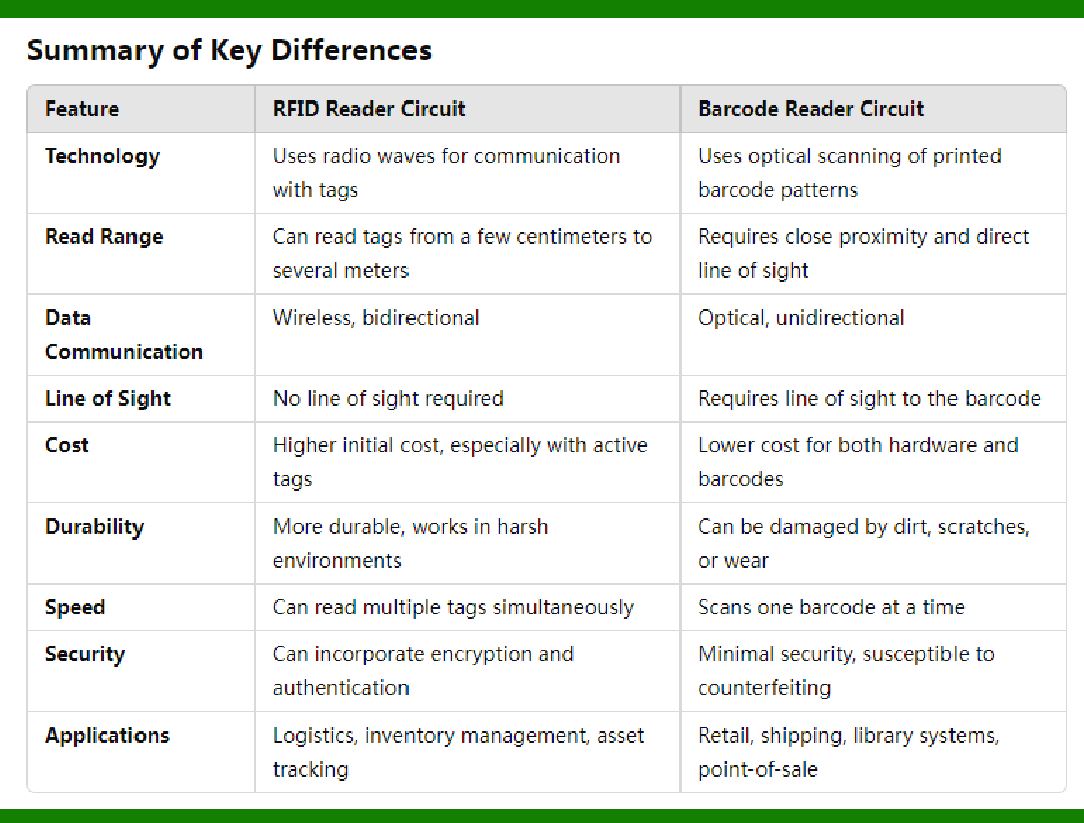
The differences between an RFID reader circuit and a barcode reader circuit are primarily based on the technology, communication methods, and the way data is read and transmitted. While both devices are used for automatic identification, they operate on different principles and have unique design considerations. Below are the key differences between the two: |
1. Technology Basis: RFID vs. Barcode |
RFID (Radio Frequency Identification): |
RFID uses radio waves to communicate between a reader and tags. The system is wireless, meaning the tag does not need to be in direct line of sight with the reader. It works by transmitting electromagnetic waves that power a passive RFID tag, which then returns data to the reader. Active RFID tags have their own power source and can transmit data over longer ranges. |
RFID operates in several frequency bands (low, high, and ultra-high frequency), depending on the application. For example, UHF RFID can read tags from several meters away, while LF RFID may only read them from a few centimeters. |
Barcode: |
A barcode reader, on the other hand, uses optical scanning technology to read printed patterns of black and white lines (the barcode) that represent data. Barcodes need to be in direct line of sight with the scanner, as they rely on the reflection of light from the barcode's black and white lines. |
Barcodes typically encode data visually (e.g., UPC, QR codes, etc.) in a form of either one-dimensional (1D) or two-dimensional (2D) symbols. |
|
2. Data Storage and Communication |
RFID: |
RFID tags contain microchips that store data. Passive tags store only a small amount of information (e.g., a unique ID number), while active tags can store more information, including sensors and more complex data. |
The data is transmitted wirelessly through radio frequency, and the tag communicates directly with the reader when in range, allowing for automatic and fast identification without requiring physical contact. |
Barcode: |
A barcode is simply a visual representation of data, typically a string of numbers or characters encoded in the pattern of bars and spaces. The information encoded in the barcode is read by scanning the reflected light from the printed code. |
Barcodes are static-the data encoded in a barcode cannot change unless the barcode is manually replaced. The data is passed through visual scanning rather than wirelessly transmitting data. |
|
3. Read Range |
RFID: |
RFID readers can communicate with tags over a wide range of distances, typically ranging from a few centimeters to several meters. The exact range depends on the type of RFID tag (passive vs. active), the frequency used, and the power of the reader. |
Active tags, for instance, can be read from distances up to 100 meters or more, while passive tags are often limited to a range of a few centimeters to a few meters. |
Barcode: |
A barcode reader typically operates within a short range, usually only a few centimeters to a couple of feet from the scanner, depending on the type of barcode and the scanner's capabilities. The barcode must be visible to the scanner, and it must be placed directly in the reader's line of sight. |
The range of a barcode reader is limited by the need to physically scan the barcode, unlike RFID, which can detect tags remotely. |

|
4. Line of Sight |
RFID: |
No line of sight is required for an RFID system. RFID tags can be embedded in or attached to objects, and they can be read even if the tags are not visible to the reader. This allows for easier handling of items in large batches, inventory management, and automated systems. |
RFID is suitable for environments where items may be moving, and you want to track them without needing to manually scan each individual tag. |
Barcode: |
Line of sight is required for barcode scanning. The scanner must be able to 'see' the barcode to read it. If the barcode is obscured, dirty, or damaged, the scanner may not be able to read it. |
Barcodes are usually used in situations where a user manually aligns the barcode with the reader (e.g., retail checkout). |
|
5. Cost and Maintenance |
RFID: |
RFID tags (especially passive ones) are more expensive than barcodes. While passive tags are relatively cheap compared to active tags, the cost of RFID tags is still higher than barcodes. Active tags are much more expensive due to the inclusion of a battery and more complex components. |
RFID systems often require more complex infrastructure for data management, which can result in higher setup and maintenance costs. RFID readers, antennas, and middleware can be expensive. |
Barcode: |
Barcodes are very cheap to produce, and the readers are also relatively low-cost compared to RFID systems. The infrastructure for barcode scanning is simpler and generally cheaper to implement. |
Maintenance costs are also lower, as barcode readers do not require the complex components and infrastructure that an RFID system needs. |

|
6. Durability |
RFID: |
RFID tags can be more durable than barcodes, as they do not rely on visual patterns that can be damaged or degraded. RFID tags are often designed to withstand harsh environments, and they can be embedded into products or materials. |
RFID tags can be used in extreme environments (high temperature, moisture, chemicals, etc.) and continue to function, making them ideal for industrial and logistical applications. |
Barcode: |
Barcodes are vulnerable to physical damage, such as scratches, dirt, or wear, which can prevent them from being scanned. Barcodes are printed on paper or labels, which can degrade over time, especially in harsh conditions like moisture or extreme temperatures. |

|
7. Speed of Data Capture |
RFID: |
RFID can read multiple tags simultaneously in a process called 'anti-collision.' This allows RFID systems to capture data from many tags at once, without requiring line of sight or manual scanning. This makes RFID systems very fast in applications that require high throughput, such as inventory management or asset tracking in a warehouse. |
Barcode: |
A barcode reader can only scan one item at a time, requiring the operator to position the barcode within the scanner's view. For applications with many items, barcode scanning can be slower compared to RFID. However, modern handheld barcode scanners can scan very quickly, but still, they require manual intervention for each scan. |

|
8. Security |
RFID: |
RFID systems (especially those using encryption and secure communication protocols) can provide higher security features, such as data encryption, authentication, and secure identification. RFID tags can be used to store encrypted data, and communication between the tag and the reader can be protected from unauthorized access. |
RFID can also be used with additional security features, such as tamper detection and anti-counterfeiting measures. |
Barcode: |
Barcodes provide very limited security, as the data they encode is typically static and unprotected. A barcode can easily be copied or reproduced, making it susceptible to counterfeiting. |
For higher security, barcode systems can incorporate encryption or use 2D barcodes (like QR codes), but overall, barcodes do not have the same security capabilities as RFID. |
|
9. Applications |
RFID: |
RFID is used in applications where automatic identification, high throughput, and non-line-of-sight scanning are crucial. Examples include inventory management, asset tracking, logistics, supply chain, smart cards (e.g., contactless payment), and even some healthcare applications (e.g., patient identification). |
Barcode: |
Barcode is commonly used in retail, library management, product packaging, shipping and receiving, and inventory management in low-density applications. It's especially common in consumer goods, retail point-of-sale systems, and shipping labels. |
|
10. Environmental Impact |
RFID: |
RFID tags (especially passive ones) are typically small, compact, and designed for long-term use, which can help reduce waste. However, active RFID tags (which contain batteries) can contribute to electronic waste if not properly disposed of. |
Barcode: |
Barcodes are usually printed on paper labels, which may contribute to waste, especially in high-volume applications. However, they are cheap to produce and easily recyclable in many cases. |
|
Both RFID and barcode systems are valuable in different use cases, with RFID being more suitable for applications that require high efficiency, non-line-of-sight reading, and longer-range identification, while barcodes are simpler, cheaper, and ideal for applications where physical line-of-sight scanning is sufficient. |
 cs@easiersoft.com